
Stop Reading. Start Scoring.
Sections 1 to 10 taught you this chapter — inertia and the first law, the second law and impulse, the third law and momentum conservation, the common forces, equilibrium and free-body diagrams, friction, circular dynamics, connected bodies and lifts, and the JEE-only extensions in Section 10. This section finds out whether you can use any of it with a clock running, which is a completely different skill.
There is no new theory below. There are 30 questions built to the JEE Main pattern, and a marking scheme that punishes the thing students do most in this chapter: reaching for a formula before drawing the free-body diagram.
The rules of engagement
Key Point: Do not treat this as a reading exercise. Sit down with a blank sheet, a pen and a timer, and attempt all 30 questions in one unbroken sitting before you look at a single explanation.
| The setup | What it is |
|---|---|
| Number of questions | 30 |
| Marking scheme | correct, incorrect, unattempted |
| Maximum score | marks |
| Minimum possible score | marks |
| Suggested time limit | 35 minutes (JEE Main pace is a little over 1 minute per question) |
| Take as | 10 m/s^2 unless a question says otherwise |
| Useful values | , , , , , |
| Allowed | rough sheet, your own brain |
| Not allowed | calculator, formula sheet, looking back at Sections 1 to 10 |
[Exam Tip] That is not decoration. Four wild guesses that produce one lucky hit earn you mark for four minutes of work — a terrible trade. But a question you have narrowed to two options is worth attempting: on average that returns marks. Narrow first, then commit. Leave blank only what you could not narrow at all.
What this set covers
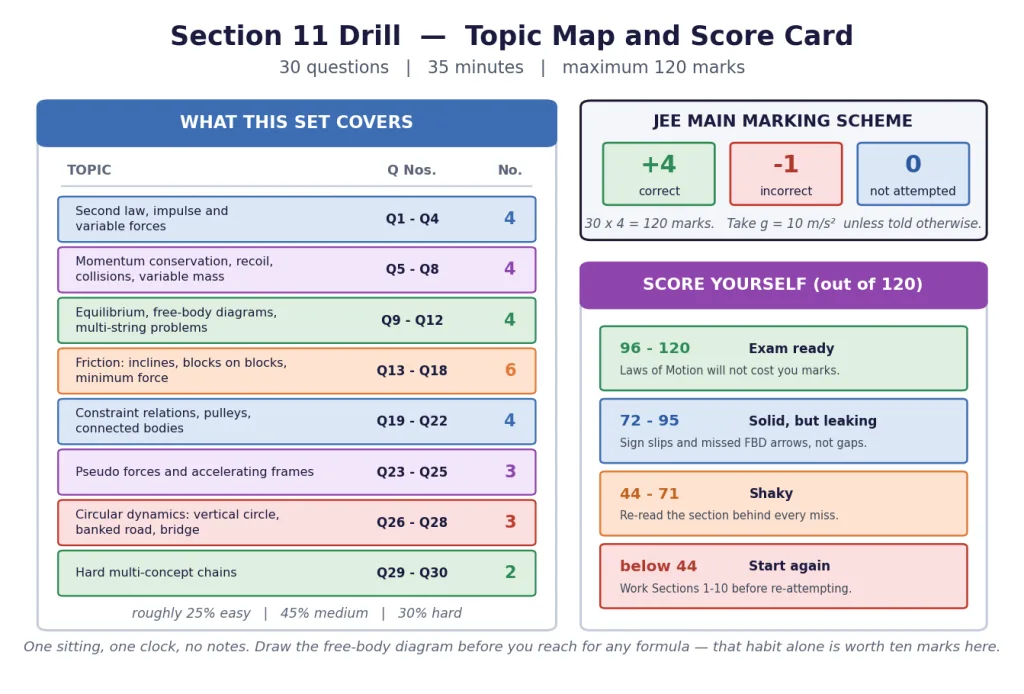
| Topic | Questions | How many |
|---|---|---|
| Second law, impulse, variable forces | Q1 to Q4 | 4 |
| Momentum conservation, recoil, collisions, variable mass | Q5 to Q8 | 4 |
| Equilibrium, free-body diagrams, multi-string problems | Q9 to Q12 | 4 |
| Friction: inclines, blocks on blocks, minimum force | Q13 to Q18 | 6 |
| Constraint relations, pulleys, connected bodies | Q19 to Q22 | 4 |
| Pseudo forces and accelerating frames | Q23 to Q25 | 3 |
| Circular dynamics: vertical circle, banked road, bridge | Q26 to Q28 | 3 |
| Hard multi-concept chains | Q29 to Q30 | 2 |
That spread is deliberate — it mirrors how JEE Main actually samples Laws of Motion. Friction alone is 6 of the 30, because in the real paper it carries more marks from this chapter than anything else, and because it is the topic where a confident wrong answer is easiest to produce. Connected bodies, constraints and pseudo forces take another 7, and they are the questions most candidates over-think.
The difficulty mix is roughly 25% easy, 45% medium and 30% hard, so do not panic if a handful feel brutal. They are meant to.
[Exam Tip] Before you start, write two lines at the top of your sheet: one body at a time and does it move? The first is the free-body-diagram discipline; the second is the static-versus-kinetic test. More marks are lost in this chapter to a force drawn on the wrong body, or to applied to a block that never started sliding, than to any forgotten formula.
Scoring Yourself Honestly
Mark your sheet with the real scheme — , , — and total it. No half marks for "I knew that one really". The number you get is the number that matters.
The bands
| Your score (out of 120) | Verdict | What to do next |
|---|---|---|
| 96 to 120 | Exam ready. 80% or more on a hard set, inside the time. | Move on. Laws of Motion will not cost you marks. Revisit only the specific items you missed. |
| 72 to 95 | Solid, but leaking marks. | These are almost always slips, not gaps — a sign flipped on an incline, a normal reaction taken as when something else pushed on the block, a tension assumed equal on two different strings. Redo every wrong question without the explanation first. |
| 44 to 71 | Shaky. The ideas are there; the execution is not. | For each wrong answer, go back to the section it came from (use the topic map above) and rework its solved examples before re-attempting. |
| Below 44 | Start again. | Work Sections 1 to 10 properly, then Section 9's solved examples, then come back. Re-attempting this set now teaches you nothing. |
Read your own answer sheet
Before you touch the explanations, sort your mistakes into three piles. This is the most valuable ten minutes in the whole section.
- Concept errors — you did not know that is not always , or that static friction is self-adjusting, or that a pseudo force exists only in a non-inertial frame, or that the centripetal force is a requirement rather than a new arrow on the diagram. Fixable by revision, and quickly.
- Execution errors — right free-body diagram, wrong arithmetic, or you resolved the weight along the wrong pair of axes. On an incline the perpendicular component is and the along-slope one is ; swapping them is the single commonest execution error in this chapter.
- Reading errors — the force was applied to the lower block and you solved it for the upper one; the lift was moving up but decelerating; the angle was measured from the vertical and you took it from the horizontal; the question asked for the friction that acts, not the maximum friction available. These are the cheapest marks in the paper to win back.
Key Point: In this chapter, pile 3 is dominated by four traps: which body the force is applied to, whether the surface is smooth or rough, whether the body is on the verge of sliding or already sliding, and whether an angle is measured from the horizontal, the vertical or the slope. Check which of the four caught you, every single time.
The seven habits this set is drilling
- One body at a time. Draw the free-body diagram of a single body, with only the forces acting on it. No "force of motion", no centrifugal arrow in a ground frame, no reaction force belonging to a different body.
- Never write without checking. Resolve perpendicular to the surface and solve for . An extra push, an angled pull, an incline or an accelerating lift all change it, and is what friction is built from.
- Test before you choose your friction. Compute the driving force, compute , compare. Only if driving exceeds the limit is the friction ; below it, friction equals the driving force exactly.
- Write the constraint before the dynamics. An inextensible string over a fixed pulley gives equal accelerations; a movable pulley gives a factor of 2; a rope reeled in at speed moves a boat at . The constraint is an extra equation, and without it the system is underdetermined.
- In a non-inertial frame, add to every body — or do not use the frame at all. Mixing the two pictures is what produces impossible answers.
- On a circle, name the real force that supplies . Tension, friction, gravity, the normal reaction, or a combination — then write the equation towards the centre.
- Sanity-check the size of the answer. A block on a slope cannot accelerate faster than ; a tension cannot be negative; a normal reaction that comes out negative means the surfaces have separated and your model is wrong.
[Exam Tip] Every explanation below is a full step-by-step solution, so this set doubles as revision material. Read the explanation even for the questions you got right — sometimes you got there the slow way, and the fast way is what you will need in the hall.