
The Question Chapters 2 and 3 Never Asked
For two whole chapters you have been describing motion. Position, displacement, velocity, acceleration, graphs, projectiles, relative velocity. Not once did anybody ask why anything moved. That was deliberate. Describing motion is kinematics; explaining it is dynamics, and dynamics starts here.
So let's ask the question properly, and let's ask it in the form that took humanity about two thousand years to get right:
The question: Is an external force needed to keep a body moving with uniform velocity?
Before you answer, notice how loaded your intuition already is. To move a football at rest, someone must kick it. To throw a stone upwards, you have to push it up. A breeze swings the branches of a tree. A boat drifts down a flowing river without anyone rowing. In every one of these, something external is clearly doing something. And to stop a body you also need something external — you can stop a ball rolling down an incline by pushing against its motion.
That external agency need not even touch the body. A stone released from a rooftop accelerates downward because the earth pulls it. A bar magnet attracts an iron nail across a gap. So:
Key Point: A force is that which is capable of changing the state of rest or of uniform motion of a body. The external agency providing it may or may not be in contact with the body.
Fine so far. But now the hard case. A skater glides in a straight line at constant speed across a horizontal ice slab. Is a force needed to keep her going?
Aristotle's answer
The Greek thinker Aristotle (384 BC to 322 BC) said yes, and stated it as a law of nature:
Aristotle's law of motion: An external force is required to keep a body in motion.
He was not being careless. He built an entire, internally consistent system of the world on this, and for two thousand years almost nobody found a hole in it. Under this view an arrow shot from a bow keeps flying because the air closing in behind it keeps pushing it forward — the moment that push fails, down it comes.
And honestly? Everyday experience seems to shout its agreement. A small child with a wooden pull-along toy discovers within about four seconds that she has to keep dragging the string. Let go and the toy stops. Push a heavy carton across a floor and the instant you stop pushing, the carton stops. Pedal a bicycle on a level road and stop pedalling, and you coast to a halt. Left to themselves, everything on earth eventually comes to rest. What could be more obvious than "motion needs a cause, and that cause is force"?
Where the flaw hides
Here is the thing: Aristotle correctly recorded what he saw. He just wrote down the wrong law to explain it. His mistake was one of bookkeeping — he counted only one of the forces acting.
When the child drags the toy car, the floor is pushing back on the car through friction. That friction is a genuine external force, and it opposes the motion. So the child's pull is not doing what it looks like it is doing:
Key Point — the resolution of Aristotle's fallacy: The applied force is needed to balance friction, not to maintain motion. When the toy car moves at a constant speed, the pull by the child and the friction by the floor are equal and opposite, so the net external force on the car is zero. If friction could be switched off, no force at all would be needed to keep the car moving.
Read that again, because it is the whole section in one paragraph. Aristotle looked at a body moving uniformly and concluded "there is a force, therefore force causes motion". The correct reading is "there are two forces and they cancel, therefore uniform motion goes with zero net force."
Opposing forces of this kind — friction between solids, viscous drag in fluids, air resistance — are present everywhere in the natural world. That is exactly why external agencies always seem necessary. They are necessary to cancel the opposition, and for no other reason.
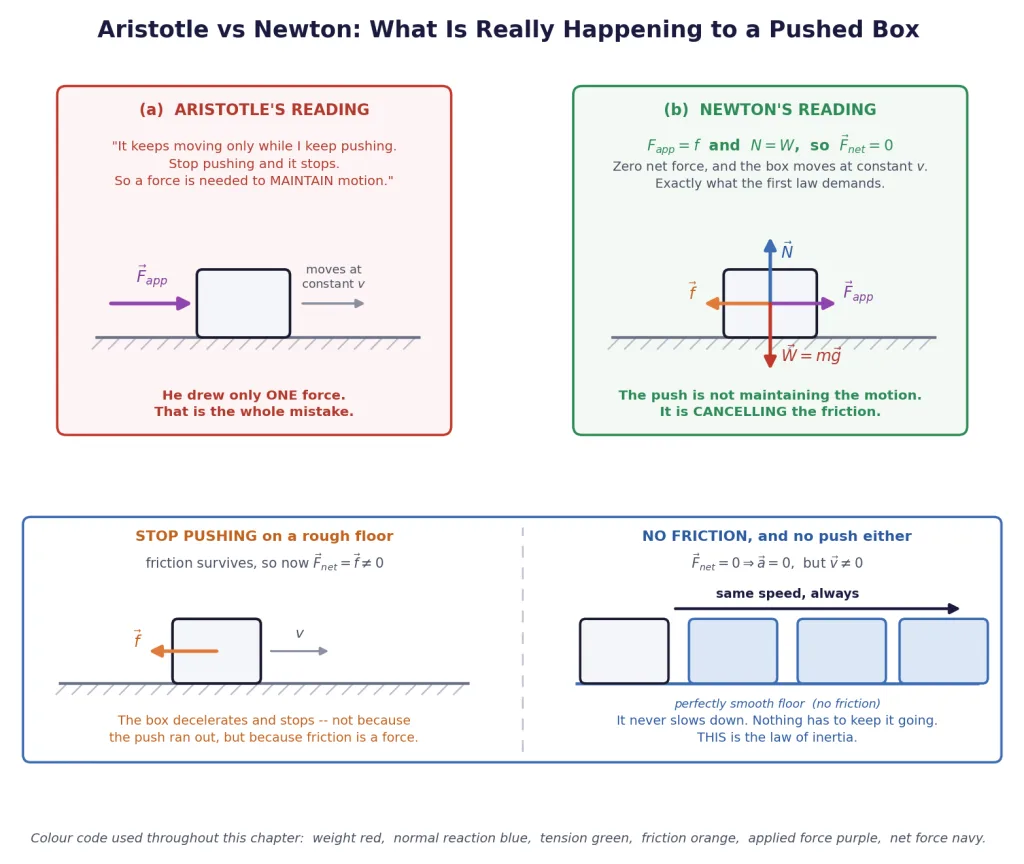
Look hard at panel (a) versus panel (b) of that figure. Nothing about the physics changed between them. The box is the same box moving in the same way. The only difference is that panel (b) counts all four forces and panel (a) counts one. Almost every mistake you will make in this chapter is a version of panel (a): a force you forgot to draw.
The escape route
To find the true law connecting force and motion, you have to do something that sounds impossible — imagine a world with no friction at all, where uniform motion can just happen. Since you cannot build such a world in a laboratory, you have to reason your way to it.
That is exactly what Galileo did, in the seventeenth century, and it is the subject of the next block. Newtonian mechanics — and with it modern science — starts there.
[Board Important] "What is Aristotle's fallacy? Explain with an example" is a standard short-answer question. The full-mark answer has three parts: (1) state Aristotle's law; (2) give the everyday observation that seems to support it; (3) identify friction as the neglected force and state that the applied force balances friction so that the net force is zero.
Galileo's Inclined Planes and the Law of Inertia
Galileo could not remove friction. So he did the next best thing: he made it smaller and smaller, watched what the trend was doing, and then followed the trend to its limit. This is one of the great arguments in the history of physics, and it is worth going through slowly.
Step 1: the single inclined plane
Galileo rolled balls on an inclined plane and noticed three cases:
| Case | The plane | What the ball does |
|---|---|---|
| (i) | Sloping down | It accelerates |
| (ii) | Sloping up | It retards |
| (iii) | Horizontal | …the in-between case |
Now, case (iii) sits exactly between "speeding up" and "slowing down". Galileo's move was to take that seriously: if the downward slope gives acceleration and the upward slope gives retardation, then the horizontal plane, being neither, should give neither. A ball on a perfectly smooth horizontal plane should have no acceleration and no retardation — that is, it should move with constant velocity.
That is already the answer. But it was an inference, not an observation, so Galileo backed it with a second and far more beautiful experiment.
Step 2: the double inclined plane
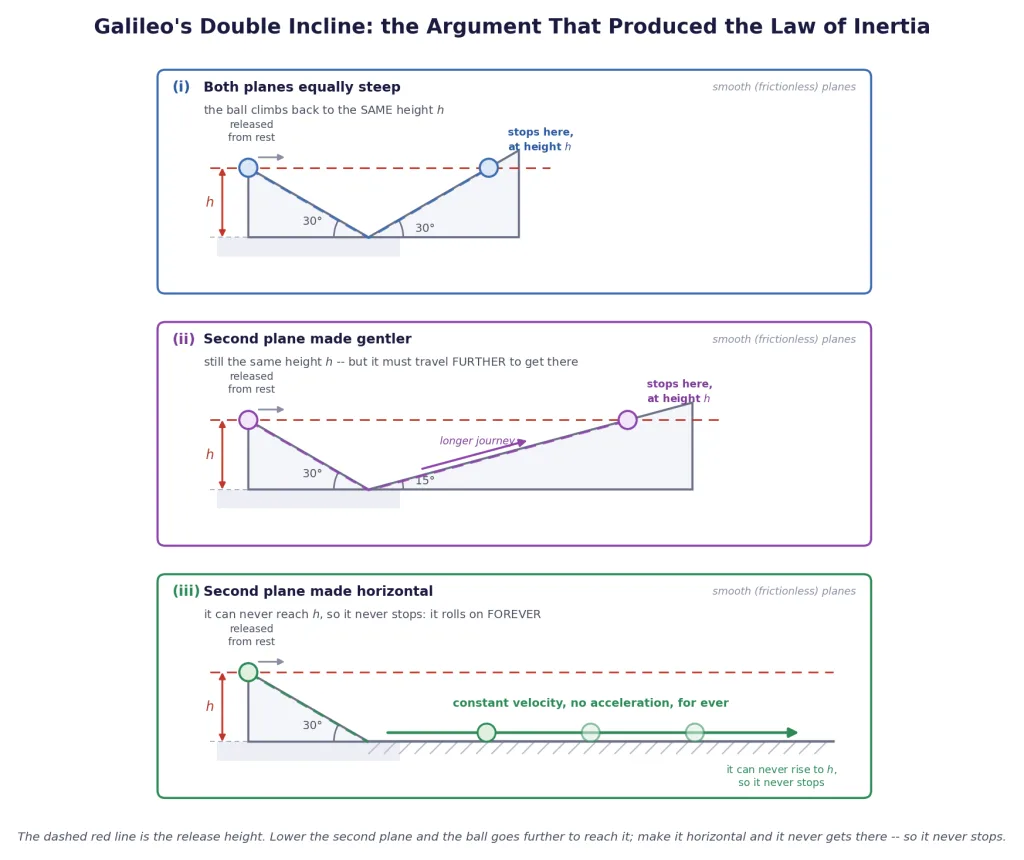
Take two inclined planes facing each other, meeting at the bottom in a V. Release a ball from rest at some height on the left-hand plane. It rolls down, crosses the bottom, and climbs the right-hand plane.
What Galileo observed: the ball climbs to very nearly the height it started from — a little less, but never more. And the smoother he made the planes, the closer that final height got to the initial one. So in the ideal, friction-free case:
Key Point: On smooth double inclined planes, the ball rises to exactly the same height from which it was released, no matter what the slope of the second plane is.
Hold on to that phrase — no matter what the slope of the second plane is — because everything now follows from it.
Step 3: make the second plane gentler, and gentler, and gentler
Now run the experiment again with the second plane at a smaller angle. The ball must still climb to the same height . But the plane is now less steep, so to gain that same vertical height it has to cover a longer distance along the plane. The geometry is simply
Halve and the ball travels twice as far. Make a tenth as large and it travels roughly ten times as far. The ball is not "trying harder" — it is just that a gentle slope buys height very slowly.
Step 4: the limit, and the punchline
So push the argument to its end. Let — that is, lay the second plane flat. Then and
The ball must still rise to the height to stop. But a horizontal plane offers no height at all. The ball can never reach , so it can never stop. It travels an infinite distance — its motion never ceases.
Key Point — the law of inertia (Galileo): A body moving on a frictionless horizontal plane continues to move with constant velocity for ever. No force whatsoever is needed to keep it going.
In practice the ball does stop after a finite distance, because friction can never be totally eliminated. But that is a statement about the apparatus, not about nature. The ideal case is the law; the real case is the law plus friction.
What Galileo actually overturned
Notice how radical this is. For Aristotle, rest was the natural state of a body and motion was the thing needing explanation. Galileo's conclusion says something entirely different:
Key Point: The state of rest and the state of uniform motion in a straight line are physically equivalent. Neither requires a cause. In both, the net external force on the body is zero. What needs a cause is a change in the state of motion.
This property — the refusal of a body to change its state of rest or of uniform motion by itself — is called inertia, from the Latin for "sluggishness". Inertia means, quite simply, resistance to change.
Key Point: A body does not change its state of rest or of uniform motion unless an external force compels it to change that state. This is the law of inertia.
[JEE/NEET] Two lines that are asked directly and must be reproduced exactly: (1) "A body moving on a frictionless horizontal plane must have neither acceleration nor retardation, so it moves with constant velocity." (2) "In the ideal frictionless case, the ball on a double inclined plane rises to the same height as its initial height, and when the second plane is horizontal it travels an infinite distance."
A note on Indian thought
Ancient Indian thinkers had a developed theory of motion. In the Vaisesika system, vega — the persistent tendency of a body to move in a straight line — comes remarkably close to the modern idea of inertia, and it was understood to be opposed by contact with other objects including the atmosphere, which parallels friction and air resistance rather neatly.
Newton's First Law of Motion
Galileo's ideas dethroned Aristotelian mechanics, but a demolition is not a replacement. Building the new mechanics was accomplished almost single-handedly by Isaac Newton, who took Galileo's law of inertia as his starting point and made it the first of three laws.
Key Point — Newton's first law of motion: Every body continues to be in its state of rest or of uniform motion in a straight line unless compelled by some external force to act otherwise.
Learn it in that wording. Boards, JEE and NEET all quote it verbatim. Now let's unpack the three things it is really saying, because a bare statement is not understanding.
Reading 1: it defines what a force IS
Look at the structure of the sentence. It says a body keeps doing what it was doing unless a force acts. So the law is not primarily telling you what bodies do — it is telling you what a force is, by naming the one job only a force can do.
Key Point: A force is that external agency which changes, or tends to change, the state of rest or of uniform motion of a body. This is called the qualitative definition of force, and the first law is where it comes from.
That is why the first law is not just a special case of the second law. The second law says ; but you cannot even write that equation until somebody has told you what the symbol means. The first law is the sentence that gives it meaning.
Reading 2: zero net force means zero ACCELERATION, not zero velocity
This is the single most examined misconception in the whole chapter, so let's kill it now.
"Rest" and "uniform motion in a straight line" sound like two different states. They are not. Both mean zero acceleration. So the first law can be rewritten in its sharpest form:
Key Point: If the net external force on a body is zero, its acceleration is zero. Acceleration can be non-zero only if there is a net external force on the body.
Notice what is missing from the right-hand side: any mention of . A body can be screaming along at 30000 m/s and still have zero net force on it. It just cannot be changing its velocity.
| Situation | |||
|---|---|---|---|
| A book lying on a table | |||
| A spaceship coasting with engines off | large, constant | ||
| A car at a steady 60 km/h on a straight road | constant | ||
| A car speeding up on a straight road | not | not | changing |
| A car turning a corner at constant speed | not | not | changing (direction) |
| A stone at the top of its flight | not | downward | momentarily |
Look at the last two rows. In row 5 the speed is constant but the velocity is not, because direction changed — velocity is a vector, so a net force is required. In row 6 the velocity is momentarily zero yet the net force is at its usual full value. Zero velocity and zero force have nothing to do with each other.
[NEET Important] If a question says "a body is moving with uniform velocity", you may write immediately, without knowing a single one of the individual forces. Conversely, "the body is at rest" also gives . Both are the first law being used as a tool rather than as a slogan.
Using the law in the two directions
Problems come in two flavours, and it is worth knowing which one you are in.
Flavour A — you know the forces, so deduce the motion. A spaceship out in interstellar space, far from every other object, with all its rockets switched off, has no net external force on it. By the first law its acceleration must be zero. So if it was moving, it keeps moving with uniform velocity, for ever.
Flavour B — you know the motion, so deduce the forces. This is far more common, because on earth you rarely know every force in advance. Gravity is everywhere; friction and viscous drag are almost everywhere. So if a terrestrial object is observed to be at rest or in uniform motion, it is not because no forces act on it, but because the various forces cancel out to zero net force.
Be careful about the logic here. Consider a book at rest on a table. Two forces act: its weight downward, and the normal reaction from the table upward.
- Wrong reasoning: "Since , the forces cancel, and therefore the book is at rest."
- Correct reasoning: "Since the book is observed to be at rest, the net external force on it must be zero by the first law. This implies that must be equal and opposite to ."
The difference is which fact is the evidence and which is the conclusion. You do not know in advance that the table pushes up with exactly — the normal reaction is a self-adjusting force, and it is the observed state of rest that tells you its value. (Section 4 will look at the normal reaction properly.)
Reading 3: the first law defines inertial frames
Here is a subtlety that Class 11 often skips and JEE never does. The first law cannot be true in every frame of reference.
Picture a ball resting on the perfectly smooth floor of a railway carriage. The carriage now accelerates forward. Nothing touches the ball horizontally, so the net horizontal force on it is zero — but an observer sitting inside the carriage sees the ball accelerate backwards. In that observer's frame, a body with zero net force on it is accelerating. The first law is false there.
So the first law is not merely a claim about bodies. It is a claim about which frames of reference are allowed.
Key Point: An inertial frame of reference is one in which Newton's first law holds — a frame in which a body with zero net external force on it has zero acceleration. Any frame moving with constant velocity relative to an inertial frame is itself inertial. Any frame accelerating relative to an inertial frame is non-inertial, and in it the first law fails.
For nearly all Class 11 problems the ground is treated as inertial, and that is good enough. A carriage moving at constant velocity is inertial too — which is why you cannot tell, from inside a smoothly cruising train, whether you are moving at all.
[JEE Tip] In a non-inertial frame you can rescue by inventing an extra force, the pseudo force, of magnitude directed opposite to the frame's acceleration. That machinery — pseudo forces, the accelerating wedge, centrifugal force — belongs to Section 10 (JEE Corner), and we will not use it here. For this section, just be able to say which frames are inertial and why.
Mass Is the Measure of Inertia
Every body has inertia. But not equally.
Try to start a stationary bicycle moving and then try the same with a stationary loaded truck. Try to stop a rolling football, then a rolling cannonball moving just as fast. In each pair, one of them fights back far harder. Both bodies resist a change of state — one of them just resists a great deal more.
Key Point: The mass of a body is the quantitative measure of its inertia. The greater the mass, the greater the inertia, and the harder it is to change the body's state of rest or of uniform motion.
This is what physicists call inertial mass, and it is a completely different idea from "amount of stuff you can weigh". A body's mass does not change if you carry it to the moon, and it would still take the same effort to shove a loaded truck sideways in deep space where it weighs nothing at all.
The quantitative statement, in one line
Apply the same force to two bodies at rest on a frictionless surface. The lighter one picks up speed faster. In fact, for the same force,
Four times the mass, one quarter of the acceleration, for the same push. Section 2 turns this proportionality into the equation and makes it exact; for now, take it as the sharpest available way of saying "mass measures how hard a body is to get going".
The three faces of inertia
Textbooks split inertia into three kinds. They are not three different physical properties — they are the same property showing up in the three ways a state of motion can be changed.
| Kind | What the body resists | The one-line test |
|---|---|---|
| Inertia of rest | being set into motion | a body at rest tends to stay at rest |
| Inertia of motion | being brought to rest, or slowed | a moving body tends to keep moving at the same speed |
| Inertia of direction | having its direction changed | a moving body tends to keep going in a straight line |
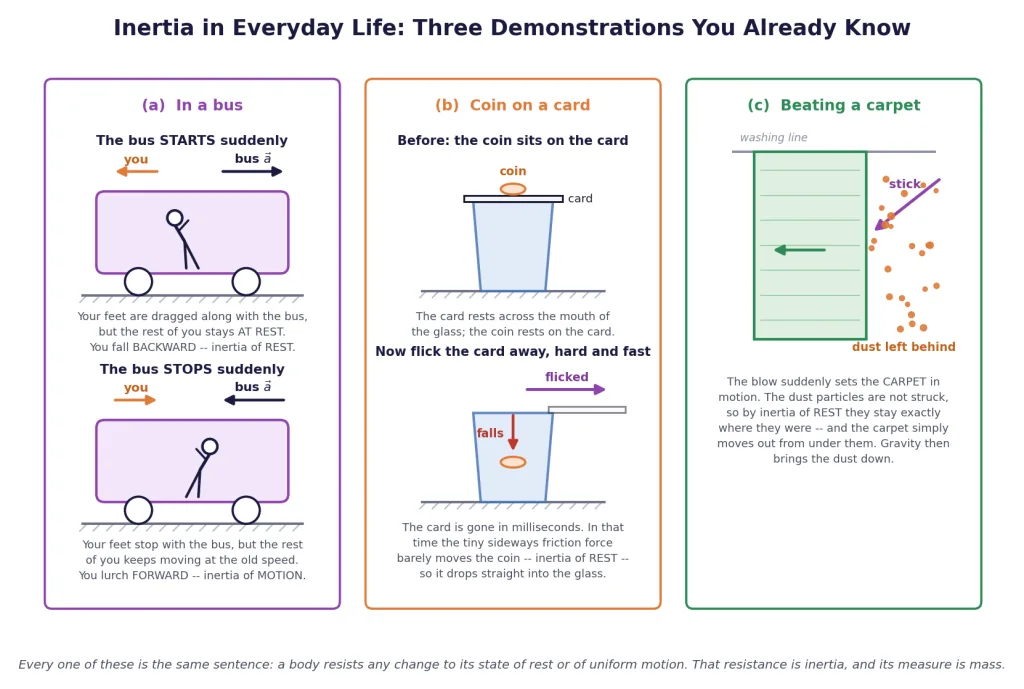
Inertia of rest, in three classic demonstrations
1. The bus that starts suddenly. You are standing in a stationary bus and the driver pulls away sharply. You are thrown backward. Why?
The explanation is worth having in full, because the sloppy version is wrong. Your feet are in contact with the floor, and friction between your shoes and the floor is enough to accelerate your feet along with the bus. But you are not a rigid body — different parts of you can move relative to one another. So while your feet go with the bus, the upper part of you tends to stay where it was, by inertia of rest. Relative to the bus, therefore, you are thrown backward. The moment that happens, muscular forces from your legs come into play and haul the rest of you along.
And if there were no friction at the floor at all? Then you would simply stay put while the floor slid forward under your feet, and the back of the bus would come and hit you. That is the cleanest statement of what inertia is doing here.
2. The coin and the card. Rest a playing card on the mouth of a glass and balance a coin on the card, over the centre. Now flick the card away sharply and horizontally. The coin drops into the glass.
The card is gone in a few milliseconds. During those milliseconds the only horizontal force on the coin is a small friction force from the card, and it acts for such a short time that it barely moves the coin sideways at all. By inertia of rest, the coin stays where it is horizontally — and then, with the card no longer under it, gravity takes it straight down into the glass. Flick the card slowly and the coin travels away with it; the whole trick lives in the shortness of the time.
3. Beating dust out of a carpet. Hang a carpet on a line and strike it with a stick. Dust flies out. The blow sets the carpet suddenly in motion, but the dust particles are not struck. By inertia of rest they stay where they were, so the carpet moves out from under them and they are left behind in the air, from where gravity brings them down.
The same idea explains why you shake an umbrella to get the water off, why fruit falls when you shake the branch of a tree, and why a passenger's luggage on a roof-rack slides backward when the vehicle starts.
Inertia of motion
The bus that stops suddenly. Now the bus is moving and the driver brakes hard. You lurch forward. Your feet stop with the floor because friction does not allow them to slide, but the rest of you keeps moving forward at the old speed by inertia of motion, until your muscles bring you back. This is precisely why buses and trains have handrails, and why seat belts exist.
Other examples of the same thing: an athlete runs a distance before the long jump so that at take-off the inertia of motion carries her further; a man jumping out of a moving bus keeps the bus's forward velocity and falls forward unless he runs on landing; a moving cycle keeps rolling for a while after you stop pedalling.
Inertia of direction
A body resists a change of direction just as it resists a change of speed.
- Mud flying off a rotating wheel leaves along the tangent, in a straight line, not along the curve.
- Sparks from a grinding wheel fly off tangentially, for exactly the same reason.
- When a car turns a sharp corner, you are pushed toward the outside of the turn — your body was going straight and would have preferred to continue.
- A stone whirled on a string flies off along the tangent the instant the string snaps, not radially outward.
Key Point: All three kinds of inertia are the same first law. A body opposes any change in its velocity vector, whether that change is in magnitude (starting, stopping, speeding up) or in direction (turning).
[NEET Important] The tangential escape of the stone when the string breaks is asked almost every year in one form or another. The stone does not fly radially outward. It carries on in the straight line it was travelling along at the instant the string broke — inertia of direction.
Putting the First Law to Work, and the Traps in It
The first law is short, so students assume applying it is easy. It is easy — provided you obey one discipline: find the net force before you say anything about the motion, and find the motion before you say anything about the forces. Never mix the two directions of reasoning in one sentence.
The three-step method
| Step | What you do |
|---|---|
| 1 | Decide which single body you are talking about |
| 2 | Ask: is it at rest, or in uniform motion in a straight line? If yes, write |
| 3 | Split into components: and , and solve for the unknown force |
That is it. And running the logic backwards works too: if you can see the body accelerating, you know at once that , and it points along the acceleration, not along the velocity.
A worked reading: the car that starts from rest
Take a car starting from rest, picking up speed, and then cruising on a straight road at uniform speed.
- Stationary: no net force.
- Picking up speed: it is accelerating, so by the first law there must be a net external force. And here is the part that surprises people: it has to be an external force. The engine is internal to the car, and no internal force can accelerate the car as a whole. The only external horizontal force available is friction from the road on the tyres, and that is what actually accelerates the car. (Section 6 does friction properly.)
- Cruising at uniform speed: back to zero net force, with the driving force and the resistances cancelling exactly.
The mistakes that cost marks
| Mistake | Why it is wrong |
|---|---|
| "A moving body must have a force acting on it" | Only if it is accelerating. Uniform motion needs zero net force |
| "Zero net force means the body is at rest" | It means zero acceleration. The body may be moving very fast |
| "Zero velocity means zero force" | A stone at the top of its flight has and downward |
| "Constant speed means zero net force" | Only for motion in a straight line. Circular motion at constant speed needs a net force |
| Confusing as the cause of rest | Rest is the evidence; is the conclusion |
| Saying the engine accelerates the car | Internal forces cannot. Friction from the road is the external force |
| "Aristotle was simply stupid" | He recorded the observation correctly and missed one force. That is a subtle error, not a silly one |
| Using the first law inside an accelerating lift or carriage | Those are non-inertial frames. The law holds only in inertial frames |
| "The stone flies radially outward when the string breaks" | Tangentially. Inertia of direction |
| Forgetting that inertia depends on mass alone | Not on speed, not on the applied force, not on the surface |
Where this goes next
The first law tells you what happens when the net force is zero. It says nothing at all about how much acceleration you get when the net force is not zero — for that you need a quantitative law.
- Section 2 supplies it: momentum, , the newton, and impulse.
- Section 3 takes up the third law and conservation of momentum.
- Sections 4 and 5 name the common forces and build the free-body-diagram technique that turns into actual equations.
- Section 6 finally does friction properly — the force that hid Aristotle's mistake for two thousand years.
- Section 10 handles non-inertial frames and pseudo forces for JEE.
Before you move on, try this: close the book and explain, out loud, why a pushed box stops when you stop pushing, without using the sentence "because the force ran out". If you can do that, you have understood this section better than Aristotle did.
Solved Examples
A note on before we start: some problems here use m/s^2 and others use m/s^2. Every example below states the value it uses, and never mixes two values inside one problem.
Example 1: The astronaut who lets go
An astronaut accidentally gets separated out of his small spaceship, which is accelerating in interstellar space at a constant rate of 100 m/s^2. What is the acceleration of the astronaut the instant after he is outside the spaceship? Assume there are no nearby stars to exert a gravitational force on him.
Solution:
- List every force on the astronaut the moment he is outside. There are no nearby stars, so no gravitational pull from them. The spaceship is small, so its own gravitational attraction on him is negligible. He is not touching anything, so there is no contact force. There is no air, so no drag.
- Therefore the net external force on the astronaut is zero:
- By Newton's first law, zero net external force means zero acceleration:
Final Answer: The acceleration of the astronaut is zero.
Takeaway: The 100 m/s^2 is a deliberate red herring — it is the acceleration of the spaceship, produced by its rocket engines, and those engines are no longer connected to the astronaut in any way. He keeps whatever velocity he had at the instant of separation, for ever. He will therefore drift away from the accelerating ship at an ever-increasing rate, which is why the answer feels wrong until you remember that "drifting apart" is about relative motion, not about his own acceleration.
Example 2: Five bodies, one answer
Give the magnitude and direction of the net force acting on: (a) a drop of rain falling down with constant speed; (b) a cork of mass 10 g floating on water; (c) a kite skilfully held stationary in the sky; (d) a car moving with a constant velocity of 30 km/h on a rough road; (e) a high-speed electron in space far from all material objects and free of electric and magnetic fields. Take m/s^2.
Solution:
Run the first law in the "flavour B" direction every time: look at the state of motion first, and read off the net force.
- (a) "Falling with constant speed" in a straight line means zero acceleration, so . Its weight is exactly balanced by the upward viscous drag and buoyancy of the air.
- (b) Floating means at rest, so . Its weight, N downward, is exactly balanced by the buoyant force of the water.
- (c) "Held stationary" means at rest, so . The weight, the string tension and the force of the wind add up to zero.
- (d) "Constant velocity" means zero acceleration, so . Note the word rough — friction is certainly acting, and it is certainly not zero, but the driving force cancels it exactly. (For reference, 30 km/h is m/s, though the speed never enters the answer.)
- (e) No gravity worth speaking of, no fields, nothing to touch. , and the electron travels in a straight line at constant speed for ever.
Final Answer: The net force is zero in every one of the five cases.
Takeaway: Five completely different physical situations, one answer, and you never needed to know a single individual force. That is the power of the first law used backwards. Note especially (a) and (d): the presence of drag or friction does not mean the net force is non-zero — it means something else is cancelling it.
Example 3: Galileo's double incline, with numbers
A ball is released from rest at a height of 1.20 m on a smooth plane inclined at . It rolls down and climbs a second smooth plane. Take m/s^2. Find (a) the distance it travels along the first plane, (b) the distance it travels along the second plane if that plane is at , (c) the same if the second plane is at , and (d) its speed at the bottom.
Solution:
- The governing idea. On smooth planes the ball always rises back to its release height of 1.20 m, whatever the slope. So on any plane at angle , the distance along the plane needed to gain a height is
- (a) On the first plane, :
- (b) On a plane:
- (c) On a plane:
- (d) The speed at the bottom depends only on the height dropped, by the Chapter 2 relation applied along the incline with and , so : Notice that the cancelled: the speed at the bottom is the same whatever the slope of the first plane.
Final Answer: (a) 2.40 m; (b) 3.51 m; (c) 6.91 m; (d) 4.85 m/s.
Takeaway: Watch the trend in (a), (b), (c): 2.40 m, then 3.51 m, then 6.91 m — the same climb, over an ever longer road. Now let and . That single limit is Galileo's argument, and this example is it with the numbers filled in.
Example 4: The coin and the card, quantitatively
A coin rests at the centre of a card lying across the mouth of a glass. The mouth of the glass has a radius of 3.0 cm and the coin has to fall 8.0 cm to reach the bottom. The card is flicked away horizontally and is clear of the coin after only 0.050 s; during that time friction from the card gives the coin a sideways acceleration of 0.80 m/s^2. Take m/s^2. Find (a) the sideways speed the coin gains, (b) how far sideways it moves while the card is still under it, (c) how far it drifts sideways while falling, and (d) whether it lands in the glass.
Solution:
- (a) While the card is in contact, the coin accelerates sideways from rest:
- (b) The sideways shift during that same 0.050 s:
- (c) Once the card has gone, nothing pushes the coin sideways any more, so by the first law it keeps its 0.040 m/s horizontally while gravity takes it down. Time to fall 8.0 cm:
- (d) Total sideways travel: The coin started at the centre and the mouth has a radius of 30 mm. Since , the coin drops comfortably inside the glass.
Final Answer: (a) 0.040 m/s; (b) 1.0 mm; (c) 5.1 mm; (d) yes, it lands well inside — total sideways travel about 6.1 mm against a 30 mm radius.
Takeaway: The trick works because of the in step 2. Flick the card ten times slower, so that the contact lasts 0.50 s, and the sideways shift becomes mm = 100 mm — the coin sails away with the card and misses the glass entirely. Inertia of rest is not about the force being zero; it is about the force having far too little time to act.
Example 5: Why you lurch forward when the bus brakes
A bus travelling at 36 km/h brakes uniformly and comes to rest in 4.0 s. Take m/s^2 where needed. Find (a) the deceleration of the bus, (b) the distance it travels while stopping, and (c) if your upper body were completely free to move and took 0.20 s to react, how far forward would it slip relative to the bus in that time?
Solution:
- Convert first. m/s.
- (a) From with at s: A deceleration of 2.5 m/s^2.
- (b) Check with : , so m. Agreed.
- (c) In the first 0.20 s the bus moves Your free upper body has no horizontal force on it, so by the first law it keeps 10 m/s: Slip relative to the bus:
Final Answer: (a) 2.5 m/s^2; (b) 20 m; (c) about 5 cm forward.
Takeaway: Five centimetres does not sound like much — until you notice it happens in a fifth of a second, and that it is your head doing the travelling. This is inertia of motion with a number attached, and it is the entire argument for handrails, headrests and seat belts. Brake twice as hard and the slip quadruples, because it goes as .
Example 6: The stone dropped from a train
Give the magnitude and direction of the net force acting on a stone of mass 0.1 kg (a) just after it is dropped from the window of a stationary train; (b) just after it is dropped from the window of a train running at a constant velocity of 36 km/h; (c) just after it is dropped from the window of a train accelerating at 1 m/s^2; (d) lying on the floor of a train that is accelerating at 1 m/s^2, the stone being at rest relative to the train. Neglect air resistance throughout. Take m/s^2.
Solution:
- (a) The moment it is released, the stone touches nothing. Air resistance is neglected. The only force on it is its weight:
- (b) Identical reasoning. The train's constant velocity is shared by the stone, but a velocity produces no force. The stone still has only its weight on it:
- (c) Still identical, and this is the interesting one. The moment the stone leaves the hand it is no longer in contact with the train, so nothing can communicate the train's 1 m/s^2 to it. The stone carries no memory of the train's acceleration. Only gravity acts: (Its horizontal velocity stays at whatever the train's velocity was at the instant of release, which is the first law again.)
- (d) Now the stone is in contact with the floor and is accelerating horizontally with the train at 1 m/s^2. Vertically it is unaccelerated, so the vertical forces cancel and the normal reaction is N. Horizontally it is accelerating, so by the first law there must be a non-zero net horizontal force; its size comes from (Section 2): This force is supplied by friction from the floor on the stone.
Final Answer: (a), (b) and (c) all 1.0 N vertically downward; (d) 0.1 N horizontal, along the train's acceleration.
Takeaway: Parts (a) to (c) are the same question asked three times to see whether you will be fooled into thinking the train's motion follows the stone out of the window. It does not. Part (d) flips it: contact is what allows a body to share a vehicle's acceleration, and the moment contact ends, so does the sharing.
Example 7: Zero net force, very large velocity
A spacecraft far from all stars and planets is coasting with its engines switched off at 4.0 km/s. (a) What is the net external force on it? (b) What is its acceleration? (c) What is its speed one hour later, and how far has it gone? (d) What about one day later?
Solution:
- (a) Far from all objects, engines off, no atmosphere. Nothing acts on it:
- (b) By the first law, .
- (c) Zero acceleration means the velocity never changes. So the speed after one hour is still 4.0 km/s = 4000 m/s, in the same direction, and
- (d) Still 4000 m/s. In one day, s: That is almost the distance from the earth to the moon, covered with not one newton of force acting the whole way.
Final Answer: (a) zero; (b) zero; (c) 4.0 km/s, km; (d) 4.0 km/s, km.
Takeaway: This is the answer to "zero force means the body must be at rest" and it is worth carrying around as a mental picture. Enormous speed, enormous distance, absolutely no force. Force is related to the change of velocity, and here nothing is changing.
Example 8: The crate, and what really stops it
A 25 kg crate is pushed across a floor by a horizontal force of 22.5 N and moves at a constant 1.5 m/s. (a) What is the net force on the crate while it moves steadily? (b) How large is the friction force from the floor? (c) The push is now removed and the crate slides 1.25 m before stopping. Find its deceleration and the time it takes. (d) Does the crate stopping mean the first law failed?
Solution:
- (a) "Moves at a constant 1.5 m/s" in a straight line means zero acceleration. By the first law,
- (b) The horizontal forces are the 22.5 N push forward and friction backward. Since they must sum to zero, (Vertically, , but no vertical motion is involved here.)
- (c) With the push gone, friction is the only horizontal force left, so there is now a net force and the crate must decelerate. From with m/s, , m: Cross-check: the friction force is still 22.5 N and the mass is 25 kg, so the deceleration should be m/s^2. It matches the value obtained from the stopping distance, which is a genuine consistency check on the whole problem.
- (d) No. The first law says a body keeps moving uniformly unless compelled by an external force. Here there is an external force — friction — so the crate is compelled to change its state. That is the law working, not failing.
Final Answer: (a) zero; (b) 22.5 N backward; (c) 0.90 m/s^2, taking 1.67 s; (d) no.
Takeaway: This is Aristotle's fallacy dismantled with arithmetic. While the crate is pushed, the net force is zero despite two large forces acting. When the push stops, the net force is not zero — and that is what stops the crate. The push was never maintaining the motion; it was cancelling the friction.
Example 9: Which frames are inertial?
A ball lies at rest on the perfectly smooth floor of a railway carriage. The carriage now accelerates forward at a steady 2.0 m/s^2 for 3.0 s. (a) Describe the ball's motion as seen from the ground. (b) Describe it as seen by a passenger in the carriage, and find how far the ball moves relative to the carriage in the 3.0 s. (c) Is the carriage an inertial frame? Is the ground?
Solution:
- (a) The floor is perfectly smooth, so there is no horizontal force on the ball. Vertically its weight and the normal reaction cancel. So , and by the first law : the ball simply stays exactly where it was, at rest relative to the ground, for the whole 3.0 s.
- (b) The carriage, meanwhile, moves forward from rest: The ball moved 0 m. So relative to the carriage, the ball has slid 9.0 m backward, and is moving backward at 6.0 m/s relative to it, with a relative acceleration of 2.0 m/s^2 backward. The passenger sees a ball with nothing touching it accelerating backward all by itself.
- (c) In the passenger's frame, a body with zero net force on it has a non-zero acceleration. That directly violates the first law, so the accelerating carriage is a non-inertial frame. The ground, in which the ball behaved exactly as the first law demands, is (to a very good approximation) an inertial frame.
Final Answer: (a) it stays at rest; (b) it slides 9.0 m backward relative to the carriage, reaching 6.0 m/s relative to it; (c) the carriage is non-inertial, the ground is inertial.
Takeaway: Nothing physical happened to the ball at all — the entire "backward acceleration" is an artefact of watching from an accelerating platform. This is why the first law is really a statement about which frames you are allowed to use. To do mechanics in the carriage frame you would have to invent a pseudo force of pointing backward, which is Section 10's business.
Example 10: Mass as the measure of inertia
Two blocks, of masses 2 kg and 8 kg, rest on a frictionless horizontal surface. Each is given the same horizontal push of 12 N for 1.5 s, starting from rest. Find, for each block, (a) the acceleration, (b) the speed after 1.5 s and (c) the distance travelled. (d) What is the ratio of the accelerations, and what does it tell you?
Solution:
- (a) For the same force, :
- (b) From rest, :
- (c) From rest, with :
- (d) The accelerations are in the inverse ratio of the masses. The 8 kg block, having four times the inertia, is four times harder to get moving — it ends up with a quarter of the speed and a quarter of the distance for exactly the same push over exactly the same time.
Final Answer: 2 kg block: 6.0 m/s^2, 9.0 m/s, 6.75 m. 8 kg block: 1.5 m/s^2, 2.25 m/s, 1.69 m. Ratio of accelerations 4 : 1, the inverse of the mass ratio.
Takeaway: This is what "mass is the measure of inertia" actually means, stated as a number you can check. Nothing about the material of the blocks entered — only the mass. Section 2 will write this proportionality as the exact equation .
Example 11: Galileo's limit, computed
A ball leaves the bottom of an incline onto a long horizontal plane at 4.0 m/s. Find how far it travels and how long it takes to stop if the plane retards it at (a) 0.50 m/s^2, (b) 0.10 m/s^2, (c) 0.010 m/s^2. (d) What happens in the ideal case of a perfectly smooth plane?
Solution:
- The two formulas, from Chapter 2 with : with m/s throughout, so .
- (a) : m, s.
- (b) : m, s.
- (c) : m, s.
- (d) Now read the pattern: smoother by a factor of 10, and both the distance and the time grow by a factor of 10. Since , On a perfectly smooth plane the ball never stops. It keeps its 4.0 m/s in a straight line for ever, exactly as the law of inertia says.
| Retardation (m/s^2) | Distance (m) | Time (s) |
|---|---|---|
| 0.50 | 16 | 8.0 |
| 0.10 | 80 | 40 |
| 0.010 | 800 | 400 |
| 0 (ideal) | infinite | infinite |
Final Answer: (a) 16 m in 8.0 s; (b) 80 m in 40 s; (c) 800 m in 400 s; (d) it never stops.
Takeaway: This is Galileo's argument in a table. He could not build a frictionless plane, and neither can you — but you do not need to. You only need to see that the stopping distance blows up as the friction shrinks, and then take the limit. That is what makes the law of inertia a law rather than a guess: it is where the trend is unmistakably heading.