
The Recipe, Stated as a Method
Everything up to this point has been about one body at a time. Real problems are rarely so kind. A typical mechanics problem involves an assembly — two blocks touching, a string over a pulley, a person inside a lift — where the parts push and pull on each other while gravity acts on every one of them.
The good news is that no new physics is needed. What is needed is discipline, and the procedure below is exactly the right one.
Key Point — the five steps:
- Draw a diagram of the whole set-up: the bodies, the strings, the pulleys, the supports.
- Choose a convenient part of the assembly as the system. It can be one block, or several blocks taken together — whatever makes the algebra shortest.
- Draw a separate free-body diagram for that system, showing only the external forces on it — the forces exerted on it by the rest of the assembly and by anything else. Never draw a force the system exerts on something else.
- Apply Newton's second law along well-chosen axes.
- Repeat for another choice of system if you need to, and use Newton's third law to link the diagrams: if the force on A due to B is in A's diagram, then the force on B due to A is in B's.
The one strategic idea that saves the most time
Step 2 says "choose a convenient system", and that word convenient is doing an enormous amount of work. Here is the choice, made explicit:
Key Point — the two-stage strategy:
- To find the acceleration quickly, take the whole assembly as one system. Every internal force then cancels in pairs and disappears from the equation, leaving only the external forces.
- To find an internal force (a contact force, a tension), isolate one part. That force is external to that part, so it appears in its free-body diagram.
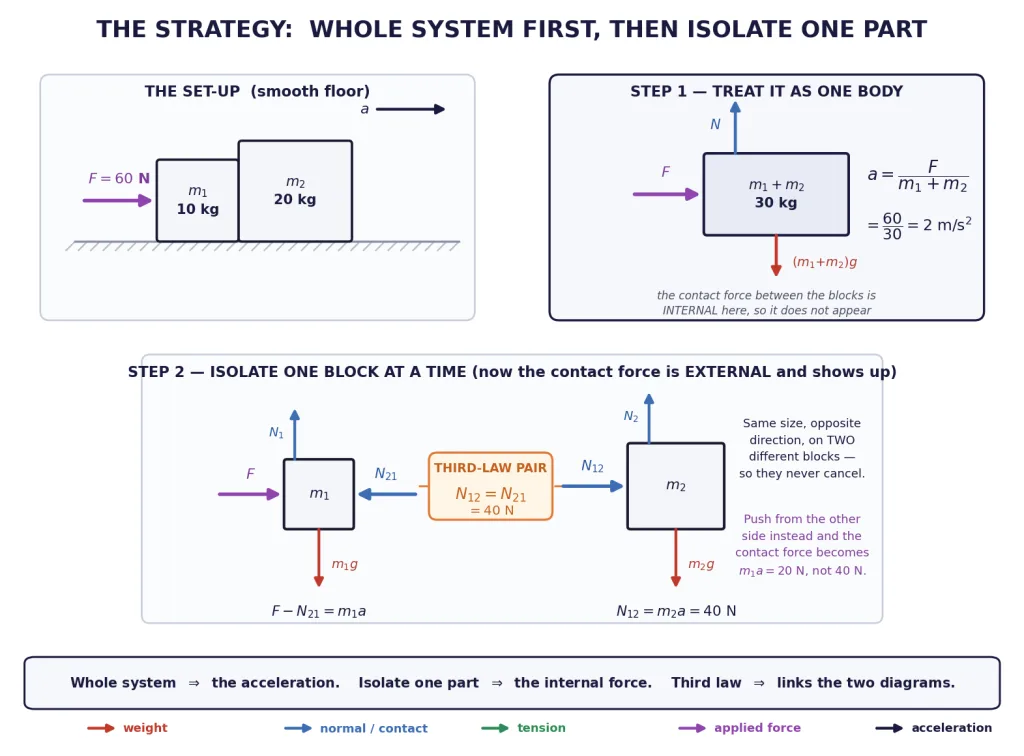
Look at the figure. Two blocks, 10 kg and 20 kg, in contact on a smooth floor, pushed by N.
Stage 1 — whole system. Treat the two blocks as a single 30 kg body. The push between them is now internal, so it does not appear at all: One line, and it is done.
Stage 2 — isolate. To find the contact force, look at block 2 alone. The only horizontal force on it is the push from block 1:
That is the entire method. Everything else in this section is practice.
Why internal forces cancel — properly
This is worth one careful paragraph, because it is the reason the whole trick works.
When you take both blocks as one system, block 1 pushes block 2 forward with , and by the third law block 2 pushes block 1 backward with , equal in size. Both of these forces are now inside the system. Adding all the forces on the system, they cancel exactly. The same argument works for the tension in a string joining two parts of a system, and for any number of parts.
[JEE/NEET] But notice what has not happened. The two forces still act on two different bodies, so they do not cancel in either individual free-body diagram. That is exactly why isolating a part brings the internal force back into view — and it is why Section 3's insistence that action-reaction pairs act on different bodies actually earns its keep here.
One more habit: check the direction assumptions
You will often not know in advance which way a system moves. Do not agonise. Assume a direction, write the equations consistently with that assumption, and solve. If the acceleration comes out negative, the system moves the other way, and the magnitude is still correct. The only rule is consistency: once you have called "down for block 1" positive, "up for block 2" must be positive too, because the string forces them to move together.
The one place where this shortcut fails is friction, because friction is not a linear force — its direction depends on the direction of motion, and its magnitude has a ceiling. So for friction problems, keep Section 6's habit: decide whether the system moves at all, before you write .
Archetypes 1 and 2: Blocks in Contact, and Blocks on a String
Archetype 1 — two blocks in contact, pushed
Two blocks and sit touching each other on a smooth horizontal surface. A horizontal force is applied to , pushing both.
Whole system:
Isolate . The only horizontal force on is the contact push from :
Check it with the other block. Isolating : , so . Same answer — as the third law demands. Always run this check; it catches sign errors instantly.
The reversed push — the classic exam pairing
Now apply the same to instead, so the blocks are pushed the other way.
The acceleration is unchanged: , because the whole-system equation does not care where the force is applied. But now the front block is , so the contact force is
Key Point: The contact force is always . Push the same pair from opposite ends and you get different contact forces, in the ratio of the two masses.
With kg, kg and N: push on and the contact force is 40 N; push on and it is 20 N. Same blocks, same force, half the contact force. [JEE Tip] This pair of parts appears constantly, and the trap is to assume the contact force is the same both ways.
Three blocks? Same idea. For , , in a row pushed by on : The force at any joint equals (mass still ahead of that joint) .
Archetype 2 — two blocks joined by a string
Two blocks on a smooth table are joined by a light string. A force is applied to , which drags behind it through the string.
Whole system:
Isolate , the block being dragged. The only horizontal force on it is the tension:
Notice this is structurally identical to Archetype 1: the tension, like the contact force, equals (the mass it has to accelerate) . Strings pull, blocks push, but the bookkeeping is the same.
Check with : gives . Agrees.
The reference card
| Situation | Acceleration | Internal force |
|---|---|---|
| Two blocks in contact, on | contact | |
| Same pair, on | contact | |
| String, applied to | ||
| Three in a row, on the first | at each joint, (mass ahead) |
Key Point: In every row of that table, the acceleration is the same — the total external force divided by the total mass. Only the internal force changes. That is the two-stage strategy in a nutshell.
[Board Important] A very common instruction is "find the force exerted by block 1 on block 2, and by block 2 on block 1". They are equal and opposite — one number and two directions, not two numbers.
Archetype 3: the Atwood Machine
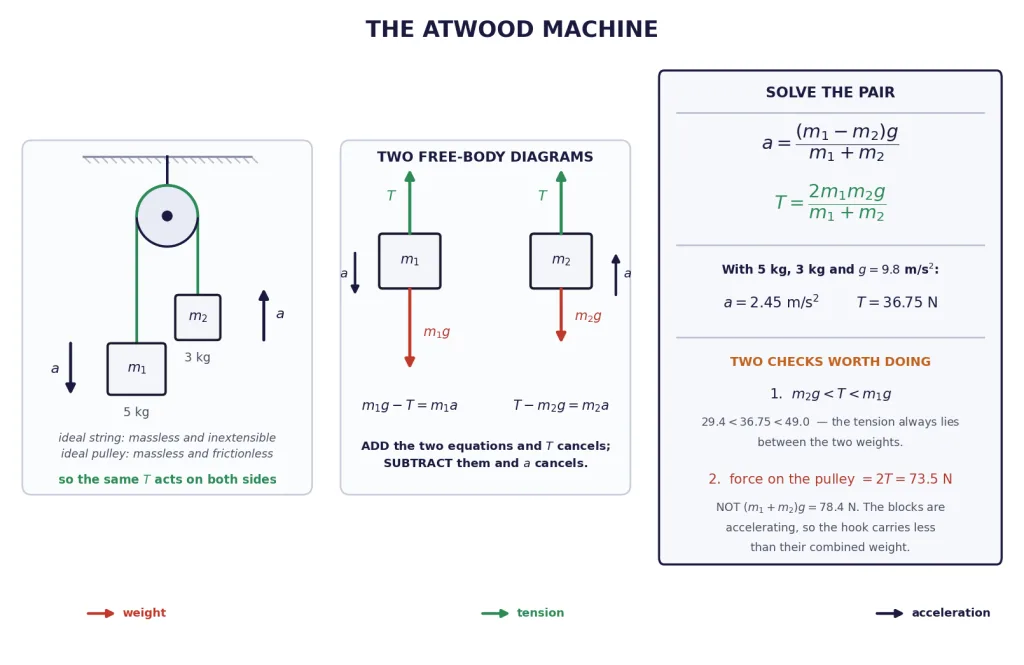
Two masses and (with ) hang from the two ends of a light inextensible string passed over a light frictionless pulley. This is the Atwood machine, invented in 1784 to measure by slowing gravity down to something a pendulum clock could time.
What "ideal" buys you
Section 4 set this up, and it is worth restating because every step below depends on it:
- the string is massless, so the tension is the same all along it;
- the pulley is massless and frictionless, so it merely redirects the string without changing the tension — the tension on both sides is the same ;
- the string is inextensible, so if goes down by , goes up by : both have the same magnitude of acceleration .
The two free-body diagrams
is heavier, so take it to be going down and up, both with magnitude .
For , taking downward as positive:
For , taking upward as positive:
Solving
Add (1) and (2). The tension cancels — that is exactly the "internal force disappears" effect:
Key Point:
Now put this back into (1) — or, more elegantly, multiply (1) by , (2) by , and add so that cancels:
Key Point:
Note that contains the harmonic mean of the two masses — a small but memorable structural fact that helps you recall the factor 2.
Three checks worth doing every single time
1. Special cases. If , then and — the system just hangs, as it should. If , then and — free fall, as it should. If either limit fails, your algebra is wrong.
2. The tension lies between the two weights. Why? is accelerating up, so the tension pulling it up must beat its weight. And is accelerating down, so the tension holding it back must lose to its weight. For kg, kg and m/s^2: m/s^2 and N, sitting neatly between 29.4 N and 49 N. [JEE Tip] If your falls outside that window, you have made a sign error.
3. The force on the pulley is , not the total weight. Two string segments pull down on the pulley, each with tension , so the hook or ceiling supports For our numbers that is N — noticeably less than N. There is no contradiction: the system's centre of mass is accelerating downward (the heavier mass falls faster than the lighter one rises), so the support carries less than the dead weight. This appears as a JEE Main question every few years.
What the Atwood machine was for
With kg and kg the acceleration is 2.45 m/s^2, exactly one quarter of . Rearranged, , so measuring a small, slow gives you . Pick masses close together and you can slow gravity down as much as you like — which in 1784, with no stopwatch better than a pendulum, was the whole point.
Archetypes 4 and 5: Over the Edge of a Table, and Down an Incline
Archetype 4 — a block on a table, connected over a pulley to a hanging block
lies on a horizontal table; a string from it runs over a pulley at the edge and down to a hanging block .
Smooth table. For (horizontally) and (vertically): Adding:
With kg, kg and m/s^2: m/s^2 and N. Check: N, as it must be, otherwise could not be falling.
Note that 's weight does not appear in the answer. It is balanced by the normal reaction from the table and plays no part — until friction enters.
Rough table. Now also feels friction. Do the test first:
- The driving force is .
- The most static friction the table can supply is .
- If , nothing moves. Then , , and the friction acting is — not .
- If , it moves, and only now does kinetic friction apply:
Key Point: The comparison against comes first, always. Applying to a system that never moves is the single most expensive error in this whole section.
Archetype 5 — a block on an incline, connected over a pulley
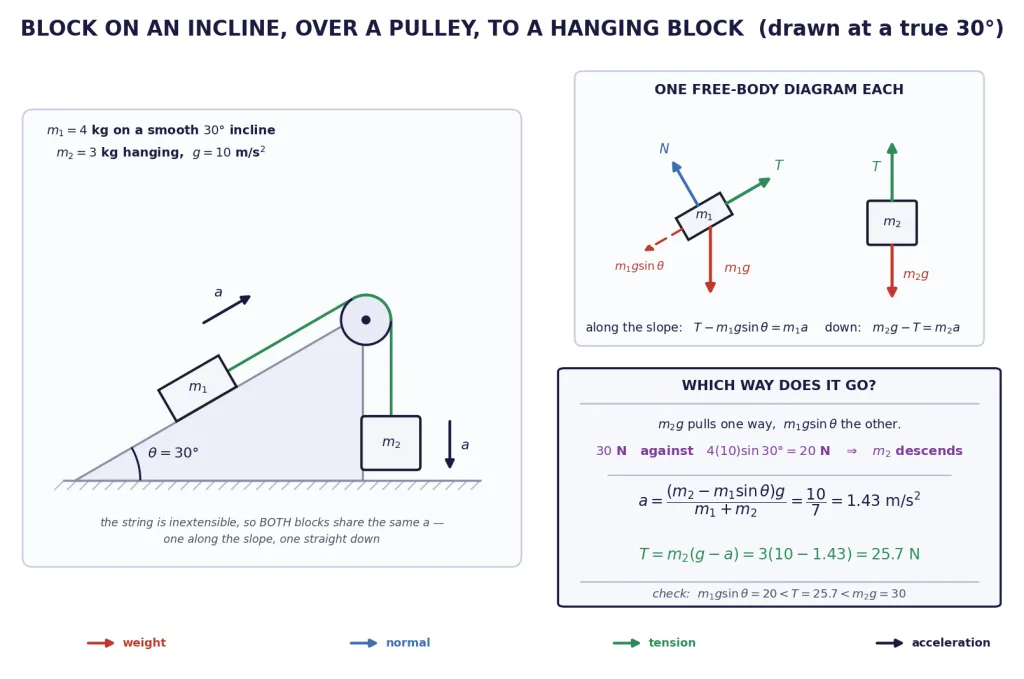
rests on an incline of angle ; the string runs up the slope, over a pulley at the top, and down to a hanging . Take axes along the slope for and vertical for — the two axes are different, and that is fine, because each body only needs axes suited to its own motion.
Which way does it go? Compare the two competing pulls along the string:
- tries to drag up the slope;
- tries to drag up.
Key Point — the direction condition (smooth incline):
- if , the hanging block descends;
- if , the block slides down the incline instead;
- if , the system stays in equilibrium.
The equations, assuming descends:
With kg, kg, and m/s^2: the contest is 30 N against 20 N, so wins, m/s^2 and N. And the check: — the tension again lies between the two competing pulls, exactly as in the Atwood machine.
Do not forget on the incline block. It does not affect the acceleration on a smooth slope, but the moment friction is added, everything hangs on it.
With friction on the incline, the friction opposes whichever way the system tends to move, and the same three-step routine applies: find the net driving force , compare it with , and only if it wins does anything move.
The four archetypes on one card
| Archetype | Acceleration | Internal force |
|---|---|---|
| Blocks in contact, on | ||
| String on a table, on | ||
| Atwood machine | ||
| Table and hanging block (smooth) | ||
| Incline and hanging block (smooth) |
Every single one has the same shape: acceleration = (net external driving force) / (total mass). Memorise the shape, not the five rows.
Archetype 6: the Lift, and What a Weighing Machine Really Measures
Stand on a weighing machine inside a lift. As the lift starts up you feel heavier; as it slows to a stop at the top you feel lighter. Your body has not changed. What has?
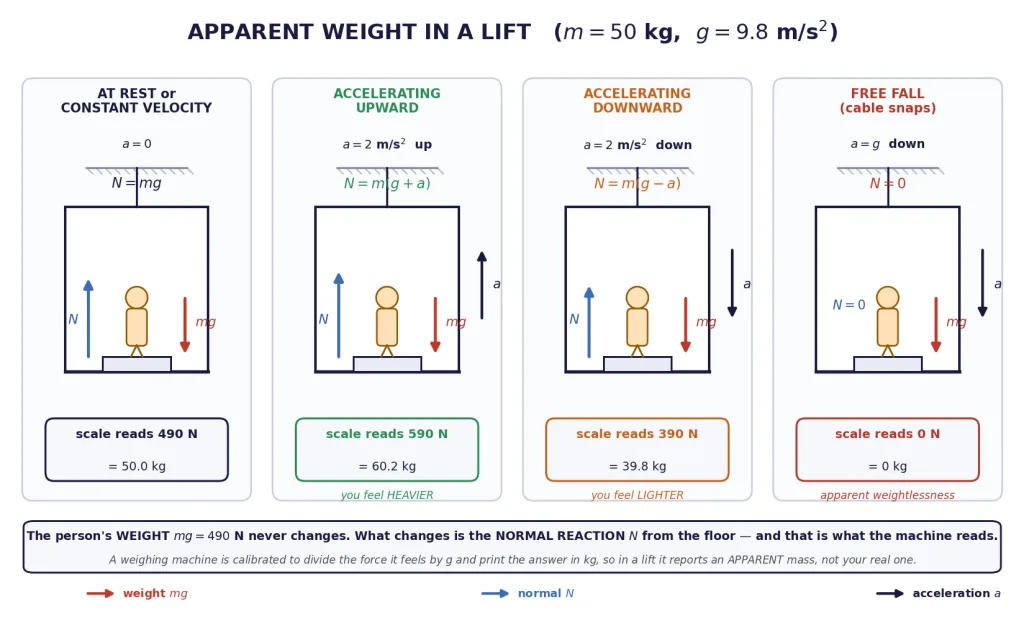
Key Point — the central idea: Your weight is the pull of the Earth on you. It does not change in a lift. What changes is the normal reaction from the floor of the lift — and a weighing machine measures precisely , the force pressing on its platform. That is why the reading changes.
The four cases
Draw the free-body diagram of the person: up from the floor, down. Take upward as positive and let the lift's acceleration be . where is signed. Now read off the four cases.
| Case | Normal reaction | You feel | |
|---|---|---|---|
| At rest, or moving with constant velocity | normal | ||
| Accelerating upward at | heavier | ||
| Accelerating downward at | lighter | ||
| Free fall (cable snaps) | weightless |
For a 50 kg person with m/s^2 and m/s^2, the machine reads 490 N at rest, 590 N accelerating up, 390 N accelerating down and 0 in free fall.
The three things students get wrong
1. "Constant velocity" is not "at rest", but it gives the same answer. A lift moving up at a steady 3 m/s has , so . [NEET Important] The question will say "moving upward with uniform velocity" hoping you will add something. Do not — velocity does not appear in Newton's second law.
2. Going up is not the same as accelerating up. A lift that is moving upward but slowing down has a downward acceleration, so and you feel lighter. Read for the direction of , never the direction of .
3. "Apparent weightlessness" does not mean gravity has switched off. In free fall , so : nothing presses on the floor, and there is no sensation of weight. But the Earth is still pulling with — that is exactly why you are falling at . This is precisely the situation of astronauts on the space station, who are in continuous free fall around the Earth.
The weighing-machine-in-kg subtlety
A bathroom scale actually senses a force in newtons. It is calibrated to divide by and print the answer in kilograms, on the assumption that it is standing still on the ground.
Key Point: In a lift the machine reads kilograms. That number is an apparent mass, not your real mass. Your mass never changes at all.
Our 50 kg person sees 60.2 kg going up and 39.8 kg going down — the same body, two readings, neither of them 50 except when .
The same idea, three other places
- A spring balance holding a mass inside a lift reads the tension, and the identical algebra gives .
- A person standing in a lift exerts downward on the floor by the third law, so an accelerating lift's cable carries more than the dead weight of lift plus passengers.
- A body on a weighing machine at the equator reads slightly less than at the poles, because a small part of is spent supplying the centripetal force of the Earth's rotation — Section 7's idea, reappearing.
[Board Important] The lift is one of the most frequently examined topics in the whole chapter, and almost all of the marks come from one sentence: the weight is unchanged; it is the normal reaction that changes. Say it explicitly in your answer.
The Mistakes That Cost Marks, and Where This Goes Next
The checklist, in the order you should work
- Draw the whole set-up. Then draw a separate FBD per body. Two bodies, two diagrams — never one crowded picture.
- Only forces ON the body. If you have drawn a force the body exerts on something else, delete it.
- Same for connected bodies — that is what "inextensible string" means. Different directions, same magnitude.
- Same throughout a light string over a light pulley. If the pulley had mass, or the string had mass, this would fail — and that is exactly what Section 10 explores.
- Choose the sign convention once, in the direction you think the system will move, and stick to it in both equations.
- Test for motion before using friction. Compare the driving force with .
- Sanity-check the answer. Does lie between the competing weights? Does reduce to something sensible when a mass goes to zero or the masses become equal?
The mistakes
- Applying to a system that never moves. The most expensive single error here.
- Forgetting that the two blocks share the same , and solving two independent problems.
- Using different tensions on the two sides of an ideal pulley. For an ideal pulley they are equal. (For a pulley with mass they are not — Section 10.)
- Saying the force on an Atwood pulley is . It is , which is smaller whenever the system is accelerating.
- Writing the contact force between two blocks as , or as the same value whichever side you push from. It is (mass being pushed) .
- Claiming your weight changes in a lift. It is that changes.
- Treating "moving up" as "accelerating up". A decelerating upward lift has downward acceleration.
- Using for a block on an incline. It is , and the tension in the string does not change that on a smooth slope.
- Forgetting to check which way the system moves in an incline-and-pulley problem before assigning signs.
- Including internal forces when you have chosen the whole assembly as the system. They cancel — that is the entire point of choosing it.
A 60-second self-test
- Blocks of 2 kg and 3 kg touch on a smooth floor; N pushes the 2 kg one. Find and the contact force. m/s^2, contact N.
- Same pair, same force, pushed from the other side. m/s^2 still, contact N.
- Atwood with 3 kg and 2 kg, m/s^2. Find , and the pulley force. m/s^2, N, pulley N.
- A 3 kg block on a smooth table is joined over a pulley to a 2 kg hanging block, m/s^2. m/s^2, N.
- A 70 kg person in a lift accelerating up at 2 m/s^2, m/s^2. What does the scale read? N, i.e. 84 kg.
- Same lift, now in free fall. Zero.
Where this goes next
- Section 9 works 30+ more problems across the whole chapter, covering every standard problem type in it.
- Section 10 (JEE Corner) removes the training wheels: constraint relations for systems where the accelerations are not equal, movable pulleys, pseudo forces so you can solve lift problems from inside the lift, blocks on blocks with friction at two surfaces, and pulleys and strings with mass.
- Chapter 5 re-solves several of these with energy methods, where the internal forces of an ideal string do no net work — a shortcut worth waiting for.
You now have the complete toolkit for Laws of Motion. Everything after this is practice and extension.
Solved Examples
Example 1: The block and the cylinder
A wooden block of mass 2 kg rests on a soft horizontal floor. When an iron cylinder of mass 25 kg is placed on top of it, the floor yields steadily and the block and cylinder together go down with an acceleration of 0.1 m/s^2. Take m/s^2. What is the action of the block on the floor (a) before and (b) after the floor yields?
Solution:
(a) Before. The system is just the block, and it is at rest. Its free-body diagram has two forces: gravity N down, and the normal force from the floor, up. Since : By the third law, the action of the block on the floor is 20 N, vertically downward.
(b) After. Now choose the whole system (block + cylinder), total mass 27 kg, accelerating downward at 0.1 m/s^2. Its free-body diagram shows only two external forces: gravity N down, and the normal force from the floor, up. The force between block and cylinder is now internal and does not appear. Taking downward as positive: By the third law, the action of the system on the floor is 267.3 N downward.
The action-reaction pairs. For (a): the Earth pulls the block down with 20 N and the block pulls the Earth up with 20 N; the block pushes the floor down with 20 N and the floor pushes the block up with 20 N. For (b): the same two pairs for the system, plus the force on the block by the cylinder and the force on the cylinder by the block.
Final Answer: (a) 20 N downward; (b) 267.3 N downward.
Takeaway: Note carefully what happens in case (a): and on the block happen to be equal and opposite — but they are not an action-reaction pair, because both act on the same body. They are equal only because . In case (b) they are unequal (270 N against 267.3 N), which proves the point beyond argument.
Example 2: Two blocks in contact, pushed both ways
Blocks of 10 kg and 20 kg lie in contact on a smooth horizontal floor. A horizontal force of 60 N is applied. (a) Find the acceleration when the force is applied to the 10 kg block, and the contact force between them. (b) Repeat with the force applied to the 20 kg block instead.
Solution:
(a) Whole system first. Total mass 30 kg, total external horizontal force 60 N:
Now isolate the 20 kg block. The only horizontal force on it is the contact push from the 10 kg block: Cross-check with the 10 kg block: , so N. Equal, as the third law requires.
(b) Push the 20 kg block instead. The whole-system equation is untouched, so But now the block being pushed by the contact force is the 10 kg one:
Final Answer: (a) m/s^2, contact force 40 N; (b) m/s^2, contact force 20 N.
Takeaway: Same blocks, same force, and the contact force halves when you push from the other side. The reason is simple once you see it: the contact force only has to accelerate whatever is in front of it, and 20 kg needs twice as much force as 10 kg. [JEE Tip] The acceleration never changes — only the internal force does.
Example 3: Three blocks in a row
Blocks of 1 kg, 2 kg and 3 kg lie in contact in that order on a smooth floor. A force of 12 N is applied to the 1 kg block. Find the acceleration and the force at each contact.
Solution:
Whole system:
The contact between the 1 kg and 2 kg blocks. Take the 2 kg and 3 kg blocks together as the system — 5 kg, driven only by that contact force:
The contact between the 2 kg and 3 kg blocks. Take the 3 kg block alone:
Check the middle block on its own: N, and N. Consistent.
Final Answer: m/s^2, N, N.
Takeaway: The rule is worth memorising: the force at any joint equals the mass still ahead of that joint, times . The force drops as you move along the chain, from 12 N applied, to 10 N, to 6 N — each block "uses up" its share. And step 4 is the habit to build: whenever you have solved a system three ways, check that one of the equations you did not use is also satisfied.
Example 4: Two blocks joined by a string on a table
A 2 kg block and a 3 kg block on a smooth horizontal table are joined by a light string. A horizontal force of 10 N is applied to the 3 kg block, dragging the 2 kg block behind it. Find the acceleration and the tension.
Solution:
Whole system: the string tension is internal, so
Isolate the 2 kg block, the one being dragged. The only horizontal force on it is the tension:
Cross-check with the 3 kg block:
Final Answer: m/s^2, N.
Takeaway: Compare with Example 2. A string joining the blocks and a contact force between them do exactly the same bookkeeping job — the only difference is that a string can pull and a contact can only push. In both cases the internal force equals (the mass it must accelerate) . [NEET Important] Note that N is much less than the applied 10 N; the string only has to move 2 kg, not 5 kg.
Example 5: The Atwood machine, fully
Masses of 5 kg and 3 kg hang from the ends of a light string over a light frictionless pulley. Take m/s^2. Find (a) the acceleration, (b) the tension, (c) the force the pulley exerts on its support.
Solution:
Write both free-body diagrams. For the 5 kg mass (downward positive) and the 3 kg mass (upward positive):
(a) Add them so that cancels:
(b) Substitute back into the second equation: Or from the standard result, N.
The check. N and N, and indeed .
(c) The pulley. Two string segments pull down on it, each with tension :
Final Answer: (a) 2.45 m/s^2; (b) 36.75 N; (c) 73.5 N.
Takeaway: Compare (c) with the total weight N. The pulley carries less than the dead weight, because the system's centre of mass is accelerating downward. [JEE Tip] The wrong answer 78.4 N is offered in almost every multiple-choice version of this question. It would only be right if the system were static.
Example 6: The Atwood machine used backwards
Two masses totalling 10 kg hang over a light pulley and are observed to accelerate at 1.96 m/s^2. Taking m/s^2, find the two masses and the tension.
Solution:
Use the acceleration relation as an equation for the mass difference:
Solve the pair of simultaneous equations:
The tension:
Check: N, N, and . Good. And running the forward calculation on 6 kg and 4 kg gives m/s^2, as observed.
Final Answer: 6 kg and 4 kg, with N.
Takeaway: This is what Atwood built the machine for. Rearranged, — so by choosing two nearly equal masses you can make as small as you like and time it comfortably by hand. Here is exactly , which was slow enough to measure accurately in 1784.
Example 7: Over the edge of a smooth table
A 5 kg block on a smooth horizontal table is connected by a light string over a frictionless pulley at the edge to a 2 kg block hanging freely. Take m/s^2. Find the acceleration and the tension.
Solution:
Free-body diagrams. The 5 kg block: tension horizontally towards the pulley, weight down, normal reaction up (these two cancel). The 2 kg block: up, down.
Add to eliminate :
Substitute back:
Check: N is less than N, which it must be for the hanging block to be accelerating downward.
Final Answer: m/s^2, N.
Takeaway: The 5 kg block's weight never entered the calculation — on a smooth table it is completely cancelled by the normal reaction. Only its inertia matters. That changes the moment friction appears, which is exactly the next example.
Example 8: The same set-up, with friction
Repeat Example 7 with a rough table, and . Then repeat it with the hanging block reduced to 1 kg. Take m/s^2.
Solution:
Set up the standard quantities. On the table block, N, so
Case A: 2 kg hanging. The driving force is N. Compare: , so the system moves, and kinetic friction now applies. Adding: , so Cross-check on the table block: N, and N. Consistent.
Case B: 1 kg hanging. The driving force is now N. Compare: , so nothing moves. Therefore , and from the hanging block, N. The friction actually acting on the table block is
Final Answer: With 2 kg: m/s^2, N. With 1 kg: , N, N.
Takeaway: Case A and Case B differ by one comparison, and everyone who skips that comparison gets Case B badly wrong — plugging N into the moving equations would give by luck here, but change the numbers slightly and it gives a negative acceleration, which is physically meaningless. Test for motion first, every time. Also compare the two tensions: friction raises from 14.29 N to 17.14 N, because the string now has to overcome friction as well as accelerate the block.
Example 9: Incline and pulley
A 4 kg block rests on a smooth incline of . A light string from it passes over a pulley at the top of the incline and carries a 3 kg block hanging vertically. Take m/s^2. Which way does the system move, and with what acceleration and tension?
Solution:
Decide the direction first. Compare the two competing pulls along the string: Since , the hanging block descends and the block on the incline is dragged up the slope.
Two free-body diagrams, two sets of axes. For the 4 kg block, along the slope (up-slope positive); for the 3 kg block, vertically (down positive):
Add:
Substitute back:
Two checks. The normal reaction on the incline block is N (needed only if friction is present). And the tension satisfies — it lies between the two competing pulls, exactly as in the Atwood machine.
Final Answer: The hanging block descends; m/s^2 and N.
Takeaway: Step 1 is the whole difficulty of this archetype. Get the direction wrong and every sign afterwards is wrong. [JEE Tip] The rule is a one-liner worth memorising: on a smooth incline the hanging block descends if . Notice that with the incline becomes vertical and the condition reduces to — the Atwood machine.
Example 10: A rough incline — does it move at all?
A 4 kg block rests on an incline of with . A string over a pulley at the top connects it to a 2.5 kg hanging block. Take m/s^2, , . (a) Does the system move? (b) Find the tension and the friction force. (c) What is the smallest hanging mass that would drag the block up the slope?
Solution:
(a) Compute the three standard quantities. The two competing pulls are N and N, so the net driving force along the string is
Compare. , so static friction can easily hold everything. The system does not move.
(b) Therefore . From the hanging block, : with , For the incline block, along the slope: , so (down the slope, because the tendency is to be dragged up it).
(c) To just start moving up, the hanging weight must beat both the down-slope weight component and the maximum friction:
Final Answer: (a) No; (b) N and N down the slope; (c) about 4.08 kg.
Takeaway: Anyone who reached straight for would have got m/s^2 — a negative acceleration, which here is nonsense rather than a direction. It is the algebra warning you that the system never started moving. Always compare the net driving force with first.
Example 11: The lift, all four cases
A person of mass 50 kg stands on a weighing machine in a lift. Take m/s^2. Find the reading, in newtons and in kilograms, when the lift is (a) at rest, (b) moving up at a constant 3 m/s, (c) accelerating upward at 2 m/s^2, (d) accelerating downward at 2 m/s^2, (e) in free fall.
Solution:
One equation for all five parts. Draw the person's free-body diagram: up from the machine, down. Taking up as positive,
(a) At rest: , so N, reading kg.
(b) Constant velocity: again — the 3 m/s is a distraction. N, reading 50 kg.
(c) Accelerating up at 2 m/s^2:
(d) Accelerating down at 2 m/s^2:
(e) Free fall: , so , reading zero.
Final Answer: (a) and (b) 490 N = 50 kg; (c) 590 N = 60.2 kg; (d) 390 N = 39.8 kg; (e) 0.
Takeaway: The person's weight was 490 N in every single case. Only the normal reaction changed, and only the normal reaction is what the machine measures. [NEET Important] Part (b) is the trap: constant velocity means zero acceleration, exactly like being at rest. And part (e) is apparent weightlessness — gravity is still acting at full strength, which is precisely why the fall is at .
Example 12: Reading the lift's acceleration off the scale
A 60 kg person stands on a weighing machine in a lift. The machine reads 54 kg. Take m/s^2. Find the magnitude and direction of the lift's acceleration.
Solution:
Convert the reading to a force. The machine reads in kilograms, so
The reading is less than the true weight N, so and the acceleration must be downward.
Apply the second law with downward acceleration :
Check: N. Matches.
Final Answer: m/s^2, directed downward (which is ).
Takeaway: A neat shortcut worth knowing: the fractional drop in the reading equals . Here the reading fell from 60 to 54, a drop of 10%, so m/s^2 straight away. And remember that "accelerating downward" does not mean the lift is going down — it could equally be moving upward and slowing to a halt at the top floor.