
Newton's Third Law of Motion
Section 2 gave you a law that connects the force on a body to its acceleration. It left one question wide open:
What is the origin of the external force on a body? What agency provides it?
The Newtonian answer is beautifully simple. The external force on a body always arises because of some OTHER body. A force is never something a body has on its own; it is always something one body does to another.
That immediately raises the follow-up. Take two bodies, A and B. Body B exerts a force on A. Does A, in turn, exert a force on B?
Two examples that make the answer obvious, and one that does not
Press a coiled spring with your hand. The spring gets compressed by the force of your hand — and you can feel the compressed spring pushing back on your palm. Nobody needs convincing here.
Now the hard case. The Earth pulls a stone downwards. Does the stone pull the Earth? You have never seen the Earth move towards a falling stone, so the answer is not obvious at all.
Newton's answer is yes. The stone pulls the Earth up with exactly the same force with which the Earth pulls the stone down. We never notice it because the Earth's mass is about kg, so that force produces an acceleration of the Earth so absurdly small that no instrument could ever detect it. Equal forces do not mean equal accelerations — that is the second law's business, and it divides by mass.
The law
Key Point — Newton's third law of motion: To every action there is always an equal and opposite reaction.
That famous phrasing "can sometimes be confusing", so here is a simple and clear way of stating it instead — this is the version to write in an exam:
Forces always occur in pairs. Force on a body A by B is equal and opposite to the force on the body B by A.
where means the force on A by B and means the force on B by A.
Read the notation carefully, because it trips people up: in , the first subscript is the body the force acts on, and the second is the body that exerts it. The phrase "force on A by B" is in exactly that order.
Three warnings that come with the law
Three cautions come with the third law, and every one of them is a standard exam question.
1. "Action" and "reaction" are just names — neither causes the other. Ordinary English suggests that a reaction is a response: first the action happens, then the reaction follows. There is no cause-and-effect relation implied in the third law at all. The force on A by B and the force on B by A act at the same instant. There is zero time lag between them.
2. Because of that, either one may be called the action. Since neither comes first and neither causes the other, the labels are completely interchangeable. If a question asks "which is the action and which is the reaction?", the honest answer is either one; the labels carry no physics.
3. They act on DIFFERENT bodies. This is the big one, and it gets its own block next.
What the law does NOT say
| The law says | The law does NOT say |
|---|---|
| the two forces are equal in magnitude | that the two accelerations are equal |
| the two forces are opposite in direction | that the two bodies move in opposite directions |
| they act at the same instant | that one causes or precedes the other |
| they act on two different bodies | that they add up to zero on any one body |
| they are of the same type (both gravitational, or both contact) | that a contact push can pair with a gravitational pull |
[NEET Important] That last row is worth memorising on its own. An action-reaction pair is always the same kind of force: a gravitational pull pairs with a gravitational pull, a normal push pairs with a normal push, a frictional drag pairs with a frictional drag. If you ever pair a weight with a normal reaction, you have paired two different kinds of force — and that is your signal that you have got it wrong.
The One Thing Everybody Gets Wrong: TWO Different Bodies
Here is the thing. If the two forces in an action-reaction pair are equal in size and opposite in direction, why does anything in the universe ever accelerate? Shouldn't every force be cancelled by its partner, leaving nothing to move anything?
This is the single most common confusion in the whole chapter, and the answer is one line long.
Key Point — the rule that resolves everything: Two forces cancel only if they act on the SAME body. The two forces of an action-reaction pair always act on two DIFFERENT bodies. So they can never cancel each other. Ever.
When you apply Newton's second law, you apply it to one body at a time. You draw that body, and you add up only the forces that act on it. The partner force in each pair acts on some other body, and is therefore simply not in your equation. Stated bluntly:
Thus if we are considering the motion of any one body (A or B), only one of the two forces is relevant. It is an error to add up the two forces and claim that the net force is zero.
The book on the table, done properly
A book of mass 1 kg lies at rest on a table. There are two separate action-reaction pairs hiding in this picture, and one very tempting pairing that is not a pair at all.
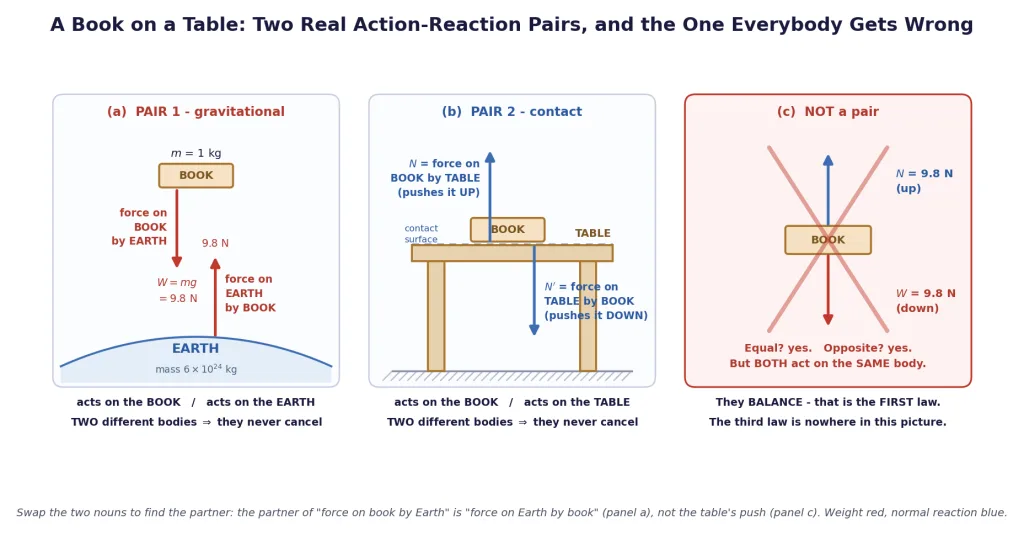
Pair 1 — gravitational.
- Force on the book by the Earth = = 9.8 N, downward. This is the book's weight.
- Force on the Earth by the book = 9.8 N, upward, acting on the Earth.
Pair 2 — contact.
- Force on the book by the table = = 9.8 N, upward. This is the normal reaction.
- Force on the table by the book = 9.8 N, downward, acting on the table.
And the pairing that is NOT a pair. Almost everyone's first instinct is to say that the reaction to the book's weight is the table's normal reaction. It is not, and here is the giveaway: both of them act on the book. Two forces acting on the same body cannot be an action-reaction pair, no matter how equal and opposite they look.
So why are and equal here? Because the book is in equilibrium, so by the first law the net force on it is zero. That is a completely different reason, and it is fragile:
Key Point — the trap: The familiar equation for a body on a table is true only if the body is in equilibrium. Put the same book in a lift that accelerates upward, and . Put it in a freely falling lift and . The equality of and has no connection whatsoever with the third law. The third-law partners of and are still exactly 9.8 N each, in every one of these cases.
Why the two pairs cannot be mixed up
| Pair 1 | Pair 2 | The wrong "pair" | |
|---|---|---|---|
| Type of force | gravitational | contact (normal) | one of each — impossible |
| Acts on | book / Earth | book / table | book / book |
| Equal and opposite? | yes, always | yes, always | only when the book is in equilibrium |
| Survives if the table is removed? | yes | no, both vanish | no |
| Survives in an accelerating lift? | yes | yes | no, then |
That fourth row is a lovely test. Whisk the table away and the book falls: the normal-reaction pair disappears together, both members at once, as an action-reaction pair must. But the gravitational pair carries on unchanged, because gravity does not need contact.
Internal forces cancel — but only for a SYSTEM
There is one situation in which you do get to add the two forces of a pair together, and it needs care.
If you treat A and B together as one system, then and are internal forces of that system. They are equal and opposite, so when you add up every force acting on the system they cancel in pairs, and only the external forces survive.
Key Point: Internal forces in a body, or in a system of particles, always cancel away in pairs. This is exactly what allows the second law to be applied to an extended body or a whole system, using only the external forces. It is also the seed of the conservation law you will meet in a moment.
[JEE Tip] This gives you a genuine strategic choice in every multi-body problem. Treat the bodies as one system and the internal contact forces vanish from your equation, which is the fastest route to the common acceleration. Then isolate one body and the internal force reappears as an unknown you can solve for. Section 8 turns this into a full working method.
Identifying a Genuine Pair: Swap the Two Nouns
You now need a mechanical, thought-free recipe for spotting an action-reaction pair, because instinct is unreliable here. One rule supplies it:
Every force and its equivalent terms encountered in mechanics should be reduced to the phrase "force on A by B".
Do that, and the recipe writes itself.
Key Point — the swap-the-nouns recipe:
- Write the force in the form "force on A by B".
- Swap the two nouns. The partner is "force on B by A".
- Sanity check: the partner is the same type of force, equal in magnitude, opposite in direction, and acts on a different body.
That is the entire method. Applied to the book: "force on book by Earth" swaps to "force on Earth by book" — the book's gravitational pull on the planet. Not the table. The table never entered the sentence.
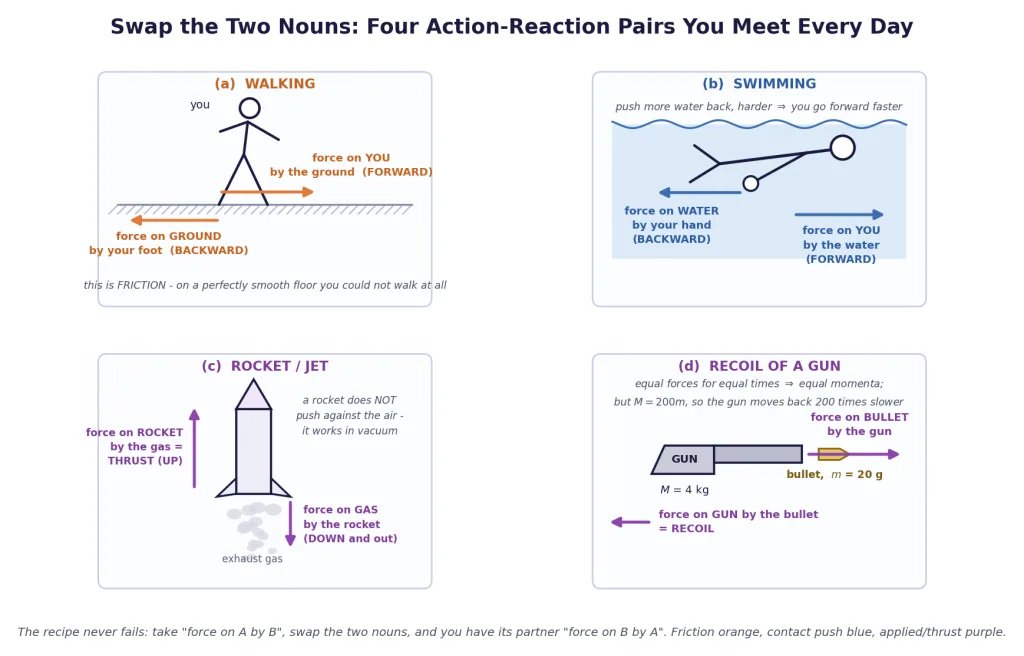
The four everyday pairs
Walking. Your foot pushes the ground backward; the ground pushes your foot forward. The force that actually accelerates you is the ground's push on you, and it is friction. The point is worth making sharply: there is no conceptual distinction between animate and inanimate objects, and without the external force of friction, we cannot walk on the ground. On perfectly smooth ice you can push backward as hard as you like and go nowhere.
Swimming. Your hand pushes water backward; the water pushes you forward. Push more water, and push it harder, and you go faster.
Rocket and jet propulsion. The rocket pushes the exhaust gas downward and out; the gas pushes the rocket upward. That upward force on the rocket is called the thrust.
Key Point — the vacuum question, asked in every exam: A rocket does not work by pushing against the air. The partner of "force on gas by rocket" is "force on rocket by gas" — the air is nowhere in that sentence. A rocket therefore works perfectly well in vacuum, and in fact works better there, with no air resistance. A jet engine is different: it takes in atmospheric air, so it does need an atmosphere — but the propulsion is still third-law, from the exhaust it throws backward.
Recoil of a gun. The gun pushes the bullet forward; the bullet pushes the gun backward. Same force, same duration, so the same size of momentum change for each. But the gun is hundreds of times heavier, so it moves back hundreds of times slower. That is the second law talking, not the third.
The same sentence pattern covers the rest of them: a swimmer against a wall, a balloon released with its neck open, the kick of a fire hose, a bird pushing air down with its wings and being pushed up in return, and the squid that moves by squirting water backward.
The horse and the cart, resolved
This is the oldest objection to the third law, and it deserves a full answer rather than a slogan.
The objection: the horse pulls the cart forward; by the third law the cart pulls the horse backward with an equal force. The two are equal and opposite, so they cancel, so nothing can ever move. And yet carts move.
The resolution, in three steps.
Step 1 — those two forces act on different bodies, so they never cancel. "Force on cart by horse" acts on the cart. "Force on horse by cart" acts on the horse. They belong to two different second-law equations and can never appear in the same one.
Step 2 — look at what accelerates the cart. The only forward force on the cart is the pull of the traces. If that pull beats the resistance on the cart, the cart accelerates. Done.
Step 3 — look at what accelerates the horse, which is where the real answer lives. The horse leans forward and pushes the ground backward with its hooves. By the third law, the ground pushes the horse forward — friction again, exactly as in walking. That is the force that drives the whole assembly. If the horse's push on the ground beats the cart's backward pull on the horse, the horse accelerates too.
Step 4 — take the horse and cart as one system. Now the horse-cart forces are internal and cancel in pairs. What is left is purely external: the ground's forward friction on the hooves, minus the resistance. Whenever that is positive, the system accelerates.
Key Point: The cart moves not because the horse "wins" against the cart, but because the ground pushes the system forward. Ask a horse to pull a cart on frictionless ice and the third law is still perfectly obeyed — and nothing moves at all.
Example 4 works this out with real numbers, and you will see the two equal-and-opposite trace forces sitting quietly in the two separate equations while the system accelerates at 1 m/s^2.
The mis-pairings to refuse
| Situation | The tempting wrong partner | The genuine partner |
|---|---|---|
| Weight of a book on a table | the table's normal reaction on the book | the book's gravitational pull on the Earth |
| Weight of a hanging block | the tension in the string | the block's gravitational pull on the Earth |
| Tension pulling a block | the block's weight | the block's pull back on the string |
| Normal reaction on a block on an incline | the block's weight | the block's push on the incline surface |
| Centripetal force on a whirling stone | the "centrifugal force" | the stone's outward pull on the string, felt by your hand |
[JEE/NEET] The last row is a favourite. The centrifugal force is a pseudo force invented inside a rotating frame; it is not the third-law partner of anything. The genuine partner of the string's inward pull on the stone is the stone's outward pull on the string. Section 7 does circular motion, and Section 10 does pseudo forces.
Conservation of Linear Momentum
Now for the payoff. Put the second and third laws side by side and something remarkable drops out — a quantity that simply refuses to change, no matter how complicated the interaction.
The derivation, in four lines
Take two bodies, 1 and 2, that interact with each other and with nothing else. Let be the force on 1 by 2, and the force on 2 by 1.
Second law, applied to each body separately:
Third law, relating the two forces:
Put them together:
A quantity whose rate of change is zero is a constant. So:
Every bit of momentum body 1 gains, body 2 loses. The two changes are equal and opposite because the forces causing them are equal and opposite and act for exactly the same time. The books balance perfectly, always.
The law
Key Point — law of conservation of linear momentum: The total momentum of an isolated system of interacting particles is conserved. An isolated system is one on which the net EXTERNAL force is zero. Then so for any interaction whatever,
Read the condition precisely, because two words in it do all the work.
"NET" force. External forces are allowed to exist — they just have to cancel out. A ball rolling on a table has gravity and a normal reaction acting on it, and they cancel.
"EXTERNAL" force. The forces the parts of the system exert on each other can be enormous. A shell bursting apart is held together by internal forces of many thousands of newtons, and the law does not care one bit. Internal forces cancel in pairs, exactly as Section N2 showed.
The derivation for a collision
The same result can be derived for two colliding bodies, and it is worth having in full. Bodies A and B have initial momenta , ; they collide and separate with final momenta , . Over the common contact time , the impulse-momentum theorem from Section 2 gives
Since by the third law,
Key Point — and this is the beauty of it: this is true whether the collision is elastic or inelastic. Momentum conservation does not care whether the bodies bounce apart, stick together, or shatter. Kinetic energy is a different story: in an elastic collision the total kinetic energy is also conserved, and in an inelastic one it is not. Chapter 5 deals with that. Do not confuse the two conservation laws.
It holds component by component
The conservation law is a vector equation, and a vector equation is really three scalar equations bolted together:
Key Point — a JEE favourite: momentum can be conserved along one axis and not along another. The test is applied axis by axis: momentum is conserved along any direction in which the net external force has no component.
Two situations where this is the whole question:
- A ball bouncing off the floor. During the bounce the floor exerts a large upward external force, so the ball's vertical momentum is emphatically not conserved. But the floor exerts no horizontal force, so the ball's horizontal momentum is conserved — which is why a ball thrown forward keeps moving forward as it bounces.
- A shell bursting in mid-flight. Gravity acts throughout, so strictly the momentum of the fragments is not conserved. But the burst lasts a few milliseconds, in which the impulse of gravity, , is utterly negligible next to the internal explosive impulse. So we treat momentum as conserved through the instant of the burst, in every direction. Example 8 does exactly this.
Why this law is a big deal
Three reasons, and they explain why conservation laws dominate modern physics.
- It skips the interaction entirely. You never need to know the force between two colliding bodies, or how it varied during the contact, or how long the contact lasted. Only the before and the after.
- It works when the second law is unusable. In an explosion the internal forces are unknown, enormous and wildly time-dependent. The conservation law does not blink.
- It is more general than the laws it came from. Momentum conservation survives into relativity and quantum mechanics, where does not. It is, as far as anyone can tell, exact.
The Three Archetypes: Recoil, Collision, Explosion
Nearly every momentum-conservation problem you will ever be set is one of three shapes. Learn the shapes and the problems become almost mechanical.
The recipe, once, for all three
- Draw a BEFORE box and an AFTER box. Nothing else prevents more mistakes than this.
- Fix a positive direction (or a pair of axes) and write every velocity with its sign.
- Check the condition: is the net external force zero along the axis you are using?
- Write , component by component.
- Solve, then sanity-check the direction of your answer.
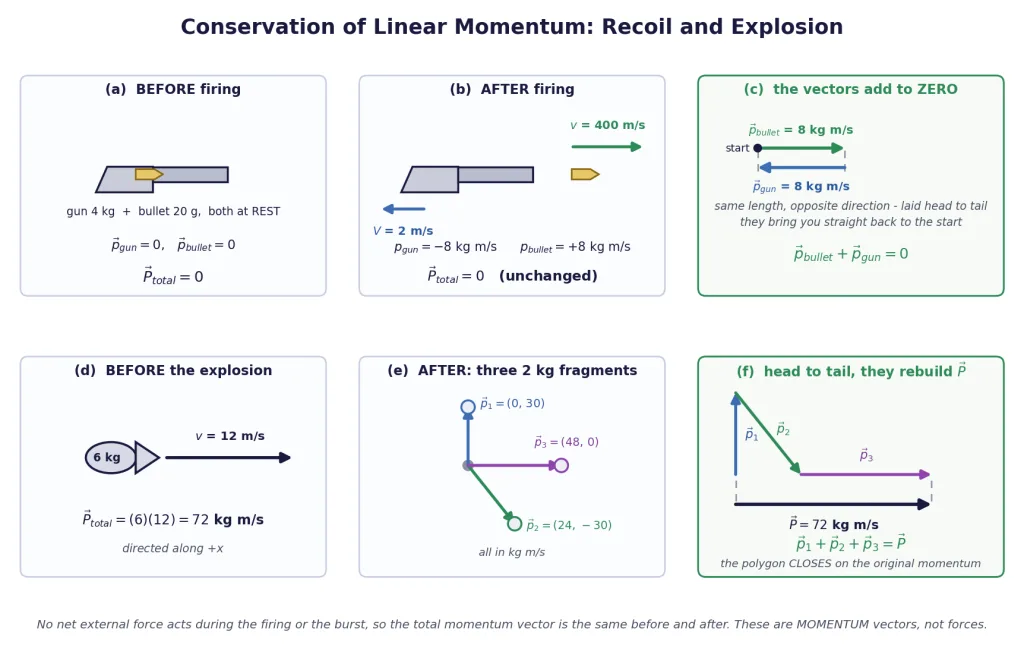
Archetype 1 — recoil: total momentum zero
Everything starts at rest, so the total momentum is zero, and it must stay zero.
In magnitudes, , so
The recoil velocity is smaller than the bullet's velocity in exactly the ratio of the masses, and it points the other way. The same single equation handles the recoil of a gun, a man jumping from a boat, a swimmer pushing off a wall, an astronaut throwing a spanner, two skaters shoving each other apart, and a compressed spring flinging two blocks in opposite directions.
[JEE Tip] The kinetic energies are not shared equally. Since and the two momenta have the same magnitude, the lighter body carries away the larger share of the kinetic energy, in the ratio . In Example 2 the bullet takes 1600 J and the gun only 8 J — a ratio of 200, exactly the mass ratio. This is why a bullet is lethal and a recoil is merely a shove.
Archetype 2 — collision: two bodies in, two bodies out
The special case worth memorising is the perfectly inelastic collision, where the bodies stick together and move off as one lump:
This covers the bullet embedding itself in a block, two railway wagons coupling, and a lump of putty hitting a trolley. Kinetic energy is always lost in such a collision — it goes into heat, sound and permanent deformation — but momentum is not.
Archetype 3 — explosion: one body in, many bodies out
An explosion is a collision run backwards. One body becomes several, and
Two sub-cases:
- The body was at rest. Then , so the fragment momentum vectors form a closed polygon. With two fragments they are back to back; with three, they close into a triangle.
- The body was moving. Then the fragment momenta must add up, head to tail, to the original momentum vector — as in the figure in the previous block, where three 2 kg fragments rebuild the shell's original 72 kg m/s.
Key Point — the component habit that saves you: never try to add momentum vectors "by eye". Resolve every velocity into and components, write two scalar equations, and solve them. Then recombine with and . Examples 7, 8 and 11 all run on this one habit.
The continuous version: a stream of momentum
Some situations deliver momentum not in one lump but as a steady stream — a jet of water hitting a wall, a machine gun firing, a conveyor belt being loaded, a rocket burning fuel. For these, go back to the second law in its momentum form and read it as a rate:
- Water jet on a wall, cross-section , speed , density : mass arriving per second is , so the force is if the water stops dead on impact, and if it rebounds elastically.
- Machine gun: bullets a second, each of mass leaving at speed , needs a holding force .
- Rocket: burning fuel at and expelling it at exhaust speed gives a thrust .
Examples 9 and 10 work two of these. The full variable-mass rocket equation is Section 10's job.
Mistakes That Cost Marks, and Where This Goes Next
The checklist
- Never add an action-reaction pair together. They act on different bodies, so they never appear in the same free-body diagram, let alone the same equation.
- The reaction to a weight is always a gravitational pull on the Earth — never a normal reaction, never a tension. If you have paired a contact force with a gravitational force, you are wrong by definition.
- is the first law, not the third. It is true only in equilibrium and it fails the instant the body accelerates vertically.
- Equal forces do not mean equal accelerations. A bullet and a gun feel the same force for the same time and end up with the same momentum — never the same speed and never the same acceleration.
- Check "net EXTERNAL force = 0" before conserving momentum, and check it along each axis separately. If a wall, a floor or a hand is delivering an impulse along that axis, momentum along that axis is not conserved.
- Momentum conservation does not imply energy conservation. Momentum is conserved in every collision; kinetic energy only in elastic ones.
- Keep momentum a vector. In one dimension that means signs; in two dimensions it means components. A momentum "sum" done with bare magnitudes is almost always wrong.
- Do not confuse "the system" with "the body". Internal forces vanish only when you treat the parts as one system; the moment you isolate a part, they come back as real forces on it.
A quick self-test
Answer these in your head before you move on.
- A magnet attracts a nail. What is the partner of "force on nail by magnet"? Force on magnet by nail — equal, opposite, and magnetic, not something else.
- A ball is falling freely. Is momentum conserved? For the ball alone, no — gravity is an external force. For the ball-plus-Earth system, yes.
- Two identical trolleys collide and stick. Was momentum conserved? Yes. Was kinetic energy? No.
- You are stranded at the exact centre of a perfectly frictionless frozen lake. How do you get off? Throw something — a shoe, your bag — hard, away from the shore. Momentum conservation slides you the other way. Blowing hard, or throwing air, works too, just very slowly.
Where this goes next
You now have all three laws and the conservation law that follows from them. What is missing is the vocabulary of forces to put into them.
- Section 4 introduces the forces you will actually be writing down — weight, normal reaction, tension and the spring force — and settles the question of when equals and when it does not.
- Section 5 turns the second law into a disciplined technique: the free-body diagram, and equilibrium.
- Section 8 takes the third law back out of the drawer, because relating the forces between the parts of a connected system is exactly what it is for.
Solved Examples
A note on before we start: this section barely needs it. Momentum conservation problems compare a before with an after, and gravity usually has no time to act. Where does appear, the example states the value it uses, and never mixes two values inside one problem.
Example 1: Two billiard balls and a wall
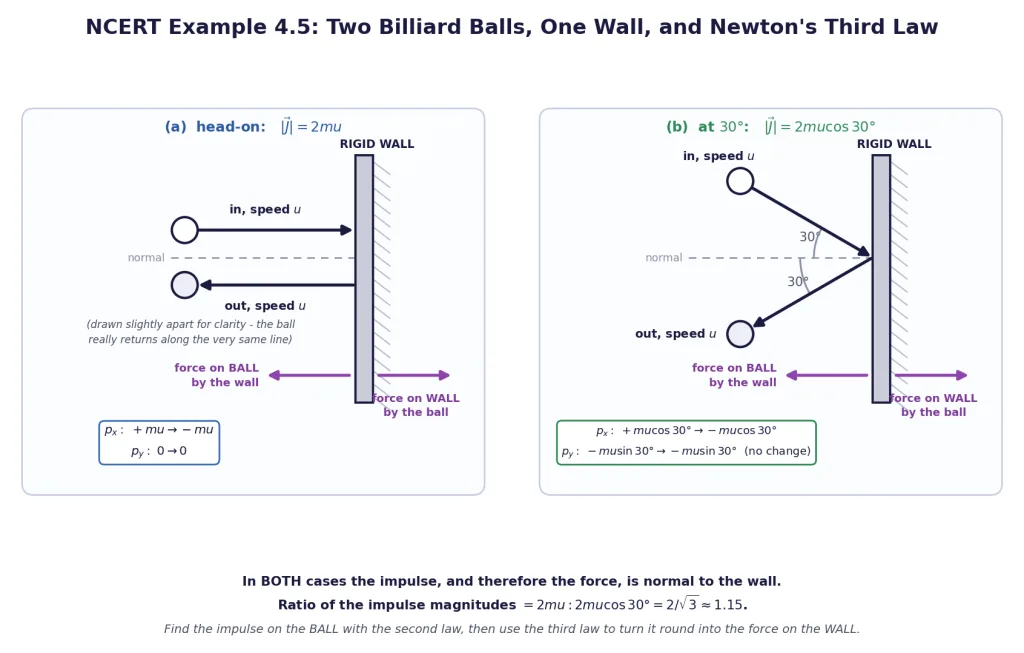
Two identical billiard balls strike a rigid wall with the same speed but at different angles, and get reflected without any change in speed. In case (a) the ball hits the wall head-on; in case (b) it strikes at to the normal and reflects at on the other side. Find (i) the direction of the force on the wall due to each ball, and (ii) the ratio of the magnitudes of the impulses imparted to the balls by the wall.
Solution:
A warning about the instinctive answer first: an instinctive answer to (i) might be that the force on the wall in case (a) is normal to the wall, while that in case (b) is inclined at to the normal. This answer is wrong.
The trick, and it is the whole point of the problem. You cannot get at the force on the wall directly. So find the impulse on the ball using the second law (Section 2's machinery), and then flip it round with the third law to get the force on the wall. Take along the outward normal to the wall and along the wall.
Case (a), head-on. Before: , . After: , . So the impulse on the ball has magnitude and points along the negative direction — that is, straight into the wall, along the normal.
Case (b), at . Before: , . After: , . changes sign, but does not change at all. So again the impulse is purely along the negative direction — normal to the wall, exactly as in case (a).
Now the third law, for part (i). The impulse and hence the force on the ball due to the wall is along in both cases. Therefore the force on the wall due to the ball is along — normal to the wall in both cases. The magnitude of the force cannot be found, because the (very short) collision time is not given; only the impulse can.
Part (ii), the ratio.
Final Answer: (i) The force on the wall is normal to the wall in both cases. (ii) The ratio of the impulse magnitudes is , usually rounded to about 1.2.
Takeaway: Two lessons in one problem. First, the component along the wall never changes, so it contributes nothing to the impulse — only the normal component reverses. Second, and more important, this is the standard route for any "force on the wall / floor / bat" question: compute the change of momentum of the small object, then turn it round with the third law. You are never asked to analyse the wall directly.
Example 2: The recoil of a gun
A gun of mass 4.0 kg fires a bullet of mass 20 g with a muzzle speed of 400 m/s. The bullet takes 4.0 ms to travel down the barrel. Find (a) the recoil velocity of the gun, (b) the force the gun exerts on the bullet and the force the bullet exerts on the gun, and (c) the kinetic energies of the two.
Solution:
Set up before and after. Take the direction of the bullet as positive. Before firing, both are at rest, so The explosion is internal to the gun-plus-bullet system, and over the 4.0 ms of firing the external forces (gravity, the shooter's grip) contribute a negligible horizontal impulse. So the horizontal momentum is conserved.
(a) Apply conservation. The minus sign says backwards, which is what "recoil" means.
(b) The two forces, computed separately, from the impulse-momentum theorem. They come out equal, as the third law demands, and opposite in direction.
(c) Kinetic energies.
Final Answer: (a) recoil velocity 2.0 m/s backwards; (b) both forces 2000 N, equal and opposite; (c) bullet 1600 J, gun 8.0 J.
Takeaway: Look at part (c) hard. The momenta are equal in size (8.0 kg m/s each), but the kinetic energies are in the ratio 200 : 1 — exactly the mass ratio, because . Equal momentum does not mean equal energy. This is precisely why a 20 g bullet is deadly and a 2 m/s shove in the shoulder is not, and it is a standard JEE distractor.
Example 3: The book on the table — naming the pairs
A book of mass 2.0 kg rests on a horizontal table. Take m/s^2. (a) Find the weight of the book and the normal reaction on it. (b) Name the third-law partner of each of these two forces, stating the body it acts on. (c) A student says " and are an action-reaction pair because they are equal and opposite". Explain the error.
Solution:
(a) Weight. The book is at rest, so by the first law the net force on it is zero:
(b) The two partners, found by swapping the nouns.
- is the "force on the book by the Earth". Swap: its partner is the "force on the Earth by the book" — a gravitational pull of 19.6 N acting on the Earth, directed upward (toward the book).
- is the "force on the book by the table". Swap: its partner is the "force on the table by the book" — a contact push of 19.6 N acting on the table, directed downward.
- (c) The error, in two independent ways.
- Both and act on the same body, the book. An action-reaction pair must act on two different bodies. That alone settles it.
- They are also different kinds of force — one contact, one gravitational — and a genuine pair is always the same kind.
- The equality here is an accident of equilibrium. Put the book in a lift accelerating upward at and you get , while the third-law partners of and remain exactly equal to and as always.
Final Answer: (a) N down, N up. (b) The partner of is the book's 19.6 N gravitational pull on the Earth; the partner of is the book's 19.6 N push on the table. (c) and act on the same body and are of different types, so they cannot be a pair; their equality comes from the first law.
Takeaway: Whenever you are asked to name a partner, write the force out as "force on A by B" and swap. Do not reason about which forces happen to be equal — that is the first law's department, and it will mislead you every single time.
Example 4: The horse and the cart, with numbers
A horse of mass 300 kg is harnessed to a cart of mass 200 kg. The ground pushes the horse forward with a frictional force of 700 N, and the total resistance opposing the cart's motion is 200 N. Find (a) the acceleration of the horse-and-cart, and (b) the tension in the traces connecting them. Then explain how the cart can accelerate at all when the horse and cart pull on each other with equal and opposite forces.
Solution:
Draw the two bodies separately and name the forces. Let be the force in the traces. By the third law, the horse pulls the cart forward with and the cart pulls the horse backward with the same . Take forward as positive.
Second law on the horse:
Second law on the cart:
(a) Add (1) and (2). The terms cancel — precisely because they are an action-reaction pair and therefore internal to the horse-plus-cart system:
(b) Put back into (2): Check with (1): . Consistent.
Now the resolution of the paradox. The cart pulls the horse back with 400 N, and the horse pulls the cart forward with 400 N. Equal and opposite — and completely irrelevant to whether anything moves, because they act on different bodies and therefore live in two different equations. What accelerates the whole assembly is the external force: the 700 N the ground pushes forward on the horse's hooves, minus the 200 N of resistance, a net 500 N.
Final Answer: (a) m/s^2 forward; (b) N. The system accelerates because the ground supplies a net external force of 500 N; the equal and opposite trace forces are internal and cancel for the system.
Takeaway: Notice what happened in step 4. Adding the two equations made the internal pair vanish — the algebraic version of "internal forces cancel in pairs". On frictionless ice the ground's 700 N would be zero, the third law would still hold perfectly, and nothing would move. The horse does not beat the cart; the ground pushes them both.
Example 5: The man and the boat
A man of mass 60 kg is standing on a stationary boat of mass 240 kg floating on still water. He jumps off horizontally with a speed of 3.0 m/s relative to the water. With what speed does the boat move, and in which direction? Neglect the resistance of the water.
Solution:
Choose the system and check the condition. Take the man plus the boat as the system. Horizontally, the water offers no resistance (given), so there is no net external horizontal force, and horizontal momentum is conserved. Take the man's direction as positive.
Before: everything is at rest.
After:
Conserve:
Final Answer: The boat moves at 0.75 m/s in the direction opposite to the man's jump.
Takeaway: This is the recoil archetype wearing different clothes — same equation as the gun and the bullet. It is also why stepping off a small boat onto a jetty is so treacherous: the boat slides back as you push forward, and the gap opens up underneath you. And note the phrase "relative to the water" in the question; had the speed been given relative to the boat, you would have had to convert first, which is a favourite JEE twist.
Example 6: A perfectly inelastic collision
A block of mass 4.0 kg moving at 6.0 m/s on a smooth horizontal surface collides head-on with a stationary block of mass 2.0 kg. The two stick together after the collision. Find (a) their common velocity, and (b) the kinetic energy lost in the collision.
Solution:
Check the condition. The surface is smooth and horizontal, so gravity and the normal reaction cancel vertically and there is no horizontal external force. Momentum is conserved along the direction of motion.
(a) Before and after.
(b) Kinetic energies.
Final Answer: (a) The combined block moves at 4.0 m/s in the original direction. (b) 24 J of kinetic energy is lost.
Takeaway: Momentum came out exactly conserved; kinetic energy did not, and one third of it disappeared into heat, sound and deformation. This is the central distinction to keep straight: momentum is conserved in every collision, kinetic energy only in elastic ones. Whenever two bodies stick together, expect an energy loss and never write "energy is conserved" out of habit.
Example 7: A bomb at rest bursts into three fragments
A bomb of mass 8.0 kg, initially at rest, explodes into three fragments. One fragment of mass 2.0 kg flies due east at 6.0 m/s, and a second fragment, also of mass 2.0 kg, flies due north at 6.0 m/s. Find the mass, speed and direction of the third fragment.
Solution:
Condition and axes. The explosive forces are internal; over the burst the external forces contribute nothing measurable. So the total momentum stays zero. Take east and north.
Mass of the third fragment, from conservation of mass:
Momenta of the first two, in components:
Conserve momentum, component by component. The total must be zero:
Magnitude and direction: Both components are negative, so the direction is into the third quadrant, at below the west axis — that is, south-west.
Final Answer: The third fragment has mass 4.0 kg and moves at 4.24 m/s (that is, m/s) towards the south-west.
Takeaway: Because the bomb started at rest, the three momentum vectors must form a closed triangle. Notice the two clean checks built into the answer: the third momentum bisects the angle between the first two (because those two are equal in size and perpendicular), and it points exactly opposite their resultant. If your answer does not close the polygon, you have made an arithmetic slip.
Example 8: A shell bursts at the top of its trajectory
A shell of mass 2.0 kg is moving horizontally at 40 m/s at the highest point of its trajectory when it explodes into two equal fragments. Immediately after the explosion one fragment is observed moving vertically downward at 20 m/s. Find the velocity of the other fragment immediately after the burst.
Solution:
Why momentum is conserved here. Gravity is an external force and it never switches off. But the burst lasts a few milliseconds, and the impulse of gravity over that time, , is negligible next to the explosive impulse. So we conserve momentum through the instant of the burst, in both directions.
The key observation about the "top of the trajectory". At the highest point the vertical component of velocity is zero (Chapter 3). So just before the burst the shell's velocity is purely horizontal:
After the burst, each fragment has mass 1.0 kg. The first has m/s, so kg m/s. Let the second be .
Conserve, component by component:
Recombine:
Final Answer: The second fragment moves off with velocity m/s — that is, 82.46 m/s at about above the horizontal, in the original direction of flight.
Takeaway: Three things to steal from this one. The vertical velocity is zero at the top — that is what makes the problem tractable. Do the two axes separately; trying to combine 40 m/s and 20 m/s in your head is how marks are lost. And notice that one fragment ends up faster than the shell ever was: the explosion put energy in, and momentum bookkeeping alone permits it.
Example 9: A water jet against a wall
Water from a hose of cross-sectional area 2.0 cm^2 strikes a wall horizontally at 20 m/s and, after hitting it, runs down the wall without rebounding. Take the density of water as 1000 kg/m^3. Find the force exerted on the wall.
Solution:
Convert the area. cm^2 m^2.
Find the mass of water arriving each second. In one second, a column of water of length m and cross-section arrives at the wall:
Find the rate of change of momentum. Each kilogram arrives at 20 m/s and is brought to rest horizontally, losing 20 kg m/s of momentum. Using the second law in its rate form: Equivalently, N.
Turn it round with the third law. That 80 N is the force the wall exerts on the water to stop it. By the third law, the water exerts 80 N on the wall, directed horizontally into the wall.
Final Answer: The force on the wall is 80 N.
Takeaway: The same two-step pattern as Example 1 — get the momentum change of the moving stuff, then flip it with the third law to get the force on the big stationary thing. And watch the wording: if the water had rebounded with the same speed instead of running down the wall, the momentum change per kilogram would have been and the force would have doubled to 160 N.
Example 10: Holding a machine gun
A machine gun fires 20 bullets per second, each of mass 50 g, with a muzzle speed of 1000 m/s. What average force must the soldier exert to hold the gun steady?
Solution:
Momentum given to one bullet:
Momentum given per second. Twenty bullets leave every second, so the gun delivers
Second law in rate form. The forward force the gun exerts on the bullets is therefore
Third law. The bullets push back on the gun with 1000 N. To hold the gun steady the soldier must supply an equal and opposite force, so the required force is 1000 N, directed forward.
Final Answer: The soldier must exert an average force of 1000 N.
Takeaway: That is about the weight of a 100 kg person — which is why automatic weapons are braced against the shoulder or mounted. Note also the word average: the force is really a rapid train of 20 sharp impulses a second, and 1000 N is the constant force that would deliver the same total impulse. That is Section 2's doing its job.
Example 11: An oblique collision on a smooth table
A ball of mass 1.0 kg moving at 10 m/s along the -axis strikes an identical stationary ball on a smooth horizontal table. After the collision the first ball moves at 6.0 m/s in a direction making with the -axis (take , ). Find the velocity of the second ball.
Solution:
Check the condition and set axes. The table is smooth and horizontal, so there is no net external force in the plane. Momentum is conserved in both and . This is a two-dimensional problem, so components are compulsory.
Before:
First ball after:
Conserve, one axis at a time:
Recombine:
Final Answer: The second ball moves at 8.0 m/s at below the -axis, on the opposite side of the original line from the first ball.
Takeaway: The two balls always go off on opposite sides of the original line — that is what the -equation enforces, since the transverse momenta must cancel. Worth noticing as a curiosity: here exactly. For equal masses in a perfectly elastic oblique collision, the two outgoing directions are always at right angles; check the kinetic energies and you will find , so this collision happens to be elastic.
Example 12: A spring flings two blocks apart
Two blocks of mass 2.0 kg and 3.0 kg are held together on a frictionless horizontal table with a compressed spring squeezed between them, the whole assembly at rest. The blocks are released. The 2.0 kg block flies off at 3.0 m/s. Find the speed of the 3.0 kg block, and check the total momentum.
Solution:
Condition. The table is frictionless and horizontal, and the spring force is internal to the two-block system. So the total momentum is conserved and stays at its initial value of zero.
Conserve. Take the 2.0 kg block's direction as positive:
Check the total:
Read off the general rule. The speeds are in the inverse ratio of the masses:
Final Answer: The 3.0 kg block moves at 2.0 m/s in the opposite direction. The total momentum is zero, as it was before release.
Takeaway: Exactly the same equation as the gun-and-bullet and the man-and-boat — the recoil archetype for the third time. Whenever a system that starts at rest breaks into two parts, the two momenta are equal and opposite, and the lighter part always moves faster. Ask yourself which is heavier, and you already know which one crawls away. (The spring's stored energy, incidentally, is J — shared unequally, with the lighter block taking more.)