
Friction: the Other Half of the Contact Force
Section 4 gave you the normal reaction: the part of the contact force perpendicular to the surface. There is a second part, and this section is about it.
Key Point — the contact force splits in two: When two bodies touch, the force each exerts on the other can be resolved into two components:
- the component perpendicular to the surfaces in contact is the normal reaction ;
- the component parallel to the surfaces in contact is friction .
Friction opposes relative motion, or the tendency towards relative motion, between the two surfaces.
Those two words — relative motion — do a lot of work, and we will come back to them.
Where friction comes from
Look at two "smooth" surfaces under a microscope and they are not smooth at all. Both are covered in hills and valleys, and they touch only at a scattering of high points. At those points the atoms are close enough to bond, forming tiny cold welds. Sliding one surface over the other means continuously breaking and re-forming those welds — and that resistance is what we feel as friction.
Two useful consequences follow immediately from that picture:
- The real area of contact is far smaller than the apparent area — it is only the high points that touch. And that real area is proportional to how hard the surfaces are squeezed together, which is why friction turns out to depend on and not on the apparent area.
- Friction is fundamentally electromagnetic. Those bonds between atoms are electrical. It fits exactly with what Section 4 said about the four fundamental forces: every contact force in mechanics is electromagnetic in disguise.
Key Point: The laws of friction are empirical — approximate summaries of experiment, not fundamental laws like Newton's or the law of gravitation. They work extremely well for ordinary dry surfaces, and that is enough for us.
It opposes RELATIVE motion, not motion
Here is the sharpest test of whether you have understood the definition. A box sits on the floor of a train that is accelerating forward. The box does not slide; it accelerates forward along with the train.
What force accelerates the box? Look at its free-body diagram. Vertically, and cancel. Horizontally, the only candidate is friction from the floor. So friction on the box must point forward — in the direction of the box's motion.
Is that a contradiction? No. Without friction the floor would slide backwards underneath the box, which would stay put by inertia and hit the rear wall. That is the relative sliding that friction opposes, and to oppose it friction must push the box forward.
Key Point: Friction opposes relative sliding between the surfaces in contact, not the motion of the body through space. It can perfectly well point in the direction a body is moving — and when you walk, when a car accelerates, and when a box rides in a truck, it does exactly that.
The three kinds
| Kind | When it acts | Magnitude |
|---|---|---|
| Static | surfaces at rest relative to each other | self-adjusting, |
| Kinetic (sliding) | surfaces sliding over each other | , constant |
| Rolling | one body rolls over the other | , with far smaller |
The rest of this section takes them one at a time. Start with static, because it is the one that costs the most marks.
Static Friction Is Self-Adjusting
This is the most important idea in the section, and the one most often got wrong. Read it twice.
Put a heavy crate on the floor and push it gently. It does not move. Now Newton's first law is uncompromising: if the crate is not accelerating, the net force on it is zero. Your push is real, so something must be cancelling it exactly. That something is static friction.
Push a little harder. Still nothing moves — so friction must have grown too, to match your new push exactly. Push harder still, and at some point the crate breaks free. Static friction has a limit, and you have just exceeded it.
The law, stated as an inequality
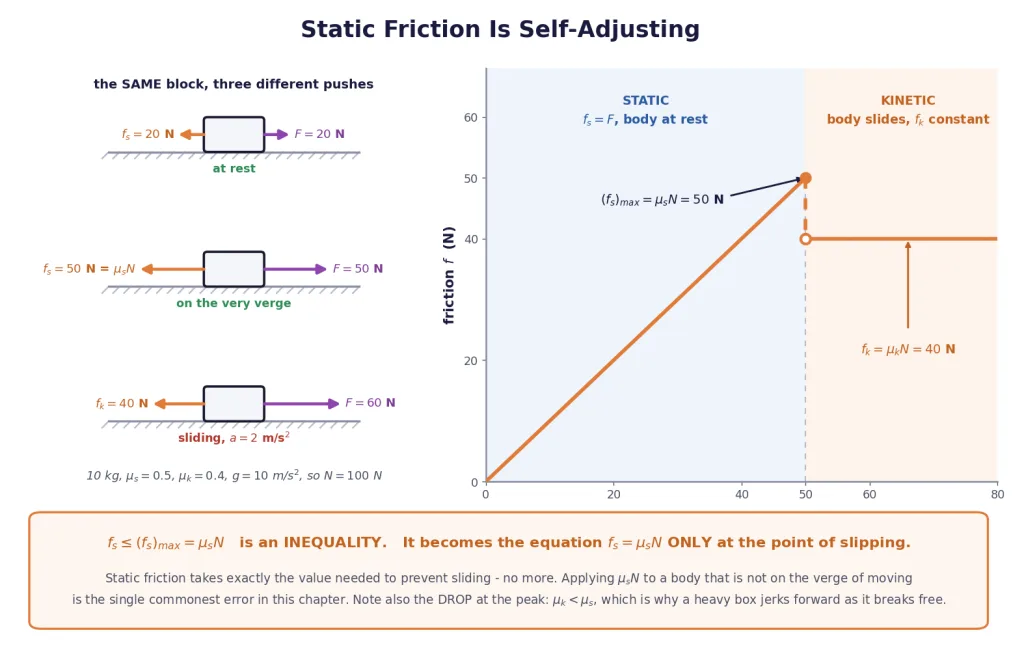
Key Point — the law of static friction: Static friction takes exactly the value needed to prevent relative sliding, and no more. It reaches only at the point of slipping. is the coefficient of static friction, and it depends only on the nature of the two surfaces in contact.
Key Point — the mistake this prevents: is not a formula you may apply to any stationary body. It holds only at the instant motion impends. For a body sitting comfortably below its limit, you must find from the equilibrium condition instead — usually = the applied force, or on an incline.
[JEE/NEET] If you take one habit from this section, take this one: compare first, then choose. Compute the driving force and compute . If driving , the body stays put and equals the driving force. Only if driving does the body slide, and only then do you use . Skipping that comparison is the single commonest silent error in this chapter — silent because the arithmetic still "works" and hands you a confident wrong answer.
Reading the graph
The figure shows friction plotted against the applied force , for a 10 kg block with and on a horizontal floor ( m/s^2, so N). Three things to read off it:
- The straight rising line, . From up to N, friction simply matches whatever is applied. It is a line at because and are equal, not because of any coefficient. Every point on it is a body at rest.
- The peak at N. This is the largest static friction those two surfaces can produce with this . The body is on the verge of sliding — physicists say motion is impending.
- The drop, then the flat line at N. Once sliding starts, friction falls to a smaller, constant value.
A note on "impending motion": it means the motion that would take place under the applied force if friction were absent. Static friction opposes impending motion — so to find its direction, ask which way the body would slide if the surface suddenly turned to ice, and point the arrow the other way.
And when the applied force wins
Once exceeds , the body accelerates, and the second law gives Note carefully that this is , not . Once the body is sliding, static friction is out of the picture entirely.
The three regimes on one card
| Condition | State | Friction | Acceleration |
|---|---|---|---|
| at rest | (self-adjusting) | ||
| on the verge | (its maximum) | ||
| sliding | (constant) |
Kinetic Friction, Rolling Friction, and the Wheel
Kinetic friction
Once sliding has begun, friction settles down to a simpler behaviour.
Key Point — the law of kinetic friction: where is the coefficient of kinetic friction, a property of the pair of surfaces. Unlike static friction this is an equation, not an inequality — once the body slides, is fully determined by .
Three properties worth stating explicitly:
- It is nearly independent of the relative speed. Sliding at 0.5 m/s or at 5 m/s makes almost no difference to . This is a very good approximation over ordinary speeds and it is what makes friction problems tractable.
- It is independent of the apparent area of contact, exactly like static friction.
- It always opposes the relative sliding, so its direction reverses when the sliding reverses. On an incline this is the fact students most often miss: a block sliding down feels friction up the slope; the same block being pushed up feels friction down the slope.
Key Point: always. Breaking free is harder than staying in motion.
That inequality is the reason a heavy box jerks as it starts to move. You push harder and harder against a friction of up to ; the moment the box breaks free, the opposition drops instantly to , so there is a sudden surplus force and the box lurches forward before you can ease off. It is also why a skidding car takes longer to stop than one braking on the edge of grip — a skidding tyre is in the kinetic regime, and .
Rolling friction
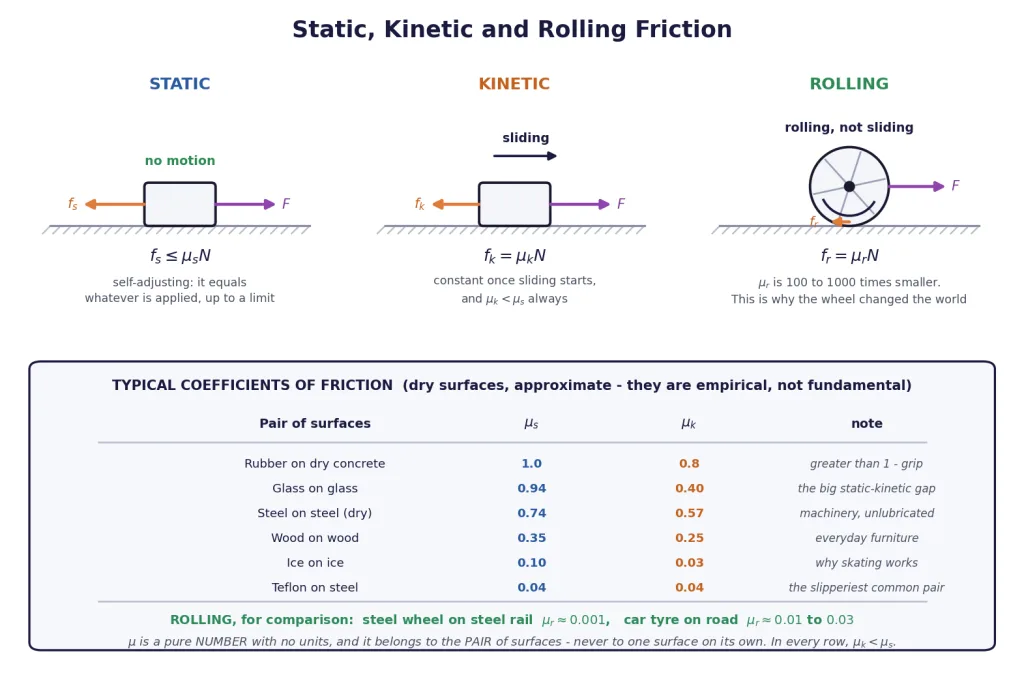
Here is the surprising part. A perfectly rigid wheel rolling without slipping on a perfectly rigid surface would feel no friction at all — in principle. At every instant it touches the ground at just one point, and that point has zero velocity relative to the ground. There is no sliding, so there is nothing for sliding friction to oppose.
Reality is not perfectly rigid. The wheel and the surface deform slightly under load, so contact happens over a small area, not a point; material is continuously compressed in front and released behind, and that costs energy. The resulting resistance is called rolling friction:
Key Point: For the same load, is smaller than or by two or three orders of magnitude. A steel wheel on a steel rail has ; steel sliding on steel has .
That single fact reshaped human history. Dragging a load means fighting a force of order ; rolling it means fighting only , hundreds of times smaller. The discovery of the wheel was a major milestone. The same principle appears inside machines as ball bearings — trap rolling balls between two parts and you replace sliding friction with rolling friction. An air cushion, floating one surface on a thin film of air, is another way.
Friction: nuisance and necessity
The nuisance. In machinery, friction opposes the motion you want and dissipates energy as heat. It causes wear. It is why engines need lubricants — a film of oil that keeps the surfaces from touching directly and cuts dramatically.
The necessity. Try to imagine a world without it:
- You could not walk. You walk by pushing backwards on the ground; friction is what lets you push. Section 3's action-reaction analysis of walking simply fails on a frictionless floor.
- A car could not start or stop. The forward force that accelerates a car is static friction between tyre and road — static because a rolling tyre does not slide at its contact point. Brakes rely on it too.
- Nothing would stay tied. Knots, screws, nails and the friction grip of your fingers all depend on it.
- A car could not turn. Section 7 will show that friction supplies the centripetal force on a level road.
[NEET Important] Two one-line answers examiners like: friction is a necessary evil — undesirable in machines where it wastes energy, indispensable in walking, braking and gripping; and kinetic friction, though it dissipates energy, is essential for quickly stopping relative motion, which is exactly how brakes work.
The Laws of Friction and the Coefficient
The experimental facts, gathered in one place.
Key Point — the laws of friction:
- Friction acts parallel to the surfaces in contact and opposes relative sliding, or its tendency.
- The limiting static friction and the kinetic friction are proportional to the normal reaction: and .
- Both are independent of the apparent area of contact.
- Kinetic friction is almost independent of the relative speed.
- for the same pair of surfaces.
The area result, and why it is not absurd
This is the law that sounds wrong. Lay a brick flat, then stand it on its narrow end. The area touching the table changes by a factor of three or four — and the force needed to start it sliding does not change at all.
The microscopic picture explains it. What matters is the real area of contact at the high points, not the apparent area you can measure with a ruler. Stand the brick on its end and the same weight is carried on fewer contact points, so each is squeezed harder and flattens more. The real contact area is unchanged, because it depends on the load, not on the outline. Fewer, bigger patches; same total.
[Board Important] Friction is independent of the apparent area of contact but depends on the normal reaction, because the real area of contact is proportional to the normal reaction and not to the apparent area. That sentence is a complete answer.
What is, and what it is not
Key Point — the coefficient of friction: is a ratio of two forces, so it is a pure number with no units and no dimensions. It is a property of the PAIR of surfaces, never of one surface alone.
Three things follow, and all three get asked:
- "The coefficient of friction of steel" is a meaningless phrase. Steel on steel is about 0.74; steel on Teflon is about 0.04. You must always name both surfaces.
- does not depend on the mass, the weight, the area, or the applied force. It changes only if the surfaces change — polish them, wet them, oil them, roughen them.
- can be greater than 1. There is nothing forbidding it. Rubber on dry concrete is about 1.0, and specially prepared rubber on rubber can exceed 1. A value above 1 simply means the friction available is larger than the normal reaction — exactly what a good tyre is designed for.
Typical values
| Surfaces in contact | ||
|---|---|---|
| Rubber on dry concrete | 1.0 | 0.8 |
| Glass on glass | 0.94 | 0.40 |
| Steel on steel, dry | 0.74 | 0.57 |
| Wood on wood | 0.35 | 0.25 |
| Ice on ice | 0.10 | 0.03 |
| Teflon on steel | 0.04 | 0.04 |
For comparison, rolling: a steel wheel on a steel rail has , and a car tyre on a road to . Notice that in every row, and that the values span more than a factor of twenty.
A caution about the word "smooth"
In physics problems, smooth means frictionless — an idealisation, . Rough means friction is present. If a question says "a smooth incline", it is telling you to set , not that the surface has been polished. Read that word carefully; it changes the whole problem.
The Angle of Friction and the Angle of Repose
Two angles, both with the tidy result , and students mix them up constantly. They are different quantities that happen to share a formula — and once you see why, you will never confuse them again.
The angle of friction
The surface exerts two forces on a body: perpendicular and parallel. Together they make a single total contact force , tilted away from the normal.
Key Point — the angle of friction: is the angle between the total contact force and the normal to the surface, at the point of slipping. Since and at that instant, and the magnitude of the total contact force is .
Below the point of slipping, is smaller, so leans less far over and the angle is less than . The angle of friction is therefore the maximum possible tilt of the contact force — which is why is sometimes described by saying the contact force can never lie outside a cone of half-angle about the normal.
The angle of repose
Now tilt a plank with a block on it, slowly, until the block just begins to slide.
Key Point — the angle of repose: is the maximum angle of inclination at which a body placed on the surface just stays at rest. Tilt it one degree further and the body slides.
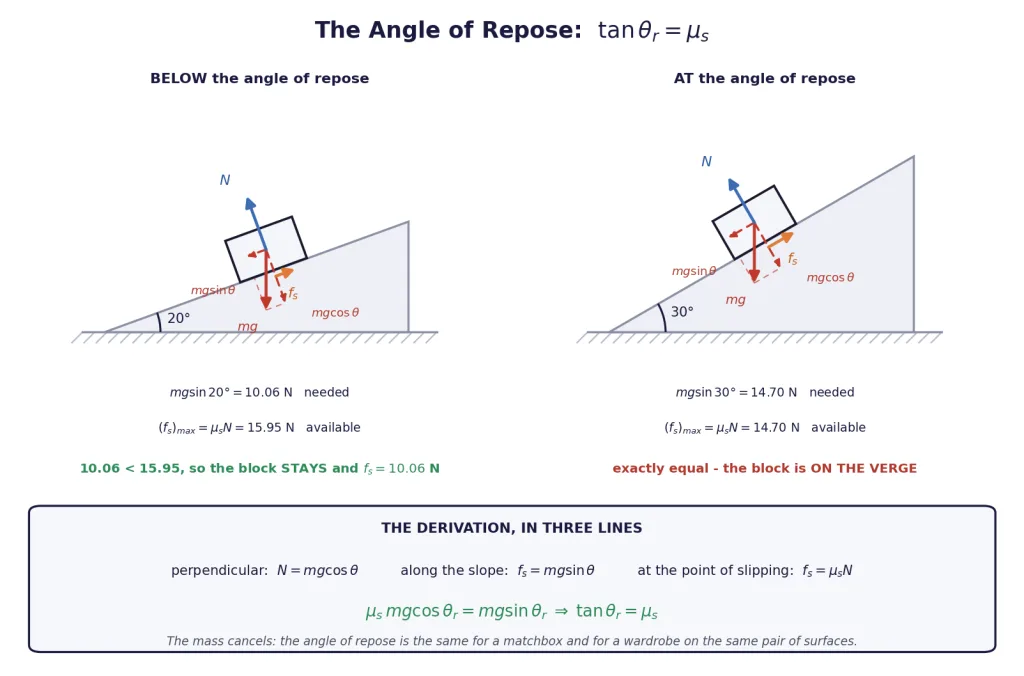
The derivation, properly. Take axes along and perpendicular to the slope, and resolve the weight.
Perpendicular to the slope, there is no acceleration, so
Along the slope, the block is at rest, so static friction balances the down-slope component of the weight:
Now increase . The driving force grows, while at the same time shrinks, so the available maximum shrinks too. They are racing towards each other, and at they meet: reaches its ceiling.
Two consequences worth memorising
1. The angle of repose does not depend on the mass. Look at the last step: cancels from both sides. A matchbox and a wardrobe on the same pair of surfaces slip at exactly the same angle. This is a very common one-mark question. It also means the angle of repose is a neat experimental way to measure — tilt until it slides, measure the angle, take the tangent.
2. , since both equal . They are numerically equal but conceptually distinct: is a property of the contact force's direction, is a property of the incline's geometry. On an incline at the angle of repose the total contact force is exactly vertical, balancing on its own — which is another way of seeing why the two angles must coincide.
Below the angle of repose
The left panel of the figure is the case that catches people out. A 3 kg block on a incline with (so ), taking m/s^2: Since , the block stays, and the friction acting on it is
Key Point: Below the angle of repose, friction is . At the angle of repose, and only there, it equals as well — because the two happen to coincide. Above it, the block slides and friction becomes .
A Block on a Rough Incline, and the Mistakes to Avoid
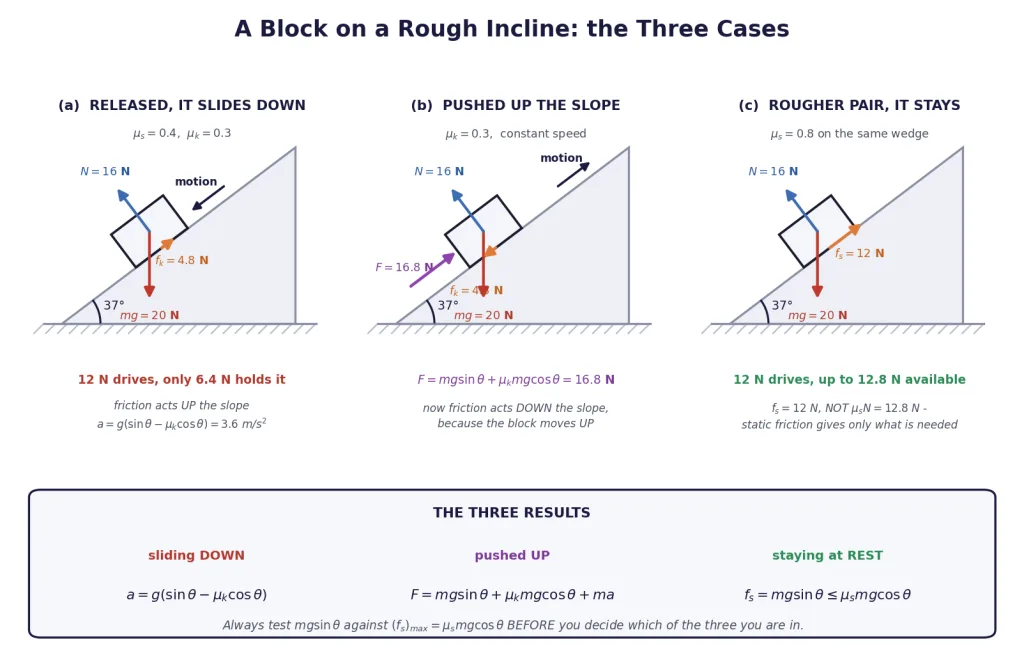
The rough incline is the workhorse of this chapter. There are exactly three cases, and the whole skill is knowing which one you are in before you start writing equations.
Always start the same way
For every rough-incline problem, whatever it asks: Then compare with — equivalently, compare with — and you know which case you are in.
Case 1: released and sliding down
If , the block slides down. Friction now acts up the slope with magnitude , and the second law along the slope gives The mass cancels again, so the acceleration is the same for any block on that pair of surfaces. Setting recovers the smooth-incline result , which is a good check.
Case 2: being pushed up the slope
Now the block moves up, so friction acts down the slope. With a force applied parallel to the slope and an acceleration up the slope: Both resistances now add rather than subtract, which is why pushing a load up a rough ramp is so much harder than letting it slide down.
Case 3: staying at rest
If — that is, if — the block stays, and
The three cases side by side:
| Case | Condition | Friction direction | Result |
|---|---|---|---|
| Sliding down | , released | up the slope | |
| Pushed up | moving up the slope | down the slope | |
| At rest | up the slope |
The mistakes that cost marks
- Using on a body that is not on the verge of moving. The headline error of this section. Static friction is an inequality. Test first, then choose.
- Using when the body is already sliding. Once it slides, only matters.
- Putting friction in the wrong direction on an incline. It opposes the relative sliding: up the slope for a block sliding down, down the slope for a block being pushed up.
- Writing on an incline. It is . And if an extra force presses the block into the surface, grows and so does the friction available.
- Thinking friction always opposes motion. It opposes relative motion. The friction that accelerates a car forward, or carries a box along on a truck floor, points forward.
- Believing a larger contact area gives more friction. It does not.
- Giving a unit. It is dimensionless.
- Assuming must be less than 1. Rubber on dry concrete is about 1.0.
- Confusing the angle of friction with the angle of repose. Numerically equal; conceptually different.
- Forgetting that , and the sliding acceleration, are independent of mass.
A 60-second self-test
- A 10 kg block on a floor has , m/s^2. You push it horizontally with 30 N. What is the friction? N. Since , the block stays and N.
- Same block, pushed with 50 N, and . What is the friction now? , so it slides and N.
- A block just slides at . What is ? .
- Two blocks, 1 kg and 100 kg, on the same rough slope. Which slides first as the slope is tilted? Neither — they slip at the same angle, because is independent of mass.
Where this goes next
- Section 7 shows friction supplying the centripetal force for a car on a level road, giving , and then combines it with banking.
- Section 8 puts friction into connected-body and pulley problems, where it appears in each free-body diagram separately.
- Section 10 takes it to JEE level: blocks on blocks with friction at two surfaces, minimum-force problems, and friction in accelerating frames.
Solved Examples
Example 1: The box on the floor of a train
Determine the maximum acceleration of a train in which a box lying on its floor will remain stationary, given that the coefficient of static friction between the box and the train's floor is 0.15. Take m/s^2.
Solution:
Isolate the box and find the only horizontal force. Vertically, . Horizontally, nothing touches the box except the floor, so the only horizontal force available is friction. Therefore friction is what accelerates the box.
Second law, horizontally.
Apply the limit. The box stays put only as long as the friction required is within what static friction can supply:
Cancel the mass and solve.
Final Answer: m/s^2.
Takeaway: Two lessons in one short problem. First, the friction here points forward, in the direction of motion — it opposes the box's tendency to slide backwards relative to the floor, not its motion through space. Second, the mass cancels: a matchbox and a refrigerator on that same floor start to slide at exactly the same acceleration. Whenever you see , expect the mass to disappear.
Example 2: Measuring by tilting
A mass of 4 kg rests on a horizontal plane. The plane is gradually inclined until, at an angle with the horizontal, the mass just begins to slide. What is the coefficient of static friction between the block and the surface?
Solution:
Draw the FBD at the critical angle. Three forces: weight vertically down, normal reaction perpendicular to the plane, and static friction up the plane, opposing the impending slide.
Resolve along and perpendicular to the plane.
"Just begins to slide" is the key phrase. At that instant, and only at that instant, static friction has reached its maximum:
Substitute and cancel.
Final Answer: .
Takeaway: The 4 kg is a complete distractor — the mass cancels, so the answer would be the same for 4 g or 4 tonnes. This is the angle of repose, and this experiment is the standard laboratory method for measuring : tilt until it slides, measure the angle, take the tangent. Note also that never had to be given a value.
Example 3: Block, trolley and friction
A 3 kg block hangs from a light string that passes over a smooth pulley at the edge of a table and is attached to a 20 kg trolley on the table. The coefficient of kinetic friction between the trolley and the surface is 0.04. Take m/s^2 and neglect the mass of the string. Find the acceleration of the system and the tension in the string.
Solution:
First check that it moves at all. The driving force is the weight of the hanging block, N. The friction resisting it is at most about N. Since , the system certainly slides, so kinetic friction applies.
The string is inextensible and the pulley smooth, so both bodies have the same magnitude of acceleration , and one tension throughout.
FBD of the hanging block (taking downward as positive for it):
FBD of the trolley (taking the direction of motion as positive). Vertically N, so
Add the two equations — cancels:
Back-substitute for the tension.
Final Answer: m/s^2 and N.
Takeaway: Check the answer for sense. N is less than the block's weight of 30 N — it has to be, or the block could not accelerate downward. And it is more than the 8 N of friction, or the trolley could not accelerate forward. If your tension ever comes out above 30 N or below 8 N here, you have made a sign error. Section 8 develops this connected-body technique properly; here the point is simply that friction enters as one more force on one more free-body diagram.
Example 4: The most important example in this section
A 10 kg block rests on a horizontal floor with and . Take m/s^2. Find the friction force on the block and its acceleration when the horizontal applied force is (a) 20 N, (b) 49 N, (c) 60 N.
Solution:
Set up once, use three times. Vertically, N. The most static friction those surfaces can supply is and if it does slide, the kinetic friction will be
(a) N. Compare: , so the block does not move. Static friction adjusts itself to whatever is needed for equilibrium:
(b) N. Compare: , so it still does not move. Notice that friction has gone up from 20 N to 49 N all by itself, without , or the surfaces changing at all.
(c) N. Compare: , so the block breaks free and slides. Now, and only now, friction is given by a formula:
Final Answer: (a) N, ; (b) N, ; (c) N, m/s^2.
Takeaway: Look at part (b) against part (c). The applied force went up by 11 N, and the friction went down, from 49 N to 40 N. That is the whole personality of friction in one comparison. Anyone who blindly writes gets part (a) wrong by 30 N and part (b) wrong by 29 N. Compare the driving force with first — every single time.
Example 5: The angle of repose, and what happens below it
A block placed on a plank starts to slide when the plank is tilted to . (a) Find between the block and the plank. (b) A 3 kg block is now placed on the same plank held at . Take m/s^2. Find the friction force acting on it.
Solution:
(a) At the angle of repose, :
(b) Do the comparison before anything else. At , with kg:
Compare. , so the block does not slide. (You could also have said it immediately: .)
Therefore friction is whatever equilibrium demands, not the maximum:
Final Answer: (a) ; (b) N up the slope.
Takeaway: The wrong answer to (b) is N, and it is wrong by nearly 60%. It is wrong because static friction never supplies more than is asked of it — 15.95 N is the ceiling, not the value. A block that only needs 10.06 N to stay put gets exactly 10.06 N. [JEE Tip] Whenever a question gives you both an angle and , your very first move should be to compare with .
Example 6: Released on a rough incline
A 2 kg block is released from rest on an incline of with and . Take m/s^2, and . Does it slide, and if so with what acceleration?
Solution:
Compute the three standard quantities.
Compare. , so static friction is nowhere near enough. The block slides down. (Equivalently, .)
Now, and only now, switch to kinetic friction, acting up the slope because the block slides down:
Second law along the slope, taking down-slope as positive: Or straight from the standard formula:
Final Answer: Yes, it slides, with m/s^2 down the slope.
Takeaway: The mass cancels out of , so every block on this slope accelerates at 3.6 m/s^2 regardless of its mass. Two checks worth doing: put and you get m/s^2, the smooth-incline answer, which must be larger — it is. And if the formula ever gives you a negative , that is not a strange answer; it means the block would not have started sliding in the first place, and you should have caught it at step 2.
Example 7: Pushed up a rough incline
A 5 kg block is on a rough incline of with and . Take m/s^2. (a) What force , applied parallel to the incline, is needed to push the block up the slope with an acceleration of 2.0 m/s^2? (b) What is the minimum force parallel to the incline needed just to hold the block at rest?
Solution:
The standard three quantities.
(a) Moving up means friction acts DOWN the slope. Everything opposes you:
(b) Would it slide on its own? Compare N with N. Since , yes — left alone it slides down. So a force is genuinely needed.
For the minimum holding force, friction helps you, acting up the slope at its maximum value:
Final Answer: (a) N; (b) N.
Takeaway: The same block on the same slope needs 43.66 N to be driven up and only 12.01 N to be held still — a factor of nearly four, and the difference is entirely down to which way friction points. In (a) friction fights you; in (b) it works for you. Before writing any incline equation, decide which way the block is moving or tending to move, and put the friction arrow the other way.
Example 8: Pull it, or push it?
A 20 kg crate rests on a floor with and . Take m/s^2. A force of 100 N is applied, either (a) as a pull at above the horizontal, or (b) as a push at below the horizontal. In each case, does the crate move, and what is the friction?
Solution:
The horizontal component is the same in both cases: The vertical component is what differs, and it changes .
(a) Pulling at above the horizontal. The upward component N helps carry the weight: Compare: , so the crate moves. Then N and
(b) Pushing at below the horizontal. Now the vertical component presses down: Compare: , so the crate does not move at all. Friction is static and self-adjusting:
Final Answer: (a) it moves, N and m/s^2; (b) it does not move, and N.
Takeaway: Same force, same angle, same crate — and one direction moves it while the other does not. Pulling upward reduces , which reduces the friction available; pushing downward increases both. This is exactly why you pull a suitcase by its handle rather than shove it downwards, and why a lawnmower is easier to pull than to push. [JEE Tip] Any time an applied force is at an angle, recompute before doing anything else. Writing out of habit is what makes this problem look impossible.
Example 9: Braking, and why skidding is worse
A car travelling at 20 m/s brakes to a stop on a road where and . Take m/s^2. Find the shortest stopping distance (a) if the wheels do not skid, and (b) if the wheels lock and the car skids.
Solution:
What decelerates the car is friction from the road. Horizontally, , and vertically , so The mass cancels, so the answer is the same for a hatchback and a truck.
(a) Wheels rolling without skidding. A rolling tyre does not slide at its contact point, so the friction available is static friction, up to :
(b) Wheels locked, car skidding. Now the tyre genuinely slides on the road, so it is kinetic friction:
Final Answer: (a) 40 m without skidding; (b) 66.7 m while skidding — about 67% farther.
Takeaway: This is exactly why cars have ABS. Anti-lock braking systems release and re-apply the brakes many times a second precisely to stop the wheels locking, keeping the tyres in the static regime where is larger. It is also why you should not slam the brakes on a slippery road: locking the wheels both lengthens the stop and removes your steering, because a skidding tyre can no longer generate a sideways force.
Example 10: A crate in an accelerating truck
A 50 kg crate sits on the floor of a truck with and . Take m/s^2. (a) The truck accelerates at 2.0 m/s^2. What is the friction on the crate? (b) What is the largest acceleration the truck can have without the crate sliding? (c) The truck now accelerates at 4.0 m/s^2. What is the crate's acceleration?
Solution:
Set up. Vertically N, so
(a) If the crate rides along with the truck, it needs an acceleration of 2.0 m/s^2, which requires a friction force of Compare with the 150 N available: , so friction can supply it and the crate does not slide.
(b) The crate rides along as long as :
(c) At 4.0 m/s^2 the crate would need N, but only 150 N is available. So it slides backwards relative to the truck, and kinetic friction takes over. The only horizontal force on the crate is now
Final Answer: (a) N forward; (b) m/s^2; (c) the crate accelerates at 2.5 m/s^2 while the truck does 4.0 m/s^2, so it slides backwards relative to the truck.
Takeaway: Part (a) is the trap: the answer is 100 N, not the 150 N you get by writing on autopilot. And part (c) shows what "slipping" really means — the crate does not stop or fly backwards; it simply cannot keep up. It still accelerates forward at 2.5 m/s^2, just less than the truck's 4.0, so it drifts towards the tailgate. This is precisely why loads are strapped down.
Example 11: The angle of friction and the total contact force
A 10 kg block rests on a horizontal surface with . Take m/s^2. A horizontal force is slowly increased until the block is just about to slide. At that instant, find (a) the friction force, (b) the magnitude of the total contact force from the surface, and (c) the angle it makes with the vertical.
Solution:
(a) At the point of slipping, and only there, static friction is at its maximum:
(b) The surface exerts both and , and they are perpendicular to each other. The total contact force is their resultant:
(c) The angle of friction is measured from the normal, which here is vertical:
Final Answer: (a) N; (b) N; (c) from the vertical.
Takeaway: Notice the 3-4-5 triangle hiding in the numbers: 75, 100 and 125 are . The total contact force is the single force the surface really exerts — and are just its components, and splitting them is our choice, not nature's. Note also N, and that is also the angle of repose for these surfaces, since both equal .
Example 12: How far does a sliding block travel?
A 5 kg block is given an initial speed of 10 m/s along a rough horizontal floor with . Take m/s^2. How far does it slide before stopping, and how long does it take?
Solution:
The only horizontal force is kinetic friction, opposing the motion. There is no comparison to make here: the block is already sliding, so kinetic friction applies from the start.
Second law: Or directly, m/s^2.
Distance, from with :
Time, from :
Final Answer: It slides 20 m and takes 4.0 s to stop.
Takeaway: The deceleration contains no mass, so a 5 kg block and a 500 kg block launched at 10 m/s on the same floor slide exactly the same 20 m. That is worth remembering, and it generalises: the stopping distance is , which depends on the square of the speed. Double the speed and you slide four times as far — the same arithmetic that makes speeding so dangerous.