
Linear Momentum: the Right Measure of "How Much Motion"
Section 1 told you what happens when the net force is zero. It did not tell you what happens when it is not. For that we need a quantitative law — and before we can write one, we need the right variable.
Here is the question that decides everything: what exactly is it that a force changes?
The obvious guess is velocity. It is not wrong, but it is incomplete, and four everyday observations build the case against it. Let's walk through them, because the second law falls out of them almost by itself.
Observation 1: mass matters
A small car and a loaded truck are both parked on a level road. Everyone knows it takes a much greater push to get the truck up to a given speed in a given time than the car. And to stop them, if both are moving at the same speed, the truck needs the much greater opposing force.
Drop a light stone and a heavy stone from a rooftop and try to catch each at the ground. The light one is easy; the heavy one hurts. Same speed, very different experience.
So mass is one of the parameters that decides the effect of a force on motion.
Observation 2: speed matters
A bullet fired from a gun can pass clean through human tissue before it stops. The same bullet thrown by hand does essentially nothing. Nothing about the bullet changed — only its speed.
So for a given mass, the greater the speed, the greater the opposing force needed to stop the body in a given time.
Observation 3: it is the PRODUCT that counts
Now the clever experiment. Apply a fixed force for a fixed time to two bodies of different masses, both starting from rest. The lighter body ends up moving much faster than the heavier one — no surprise. But measure for each at the end, and here is what you find:
The crucial clue: each body ends up with the same value of . The same force acting for the same time produces the same change in , regardless of the mass.
That is not a coincidence. It is telling you that , and not by itself, is the quantity a force actually changes.
Observation 4: it is a VECTOR
Whirl a stone on a string in a horizontal circle at constant speed. The magnitude of never changes — but its direction changes continuously, and you can feel through the string that this requires a continuous force. Spin it faster, or on a shorter string, and you have to pull harder.
So whatever this quantity is, its direction matters as much as its size.
The definition
Key Point — linear momentum: The linear momentum of a body is the product of its mass and its velocity: It is a vector, pointing in the same direction as the velocity (since mass is a positive scalar). Its SI unit is kg m/s, which is also written N s. Its dimensional formula is .
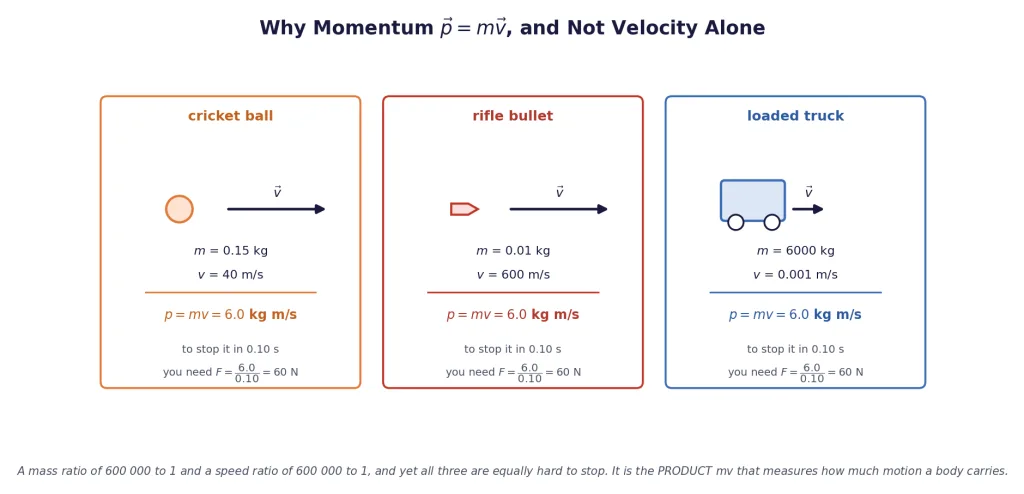
Study those three panels. A cricket ball at 40 m/s, a rifle bullet at 600 m/s, and a loaded truck creeping at 0.001 m/s. Their masses differ by a factor of 600000 and their speeds differ by a factor of 600000 — and yet every one of them carries exactly 6.0 kg m/s of momentum, and every one of them needs exactly the same 60 N to stop it in a tenth of a second. That is what "momentum is the right measure of motion" means, made concrete.
A caution about the vector part
Momentum is a vector, so its components go with the components of velocity:
And a change in momentum is a vector subtraction, not a subtraction of magnitudes:
[JEE/NEET] This is where marks disappear. A ball of mass hits a wall head-on at speed and bounces straight back at the same speed . Its speed is unchanged, so students write . Wrong. Taking the incoming direction as positive, and , so
The magnitude of the change is , twice what it would have been if the ball had merely stopped dead. Always assign a sign convention before you subtract.
Newton's Second Law of Motion
The first law is about the special case . The second law handles the general case, and it is the equation the rest of mechanics is built on.
The statement
Key Point — Newton's second law of motion: The rate of change of momentum of a body is directly proportional to the applied force and takes place in the direction in which the force acts.
Learn that sentence word for word; it is asked verbatim in Boards and NEET. Note the two separate claims packed into it: one about magnitude (proportional to the force) and one about direction (the change happens along the force).
From the sentence to the equation
Suppose a force acts for a time interval on a body of mass , changing its velocity from to . Then its momentum changes by . The law says
where is a constant of proportionality. Now take the limit , so that the ratio becomes a derivative:
For a body of fixed mass , the mass comes out of the derivative:
Why : the newton is DEFINED by this equation
Here is the part students skip, and it is genuinely important. At this stage in the development of mechanics, the unit of force has not been defined yet. We have units for mass (kg), length (m) and time (s), but "how much force is one unit of force?" is still an open question.
So we use this very equation to define it. Since the unit is ours to choose, we are free to choose any value for — and the simplest possible choice is .
Key Point: Setting is a choice of unit, not a physical result. With that choice, and the SI unit of force is defined as the force that gives a mass of 1 kg an acceleration of 1 m/s^2. This unit is the newton:
Its dimensional formula is .
[Board Important] "Derive from Newton's second law" is a standard 3-mark question. The full-credit answer is exactly the chain above: state the law in words, write , introduce , take the limit to , expand for constant mass to , then state that by the choice of the unit of force, which defines the newton.
The two forms, and when to use which
| Form | When to use it |
|---|---|
| mass is constant -- almost every Class 11 problem | |
| mass is changing, or you are given momentum directly |
The general form is the honest one. is the special case for constant mass. A rocket burning fuel, a conveyor belt being loaded, a raindrop growing as it falls — all need , and JEE Advanced likes them (Section 10 handles those).
The first law is not redundant
Set in the second law and you get , which is exactly the first law. So is the first law just a special case?
Not quite. As Section 1 argued, the first law is what tells you what a force is and which frames of reference the equation is allowed to be used in. Without it, is a formula with an undefined symbol in it, valid in an unspecified frame. The second law being consistent with the first is a check, not a replacement.
A worked reading of the equation
Three things the equation is quietly telling you:
- Force causes acceleration, not velocity. If a body has a large velocity, that says nothing about the force on it. If it has a large acceleration, the net force is large.
- is parallel to , always. Not parallel to . A ball thrown upward has up and down, because the force is down.
- The same force on a bigger mass gives less acceleration. That is Section 1's "mass measures inertia", now exact: .
The Four Properties of the Second Law
There are four things about that are easy to read past and expensive to get wrong. Each one is a source of exam questions.
Property 1: it is a VECTOR law, so it holds component by component
is not one equation. It is three, one for each coordinate direction:
Key Point: A force along one axis produces acceleration only along that axis. If a force is not parallel to the velocity, it changes only the component of velocity along the force; the component perpendicular to the force is left completely unchanged.
You have already used this without naming it. In projectile motion the only force is vertical, so the horizontal component of velocity never changes for the whole flight. That is Property 1 in action.
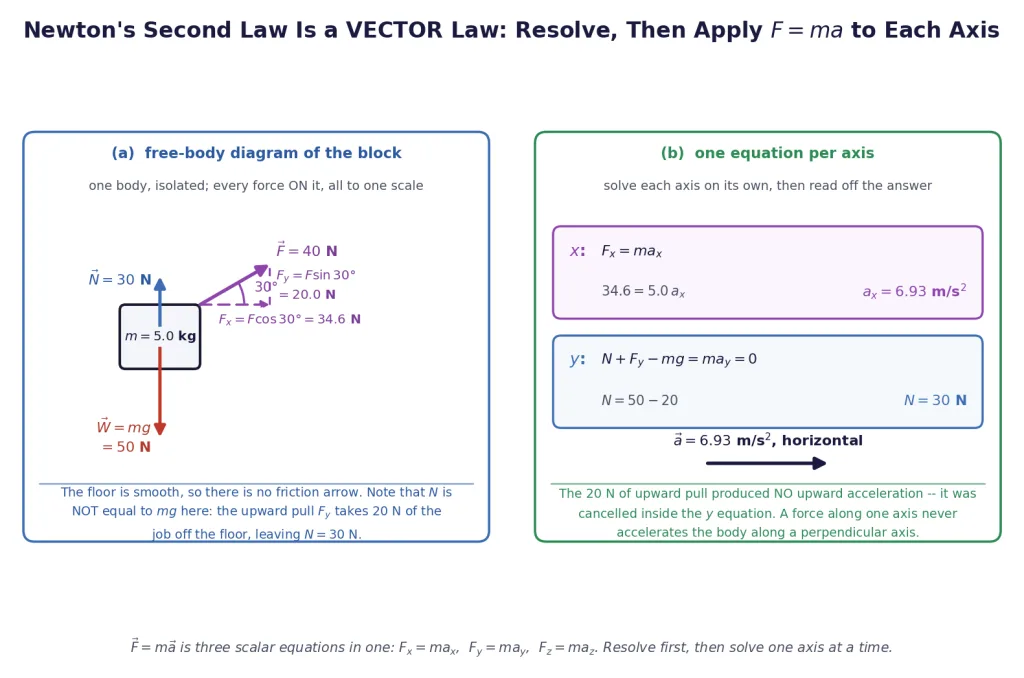
Read that figure carefully, because it is the working method for the whole chapter. The 40 N pull at is resolved into 34.6 N horizontally and 20 N vertically. The horizontal equation gives the acceleration; the vertical equation gives the normal reaction. And notice the result that catches everyone: the 20 N of upward pull produced no upward acceleration at all. It was cancelled inside the equation, and its only effect was to reduce from 50 N to 30 N.
Property 2: means the NET EXTERNAL force
The in the equation is the vector sum of all external forces acting on the body. Two words, both load-bearing:
- Net — add them as vectors first, then apply the law once. Do not apply to each force separately.
- External — internal forces within the system never appear. This is why the engine cannot accelerate a car; only the external friction from the road can.
[JEE Tip] Whenever you write , say out loud which body you are writing it for. Half the errors in connected-body problems come from mixing forces on block A into the equation for block B. Section 5 turns this into the free-body-diagram discipline.
Property 3: it is a LOCAL relation
Key Point: The second law is a local relation. The force acting at a point in space at a certain instant of time is related to the acceleration at that same point at that same instant. Acceleration here and now is determined by the force here and now — not by any history of the motion of the particle.
One illustration of this is beautiful and worth carrying around. A stone is dropped out of the window of an accelerating train. The instant it leaves the hand, it is touching nothing; the only force on it is gravity. So its acceleration is downward and its horizontal acceleration is zero — even though a fraction of a second earlier it was accelerating horizontally with the train.
The stone carries no memory of its acceleration with the train a moment ago. It keeps the horizontal velocity it had at release (the first law), but not the acceleration. Velocity is inherited; acceleration is not.
Property 4: it applies to a particle, and to extended bodies via the centre of mass
Strictly, is written for a single point particle. It turns out that the law in exactly the same form applies to a rigid body, and more generally to any system of particles, provided you read the symbols correctly:
- is then the total external force on the system;
- is the acceleration of the system as a whole — more precisely, the acceleration of its centre of mass (Chapter 6);
- any internal forces within the system are not to be included in .
This is what licenses you to treat a car, a lift or a two-block system as one object when it suits you.
The four properties on one card
| # | Property | The one-line consequence |
|---|---|---|
| 1 | Vector law | , , , solved separately |
| 2 | Net external force | add all external forces as vectors; ignore internal ones |
| 3 | Local relation | acceleration now depends on the force now, not on history |
| 4 | Particle or centre of mass | a whole system can be treated as one body |
Impulse and the Impulse-Momentum Theorem
Some forces are impossible to measure directly. A bat striking a ball, a ball bouncing off a wall, a hammer hitting a nail, two cars colliding — in each of these, a very large force acts for a very short time, and neither the force nor the duration is easy to pin down separately.
But their product is not only measurable, it is exactly the thing that matters.
The definition
Start from the second law in its momentum form and multiply through by :
Key Point — impulse: The impulse of a force is the product of the force and the time for which it acts: and by the second law this equals the change in momentum of the body: This is the impulse-momentum theorem. Impulse is a vector, in the direction of the force. Its SI unit is N s, which is dimensionally identical to kg m/s — the same unit as momentum, as it must be. Dimensional formula .
A large force acting for a short time to produce a finite change in momentum is called an impulsive force. Historically these were put in a separate conceptual category from ordinary forces; Newtonian mechanics makes no such distinction. An impulsive force is like any other force, except that it is large and acts for a short time.
The general form: the area under the F-t graph
Real impulsive forces are not constant — they rise to a peak and fall away again. For a varying force, sum up over the whole contact:
Key Point: The impulse is the area under the force-time graph. And the constant force that would deliver the same impulse over the same interval is the average force:
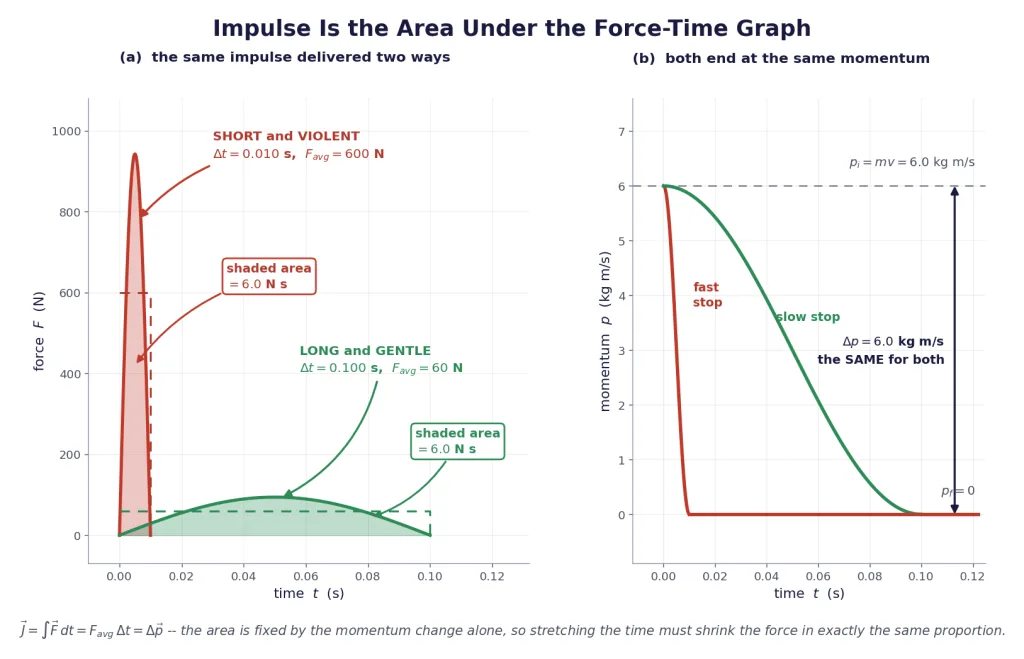
This figure is the whole idea in one picture. The red pulse is short and violent, the green pulse is long and gentle — and the two shaded areas are identical. Both bring the same 0.15 kg ball, moving at 40 m/s, to rest. Panel (b) shows the two momentum curves arriving at exactly the same place by completely different routes.
The relation you will actually use
Rearranged, the theorem becomes the single most useful sentence in this section:
Read it as a trade-off. is usually fixed by the physics — the ball is coming in at a certain speed and has to end up at rest, and nothing you do changes that. So and are locked in inverse proportion:
| If you… | then… | because is fixed |
|---|---|---|
| double the contact time | the average force halves | |
| make the contact ten times longer | the force is a tenth | |
| stop something almost instantly | the force is enormous | gives |
Why impulse is worth having as a separate idea
Three reasons, all examinable:
- It handles unmeasurable forces. When a bat hits a ball, neither the force nor the contact time is known, yet the impulse is a one-line calculation from the ball's speeds before and after.
- It handles varying forces. You never need to know the shape of the - curve, only its area.
- It converts a "before and after" question into arithmetic. You need only the initial and final momenta; everything that happened in between is irrelevant.
[NEET Important] Impulse and momentum have the same units and the same dimensions. If a question asks which of the following has the same dimensional formula as impulse, the answer is momentum, and is the formula.
Why You Bend Your Knees: Impulse in Everyday Life
Every application in this block is the same equation used the same way:
Make yourself say that sentence at each of the following. If you can, you never have to memorise any of them.
Catching a cricket ball
A seasoned cricketer catches a fast ball far more easily than a novice, who can hurt his hands. Why? Watch his hands: he draws them back as the ball arrives.
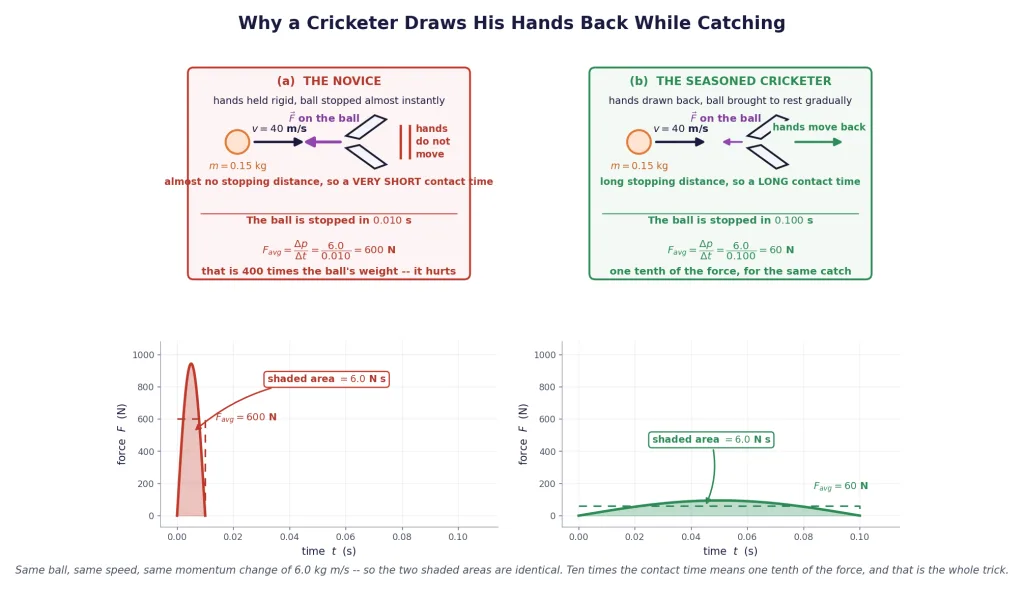
The ball's momentum change is fixed: it comes in at 40 m/s and must end at rest, so kg m/s either way. The novice holds his hands rigid and stops the ball in about 0.010 s:
That is 400 times the ball's own weight, and it is why it hurts. The cricketer draws his hands back through a few tens of centimetres, stretching the contact to about 0.100 s:
One tenth of the force, for exactly the same catch. The conclusion, crisply: force not only depends on the change in momentum, but also on how fast the change is brought about. The same change in momentum brought about in a shorter time needs a greater applied force.
Airbags and crumple zones
A car crash brings a passenger from, say, 15 m/s to rest. That is fixed by the crash. What a car designer controls is .
- The crumple zone at the front of the car is deliberately built to fold up rather than stay rigid. Folding takes time, so the whole car decelerates over perhaps 0.1 s instead of 0.01 s.
- The airbag does the same for the passenger's head and chest: instead of hitting a rigid steering wheel in about 0.02 s, they sink into a bag over about 0.2 s.
Ten times the time, one tenth the force. A stiffer, stronger car would be far more dangerous, which is one of the least intuitive facts in engineering.
The rest of the family
| Situation | is fixed by | How is increased | Result |
|---|---|---|---|
| High jumper landing on foam | the speed she lands at | the foam compresses slowly | small force, no injury |
| Jumping down with bent knees | the speed you land at | knees bend over a longer time | much smaller force on the legs |
| Athlete landing in a sand pit | the speed at landing | sand gives way underfoot | smaller force |
| Nylon ropes in mountaineering | the climber's fall speed | the rope stretches | smaller jerk on the climber |
| Packing fragile goods in foam | the drop speed | packaging crushes gradually | smaller force, no breakage |
| A china cup on carpet vs on tile | the fall speed | carpet yields, tile does not | the cup survives on carpet |
Notice that the last one has nothing to do with how far the cup fell. Both cups arrive with the same speed; only the stopping time differs.
And the reverse trick
Sometimes you want the force to be large, and then you make as short as you can.
- A hammer has a hard steel head so it stops in a very short time on the nail, delivering a huge force.
- A karate expert breaks a slab by making the hand's contact time extremely short.
- A pile driver drops a heavy weight that stops almost instantly on the pile.
Same equation, run the other way.
[Board Important] These are guaranteed 2-mark questions. The full-credit answer always has three parts: (1) state that is the same in both cases; (2) write ; (3) say that increasing therefore decreases . An answer that just says "to reduce the shock" earns very little.
The Mistakes That Cost Marks, and Where This Goes Next
The checklist
| Mistake | The fix |
|---|---|
| Writing with speeds instead of signed velocities | Fix an axis first. A ball reversing at the same speed has , not |
| Thinking a large velocity means a large force | Force goes with acceleration, not velocity |
| Putting the acceleration along the velocity | is parallel to , never automatically to |
| Applying to one force instead of the net force | Add all external forces as vectors first |
| Including internal forces in | Only external forces appear in the second law |
| Assuming always | Resolve the axis. A pull at an angle changes |
| Forgetting that a stone thrown from a moving vehicle keeps its velocity but not its acceleration | The second law is a local relation |
| Using when mass is changing | Go back to |
| Mixing up the units of impulse and force | Impulse is in N s, force is in N. They differ by a second |
| Reading the F-t graph as a force rather than an area | The area is the impulse; the height is the instantaneous force |
| Saying the airbag "absorbs the force" | It increases , which reduces the force. is unchanged |
| Mixing and in one problem | Read the question and stay with one value throughout |
A quick self-test
Answer these in your head before moving on. A 2 kg body has a constant force of 10 N on it. (1) What is its acceleration? (2) If it starts from rest, what is its momentum after 3 s? (3) What impulse did the force deliver in those 3 s? (4) If instead the same 10 N had acted for 3 s on a 20 kg body, what would its final momentum be?
Answers: (1) 5 m/s^2. (2) kg m/s. (3) N s — the same number, as the theorem demands. (4) Still 30 kg m/s. The same force for the same time gives the same momentum change no matter what the mass is. That is Observation 3 from the first block, and it is worth being able to see instantly.
Where this goes next
- Section 3 takes up Newton's third law and, from the second and third laws together, derives conservation of linear momentum — recoil, collisions and explosions.
- Section 4 names the common forces (weight, normal reaction, tension, spring force) that go into .
- Section 5 builds the free-body-diagram method that turns a picture into the component equations you saw in the figure above.
- Sections 6, 7 and 8 apply to friction, circular motion and connected bodies.
- Section 10 handles the variable-mass case properly, including the rocket equation.
Before you go on, make sure you can do three things from memory: state the second law in words, derive from it and say why , and explain the cricketer's hands using .
Solved Examples
A note on before we start: some problems here use m/s^2 and others use m/s^2. Every example below states the value it uses, and never mixes two values inside one problem. Several of these examples do not need at all.
Example 1: The bullet in the block
A bullet of mass 0.04 kg moving with a speed of 90 m/s enters a heavy wooden block and is stopped after a distance of 60 cm. What is the average resistive force exerted by the block on the bullet?
Solution:
- Convert and list. kg, m/s, , cm m.
- Get the retardation from kinematics (Chapter 2), assuming it is constant:
- Apply the second law: The minus sign says the force opposes the motion, which is what a resistive force does. Its magnitude is 270 N.
- Cross-check with impulse. The time inside the block is s, so and independently kg m/s. The two agree, as the impulse-momentum theorem requires.
Final Answer: The average resistive force is 270 N, directed opposite to the bullet's motion.
Takeaway: An honest caveat is worth repeating here: the actual resistive force, and therefore the retardation, is almost certainly not uniform as the bullet ploughs through wood. So 270 N is an average. This is exactly the kind of situation impulse was invented for — you cannot know the force at each instant, but you can get its average from the momentum change.
Example 2: Reading the force off the motion
The motion of a particle of mass is described by . Find the force acting on the particle.
Solution:
- Differentiate once to get the velocity:
- Differentiate again to get the acceleration: The acceleration is a constant, equal to , and independent of and of .
- Apply the second law:
Final Answer: , that is, the particle is moving under the acceleration due to gravity, with measured in the direction of .
Takeaway: Notice the direction of travel here: you were given the motion and asked for the force, which is the reverse of the usual problem. That is always a two-step differentiation, position to velocity to acceleration, followed by one multiplication by . The plus sign in tells you that the positive direction was chosen downward, along — a sign convention worth reading off explicitly rather than assuming.
Example 3: The batsman
A batsman hits back a ball straight in the direction of the bowler without changing its initial speed of 12 m/s. If the mass of the ball is 0.15 kg, determine the impulse imparted to the ball. Assume linear motion of the ball.
Solution:
- Fix a sign convention first. Take the direction from the batsman to the bowler as positive. Then the ball arrives moving in the negative direction and leaves in the positive direction:
- Momenta:
- Impulse-momentum theorem:
Final Answer: The impulse imparted to the ball is 3.6 N s, directed from the batsman to the bowler.
Takeaway: There is a good reason the problem is set up this way: the force on the ball by the batsman and the time of contact of the ball and the bat are difficult to know, but the impulse is readily calculated. Also note the trap: had the ball merely been stopped rather than sent back, the impulse would have been only 1.8 N s. Reversing the motion needs twice the impulse of stopping it.
Example 4: Three bodies, one momentum
Compute the linear momentum of (a) a cricket ball of mass 0.15 kg at 40 m/s, (b) a rifle bullet of mass 0.010 kg at 600 m/s, and (c) a loaded truck of mass 6000 kg creeping at 0.001 m/s. (d) What average force is needed to stop each of them in 0.10 s? (e) What if you had to stop each in 0.010 s?
Solution:
- (a)
- (b)
- (c) All three are identical, despite a mass ratio of 600000 to 1 between the truck and the bullet, and a speed ratio of 600000 to 1 between the bullet and the truck.
- (d) The momentum change is the same 6.0 kg m/s in every case, so
- (e)
Final Answer: All three have kg m/s; all three need 60 N to stop in 0.10 s, or 600 N to stop in 0.010 s.
Takeaway: This is the whole case for momentum in one calculation. If you had asked "which is fastest?" or "which is heaviest?" you would have got three wildly different answers and learned nothing about how hard each is to stop. Ask for and the three become interchangeable. Notice also that part (e) needed no new physics at all — only a different .
Example 5: The second law in components
A block of mass 5.0 kg rests on a smooth horizontal floor. A rope pulls it with a force of 40 N directed at above the horizontal. Take m/s^2. Find (a) the horizontal and vertical components of the pull, (b) the acceleration of the block, (c) the normal reaction from the floor, (d) the block's speed and the distance covered after 3.0 s, and (e) whether the block could ever be lifted off the floor by tilting the rope further up.
Solution:
- (a) Resolve.
- (b) The equation. The floor is smooth, so there is no friction:
- (c) The equation. The block stays on the floor, so : Not 50 N. The upward component of the pull takes 20 N of the load off the floor.
- (d) From rest with m/s^2:
- (e) The block leaves the floor when , which needs N, that is . But the sine of an angle can never exceed 1, so no angle works. Even pulling straight up at gives only 40 N against a 50 N weight, leaving N. To lift this block you would need a force of at least 50 N.
Final Answer: (a) 34.64 N and 20.0 N; (b) 6.93 m/s^2 horizontally; (c) 30 N; (d) 20.8 m/s and 31.2 m; (e) no — it would need N.
Takeaway: Two lessons. First, is not always — you get from the equation, every time. Second, the 20 N of upward pull produced exactly zero upward acceleration; a force along one axis does not accelerate the body along a perpendicular axis. Part (e) is worth doing on every such problem as a sanity check: if your algebra ever hands you , the situation you assumed is impossible.
Example 6: Impulse from a force-time graph
A body of mass 4.0 kg is at rest on a frictionless surface. A horizontal force acts on it as follows: it rises linearly from 0 to 20 N between and s, stays constant at 20 N until s, then falls linearly to zero at s. Find (a) the total impulse delivered, (b) the final speed of the body, (c) the average force over the 6.0 s, and (d) the maximum acceleration.
Solution:
- (a) The impulse is the area under the - graph. Split it into three pieces:
- (b) Impulse-momentum theorem, starting from rest so :
- (c) Sanity check: 15 N for 6.0 s on 4.0 kg gives m/s^2 and m/s. Consistent.
- (d) The largest force is 20 N, so
Final Answer: (a) 90 N s; (b) 22.5 m/s; (c) 15 N; (d) 5.0 m/s^2.
Takeaway: You never needed to know the acceleration at any particular instant, and you never had to integrate anything harder than a triangle. That is the point of impulse: the area does all the work. Note also that the average force, 15 N, is not the average of the maximum and minimum — it is the area divided by the total time.
Example 7: The cricketer's hands, with numbers
A cricket ball of mass 0.15 kg arrives at a fielder at 40 m/s and is caught. Take m/s^2. Find the average force on the hands if the ball is stopped in (a) 0.010 s, with the hands held rigid, and (b) 0.100 s, with the hands drawn back. (c) Express each as a multiple of the ball's own weight. (d) By what factor does drawing the hands back reduce the force?
Solution:
- The momentum change is the same in both cases, and this is the key sentence:
- (a)
- (b)
- (c) The ball's weight is N. So
- (d) Ten times the contact time gives exactly one tenth of the force, because when is fixed.
Final Answer: (a) 600 N; (b) 60 N; (c) 400 times and 40 times the ball's weight; (d) a factor of 10.
Takeaway: 600 N is roughly the weight of a 60 kg person landing on your palms. That is what a novice does to himself. The seasoned cricketer changes nothing about the ball — the same mass arrives at the same speed and ends at rest — he only changes how long he takes about it. Learn to say the sentence: is fixed, so a longer means a smaller .
Example 8: The ball that bounces off a wall
A ball of mass 0.20 kg strikes a wall normally at 15 m/s and rebounds straight back at 12 m/s. The contact lasts 0.050 s. Find (a) the impulse imparted to the ball, (b) the average force exerted by the wall on the ball, and (c) what the answer to (a) would have been if the ball had simply stopped dead.
Solution:
- Fix the sign convention. Take the ball's initial direction of motion as positive.
- (a) The magnitude is 5.4 N s, directed away from the wall.
- (b) directed away from the wall, that is, opposite to the ball's original motion.
- (c) If it had stopped dead, and which is much less than 5.4 N s.
Final Answer: (a) 5.4 N s; (b) 108 N; (c) only 3.0 N s.
Takeaway: The classic error here is computing N s by subtracting speeds and forgetting that the direction reversed. That answer is out by a factor of nine. Reversing a body's motion always demands far more impulse than merely stopping it, and part (c) shows exactly how much more.
Example 9: A force that varies with time
A body of mass 3.0 kg at rest on a frictionless surface is acted on by a horizontal force newton, where is in seconds. Find (a) the impulse delivered between and s, (b) the velocity at s, (c) the distance covered in that time, and (d) the acceleration at s.
Solution:
- (a) The force varies, so integrate: (Geometrically: the graph of is a straight line from the origin up to 24 N at s, so the area is N s. Same answer.)
- (b) By the impulse-momentum theorem, starting from rest:
- (c) , so and (Check: gives m/s at s, agreeing with part (b).)
- (d)
Final Answer: (a) 48 N s; (b) 16 m/s; (c) 21.3 m; (d) 8.0 m/s^2.
Takeaway: Do not reach for here — the acceleration is not constant, so the Chapter 2 formulas do not apply. When the force depends on time, the honest routes are the impulse integral (fastest for velocity) or integrating twice (needed for the distance). Note also that the acceleration at the last instant, 8.0 m/s^2, is not the average acceleration, which was m/s^2.
Example 10: The water jet
A horizontal jet of water delivering 5.0 kg of water per second strikes a wall at 20 m/s and falls dead at the foot of the wall without rebounding. Find (a) the average force on the wall, and (b) what the force would be if the water rebounded from the wall at 20 m/s instead.
Solution:
- (a) Use the second law in its momentum form. In each second, 5.0 kg of water arrives at 20 m/s and ends at rest, so the momentum destroyed per second is
- (b) Now the water arrives at m/s and leaves at m/s, so the change in momentum per second is
Final Answer: (a) 100 N; (b) 200 N, twice as large.
Takeaway: This is used where would be awkward — there is no single body with a single acceleration here, just a continuous stream losing momentum. And note the factor of two in part (b), the same factor that appeared in the bouncing ball: reversing momentum costs twice as much as destroying it. (The force the wall feels is the third-law partner of this, which is Section 3's territory.)
Example 11: Airbags and crumple zones
A passenger of mass 60 kg is travelling in a car at 54 km/h when it crashes into a wall and stops. Take m/s^2. Find the average force on the passenger if she is brought to rest in (a) 0.020 s, hitting a rigid steering column in a stiff car, and (b) 0.200 s, thanks to an airbag and a crumple zone. (c) Express each as a multiple of her own weight.
Solution:
- Convert. m/s. Her momentum change is and this number is the same in both cases — the crash decides it, not the car's design.
- (a)
- (b)
- (c) Her weight is N, so
Final Answer: (a) 45000 N; (b) 4500 N; (c) 75 times and 7.5 times her body weight.
Takeaway: 75 times body weight is far beyond what a human skeleton survives; 7.5 times is roughly what a fairground ride delivers. Nothing about the crash changed — same mass, same speed, same — the airbag simply bought a factor of ten in time. This is also why a stiffer car is a more dangerous car: rigidity shortens and therefore multiplies the force.
Example 12: The high jumper
A high jumper of mass 60 kg lands with a downward speed of 6.0 m/s. Take m/s^2. Find the average force on her if she is brought to rest (a) in 0.020 s by landing on hard ground, and (b) in 0.50 s by landing on a thick foam mattress. (c) From what height did she fall to reach 6.0 m/s? (d) State the general principle.
Solution:
- The momentum change is fixed by the landing speed:
- (a)
- (b) A ratio of , which is just the ratio of the two times, .
- (c) From :
- (d) In both cases she arrives with the same momentum and must end at rest, so is fixed. The foam cannot reduce ; what it does is compress gradually and stretch by a factor of 25, which divides the force by 25.
Final Answer: (a) 18000 N; (b) 720 N; (c) 1.8 m; (d) the foam increases , and .
Takeaway: Notice that 720 N is only a little more than her own weight of 600 N — which is why a foam pit feels like nothing at all. And part (d) is the sentence examiners are looking for: the mattress does not "absorb the momentum" or "reduce the impact"; it extends the time, and the force follows. Say it that way and the mark is yours.