
How to Use This Section
This is the last section of the chapter, and it is built for one job: to be read the night before the paper, and again in the queue outside the hall.
Nothing new is taught here. Every card below is a compression of something Sections 1 to 13 worked through properly, in the same notation and with the same results. So if a line here surprises you, that is not a line to memorise — it is a signal to go back and reread the section that owns it.
Seven formula cards, one mistake checklist, one 60-second panic list. Screenshot the three figures.
One notation reminder before we start. Unless a card says otherwise, everything below uses m/s^2, because that is what makes the arithmetic land on clean numbers. Many worked examples elsewhere use 9.8 m/s^2 instead, and the difference is about 2% — enough to send you to the wrong option in a multiple-choice paper, which is why the last item on the mistake checklist is about exactly this.
Card 1 — The Three Laws
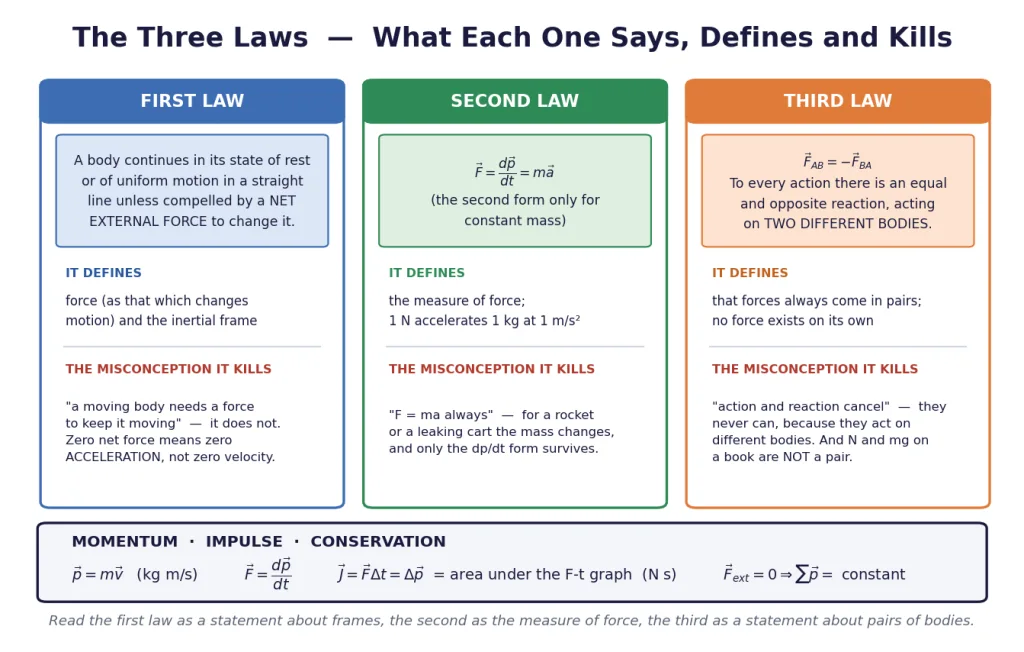
The first law
Key Point: A body continues in its state of rest or of uniform motion in a straight line unless it is compelled by a NET EXTERNAL FORCE to change that state.
What it defines. Two things, and this is what makes it more than a special case of the second law. It defines force qualitatively — force is that which changes a body's state of motion, not that which maintains it — and it defines the inertial frame, because the law is a claim about which observers see it hold. A frame in which the first law is true is an inertial frame; an accelerating lift, a braking bus and a rotating turntable are not.
The misconception it kills. Aristotle's, and it is still the intuition most students arrive with: a force is needed to keep a body moving. It is not. A body on a frictionless horizontal plane keeps moving forever with no force at all. What you experience every day as "the push needed to keep the trolley going" is the push needed to cancel friction, so that the net force is zero.
Key Point: Zero net force means zero acceleration, not zero velocity. A car at a steady 90 km/h and a car parked at the kerb both have exactly zero net force on them.
Mass is the measure of inertia. Apply the same force to a 2 kg and an 8 kg block and the accelerations are in the ratio 4:1. Mass is a scalar, is the same everywhere in the universe, and is what means in .
The second law
Key Point: in components, , , .
What it defines. The measure of force. One newton is the force that gives a mass of 1 kg an acceleration of 1 m/s^2, so .
Three properties that get asked on their own. It is a vector relation, so it splits into independent component equations. The is the net external force, never one force among several. And it is a local relation — the force and the acceleration it produces are at the same instant, which is why a time-varying force gives a time-varying acceleration and no kinematic equation applies.
The misconception it kills. " always." For a rocket, a leaking sand-cart or a conveyor belt being loaded, and only survives.
The third law
Key Point: . To every action there is an equal and opposite reaction. The two forces are of the same kind, act along the same line, appear and vanish simultaneously, and — the whole point — act on TWO DIFFERENT BODIES.
What it defines. That forces never exist alone. Every force is one half of an interaction between two bodies.
The misconception it kills. "Action and reaction cancel, so nothing can move." They can never cancel, because cancellation only makes sense for forces acting on the same body. Isolate one body and only one member of each pair appears on its free-body diagram.
The pair-finding test, and the trap. Swap the two nouns in the sentence. "The table pushes up on the book" becomes "the book pushes down on the table" — that is the pair. The weight of the book and the normal reaction on the book are not a pair: they act on the same body, they are different kinds of force (gravitational and contact), and they are equal here only by the accident of equilibrium. Put the book in a lift accelerating upward and , while every genuine third-law pair stays exactly equal.
Card 2 — Momentum, Impulse and Conservation
Momentum
Key Point: a vector, in the direction of the velocity, with SI unit kg m/s.
Momentum, not velocity alone, is the right measure of "how much motion" a body has, because it is what force changes and what stays constant for an isolated system. A cricket ball of mass 0.15 kg at 40 m/s carries 6 kg m/s; a bullet of mass 0.010 kg at 600 m/s carries the same 6 kg m/s, which is why they do comparable damage despite the enormous difference in speed.
Impulse
Key Point: with SI unit N s, which is the same unit as kg m/s.
For a force that varies, the impulse is the area under the force-time graph, and equivalently . The average force over the interval is then .
| Read the graph like this | |
|---|---|
| height of the curve | the instantaneous force |
| area under the curve | the impulse, equal to |
| area divided by the base | the average force |
Key Point: With fixed, . Stretch the time, shrink the force. That single line explains a cricketer drawing his hands back, airbags and crumple zones, sand pits under a high-jump bar, and why you bend your knees on landing. The airbag does not "absorb the force" — it lengthens .
The sign trap. For a body that rebounds, the velocity reverses, so the two speeds add: A 0.2 kg ball hitting a wall at 15 m/s and returning at 12 m/s suffers N s, not N s.
When the collision is not head-on, do it in components. Two identical balls striking a wall with the same speed, one along the normal and one at to it, receive impulses in the ratio — the wall can only push along its own normal, so only the normal component of the momentum reverses.
Conservation of linear momentum
Key Point: If the net external force on a system is zero, the total linear momentum of that system is constant: It follows directly from the second and third laws together: internal forces come in equal and opposite pairs, so they cancel in the total.
Read the condition carefully. Momentum is conserved component by component, so it is common for it to hold horizontally while failing vertically (a bomb exploding in flight, sand dropped vertically onto a moving trolley). And "isolated" means over the short duration of a collision or explosion, the impulsive internal forces swamp the external ones.
| Standard application | The one-line result |
|---|---|
| Recoil of a gun of mass firing a shell of mass at | , backwards |
| Perfectly inelastic collision, target at rest | |
| Explosion of a body at rest into two pieces | equal and opposite momenta, so they fly apart back to back |
| Rocket / variable mass | thrust |
| Man walking on a floating plank of length | plank moves the other way |
[JEE/NEET] Momentum is conserved in every collision. Kinetic energy is conserved only in elastic ones. Never assume both.
Card 3 — The Common Forces and the Free-Body Diagram
The five forces almost every problem is built from
| Force | Symbol | Direction | Magnitude |
|---|---|---|---|
| Weight | vertically downward, towards the centre of the Earth | ||
| Normal reaction | perpendicular to the surface, always a push, never a pull | whatever the perpendicular equation gives | |
| Tension | along the string, always a pull | same throughout an ideal string | |
| Friction | parallel to the surface, opposing relative sliding | Card 4 | |
| Spring force | opposite to the displacement from natural length |
Weight versus mass. Mass is a scalar in kilograms and is the same everywhere; weight is a force in newtons and changes with . A 70 kg student weighs 686 N on Earth () and 114 N on the Moon (), with the same 70 kg of mass in both places. A beam balance compares masses and reads the same on the Moon; a spring balance measures force and reads one sixth.
Tension in an ideal string. Massless means the tension is the same at every point; inextensible means connected bodies share the same magnitude of acceleration; a massless, frictionless pulley redirects the string without changing the tension, so the tension is the same on both sides. Give the rope a mass and that all breaks: the tension at any cross-section then equals the weight of everything hanging below it, so it is largest at the top.
Hooke's law. , where is the extension or compression from the natural length. The minus sign says the force is a restoring force, always directed back towards the natural length. is in N/m and measures stiffness.
is not always — the five cases
Key Point: There is no law that says . Resolve perpendicular to the surface, apply , and solve for .
| Situation | Normal reaction | Compare with |
|---|---|---|
| Horizontal surface, nothing else | equal | |
| Extra push straight down | greater | |
| Pulled by at above the horizontal | smaller | |
| Pushed by at below the horizontal | greater | |
| On an incline of angle | smaller | |
| Lift accelerating up / down with | greater / smaller | |
| Freely falling lift | zero |
That third row is why pulling a suitcase is easier than pushing it: pulling reduces , and friction is built from .
The free-body-diagram recipe
Key Point — the five steps:
- Draw the whole set-up — bodies, strings, pulleys, supports, surfaces.
- Choose ONE body (or one clearly defined system) and mentally cut it free of everything else.
- Draw only the forces acting ON it. Weight always; then one force for each thing touching it — normal reaction, tension, friction, applied force.
- Choose axes intelligently. On an incline, take one axis along the slope and one perpendicular to it. In circular motion, take one axis towards the centre.
- Resolve and write along each axis, then use Newton's third law to link the forces between parts.
Four arrows that must never appear. The force the body exerts on something else (that belongs on the other body's diagram); a "force of motion" in the direction of travel (motion needs no force to continue); a centripetal force drawn as an extra arrow (it is a requirement met by the real forces, not one of them); and a centrifugal force in a ground frame.
Equilibrium and Lami's theorem
Key Point: A particle is in equilibrium when , which in components means This covers static equilibrium (at rest) and dynamic equilibrium (moving at constant velocity) alike — a parachutist descending steadily and a car at a constant 60 km/h are both in equilibrium.
Key Point — Lami's theorem, for exactly three concurrent forces: where is the angle between the other two, that is, the angle opposite . With four or more forces Lami's theorem does not apply and you must resolve into components.
Card 4 — Friction
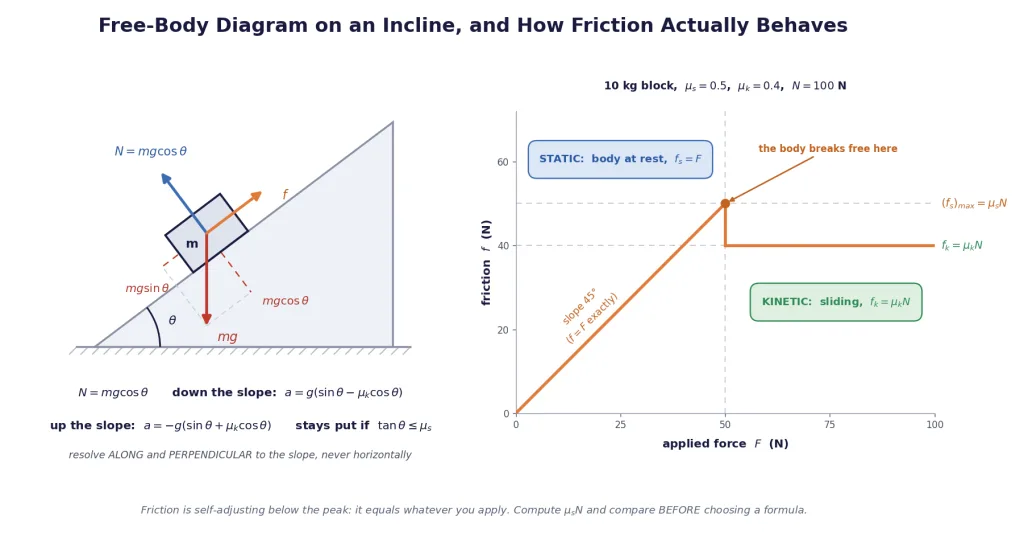
The three kinds
| Kind | When it acts | Magnitude |
|---|---|---|
| Static | surfaces at rest relative to each other | self-adjusting, |
| Kinetic (sliding) | surfaces sliding over each other | , constant |
| Rolling | one body rolls over the other | , with |
Key Point:
Static friction is self-adjusting, and this is the idea that costs the most marks. Push a crate with 10 N and it does not move, so the net force is zero, so friction is exactly 10 N. Push with 20 N and friction becomes 20 N. It grows to meet whatever you apply, up to its ceiling — and only past that ceiling does the body slide and friction drop to the constant .
Key Point — the test you must run every time: compute the driving force, compute , and compare. If driving , the body stays put and equals the driving force. Only if driving do you use . Applying to a stationary block is the classic silent error of this chapter — silent because the arithmetic still "works" and hands you a confident wrong answer.
Reading the friction-versus-applied-force graph
The figure plots against for a 10 kg block with and on a horizontal floor, so N. Three things to read off it:
- The rising straight line , from up to N. It is at because and are equal, not because of any coefficient. Every point on it is a body at rest.
- The peak at N. The largest static friction those surfaces can produce at that . Motion is impending.
- The sudden drop to N, then a flat line. Once sliding, friction is constant and smaller. That drop is why a heavy box lurches the instant it breaks free.
The laws of friction, and what does and does not depend on
is dimensionless, is a property of the pair of surfaces, and is independent of the area of contact and (to a good approximation) of the sliding speed. It can exceed 1 — rubber on dry concrete reaches about 1.0 to 1.2, which is why racing tyres work. Never eliminate an option merely because .
The two angles
Key Point: Angle of friction : the angle the total contact force (the resultant of and ) makes with the normal at the point of slipping. Angle of repose : the steepest slope on which a block will stay put unaided. Both satisfy so they are numerically equal, and neither depends on the mass. That is why tilting a plank is the standard way to measure .
The incline results
| Situation | Result |
|---|---|
| Smooth incline, released | down the slope |
| Rough incline, sliding down | |
| Rough incline, moving up | retardation |
| Block stays at rest on the incline | if |
| Slides down at constant velocity | when exactly |
| Normal reaction throughout |
The mass cancels in every one of them. And note the signs: going down, gravity and friction oppose, so they subtract; going up, they both retard, so they add.
Horizontal-surface results. Minimum stopping distance without skidding, — proportional to and independent of the mass. Maximum acceleration of a truck for which a crate on its floor does not slide, ; there the friction on the crate points forward, in the direction the crate moves, because it opposes the relative sliding, not the motion.
Key Point: Friction opposes relative sliding between the surfaces, not the motion of the body through space. It can perfectly well point the way a body is going — which is exactly what happens when you walk, when a car accelerates and when a box rides in a truck.
Card 5 — Circular Dynamics
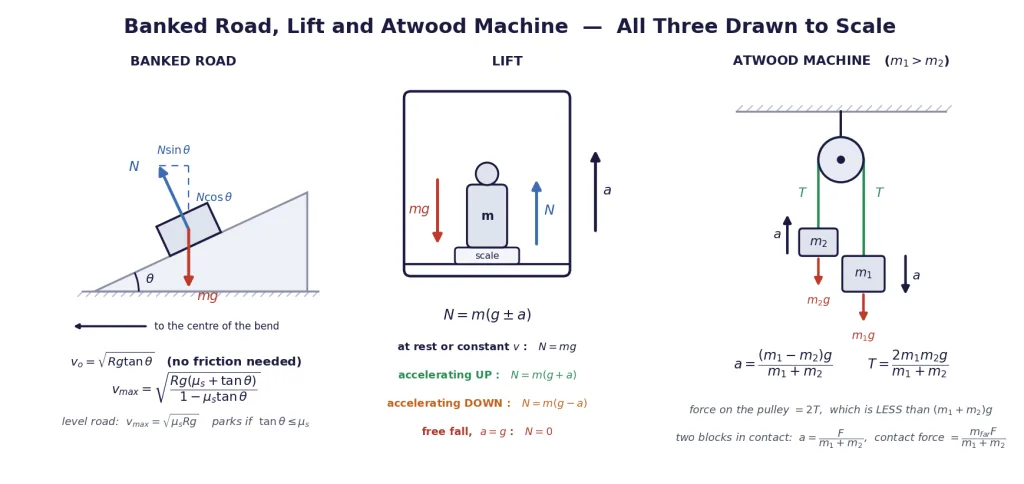
(The banked-road panel of that figure belongs to this card; the lift and Atwood panels belong to Card 6.)
The requirement, not a new force
Key Point: A body of mass moving in a circle of radius at speed must have a net inward force directed towards the centre. This is a requirement, not a new kind of force. Some real force must supply it.
| The circle | What supplies the centripetal force |
|---|---|
| Stone whirled on a string | the tension |
| Car on a level road | friction between the tyres and the road |
| Car on a banked road | the horizontal component of the normal reaction (plus friction, off the design speed) |
| Satellite in orbit | gravity |
| Rider on the inside wall of a rotor | the normal reaction of the wall |
Asked "which force provides the centripetal force?", name the real force. Never draw as an extra arrow, and never add a "centrifugal force" in a ground frame.
The level road
Key Point: Friction alone must supply the whole inward force, so and The mass cancels, so a loaded lorry and a scooter with the same tyres have the same limit on the same bend.
A cyclist taking the same bend must also lean inward, at an angle from the vertical given by , so that the total contact force passes through the centre of mass.
The banked road
Key Point — the optimum (design) speed, at which no friction is needed at all:
Key Point — the maximum speed with friction, when the vehicle tends to slide outwards and up the bank so friction acts down the slope:
Two checks that verify the formula itself. Set and it must give back , the level road. Set and it must give back , the friction-free bank. If your remembered formula fails either, it is misremembered — and note that the denominator is always less than 1, so dropping it always underestimates .
Below the vehicle tends to slide down the bank and friction acts up the slope; above it, the reverse. There is also a minimum speed on a steep bank, , which is zero (no minimum at all) whenever .
Key Point — the parking condition: a car can be left standing on a bank without sliding down only if which is the angle-of-repose condition of Card 4, wearing a different hat.
The conical pendulum
A bob on a string of length swept round in a horizontal circle, the string making with the vertical. Only two forces act — tension and weight — and their resultant is the centripetal force.
always, and as — which is why a stone can never be whirled in a perfectly horizontal circle; the string always sags a little. Notice that is the same relation as the banked road's optimum speed: in both cases exactly two forces act, one vertical and one tilted, and their resultant must be horizontal.
Card 6 — Connected Bodies and Lifts, and the JEE Extension
Two blocks in contact on a smooth floor
Push a pair of touching blocks with a force applied to :
Key Point: The contact force is always the applied force times the mass of the block away from the push, over the total. Push from the other side and is unchanged, but the contact force becomes . Which block you push changes the contact force but never the acceleration.
For a towed chain joined by strings, the tension in any string equals (mass behind that string) , so the tensions increase as you move towards the applied force.
The Atwood machine
Masses over an ideal pulley:
Key Point:
Three checks, every time. must lie between the two weights, . must be less than , tending to as and to zero as . And is always less than , because the system is accelerating, not hanging still — assuming the pulley carries the full combined weight is a standard trap.
Block on an incline connected over a pulley
A block on a smooth incline of angle , string over a pulley at the top, hanging mass : The hanging block descends only if . Make the incline rough and nothing moves at all while a window of hanging masses, centred on the frictionless balance point, because friction reverses direction between the two limits.
The lift, and apparent weight
Key Point: A weighing machine reads the normal reaction , never the weight. With upward positive,
| Case | You feel | |
|---|---|---|
| At rest, or constant velocity (up or down) | normal | |
| Accelerating upward at | heavier | |
| Accelerating downward at | lighter | |
| Free fall, | weightless |
Your weight does not change in a lift. Only does. And a lift moving up while slowing down has a downward acceleration, so the reading falls below — read the motion, not the direction of travel.
Card 7 — The JEE Extension
Everything up to Card 6 is Board and NEET material in full. NEET candidates can skip this card without losing a single mark — none of it is on the NEET syllabus for this chapter. It is Section 10 compressed to one page.
Constraint relations. An inextensible string has a fixed total length, so differentiating that length twice gives an extra equation linking the accelerations. Two rules cover most cases: the components of velocity of the two ends along the string must be equal (so a boat hauled by a rope reeled in at moves at ); and for a movable pulley, the load moves half as fast as the free end, so
Pseudo forces. In a frame accelerating at , add to every body a force and then apply the second law as if the frame were inertial. A lift accelerating down at gives an effective gravity ; a plumb line in a car accelerating at hangs at ; a block held on a smooth wedge of angle needs with .
Centrifugal force. The pseudo force of a rotating frame, of magnitude directed outward. It is legitimate only inside that rotating frame, and it is not the third-law reaction to the centripetal force — that reaction is the outward pull the body exerts on the string, or the outward push on the road, and it acts on a different body.
The vertical circle, on a string (a string can pull but not push): That last relation holds at any speed, not only the critical one. At the top ; at the bottom . With a rod, a groove or a tube, which can push as well as pull, the requirements drop to and .
Minimum force to drag a block. Pulling at angle above the horizontal, , which is least at — the angle of friction — giving
Blocks on blocks. When the force is applied to the lower block, the top block is driven only by friction, so and plus any floor friction. Remember the normal reaction at the lower surface is , not .
Springs and strings, the "just after" question. A string's tension can change instantaneously, because a string is inextensible — cut it and its tension is zero the same instant. A spring's force cannot, because it is and the length cannot change in zero time. So immediately after a supporting string is cut, the spring force is still exactly what it was.
Card 8 — The Twelve Mistakes That Cost the Most Marks
Every one of these was flagged somewhere in Sections 1 to 13. They are ordered roughly by how often they actually turn up in answer scripts.
1. Thinking that zero net force means the body must be at rest. It means zero acceleration. A car at a steady 90 km/h, a parachutist descending at a constant 5 m/s and a book on a table all have exactly zero net force on them. Conversely, a body momentarily at rest — a stone at the top of its flight — can have a large net force on it. Read "equilibrium" as "constant velocity", of which "at rest" is one case.
2. Pairing the weight of a book with the table's normal reaction. They act on the same body, they are different kinds of force (gravitational and contact), and they are equal here only because the book happens to be in equilibrium. The reaction to the book's weight is the book's gravitational pull on the Earth; the reaction to is the book's push down on the table. Put the table in a lift accelerating upward and , while both genuine pairs stay exactly equal.
3. Adding "centripetal force" as an extra arrow on a free-body diagram. is a requirement, met by tension, friction, gravity or the normal reaction. Drawing it alongside those forces double-counts, and the equation then reads "the forces equal themselves". Name the real force, put it on the diagram, and set the sum towards the centre equal to .
4. Using on a body that has not started moving. Compute the driving force, compute , compare, and only then choose. A 20 kg block with on a level floor pushed with 70 N does not move at all, and the friction on it is 70 N, not . This is the single commonest silent error in the chapter — silent because the arithmetic still works.
5. Assuming always. It is one special case, not a law. with an extra push, with an angled pull, with an angled push, on an incline, in a lift, zero in free fall. Since friction is , every error in propagates straight into the friction.
6. Forgetting that friction is self-adjusting, and using for a static body below the limit. is the maximum available friction, not the friction that acts. Below the limit, equals exactly the driving force — 10 N of push means 10 N of friction. Quoting for a block that is nowhere near sliding is the mirror image of mistake 4, and just as expensive.
7. Drawing pseudo forces in an inertial frame — or omitting them in a non-inertial one. Pick a frame and stay in it. In the ground frame there is no pseudo force and the body accelerates. In the lift's or car's frame you must add to every body, and then the body is in equilibrium. Both pictures are legal; mixing them produces answers that do not agree with themselves.
8. Confusing the centrifugal force with the third-law reaction to the centripetal force. The centrifugal force is a pseudo force, exists only in a rotating frame, acts on the same body as the centripetal force, and vanishes the moment you step back into the ground frame. The genuine reaction to the centripetal force acts on a different body — it is the outward pull the whirling stone exerts on your hand, or the outward push the car's tyres exert on the road.
9. Assuming the force on an Atwood pulley is . It is , which is always less. For 5 kg and 3 kg with m/s^2, the tension is 37.5 N and the pulley carries 75 N, not 80 N. The system is accelerating, so the two blocks are not fully "hanging" on the pulley. Only when do the two answers agree.
10. Forgetting that a spring's force cannot change instantaneously but a string's tension can. Cut a string and its tension is zero that same instant. A spring's force is , and cannot change in zero time, so immediately after the cut the spring force is unchanged. Every "find the acceleration just after the string is cut" question turns on this one line.
11. Resolving the weight along the wrong pair of axes on an incline. Perpendicular to the slope it is ; along the slope it is . Swapping them is the commonest execution error in the chapter. Two checks catch it instantly: must come back to , and below the perpendicular component must be the larger one.
12. Mixing and within one problem. Pick one value at the very start, write it at the top of your working, and use it everywhere. Question papers use 9.8 in some places and 10 in others, and the two differ by about 2% — enough to move you between two adjacent options in a multiple-choice paper. Mixing them inside a single question produces answers that do not even agree with each other.
Key Point: Three more that cost single marks each: forgetting that momentum is conserved component by component, so it can hold horizontally while failing vertically; using instead of for a body that rebounds; and quoting a bare number where a direction was asked for, since force, momentum and impulse are all vectors.
The 60-Second Revision
You are in the queue outside the hall. This is the irreducible minimum.
The laws. First: a body keeps its state of rest or uniform motion unless a net external force acts — this defines force and the inertial frame, and zero net force means zero acceleration, not zero velocity. Second: for constant mass, a vector relation about the net external force at that instant; . Third: , same kind, simultaneous, on two different bodies, so they never cancel.
Momentum and impulse. ; = area under the F-t graph, unit N s. Rebound means the speeds add. constant: recoil , perfectly inelastic , explosion at rest gives back-to-back fragments.
Forces and FBDs. Weight down, normal perpendicular and always a push, tension along the string and always a pull, spring . is not always — resolve perpendicular to the surface. One body at a time, only forces acting on it, axes along and perpendicular to the slope. Equilibrium: , ; three forces, Lami's theorem.
Friction. , self-adjusting; once sliding; ; dimensionless and independent of contact area, and it may exceed 1. Compare before you choose. . Incline: , down , up retards at , stays put if . Stopping distance .
Circular dynamics. towards the centre, supplied by a real force. Level road ; banked and ; parking needs . Conical pendulum: , , .
Connected bodies and lifts. Contact pair: , contact . Atwood: , , pulley . Lift: , zero in free fall, unchanged at constant velocity.
JEE only. Constraints and the movable pulley ; pseudo force ; centrifugal force only in a rotating frame; vertical circle , , ; at .
Habits. Draw the free-body diagram before you write a formula. Solve for , never assume it. Test whether the body moves before you pick a friction. Pick one value of and keep it.
That is the whole chapter. Go and get the marks.