
Centripetal Force Is a Requirement, Not a New Force
Here is the single most important sentence in this section, and if you take nothing else away, take this one.
Key Point: Centripetal force is not a new kind of force. It is a job description. Any body moving in a circle needs a net inward force of a particular size; whichever real force happens to supply it is "the centripetal force" in that problem.
Let's build up to why that is true.
What Chapter 3 already gave us
Chapter 3 (Motion in a Plane) established the kinematics of uniform circular motion. A body going round a circle of radius at constant speed has an acceleration directed towards the centre at every instant. That was derived there from similar triangles, and we are not going to derive it again — we are going to use it.
Notice what is strange about it. The speed is constant, and yet there is an acceleration. That is because velocity is a vector: its direction keeps changing, so keeps changing, so there is an acceleration even though never does.
Now bring in the second law
Chapter 3 said "there is an acceleration towards the centre". Newton's second law says an acceleration cannot happen on its own — something must cause it. Multiply by the mass:
Key Point — the centripetal force: For a body of mass moving in a circle of radius with speed , the net force on it must point towards the centre and have magnitude . This required net inward force is called the centripetal force ("centre-seeking").
Read that once more, slowly. It says the net force. It does not say "add a force called ". It says: whatever real forces act on the body, when you add them as vectors, the answer must come out to pointing inward. That is a condition the forces must satisfy, exactly the way was a condition in Section 5 for a body in equilibrium.
So what actually supplies it?
Different things in different situations — that is the whole point.
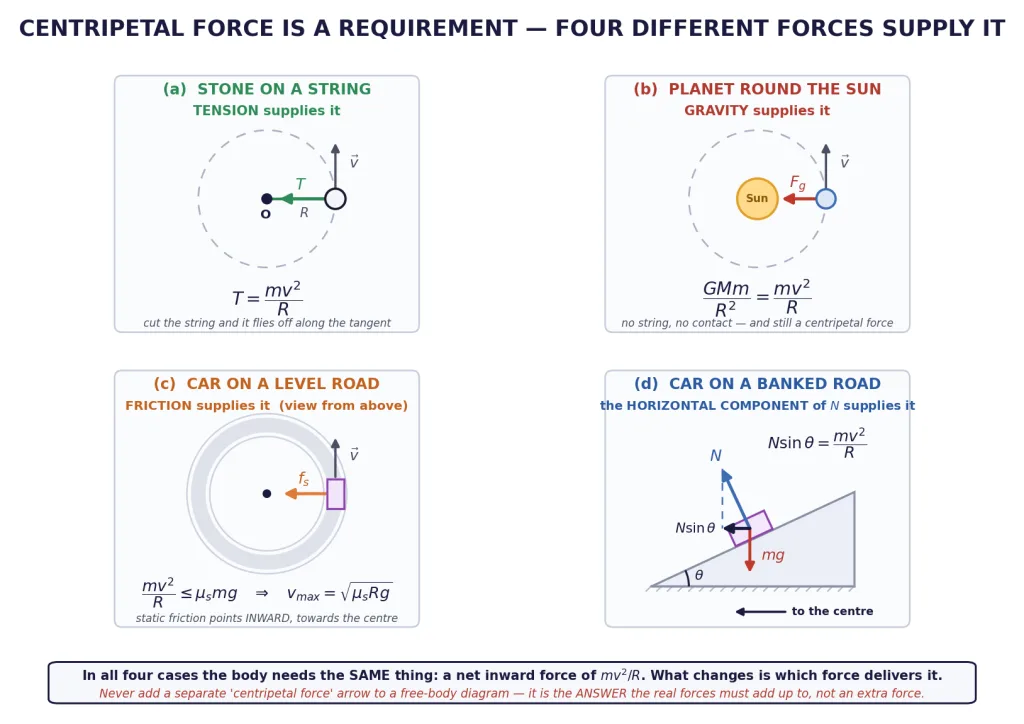
| Situation | Supplied by | The equation |
|---|---|---|
| Stone whirled on a string | tension in the string | |
| Planet orbiting the Sun | gravitational attraction | |
| Car turning on a level road | static friction from the road | |
| Car on a banked road | horizontal component of | |
| Electron in a magnetic field | the magnetic force |
Five completely different physical mechanisms; one identical requirement.
The two things this immediately tells you
1. If the supplier runs out, the circle ends. A string can only pull so hard before it snaps. Friction can only reach . When the supplier can no longer deliver , the body stops going in that circle — it flies off along the tangent, or skids outward onto a larger circle. Every "maximum speed" result in this section is exactly this statement in algebra.
2. The problem-solving method does not change at all. Section 5 taught you to draw a free-body diagram, choose axes and write along each. That is still what you do. The only new instruction is: point one axis at the centre of the circle, and on that axis write instead of .
[JEE/NEET] The single most common error in this whole chapter is drawing an extra arrow labelled "centripetal force" on a free-body diagram, next to the tension or the friction that is already supplying it. That double-counts. Section 5 listed it among the things never to draw, and here is where it does the most damage.
Two Warm-Ups: the Stone on a String and the Car on a Level Road
The stone whirled in a horizontal circle
Tie a stone of mass to a string of length and whirl it in a horizontal circle at speed . (Take the circle as horizontal and ignore the small sag of the string for now — the fully honest version is the conical pendulum, later in this section.)
The only horizontal force on the stone is the tension, and it points along the string towards your hand at the centre. So the tension is the whole centripetal force:
Three consequences worth having at your fingertips:
- Spin it faster and the string pulls harder, as . Double the speed and you quadruple the tension.
- Every string has a breaking tension . Setting gives
- The instant the string snaps, the tension vanishes. With no force left, the first law takes over and the stone travels in a straight line along the tangent — not radially outward, which is what most people first guess. Mud flying off a bicycle tyre and water leaving a spin-dryer both do exactly this.
The car on a level road
Now a car of mass takes a turn of radius on a flat, horizontal road at speed . Three forces act on it: its weight down, the normal reaction up, and friction from the road.
Vertically there is no acceleration, so
Horizontally, the car needs an inward force of . Look at the list of forces: is vertical, is vertical. The only horizontal force available is friction. So friction has to do the entire job:
And this is static friction, not kinetic, even though the car is moving fast. The tyre is rolling, so the patch of rubber in contact is not sliding along the road; what friction opposes here is the car's tendency to slide sideways, outward, off its circle. Section 6's rule therefore applies: .
Key Point — maximum speed on a level road: Go faster than this and the friction available is simply not enough; the car skids outward.
The four things examiners ask about this formula
1. The mass has cancelled. A loaded truck and an empty scooter skid off the same corner at the same speed (same tyres, same road). Students find this hard to believe, so here is the reason: a heavier vehicle needs a bigger centripetal force, but it also presses down harder, so it gets proportionally more friction. Both sides scale with , and cancels. [NEET Important] This appears almost every year.
2. It depends on , not . Skidding is the failure mode, not the operating mode.
3. Wet roads are dangerous because collapses. Halve and drops by a factor , about 30%.
4. Sharper turn, lower safe speed. . A radius-25 turn is safe at only half the speed of a radius-100 turn.
Rearranging the same statement
The same inequality can be asked in three disguises, and they are all one line apart:
The third form is the one to reach for when a question says "find the minimum coefficient of friction needed". And notice: turns up again in the very next block as for a banked road, and again as the angle a cyclist leans. That is not a coincidence — it is the same ratio of "force needed" to "weight" every time.
The Banked Road — the Full Derivation
Relying on friction alone is a bad design. Friction is unreliable: it falls with rain, ice, oil, worn tyres. So engineers tilt the road inward on a curve, raising the outer edge. This is banking, and the angle the road surface makes with the horizontal is the banking angle.
The idea is simple and rather beautiful. Tilt the road and the normal reaction — which is always perpendicular to the surface — is no longer vertical. It now leans towards the centre of the turn, so part of it points inward and can help supply the centripetal force. Friction gets a lighter job, or on a good day, no job at all.
Setting it up
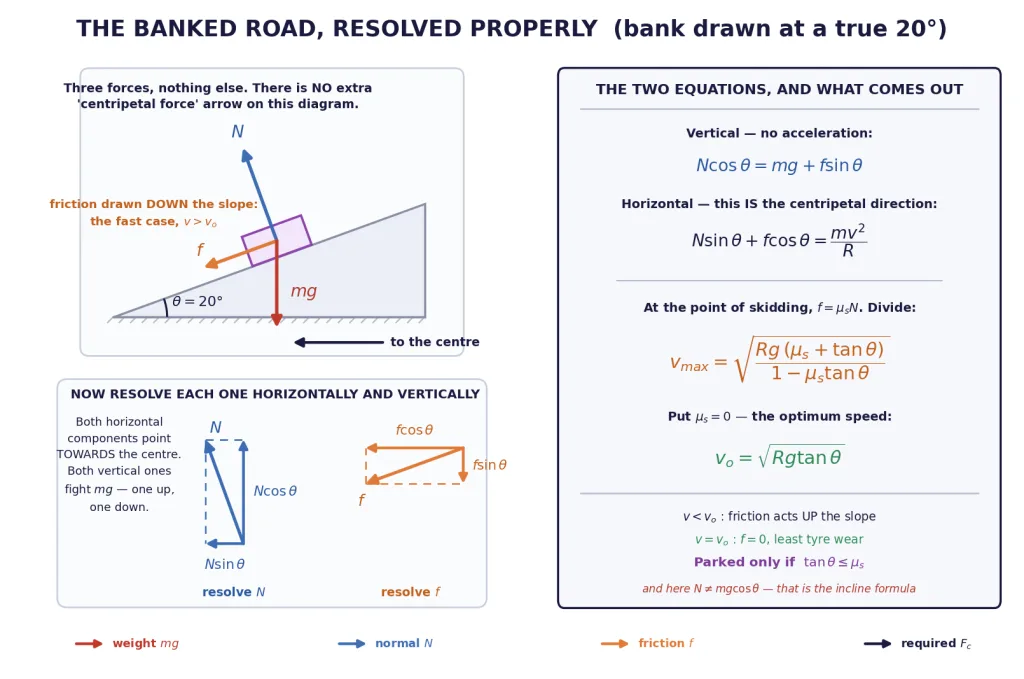
Draw the car on the banked surface, seen end-on. Three forces act on it:
- the weight , vertically down;
- the normal reaction , perpendicular to the road surface, so tilted at from the vertical;
- friction , along the road surface, up or down the slope depending on the speed.
Take the car as travelling fast — faster than the road was designed for — so it tends to slide up and outward, and friction therefore acts down the slope.
Now the crucial choice of axes. On an incline problem in Section 6 you took axes along and perpendicular to the slope, because the acceleration was along the slope. Do not do that here. Here the acceleration is pointing at the centre of the circle, which is horizontal. So take axes horizontal and vertical.
Resolving
is perpendicular to the surface, so it makes angle with the vertical: its vertical component is and its horizontal component (pointing towards the centre) is .
is along the surface, so it makes angle with the horizontal: its horizontal component is (towards the centre) and its vertical component is (downward, since it points down the slope).
Vertical direction — no acceleration:
Horizontal direction — this is the centripetal direction:
That is the complete physics. Everything else is algebra.
Getting
The fastest the car can go is the speed at which friction is working flat out, . Substitute into both equations:
Divide the second by the first. Both and vanish:
Divide numerator and denominator by :
Key Point — maximum speed on a banked road:
Two sanity checks before we go on, because a formula you cannot check is a formula you will misremember:
- Put (a flat road). Then and the whole thing collapses to — exactly the level-road result. Good.
- Put (a frictionless bank). Then , which is the optimum speed we are about to meet.
[JEE Tip] here is , and in the frictionless case , which is bigger than . It is emphatically not . That expression belongs to a block resting on an incline, where the acceleration perpendicular to the surface is zero. On a banked road the car has a horizontal acceleration, and the perpendicular balance is broken. Getting this wrong is one of the most reliable ways to lose a full question.
And a lower limit too
If the bank is steep and the car crawls, it will tend to slide down and inward instead. Then friction reverses and acts up the slope, and running the same algebra with up-slope gives If this comes out imaginary, which is the algebra's way of saying there is no minimum — the car can go arbitrarily slowly, and indeed can be parked on the bank. We will unpack that in the next block.
Reading the Banked-Road Result: Optimum Speed, Friction Direction, Parking
The formula in the last block is correct but forbidding. Almost every exam question is really about one of the four ideas hiding inside it.
1. The optimum speed
Set in the general result, or equivalently set in equations (1) and (2): Dividing:
Key Point — the optimum (design) speed of a banked road: At this one speed no friction is needed at all. The horizontal component of the normal reaction supplies the entire centripetal force by itself.
This is the speed a road is designed for. Drive at it and:
- the road works perfectly even if it is sheeted with ice, because friction is not being asked for anything;
- there is no sideways force between tyre and road, so tyre wear is least;
- the passengers feel no sideways push.
Notice contains no and no . It is a property of the road's geometry alone. That is why highway engineers can post one design speed for all vehicles.
2. Which way does friction point?
This is the part students guess at. Don't guess — reason from .
| Speed | The car tends to | Friction acts | Because |
|---|---|---|---|
| slide down the bank, inward | UP the slope | too little inward force is being supplied; gravity is winning | |
| nothing | is exactly enough | ||
| slide up the bank, outward | DOWN the slope | more inward force is needed than alone gives |
Compare with first, every time. For , the frictional force acts up the slope.
3. Can you park on a banked road?
Park the car and , so no centripetal force is needed at all. Now the bank is just an inclined plane, and Section 6's angle of repose settles it: the car stays put only if the slope angle does not exceed .
Key Point — the parking condition: A car can be parked on a road banked at only if If the car slides down the bank the moment it stops, and there is a genuine non-zero below which it cannot travel.
This is why real highways are banked gently, typically to : with around 0.7 for dry rubber on tarmac, is comfortably safe even in the wet. Racetracks with banking, where cars never stop, need not obey this rule.
4. Banking beats friction
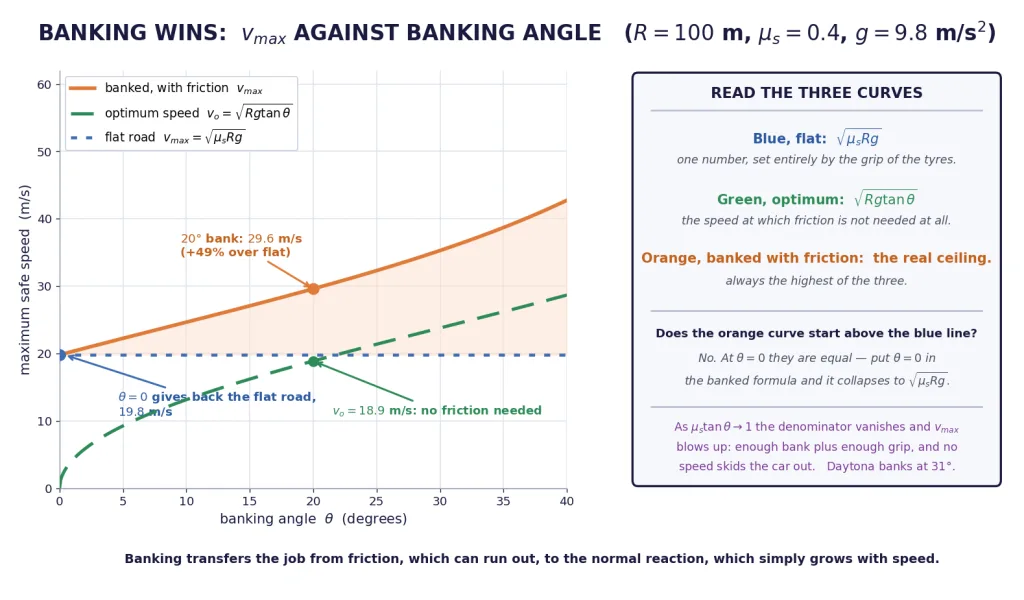
Compare the two ceilings for the same road and the same tyres:
The banked one is always larger for : the numerator gains and the denominator shrinks below 1. Both changes push the same way.
With m, and m/s^2, a flat road caps you at 19.8 m/s. Bank it at and the cap becomes 29.6 m/s — nearly 50% faster on the identical curve, with no change to the tyres.
And look at the denominator: as , . That is not a mistake in the algebra. It says that with a steep enough bank and grippy enough tyres, there is no speed at which the car skids outward at all — you would have to worry about the car flipping or the engine running out instead.
The whole block on one card
| Quantity | Formula | Depends on ? | Depends on ? |
|---|---|---|---|
| Level road ceiling | yes | no | |
| Optimum speed | no | no | |
| Banked ceiling | yes | no | |
| Banked floor | yes | no | |
| Parking possible | yes | no |
Not one of them contains the mass. If your answer to a circular-motion road problem has an in it, you have made an algebra slip.
The Conical Pendulum
Hang a bob of mass from a string of length fixed at a point, and instead of letting it swing back and forth, set it going in a horizontal circle. The string then sweeps out a cone, which is where the name comes from — and it makes a lovely test of whether you have really understood the last four blocks.
The geometry first
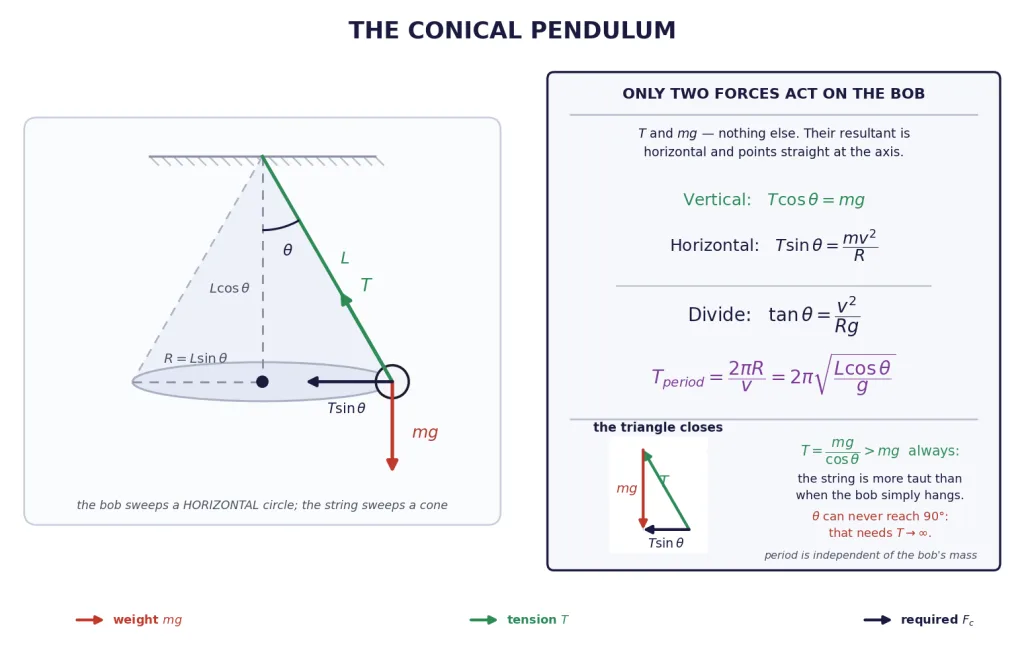
If the string makes an angle with the vertical, then the bob moves on a circle of radius and the circle lies a vertical distance below the support.
The forces — and there are only two
The bob is acted on by:
- the tension , along the string, pointing up towards the support;
- the weight , vertically down.
That is the complete list. No third force. In particular there is no "outward" force and no "centripetal force" arrow — the resultant of these two is the centripetal force.
Since the bob moves in a horizontal circle at constant height, there is no vertical acceleration. Resolve :
Vertical:
Horizontal (towards the centre):
The results
Divide (2) by (1):
Yes — the same relation as the banked road's optimum speed. That is not luck. In both cases exactly two forces act (one vertical weight, one tilted force), and their resultant must be horizontal. The geometry is identical, so the algebra must be too.
From (1) directly: which is always greater than , and grows without limit as . That is why you can never whirl a stone in a perfectly horizontal circle: the string always sags a little, because getting to would need infinite tension.
The speed, using :
The time period. The bob covers a circumference at speed : Simplify by writing :
Key Point — the period of a conical pendulum:
Notice is exactly the vertical depth of the circle below the support. So a conical pendulum has the same period as a simple pendulum of that vertical height — a fact you will meet again in Class 11 Oscillations.
[Board Important] Use for the tension and (or a different symbol entirely) for the period. Writing both as in the same solution is a genuine source of lost marks.
Three things to notice
1. The period does not depend on the mass. appears in equation (1) and in equation (2), and cancels on dividing. A heavy bob and a light bob on equal strings at equal angles go round in the same time. The tension does depend on , though — it is directly proportional to it.
2. Faster means a wider cone. From , increasing the speed increases , which increases , which lifts the circle. This is exactly how a mechanical centrifugal governor on an old steam engine worked: as the engine sped up, the arms flew wider and closed the steam valve.
3. The forces do not balance. and do not cancel. If they did, the bob would move in a straight line. Their resultant is a horizontal force of magnitude pointing at the axis, and that resultant is what keeps the bob turning. In the figure's force triangle, and cancel; is left over, and it is left over on purpose.
The Traps, a Checklist, and Where This Goes Next
The method, in five lines
- Identify the circle: where is its centre, and what is ?
- Draw the free-body diagram of the body with only the real forces on it.
- Choose axes: one towards the centre, one perpendicular to it.
- Write and .
- Solve. If friction is involved, first check whether it is at its limit or below it.
That is it. There is no separate theory of circular motion — it is the second law with a smart choice of axes.
The traps that cost the most marks
1. Drawing a "centripetal force" arrow on the FBD. The number-one error. goes on the right-hand side of the equation, never on the diagram. Draw only tension, normal reaction, friction, weight.
2. Drawing an outward "centrifugal force" in the ground frame. There is no such force acting on the car when you stand on the ground and watch it. The passenger's feeling of being flung outward is inertia — their body trying to continue in a straight line — plus the door pushing them inward. The centrifugal force is a pseudo force, real and useful only when you choose to work in the rotating frame, and Section 10 handles that properly. [JEE/NEET] In a ground-frame FBD, never.
3. Calling the centripetal force the reaction to something. " is the centripetal force and the centrifugal force is its reaction" is wrong twice over. An action-reaction pair acts on two different bodies; here both would be acting on the same stone. The genuine reaction to the string pulling the stone inward is the stone pulling the string outward, which acts on the string, not on the stone.
4. Writing on a banked road. On a bank, , which is larger than , not smaller. is the incline formula, and it applies when nothing accelerates perpendicular to the surface. A car rounding a bank has a horizontal acceleration, so that condition fails.
5. Using for a rolling car. A rolling tyre does not slide, so the friction preventing sideways skid is static, and is the right coefficient.
6. Forgetting to compare with before choosing the friction direction.
7. Putting a mass into a road answer. , , and the parking condition are all mass-free.
8. Mixing up the tension with the period in the conical pendulum.
A 60-second self-test
- A car takes a level turn of radius 100 m with , m/s^2. Maximum speed? m/s.
- Same road, now the driver's car is twice as heavy. New maximum speed? Still 20 m/s. Mass cancels.
- A road is banked at with , radius 80 m, m/s^2. Optimum speed? m/s.
- A car goes round that bank at 15 m/s. Which way does friction act? , so up the slope.
- Can it be parked there if ? , so no — it slides down.
- A conical pendulum has m and , m/s^2. Period? s.
Where this goes next
- Section 8 takes the same free-body method to connected bodies, pulleys and lifts.
- Section 10 (JEE Corner) takes circular motion further: the vertical circle, where the speed is no longer constant and the tension varies from top to bottom; pseudo forces and the centrifugal force done properly in a rotating frame; and the "death well" and banked-track problems with two coefficients.
- Chapter 5 (Work, Energy and Power) will point out that the centripetal force does zero work, because it is always perpendicular to the velocity — which is precisely why the speed in uniform circular motion never changes.
- Chapter 7 (Gravitation) reuses for satellites, with gravity as the supplier.
Solved Examples
Example 1: Will the cyclist slip?
A cyclist speeding at 18 km/h on a level road takes a sharp circular turn of radius 3 m without reducing speed. The coefficient of static friction between the tyres and the road is 0.1. Take m/s^2. Will the cyclist slip while taking the turn?
Solution:
Convert the speed first. Never mix km/h with metres.
Identify the supplier. The road is level, so the only horizontal force available is friction. The condition for not slipping is that the friction needed does not exceed the friction available:
Compute both sides.
Compare. . The condition is not satisfied — and not marginally, but by a factor of over 8.
Final Answer: Yes, the cyclist will slip while taking the turn.
Takeaway: The safe speed here is m/s, about 6.2 km/h — walking pace. That is the honest reason you instinctively slow down for a tight corner: falls with , and a 3 m radius is very tight indeed. Notice the mass of cyclist plus bicycle was never needed.
Example 2: The banked racetrack
A circular racetrack of radius 300 m is banked at . The coefficient of friction between the wheels of a race car and the road is 0.2. Take m/s^2. Find (a) the optimum speed of the race car to avoid wear and tear on its tyres, and (b) the maximum permissible speed to avoid slipping.
Solution:
(a) Optimum speed. At the optimum speed friction is not needed at all, so does not appear: With :
(b) Maximum speed. Now friction works at full stretch, down the slope: Numerator bracket: . Denominator: .
Final Answer: (a) m/s (about 101 km/h); (b) m/s (about 137 km/h).
Takeaway: Note the ordering check: , as it must be, since friction is helping at the top end. Note also what part (a) did not use: the friction coefficient. If your answer to an optimum-speed question contains , you have used the wrong formula.
Example 3: The stone on a string, and the moment it breaks
A stone of mass 0.25 kg is tied to a string of length 1.5 m and whirled in a horizontal circle. The string can withstand a maximum tension of 200 N. (a) Find the tension when the stone moves at 10 m/s. (b) Find the maximum speed the stone can be given. (c) What happens the instant the string breaks?
Solution:
(a) The tension is the whole centripetal force:
(b) Set to its breaking value and solve for : As a cross-check in angular terms, rad/s, about 3.7 revolutions per second, and N. It agrees.
(c) The instant the string breaks the tension vanishes, and with it the only horizontal force. By the first law the stone continues with the velocity it had at that instant — which was tangential. It therefore flies off along the tangent to the circle, not radially outward.
Final Answer: (a) 16.7 N; (b) 34.6 m/s; (c) it flies off along the tangent.
Takeaway: Part (a) needed 16.7 N out of an available 200 N, so at 10 m/s the string is nowhere near its limit — but tension goes as , so trebling the speed to 34.6 m/s multiplies the tension by 12. [NEET Important] Part (c) is asked in words far more often than in numbers, and the wrong answer "radially outward" is the popular one.
Example 4: The level road, and the mass that does not matter
A car of mass 800 kg goes round an unbanked curve of radius 50 m. The coefficient of static friction between tyres and road is 0.6. Take m/s^2. (a) Find the maximum speed at which it can take the turn. (b) Would the answer change for a 1600 kg lorry with the same tyres? (c) What friction force actually acts on the 800 kg car when it goes round at 10 m/s?
Solution:
(a) Friction supplies the centripetal force, so which is about 62.4 km/h.
(b) Look at the formula: no in it. The heavier lorry needs twice the centripetal force, but it also presses the road twice as hard, so it gets twice the friction. The two effects cancel exactly.
(c) Do not write here — that is the ceiling, not the value. Static friction supplies exactly what the motion requires and no more: For comparison, the maximum available is N. Since , the car is comfortably safe.
Final Answer: (a) 17.3 m/s; (b) no, unchanged; (c) 1600 N, well under the 4800 N available.
Takeaway: Part (c) is Section 6's lesson wearing a circular-motion costume. Static friction is self-adjusting. Ask how much is needed first, then check it against . Writing N here would be wrong by a factor of three.
Example 5: Designing the bank
A curve of radius 100 m on a highway is to be banked so that a car travelling at 20 m/s needs no friction to round it. Take m/s^2 and the car's mass as 1200 kg. (a) At what angle should the road be banked? (b) Find the normal reaction on the car at that speed, and compare it with and with .
Solution:
(a) "Needs no friction" means this is the optimum speed, so
(b) With , the vertical equation is , so Compare the three candidates:
- the weight N;
- the correct answer N;
- the tempting wrong answer N.
- Sanity check on the horizontal equation: N, and the required centripetal force is N. They match exactly.
Final Answer: (a) ; (b) N, which is greater than N, whereas N is smaller and wrong.
Takeaway: on a bank. The extra push is what your body registers as being pressed into the seat on a banked turn. [JEE Tip] The number 11142 N is what you get by importing the incline formula , and it is out by about 14%. On a bank, always get from the vertical equation, never by assumption.
Example 6: A banked road with friction, end to end
A road of radius 100 m is banked at , and between tyres and road. Take m/s^2, . (a) Find the optimum speed. (b) Find the maximum safe speed. (c) Can a car be parked on this road? (d) A 1000 kg car rounds it at 25 m/s. Find and the friction force, and say whether it is safe.
Solution:
(a)
(b)
(c) The parking condition is . Here and , so : yes, it can be parked. (Equivalently, comes out imaginary, meaning there is no lower limit.)
(d) Since , the car tends to slide outward, so friction acts down the slope. Write both equations with kg: With and , solving the pair gives The friction available is N. Since , the car is safe — as it must be, since m/s.
Final Answer: (a) 18.9 m/s; (b) 29.6 m/s; (c) yes; (d) N, N down the slope, and the car is safe.
Takeaway: Part (d) shows the general method: you do not need a special formula for an intermediate speed, only the two component equations solved simultaneously. And the two independent safety tests — comparing with , and comparing with — agreed, which is exactly the consistency check you should run.
Example 7: The conical pendulum, all five numbers
A bob of mass 0.5 kg hangs from a string of length 1.0 m and moves in a horizontal circle with the string making with the vertical. Take m/s^2. Find (a) the radius of the circle, (b) the tension, (c) the speed, (d) the period.
Solution:
(a) Geometry.
(b) Tension, from the vertical equation. There is no vertical acceleration: Check: N, and as it must be.
(c) Speed, from the horizontal equation. Cross-check with : . It agrees.
(d) Period. Cross-check with the standard result:
Final Answer: (a) 0.5 m; (b) 5.66 N; (c) 1.68 m/s; (d) 1.87 s.
Takeaway: Two independent routes to the period agreed to three figures — always do that check when a formula and a first-principles path are both available. Note also that if the bob were 5 kg instead of 0.5 kg, the tension would be ten times larger but the period would be exactly the same, since cancels.
Example 8: Parking on a bank, and the speed floor
A racetrack of radius 200 m is banked at , with . Take m/s^2, . (a) Can a car be parked on this track? (b) If not, find the minimum speed at which it can travel without sliding down.
Solution:
(a) Apply the parking condition. A parked car needs no centripetal force, so the bank is just an incline and the block must not slide: Here and . Since , the condition fails: the car slides down the bank the moment it stops.
(b) Find . Now the car tends to slide down the slope, so friction acts up the slope at its maximum : Numerator bracket: . Denominator: .
Final Answer: (a) No; (b) m/s, about 39 km/h.
Takeaway: The two conditions are the same statement seen twice. is exactly the condition that makes imaginary — and an imaginary minimum speed simply means no minimum exists. [JEE Tip] If a calculation ever hands you the square root of a negative number, do not panic and do not fudge the sign; write "no lower limit; the car can be parked."
Example 9: Flat against banked, on the same curve
A curve of radius 200 m has between tyres and road. Take m/s^2 and . (a) Find the maximum safe speed if the road is flat. (b) Find it if the same road is banked at . (c) By what percentage does banking raise the ceiling?
Solution:
(a) Flat road: which is 88.2 km/h.
(b) Banked at : which is 126.5 km/h.
(c)
Final Answer: (a) 24.5 m/s; (b) 35.1 m/s; (c) about 43% higher.
Takeaway: A modest of tilt buys nearly half as much speed again, without changing a single tyre. And it does so by shifting the load from friction, which has a hard ceiling of , to the normal reaction, which simply grows as the car presses harder into the bank. That is the engineering point of banking in one sentence. [Board Important] The maximum speed on a banked road is greater than on a flat one.
Example 10: Why a cyclist leans into a turn
A cyclist rounds a level circular track of radius 20 m at 10 m/s. Take m/s^2. (a) Find the angle from the vertical through which the cyclist must lean. (b) Find the minimum coefficient of static friction the road must provide. (c) Is a road with good enough?
Solution:
(a) Treat cyclist plus bicycle as one body. The road exerts a normal reaction up and friction inward. For no toppling, the total contact force must line up with the cyclist's body, so the lean angle from the vertical satisfies . But and , so
(b) The friction needed is and the most available is , so
(c) With the road cannot supply what is needed. The cyclist skids. To go round safely at the speed must drop to m/s.
Final Answer: (a) from the vertical; (b) ; (c) no — the cyclist skids.
Takeaway: The same ratio has now appeared three times: as the tangent of the banking angle, as the tangent of the conical-pendulum angle, and here as the tangent of the lean angle. It is the dimensionless "how hard is this turn" number, and the minimum required is always exactly equal to it.
Example 11: The coin on the turntable
A coin is placed 10 cm from the centre of a horizontal turntable, and between coin and turntable. Take m/s^2. (a) Find the maximum angular speed at which the coin does not slip. (b) Express that as revolutions per minute. (c) A 20 g coin sits there while the turntable turns at 5 rad/s. What friction force acts on it?
Solution:
(a) The only horizontal force on the coin is friction from the turntable, so friction is the centripetal force: The mass cancels:
(b)
(c) Test before choosing a formula. At 5 rad/s the friction required is and the maximum available is Since , the coin does not slip and static friction takes exactly the value needed: N, directed towards the centre.
Final Answer: (a) 7.0 rad/s; (b) 66.8 rpm; (c) 0.050 N towards the centre.
Takeaway: Two useful readings of part (a). First, has no in it, so a heavy coin and a light coin fly off at the same speed. Second, , so a coin further out flies off first — put two coins on a turntable and speed it up, and the outer one always goes first. [NEET Important] Part (c) is the self-adjusting-friction test yet again: quoting N there is the classic error.
Example 12: Raising the outer rail
A railway track of radius 500 m is to be built so that a train at 72 km/h rounds it with no sideways force on the rails. The distance between the rails is 1.5 m. Take m/s^2. (a) Find the required angle of banking. (b) Find how much higher the outer rail must be than the inner one.
Solution:
Convert.
(a) "No sideways force on the rails" is exactly the optimum-speed condition, so
(b) Geometry. If the rail separation is , the outer rail is raised by For small angles , so the quick version m gives the same answer.
Final Answer: (a) ; (b) the outer rail is raised by about 12 cm.
Takeaway: Real banking angles are small — a few degrees — because is small when is large. That is also why the shortcut is safe in railway problems and dangerous in racetrack ones. And notice the payoff: get the banking right and the wheel flanges never grind against the rail, which is worth a great deal in maintenance.