
Same Chapter, Half the Clock
Section 10 has just taken this chapter apart the JEE way — constraint relations, movable pulleys, pseudo forces, accelerating wedges, blocks on blocks, the vertical circle, rocket equations. If you have read it, you already know far more than this section is going to ask of you.
So why a separate NEET Corner? Because NEET does not test the same skill.
JEE gives you a hard question and enough time to think. NEET gives you a manageable question and almost no time at all. Physics is 45 questions, and inside a 180-minute paper shared with Chemistry and Biology those 45 deserve roughly 45 minutes. One minute each — and Laws of Motion is one of the highest-weightage chapters in the paper, so you will meet three or four of these. Every one of them has to be finished in well under a minute, correctly, so that the time is banked for the questions that genuinely need it.
What NEET does NOT ask from this chapter
This list is as important as anything else in this section, because it tells you what to stop worrying about.
Key Point: NEET's Laws of Motion never leaves the core syllabus. No constraint relations. No movable pulleys. No pseudo forces or accelerating wedges. No vertical circles with the string going slack. No variable mass or rocket equations. No minimisation to find an optimum angle. No calculus anywhere. Everything on the paper is a definition you recall, one formula you substitute into, a standard set-up you have already drilled, or one of the two NEET-only formats.
Every single item in that list belongs to Section 10. If you find yourself writing a constraint relation, or adding a pseudo force, you have wandered into the wrong section's version of the question.
The four types, and what each should cost you
| Type | What it looks like | Your budget | The right instinct |
|---|---|---|---|
| 1. Direct recall | "Newton's second law in its general form is…" "The three kinds of inertia are…" "A dimensionless quantity among these is…" | 15-20 s | You either know it or you don't. Never derive a definition. |
| 2. One-step plug-in | , , | 25-35 s | Spot the picture, pick the card, substitute once. |
| 3. Standard template | Atwood, two blocks in contact, block on a table with a hanging mass, the lift | 25-40 s | Recognise the set-up. You should already know the shape of the answer. |
| 4. Assertion-Reason / Column matching | Two NEET-only formats, both drilled below | 35-45 s | Judge each statement alone, then judge the link. |
[Important] A diagnostic worth internalising: if a question from this chapter needs a fourth line of working, you have misread it. NEET gives you two of the quantities and asks for a third.
The / arithmetic
Four marks for a correct answer, minus one for a wrong one, zero for a blank. On a doubtful item the real question is not "can I get this?" but "can I get this in 40 seconds?" If two options survive elimination and 40 seconds have gone, take the better one and move on — a 50-50 guess is worth marks on average. What you must never do is spend three minutes rescuing one mark's worth of doubt in a chapter where the next question might be a free one.
What this section does, and what it does not repeat
We will not re-derive Newton's laws (Section 1 to 3), rebuild the free-body-diagram method (Section 5), re-derive the friction laws (Section 6), re-derive the banked-road formula (Section 7), or re-derive the Atwood machine (Section 8). What you get instead is the same material reorganised for recognition speed:
- The sentences NEET asks back almost verbatim.
- A free-body-diagram checklist that runs in under 30 seconds.
- Plug-and-play formula cards with a chooser.
- The standard connected-body templates with numbers clean enough to remember.
- Five ways to kill an option without solving anything.
- The two NEET-only formats, drilled properly.
Throughout, m/s^2 unless a question says otherwise.
The Sentences NEET Asks Back Almost Verbatim
This block is pure recall ammunition. Read it as flashcards, not as prose. Every item here has appeared as a complete question by itself, and the wording stays close to the standard statement because that is exactly how it gets asked.
The three laws, stated precisely
Key Point:
First law. Every body continues in its state of rest or of uniform motion in a straight line unless compelled by an external unbalanced force to change that state.
Second law. The rate of change of momentum of a body is directly proportional to the applied force and takes place in the direction of the force: , which reduces to only for constant mass.
Third law. To every action there is always an equal and opposite reaction, and the two act on two different bodies.
Three traps NEET builds into those sentences:
- "Unbalanced" and "external" are both load-bearing words in the first law. Balanced forces change nothing, and internal forces never accelerate the system as a whole.
- is the special case. If an option asks for the "most general form" of the second law, the answer is .
- The third law does not say the two bodies have equal accelerations. Equal forces, unequal accelerations if the masses differ — that is the whole point of the recoil of a gun.
Inertia, and its three kinds
Key Point: Inertia is the property by which a body resists any change in its state of rest or of uniform motion. Mass is the quantitative measure of inertia — more mass, more inertia, always. Inertia is not a force and it has no direction.
| Kind | Meaning | The standard example |
|---|---|---|
| Inertia of rest | resists being set into motion | dust flies off a beaten carpet; the coin drops into the glass when the card is flicked |
| Inertia of motion | resists being brought to rest | you lurch forward when a bus brakes; an athlete runs up before a long jump |
| Inertia of direction | resists a change of direction | mud flies off a spinning wheel tangentially; you lean outward on a turn |
Why action and reaction never cancel
Key Point: They act on two different bodies. Forces only cancel when they act on the same body. That is the whole answer, and it is worth being able to say in one sentence.
The book on a table has two separate pairs, and mixing them is the classic error: the table pushes the book up and the book pushes the table down (a genuine pair); the Earth pulls the book down and the book pulls the Earth up (another genuine pair). "The weight of the book and the normal reaction" is not a pair at all — both act on the book, and they are equal only because the book happens to be in equilibrium.
Friction: the four sentences
Key Point:
- Static friction is self-adjusting. It takes whatever value is needed to prevent sliding, from zero up to a maximum . It is not always — it equals only at the point of slipping.
- Kinetic friction is not self-adjusting: once sliding begins, , a fixed value, and .
- is dimensionless (a force divided by a force) and has no unit.
- Friction is independent of the area of contact and depends only on the nature of the two surfaces in contact. It does depend on the normal force.
Two more, both asked directly: rolling friction is much smaller than sliding friction, which is why wheels exist; and friction opposes relative motion (or attempted relative motion), not motion, which is why the friction that makes you walk forward points forward.
Circular motion: the two sentences
Key Point:
- Centripetal force is not a new kind of force. It is the name for the requirement , and it is supplied by whatever is available — tension, friction, gravity, or a normal reaction. Asked "which force provides the centripetal force?", name the real force.
- The centrifugal force does not act on a body in the ground frame. A passenger's feeling of being flung outward is inertia. (Section 10 shows how it becomes legitimate inside a rotating frame; NEET does not need that.)
The equilibrium sentence everyone gets wrong
Key Point: A body is in equilibrium when the net external force on it is zero. That means zero acceleration, not zero velocity. A body moving with constant velocity is in equilibrium — this is called dynamic equilibrium, and it is as much equilibrium as a book on a table.
The always-true / never-true table
Speed comes from knowing which sentences are safe.
| Statement | Verdict |
|---|---|
| A body in equilibrium must be at rest | False — it may move with constant velocity |
| Action and reaction act on the same body | Never |
| Static friction is always | False — that is only its maximum |
| Friction depends on the area of contact | False |
| can be greater than 1 | True, and it happens for very rough or clean surfaces |
| The normal reaction always equals | False — only on a horizontal surface with no vertical pull or push |
| Centripetal force is a separate fundamental force | Never |
| A rocket works by pushing against the air | False — it works by the third law and needs no air |
| Momentum is conserved only when no force acts | False — only the external force need vanish |
| In an Atwood machine, lies between the two weights | Always true |
| A body in free fall in a lift is weightless | True — the normal reaction is zero, the weight is not |
| Impulse has the same unit as momentum | True — N s = kg m/s |
[Important] The two most reused distractors from this chapter are "static friction equals " (it is only the upper limit) and "a body in equilibrium is at rest" (it need only have zero acceleration). Read whether an option says "equals" or "cannot exceed", and whether it says "rest" or "zero acceleration".
The 30-Second Free-Body Diagram
Section 5 taught the method. This is the version you run against a clock.
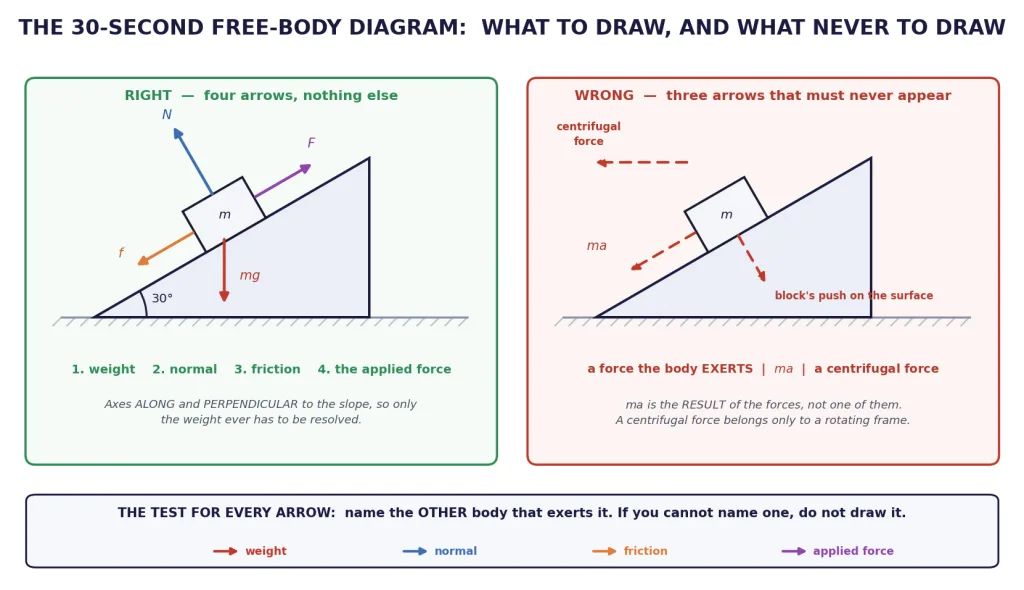
The four questions, in order
1. Which body am I isolating? One body, circled mentally, everything else erased. If a question has two blocks, you will do this twice.
2. Is there gravity? Then draw vertically down, from the centre. Always. This arrow is never at an angle, whatever the surface is doing.
3. What is touching it? Go round the body and, at every point of contact, draw at most two arrows:
- a normal force , perpendicular to the surface, pushing (never pulling);
- a friction force , parallel to the surface, opposing relative sliding. A string adds a tension pulling along the string, away from the body. A spring adds along the spring.
4. Is anything else applied? An external push or pull , and nothing more.
That is the whole diagram. On a rough incline it is exactly four arrows: weight, normal, friction, applied force.
The three arrows that must never appear
Key Point: Do not draw:
- A force the body EXERTS on something else. The block's push on the table belongs on the table's diagram, not the block's.
- , or "the force of motion". is the result of the forces, not one of them. Drawing it means counting the same thing twice.
- A centrifugal force, in the ground frame. There is no outward force on a car going round a bend.
The test for every arrow: name the other body that exerts it. Gravity — the Earth. Normal — the surface. Tension — the string. If you cannot name an agent, the arrow does not belong.
Choosing the axes: one rule
Key Point: Put one axis along the direction of the acceleration. Everything else follows.
| Situation | Axes to choose | Why |
|---|---|---|
| Block on a horizontal surface | horizontal and vertical | the acceleration is horizontal |
| Block on an incline | along and perpendicular to the slope | then only the weight needs resolving, into and |
| Lift | vertical | the only direction anything moves |
| Circular motion | radial (towards the centre) and tangential | the net radial force must equal |
| Banked road | horizontal and vertical, not along the slope | the acceleration is horizontal, towards the centre of the bend |
That last row is the one people get wrong. On an incline you tilt the axes; on a banked road you do not, because the car accelerates horizontally, not down the slope.
The 30-second run-through, on a rough incline
- Isolate the block.
- straight down.
- perpendicular to the slope, outward.
- along the slope, opposing the sliding.
- Axes along and perpendicular to the slope.
- Resolve only the weight: down the slope, into it.
- Perpendicular: (no acceleration that way).
- Along: .
Eight steps, and steps 6 to 8 are the same every single time. Practise until the picture triggers the two equations without any thinking in between.
[Important] on an incline, not . Every incline question in the paper depends on that one line, because the friction is and therefore .
Plug-and-Play Formula Cards, With a Chooser
Four pictures, four formulas. The skill being tested is recognition, so learn the pictures with the formulas attached.
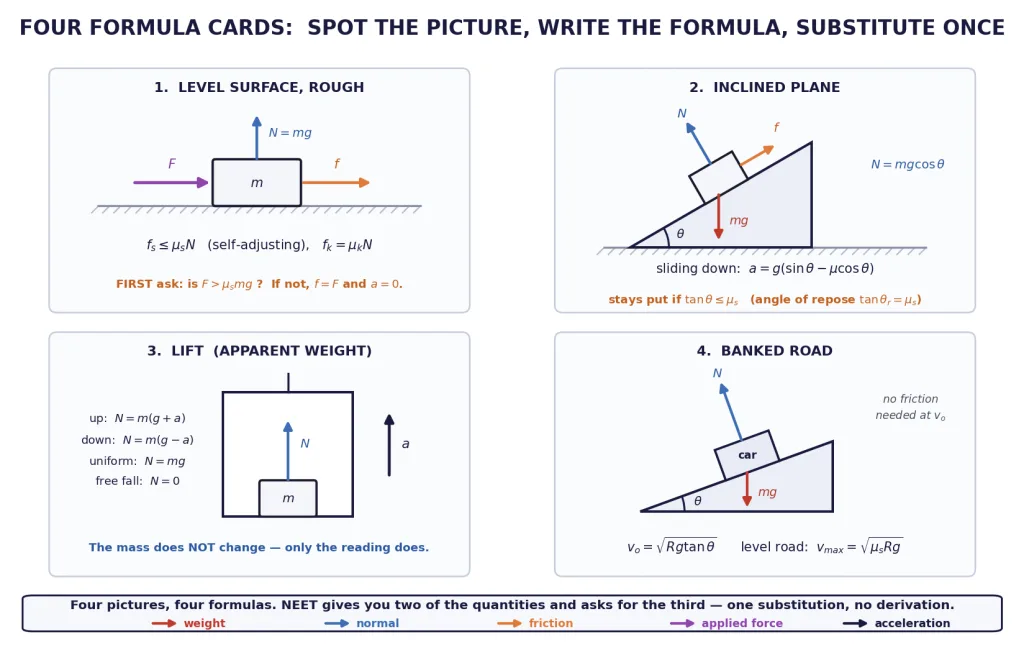
The chooser: match the picture to the card
| If the question shows… | Reach for | Watch out for |
|---|---|---|
| A block on a flat rough floor | , , | ask FIRST whether it moves |
| A block on a slope | , | is not |
| A lift, or a weighing machine | for accelerating up | |
| A car on a level bend | mass cancels | |
| A car on a banked bend | this is the no-friction speed | |
| Two blocks touching, pushed | , contact | which block is pushed matters |
| Two masses over a pulley | , | lies between the two weights |
Card 1: friction on a level surface
The question to ask first, every time: does it move? Compare the applied force with .
- If : it does not move, exactly, and .
- If : it moves, , and .
Skipping that test and writing on a stationary block is the single most expensive error available in this chapter.
Card 2: the inclined plane
And the angle of repose, the steepest slope on which a block will stay put:
which is also the angle of friction. Below nothing slides; above it, everything does. On a smooth incline all of this collapses to and , with the mass cancelling.
Card 3: the lift, and apparent weight
Three points examiners test. Going up and accelerating up are different things — a lift moving up but slowing down has directed downward, so . The mass never changes, only the reading. And a weighing machine calibrated in kilograms shows , so a 40 kg person in a lift accelerating up at 2.5 m/s^2 reads 50 kg, not 50 N.
Card 4: circular motion on a road
On a level road friction is the only thing turning the car, which is why wet roads are dangerous. On a banked road the horizontal component of the normal force does the job, and at exactly no friction is needed at all. The mass cancels from both, so "a heavier car can go faster" is always a wrong option.
The general banked-road result with friction, , is part of the syllabus and does appear, but rarely; if you see it, check that setting gives back and that setting gives back .
Two more that carry their own marks
Impulse. . Unit: N s, the same as kg m/s. For a ball that bounces back, the change in momentum is , not — the direction reverses, so the two contributions add.
Conservation of momentum. For an isolated system (zero external force), before after. Recoil: in magnitude, in opposite directions.
[Important] Every one of these formulas has the mass cancelling somewhere or a that is easy to lose. Before substituting, ask "should the mass survive?" On an incline, a level bend and a banked bend, it should not.
The Standard Templates, With Clean Numbers
The three connected-body set-ups NEET actually uses. Learn them with the numbers attached, so the shape of the answer is familiar before you start.
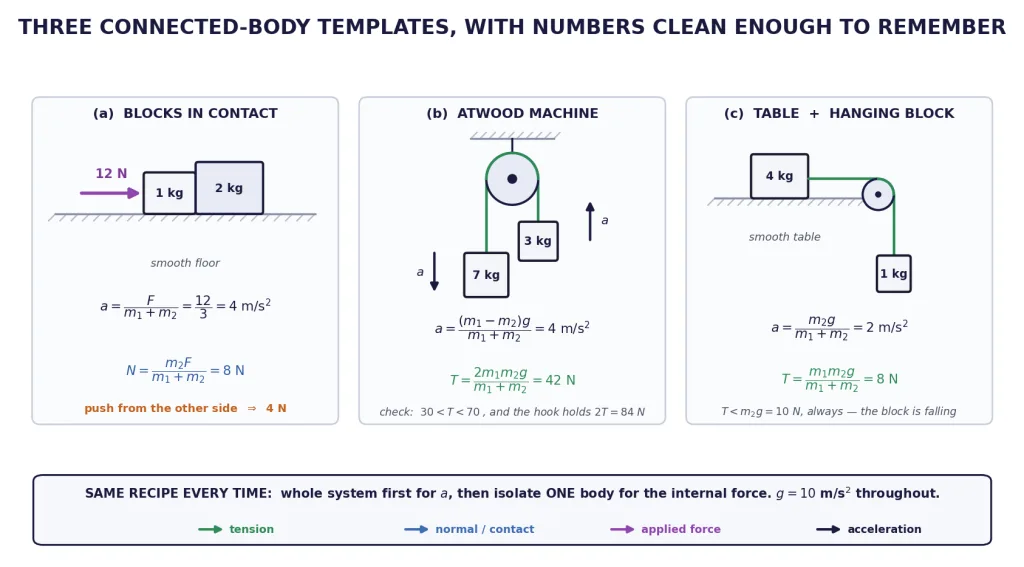
The recipe, once, for all three
- Whole system first to get the acceleration: . Internal forces cancel and never appear.
- Then isolate one body — the smaller one, if you have a choice — to get the internal force (contact force or tension).
- Check the answer against a limiting case before you move on.
Template 1: two blocks in contact
A 1 kg block touches a 2 kg block on a smooth floor, and 12 N is applied to the 1 kg block.
Isolate the 2 kg block: the only horizontal force on it is the contact force, so
Push from the other side instead and is unchanged at 4 m/s^2, but the contact force becomes N. Which block you push changes the contact force. That pairing is asked almost every year.
Template 2: the Atwood machine
Masses of 7 kg and 3 kg hang from a light string over a light frictionless pulley.
Three checks worth ten seconds each:
- must lie between the two weights: . It does.
- must be less than : . It is.
- The hook holding the pulley carries N, not N. This is asked directly, and 84 N is correct because the system is accelerating.
Template 3: a block on a table with a hanging block
A 4 kg block on a smooth table is joined over a pulley at the edge to a 1 kg block hanging.
Check: N is less than the hanging weight of 10 N — it must be, or the block could not be falling. If your tension comes out equal to or greater than , you have made a sign error.
With friction on the table (), the same recipe gives , and you must first check that , or nothing moves at all.
Template 4: the lift, all four readings
A 40 kg person stands on a weighing machine in a lift.
| Motion of the lift | Reading in kg | |
|---|---|---|
| At rest, or moving at constant speed | N | 40 |
| Accelerating up at 2.5 m/s^2 | N | 50 |
| Accelerating down at 2.5 m/s^2 | N | 30 |
| Cable snaps, free fall | 0 |
The person's mass is 40 kg in every row. Only the reading changes, because a weighing machine measures the normal force it has to supply.
The one-line summary card
| Set-up | Internal force | |
|---|---|---|
| Two blocks in contact, on | ||
| Atwood, | ||
| Table (smooth) hanging | ||
| Table (rough) hanging | ||
| Lift | given |
[Important] Everything above assumes a light, inextensible string over a light, frictionless pulley, so the tension is the same throughout and the two accelerations are equal in magnitude. NEET always gives you those words. Section 10 is where they are removed.
Five Ways to Kill an Option Without Solving the Problem
On a paper this fast, the quickest route to the answer is often not to compute it.
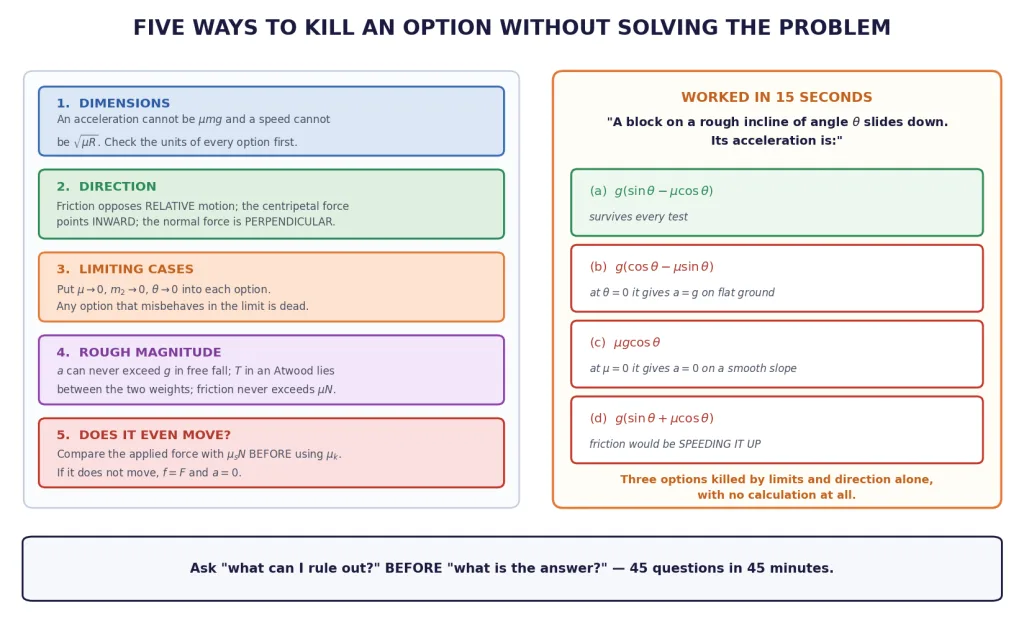
1. Kill by dimensions
Every option must have the right dimensions. An acceleration cannot be (that is a force) and a speed cannot be (that is ). Since is dimensionless, it never fixes a broken option, which makes this test very fast: strip the s and look at what is left.
Speeds in this chapter are always built like or . Accelerations are built like times something dimensionless. Forces are times something dimensionless.
2. Kill by direction
- Friction opposes relative motion, so an option in which friction speeds a sliding body up is dead. That kills for a block sliding down a slope.
- The centripetal force points inward. Any option describing an outward force on a body moving in a circle, in the ground frame, is wrong.
- The normal force is perpendicular to the surface, and it can only push.
- Tension pulls away from the body, along the string. A string can never push.
3. Kill by limiting cases
The most powerful of the five. Push each option to an extreme where you already know the answer:
| Limit | What the answer must become |
|---|---|
| the smooth-surface result: on an incline | |
| the flat-ground result: , and on a bank | |
| free fall: | |
| in an Atwood | and |
| in an Atwood | and |
| for blocks in contact | contact force |
| in a lift, downward | , weightlessness |
An option that misbehaves in any of these limits is gone, and the test costs about five seconds.
4. Kill by rough magnitude
Bounds you can apply without a calculator:
- A body under gravity alone cannot accelerate faster than . On a slope it is always less than .
- In an Atwood machine, lies strictly between the two weights.
- Friction can never exceed , so a 4 kg block with can never feel more than N of friction.
- The normal force on a horizontal floor is unless something is pushing or pulling vertically.
- Apparent weight in a lift stays between and roughly for any acceleration a real lift can produce.
5. Kill by "does it even move?"
Specific to friction, and worth its own step. Compare the applied force with before you use anywhere. If the block does not move:
Options offering or as "the friction" are then both wrong. On an incline the same test reads: compare with . If , the block stays, , and .
Putting them together
Take a genuine NEET-style item: a block slides down a rough incline of angle ; its acceleration is…
- — at this gives on flat ground. Dead by limits.
- — at this gives on a smooth slope. Dead by limits.
- — friction would be speeding the block up. Dead by direction.
- — survives everything. Answer.
Fifteen seconds, no algebra.
Key Point: Ask "what can I rule out?" before you ask "what is the answer?" On a 45-question paper in 45 minutes, that habit is worth more than being fast at algebra.
Assertion-Reason and Column Matching: the Two NEET-Only Formats
These two formats are not harder physics. They are a different reading task, and both are entirely mechanical once you know the drill.
Assertion-Reason: the four codes
You are given two statements, an Assertion (A) and a Reason (R), and asked to choose:
| Code | Meaning |
|---|---|
| (a) | Both A and R are true, and R is the correct explanation of A |
| (b) | Both A and R are true, but R is not the correct explanation of A |
| (c) | A is true but R is false |
| (d) | A is false but R is true |
Some papers add "both false". Read the option list before you start — the order of these four is not fixed between papers, and picking "option (a)" from memory when the paper has shuffled them is a self-inflicted wound.
The attack: judge A, then R, then the link
Key Point: Three separate judgements, in this order, and never let one influence the next:
- Cover R. Is A true, on its own?
- Cover A. Is R true, on its own?
- Only if both are true: does R actually explain A, or is it merely another true fact about the same topic?
Step 3 is where the marks are, and it is the step people rush. "Both true" is not enough. Ask yourself: if R were false, would A stop being true? If yes, R explains A. If A would survive without R, the answer is (b).
The trap this format is built around is a true reason attached to a false assertion, which makes the assertion sound plausible. The defence is step 1: judge A with R covered.
Worked, three times
Item 1. A: A body in equilibrium must be at rest. R: In equilibrium the net force on the body is zero. A alone: false — a body moving at constant velocity has zero net force and is in equilibrium. R alone: true, that is the definition. So A false, R true.
Item 2. A: Static friction is a self-adjusting force. R: Static friction is always equal to . A alone: true, it takes whatever value prevents sliding. R alone: false — is the maximum, not the value. So A true, R false.
Item 3. A: A body moving in a circle at constant speed is accelerating. R: Velocity is a vector, so a change of direction alone is a change of velocity. A alone: true. R alone: true. And R is exactly why A holds, not merely a related fact. So both true, R explains A.
Column matching: anchor and kill
You are given Column I (four set-ups, A to D) and Column II (four results, i to iv), and four codes that pair them up.
Key Point: Never work out all four pairings. Find the one you are surest of, use it to eliminate every code that contradicts it, and then check whichever single pairing still separates the survivors. Two confident pairings almost always settle a four-option matching question.
The drill:
- Scan Column II for the odd one out — a zero, a , a , something that obviously belongs to one entry.
- Anchor on that pairing and strike out every code that disagrees.
- Count the survivors. If one remains, stop; you are done. If two remain, find the single letter where they differ and settle just that one.
- Never check a pairing that all the surviving codes agree on. It cannot change the answer.
A worked anchor. Column I: (A) block on a smooth incline of angle ; (B) man in a lift accelerating up at ; (C) car on a frictionless banked road; (D) two masses over a light pulley. Column II: (i) ; (ii) ; (iii) ; (iv) .
Anchor on (C): the only speed in Column II is (ii), so C-ii is certain, and every code without it dies. Then (B) is the only one involving a lift acceleration, so B-i. Two anchors, and the matching is settled — (A) and (D) follow without any thought.
[Important] Column matching is answered by elimination between the codes, not by solving the physics four times. If you find yourself computing all four entries, you have already lost thirty seconds you did not have.
Where this goes next
- Section 13 (NEET Pattern Practice) drills all of this at exam pace with scoring.
- Section 10 (JEE Corner) is where the constraint relations, pseudo forces and vertical circles live, if you are also sitting JEE.
- Section 14 compresses the whole chapter into revision cards for the last week.
Solved Examples
Twelve problems at NEET level and NEET pace. Give yourself 45 seconds on each before reading the solution. m/s^2 throughout.
Example 1: Six one-liners, from the statements alone
Answer each in one sentence, with no calculation.
(a) What is the most general form of Newton's second law? (b) Why do action and reaction never cancel? (c) A 2 kg body and a 5 kg body are both at rest. Which has more inertia? (d) What are the units of the coefficient of friction? (e) A car goes round a bend at constant speed. Is it in equilibrium? (f) Which force provides the centripetal force for a car on a level road?
Solution:
(a) . The familiar follows from it only when the mass is constant, so it is a special case, not the law itself.
(b) Because they act on two different bodies. Forces cancel only when they act on the same body.
(c) The 5 kg body. Mass is the measure of inertia, so more mass always means more inertia — and it makes no difference that both are at rest.
(d) None. is the ratio of two forces, so it is dimensionless and unitless. It is also independent of the area of contact.
(e) No. Its speed is constant but its direction is changing, so it is accelerating (centripetally), and a body in equilibrium has zero acceleration.
(f) Friction between the tyres and the road, directed inward, towards the centre of the bend. Centripetal force is not a new force; it is a requirement that some real force must meet.
Final Answer: (a) (b) they act on different bodies (c) the 5 kg body (d) none, it is dimensionless (e) no (f) friction.
Takeaway: Six questions, no arithmetic, well under a minute in total. These are the sentences NEET reuses year after year, and every second you save here is a second available for a numerical.
Example 2: The 30-second free-body diagram
A block is pushed up a rough inclined plane of angle by a force acting up the slope. List every force acting on the block, state the direction of each, and write the two equations.
Solution:
Isolate the block, and go through the four questions.
Gravity: , vertically downward. Not along the slope, not perpendicular to it — vertically down, always.
Contact with the incline, two arrows:
- Normal force , perpendicular to the slope, pushing the block away from the surface.
- Friction , along the slope. The block is sliding up, so friction acts down the slope.
Applied force , up the slope. That is all four; nothing else.
What NOT to draw: the block's push on the incline (that is on the incline's diagram), an arrow (it is the result, not a force), and any "force of the push carrying it up" beyond itself.
Choose axes along and perpendicular to the slope, and resolve only the weight: so
The check: if the block were sliding down instead, only the friction arrow would flip, giving with no applied force. Same diagram, one arrow reversed.
Final Answer: Four forces — weight (vertically down), normal (perpendicular to the slope), friction (down the slope, since the block moves up), and (up the slope) — with and .
Takeaway: The diagram never changes. Only the direction of the friction arrow depends on which way the block is going, and only the weight ever has to be resolved.
Example 3: Does it even move?
A 5 kg block rests on a horizontal floor with and . Find the friction force and the acceleration when the applied horizontal force is (a) 15 N, and (b) 25 N.
Solution:
Find the threshold first. With N, Nothing moves until the applied force exceeds 20 N.
(a) N. Since , the block does not move. Static friction adjusts itself to exactly balance the push: It is not N and not N by coincidence — it is 15 N because that is what equilibrium requires.
(b) N. Now , so the block slides, and kinetic friction takes over at its fixed value:
The moment of release. Notice what happens as creeps past 20 N: friction drops from 20 N to 15 N, because . That sudden drop is why a heavy box lurches forward the instant it starts to move.
Final Answer: (a) N and . (b) N and m/s^2.
Takeaway: The two parts have the same friction for completely different reasons — 15 N of self-adjusting static friction in (a), and 15 N of kinetic friction in (b). Always run the against test before choosing which law to apply.
Solved Examples (continued)
Example 4: The rough incline, end to end
A 2 kg block is released on a rough incline of angle (, ) with . Find (a) whether it slides at all, (b) the normal force, (c) the acceleration, (d) the distance travelled in 2 s, and (e) the angle of repose for this surface.
Solution:
(a) The does-it-slide test. Compare with : so the slope is steeper than the angle of repose and the block does slide.
(b) The normal force, from the perpendicular direction where nothing accelerates: Not 20 N. The is the whole difference between an incline question and a flat-floor one.
(c) The acceleration, along the slope, with friction acting up the slope: The mass has cancelled, as it always does here. On a smooth slope of the same angle it would be m/s^2, so friction has cost 2 m/s^2.
(d) The distance in 2 s, from rest:
(e) The angle of repose: Any slope gentler than would hold this block at rest.
Final Answer: (a) yes, since ; (b) 16 N; (c) 4 m/s^2; (d) 8 m; (e) .
Takeaway: Five parts, one free-body diagram, and every answer came from the two standard lines and . Do the against test first — it takes three seconds and decides everything that follows.
Example 5: The spring balance in a lift
A block of mass 3 kg hangs from a spring balance fixed to the roof of a lift. Take m/s^2. Find the reading of the balance when the lift is (a) accelerating upward at 2 m/s^2, (b) moving downward at a constant 6 m/s, (c) accelerating downward at 4 m/s^2, and (d) in free fall after the cable snaps. (e) Has the block's mass changed in any of these?
Solution:
What the balance measures. A spring balance reads the tension in its spring, which is the upward force it must exert on the block. So every part comes from with the correct sign for .
(a) Accelerating upward at 2 m/s^2: Heavier than the 30 N it reads at rest, which is the familiar pressed-down feeling as a lift starts up.
(b) Moving downward at a constant 6 m/s. Constant velocity means , whatever the speed and whatever the direction: This is the trap. The lift is moving, and moving downward, and the reading is still the ordinary 30 N. Only acceleration changes a balance reading.
(c) Accelerating downward at 4 m/s^2:
(d) Free fall. Now , so The balance reads zero — apparent weightlessness. Gravity is still acting on the block with all of its 30 N; what has vanished is the contact force, because the block and the balance are falling together.
(e) No. The mass is 3 kg in every single part. Mass is a fixed property of the body; only the reading, which is a force, changes.
Final Answer: (a) 36 N (b) 30 N (c) 18 N (d) zero (e) no, the mass is 3 kg throughout.
Takeaway: One relation, , with for accelerating up. Two traps live here: constant velocity is not acceleration (part b), and weightlessness is zero contact force, not zero weight (part d).
Example 6: Two bends, two formulas
(a) A road of radius 45 m is banked at an angle whose tangent is 0.5. What is the speed at which no friction is needed? (b) On a level road of radius 80 m with , what is the maximum safe speed? (c) Does either answer depend on the mass of the vehicle?
Solution:
(a) On a banked road with no friction, the normal force alone turns the car. Its vertical component holds the weight and its horizontal component supplies the centripetal force: Dividing kills both and :
(b) On a level road, friction is the only horizontal force available, so at the limit
(c) No, neither. The mass cancelled in both derivations — in (a) between the two component equations, and in (b) between the friction and the centripetal requirement. A loaded lorry and an empty one skid at the same speed on the same bend, which is why speed limits on bends are posted without reference to the vehicle.
Final Answer: (a) 15 m/s (b) 20 m/s (c) no, the mass cancels in both.
Takeaway: Two pictures, two formulas, one substitution each. The banked formula has and no ; the level formula has and no angle. If a formula in the options mixes them the wrong way round, kill it by setting or and seeing what survives.
Solved Examples (continued)
Example 7: The Atwood machine, and the hook that holds it
Masses of 7 kg and 3 kg hang from the two ends of a light inextensible string passing over a light frictionless pulley. Find (a) the acceleration, (b) the tension, and (c) the force with which the pulley pulls on its support.
Solution:
(a) Whole system first. The net driving force is the difference of the weights and the mass being moved is the sum:
(b) Isolate the lighter block, which accelerates upward: Cross-check on the heavier block, which accelerates downward: gives . Correct.
Two sanity checks, five seconds each. The tension must lie between the two weights, : it does. And must be less than : it is.
(c) The pulley has the string pulling down on both sides, each with tension : Note this is not N. It is less, because the system is accelerating: the centre of mass of the two blocks is accelerating downward, so the support carries less than the full weight.
Final Answer: (a) 4 m/s^2 (b) 42 N (c) 84 N.
Takeaway: Both formulas are worth memorising with a worked pair attached: . And part (c) is the one people miss — the support feels , and unless nothing is accelerating.
Example 8: Two more templates, with the pairing that gets asked
(a) A 1 kg block is in contact with a 2 kg block on a smooth floor, and 12 N is applied to the 1 kg block. Find the acceleration and the contact force. What is the contact force if the same 12 N is applied to the 2 kg block instead? (b) A 4 kg block on a smooth table is connected over a light pulley at the edge to a 1 kg block hanging freely. Find the acceleration and the tension.
Solution:
(a) Whole system:
Isolate the 2 kg block. The only horizontal force on it is the contact force from the 1 kg block:
Push from the other side. The acceleration is unchanged at 4 m/s^2, since the same force acts on the same total mass. But now the block being pushed through is the 1 kg one: Half as much. The contact force is always the mass of the block being pushed along times , so pushing the heavier block gives the smaller contact force.
(b) Whole system. The only external driving force is the weight of the hanging block, and the table is smooth:
Isolate the hanging block: Cross-check on the table block: N. Agreed.
Check the sign. N is less than the hanging weight of 10 N, as it must be for the block to be falling. A tension of 10 N or more would mean the block was not accelerating downward at all.
Final Answer: (a) 4 m/s^2, with a contact force of 8 N one way and 4 N the other. (b) 2 m/s^2 with N.
Takeaway: Whole system for , then one isolated body for the internal force. Part (a)'s reversal is a NEET favourite: the acceleration does not change, but the contact force does.
Example 9: Impulse, and the sign that costs marks
A ball of mass 0.2 kg strikes a wall horizontally at 25 m/s and rebounds along the same line at 20 m/s. The contact lasts 0.05 s. Find (a) the change in momentum, (b) the impulse, and (c) the average force on the ball.
Solution:
Fix a positive direction — say, towards the wall. Then the initial velocity is m/s and the final velocity is m/s, because the ball has reversed.
(a) The change in momentum: The magnitude is 9 kg m/s, directed away from the wall.
The trap. Because the direction reverses, the two contributions add: . Writing kg m/s is the standard wrong answer, and it will be one of the options.
(b) The impulse is equal to the change in momentum, by the impulse-momentum theorem: in magnitude. Note that N s and kg m/s are the same unit.
(c) The average force: directed away from the wall — nearly a hundred times the ball's own weight of 2 N, which is what a very short contact time does.
Final Answer: (a) 9 kg m/s away from the wall (b) 9 N s (c) 180 N.
Takeaway: For a body that bounces back, the change in momentum is , not . Set a positive direction on paper before writing anything down, and the sign takes care of itself.
Solved Examples (continued)
Example 10: Four questions, none of them calculated
Answer each by elimination alone, without computing a final number.
(a) A block slides down a rough incline of angle . Which of these could be its acceleration: , , , ? (b) A 4 kg block on a floor with is pushed with 12 N. A student says the friction is 20 N. Is that possible? (c) In an Atwood machine with 6 kg and 2 kg, a student gets N. Is that plausible? (d) A car takes a level bend. An option says the maximum speed is . Kill it in five seconds.
Solution:
(a) Kill by dimensions, then by limits. is a force, not an acceleration — dead immediately. gives at , i.e. free fall on flat ground — dead by limits. gives when , i.e. a block that will not slide down a smooth slope — dead by limits. Only survives. No physics was computed.
(b) Kill by rough magnitude. Friction can never exceed N — but more to the point, static friction can never exceed the force it is opposing. The push is only 12 N, so the friction is exactly 12 N and the block does not move. 20 N is impossible.
(c) Kill by bounds. In an Atwood machine the tension always lies strictly between the two weights, here between N and N. A value of 75 N is above both, which would mean both blocks accelerating upward. Impossible. (The correct value is 30 N.)
(d) Kill by dimensions. carries an extra factor of mass under the root, so its dimensions are , which is not a speed. Dead. It also fails the physical test: the mass must cancel on a level bend.
Final Answer: (a) (b) no, the friction is 12 N (c) no, must lie between 20 N and 60 N (d) wrong dimensions, and the mass must cancel.
Takeaway: Four questions, no calculation, well under a minute in total. Dimensions, bounds and limiting cases are not just checking tools — on a timed paper they are often the fastest route to the answer itself.
Example 11: Assertion-Reason, worked three times
For each pair, choose from: (a) both true and R explains A; (b) both true but R does not explain A; (c) A true, R false; (d) A false, R true.
(i) A: The normal reaction on a block is always equal to its weight. R: The normal reaction is a contact force perpendicular to the surface. (ii) A: A rocket can accelerate in outer space. R: A rocket works by pushing against the surrounding air. (iii) A: It is easier to pull a lawn roller than to push it. R: Pulling reduces the normal force between the roller and the ground.
Solution:
(i) Judge A alone. only on a horizontal surface with nothing pushing or pulling vertically. On an incline ; in a lift . So A is false. Judge R alone: the normal reaction is a contact force perpendicular to the surface — R is true. Answer: (d).
(ii) Judge A alone. A rocket accelerates by ejecting mass backwards and receiving an equal and opposite reaction, which needs no medium at all. A is true. Judge R alone: "pushing against the air" is exactly the misconception the third law dispels — a rocket works better in vacuum, with no drag. R is false. Answer: (c).
(iii) Judge A alone. Pulling at an angle above the horizontal is easier — A is true. Judge R alone: the upward component of a pull reduces below , so friction falls — R is true. And that is the reason A holds: with a push, the downward component increases and friction rises. So R explains A. Answer: (a).
Final Answer: (i) d (ii) c (iii) a.
Takeaway: In all three, the decision was made by judging A with R covered. Item (i) is the format's signature trap — a perfectly true reason bolted onto a false assertion, so that the pair reads convincingly if you take them together.
Example 12: Column matching, by anchoring
Match Column I with Column II.
Column I: (A) block on a smooth incline of angle ; (B) man in a lift accelerating upward at ; (C) car on a frictionless banked road; (D) two masses over a light pulley.
Column II: (i) ; (ii) ; (iii) ; (iv) .
Solution:
Scan Column II for the odd one out. Entry (ii) is the only speed in the list — everything else is an acceleration or a force. And (C) is the only entry in Column I asking about a speed. So C-ii, with high confidence. Strike out every code that does not contain it.
Find a second anchor. Entry (i) is the only expression containing a lift acceleration alongside , and (B) is the only lift. So B-i. That is two anchors, which normally settles a four-option matching question outright.
Fill in the rest, since it costs nothing now. (A) a block on a smooth incline has , so A-iii. That leaves D-iv, which is the Atwood acceleration and is obviously right.
The complete matching: A-iii, B-i, C-ii, D-iv.
The check that costs three seconds. Every entry in Column II has been used exactly once. If your matching reuses one entry or leaves one unused, it is wrong regardless of the physics.
Final Answer: A-iii, B-i, C-ii, D-iv.
Takeaway: Two confident anchors settled it, and only then did we fill in the rest for free. Never compute all four pairings first — the codes are designed so that one or two secure matches eliminate everything else.