
The Vocabulary of Forces, and Where It All Comes From
Sections 1 to 3 gave you the three laws. Every one of them contains the word force — and so far we have treated force as a black box. This section opens the box.
Here is the good news, and it is genuinely surprising: almost every mechanics problem you will ever solve is built from just five forces. Weight, normal reaction, tension, friction and the spring force. Learn those five properly and you can draw the free-body diagram for essentially anything.
First, the big picture: four fundamental forces
Physics recognises exactly four fundamental forces in nature. Everything else is a consequence of them.
| Force | Acts between | Range | Relative strength | Where you meet it |
|---|---|---|---|---|
| Gravitational | all masses | infinite | falling bodies, planets, weight | |
| Electromagnetic | charges and currents | infinite | atoms, light, ALL contact forces | |
| Strong nuclear | quarks, nucleons | about m | holds the nucleus together | |
| Weak nuclear | most elementary particles | about m | radioactive beta decay |
Only two of these matter here: of these, the weak and strong forces appear in domains that do not concern us here. Only the gravitational and electrical forces are relevant in the context of mechanics.
The one fact worth remembering from that table
Key Point: Gravity acts at a distance, with no intervening medium needed. Every other force in this chapter is a contact force, and all contact forces are ultimately electromagnetic in origin.
That second half deserves a sentence of explanation, because it sounds absurd. We are talking about wooden blocks and steel strings, which are uncharged and non-magnetic. How can their forces be electrical?
The answer: at the microscopic level, all bodies are made of charged constituents — nuclei and electrons. When you press a book down on a table, you are pushing the electron clouds of the book's surface atoms up against the electron clouds of the table's surface atoms, and they repel electrically. Every contact force — the elasticity of solids, molecular collisions, impacts, friction, the tension in a rope — traces back to these electrical forces between charged constituents.
Key Point: The detailed microscopic origin of contact forces is complex, and not useful for handling problems in mechanics at the macroscopic scale. That is exactly why we treat them as separate types of force with their own characteristic properties, determined empirically. for rubber on concrete is not derived from electromagnetism; it is measured.
The contact-force family
When two bodies touch, the contact force between them is naturally split into two perpendicular pieces:
- the component perpendicular to the surfaces in contact is the normal reaction ;
- the component parallel to the surfaces in contact is friction .
Contact forces also arise between solids and fluids — the buoyant force on a body immersed in a fluid (equal to the weight of fluid displaced), viscous drag, and air resistance. Two more that get their own names: tension in a string, and the spring force.
And here is a point worth stressing, because it quietly saves marks:
The different terms like "friction", "normal reaction", "tension", "air resistance", "viscous drag", "thrust", "buoyancy", "weight", "centripetal force" all stand for "force" in different contexts.
They are all just forces, measured in newtons, obeying all three of Newton's laws. Different names, one physical quantity.
What this section covers, and what it does not
| Force | Symbol | Direction | Covered in |
|---|---|---|---|
| Weight | vertically down, toward the Earth's centre | this section | |
| Normal reaction | perpendicular to the surface, always a PUSH | this section | |
| Tension | along the string, always a PULL | this section | |
| Spring force | opposite to the displacement from natural length | this section | |
| Friction | parallel to the surface, opposing relative motion | Section 6 |
Friction is the other contact force, and it is a big enough subject to need a section of its own. It is coming next but one. Everything else is here.
Weight: a Force, and Why It Is Not the Same Thing as Mass
Everyone thinks they already know what weight is, and almost everyone is wrong about it in exactly the same way. Let's fix that permanently.
The definition
Key Point — weight: The weight of a body is the gravitational force exerted on it by the Earth: It is a force, so it is a vector, it is measured in newtons, and it is directed vertically downward, toward the centre of the Earth. Its magnitude is .
If you have ever written "my weight is 60 kg", you have written a force in units of mass. What you meant is that your mass is 60 kg; your weight, on Earth with m/s^2, is N.
Mass against weight, once and for all
| Mass | Weight | |
|---|---|---|
| What it is | the amount of matter; the measure of inertia | the gravitational force on the body |
| Scalar or vector? | scalar | vector, directed downward |
| SI unit | kilogram (kg) | newton (N) |
| Dimensions | ||
| Does it change with place? | never | yes, it changes wherever changes |
| Can it be zero? | never, for a real body | yes, far from any mass |
| Measured with | a beam (physical) balance | a spring balance |
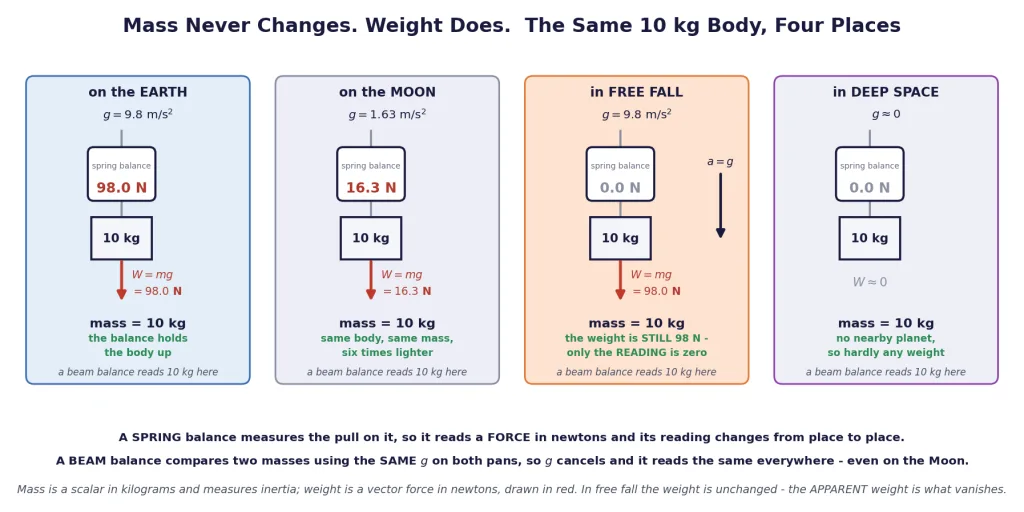
Take a body of mass 10 kg on a tour, and watch what happens (with m/s^2 on Earth and m/s^2 on the Moon):
| Where it is | Mass | Weight | Spring balance reads | |
|---|---|---|---|---|
| On the Earth | 9.8 m/s^2 | 10 kg | 98 N | 98 N |
| On the Moon | 1.63 m/s^2 | 10 kg | 16.3 N | 16.3 N |
| In a freely falling lift | 9.8 m/s^2 | 10 kg | still 98 N | 0 N |
| In deep space | about 0 | 10 kg | about 0 | 0 N |
Read the third row twice. In free fall the weight has not changed at all — the Earth still pulls the body with 98 N, because has not changed. What has become zero is the normal reaction, or the reading of the balance supporting it, and that is a different quantity, called the apparent weight. Section 8 does apparent weight in full.
Why a spring balance and a beam balance disagree — and why they don't
This is the neatest way to nail the distinction, and it is a favourite Board question.
Key Point:
- A spring balance measures the force pulling on its spring, so it really measures weight. Its reading depends on and therefore changes from place to place. Take a spring balance to the Moon and every reading falls to a sixth.
- A beam balance (the two-pan physical balance) compares two masses. Both pans sit in the same , so at balance , and cancels. It measures mass, and it reads exactly the same on the Earth, on the Moon, or anywhere else with any at all.
[Board Important] A beam balance would not work at all in a freely falling lift or in deep space — with there is nothing to tilt it. It reads mass correctly wherever it works, but it needs some gravity in order to work.
Two more things about , and one about the shopkeeper
is not even constant on the Earth. It is about 9.83 m/s^2 at the poles and 9.78 m/s^2 at the equator, and it falls off with altitude. So your weight is genuinely a little smaller at the top of a mountain and at the equator. Your mass is not.
Which to use. Some problems use m/s^2 and others round it to m/s^2. Use whichever the question gives you, state it, and never mix the two inside one problem. This section uses m/s^2 unless a problem says otherwise.
And the shopkeeper. When a grocer's spring balance says "2 kg", the instrument has actually measured a force of about 19.6 N and quietly divided by 9.8 for you. Which is fine on Earth, and useless on the Moon.
[NEET Important] The single most-asked version of this: a body is taken from the Earth to the Moon. Which of its mass, weight and inertia change? Answer: only the weight. Mass is unchanged, and inertia is measured by mass, so inertia is unchanged too.
Normal Reaction: Is NOT Always
If you take one thing from this whole section, take this one. More marks are lost to than to almost any other single habit in mechanics.
What is
Key Point — normal reaction: When two bodies are in contact, the component of the contact force perpendicular to the surfaces in contact is called the normal reaction . It is:
- always perpendicular to the surface of contact ("normal" means perpendicular, not "usual");
- always a push, never a pull — a surface can shove you away from it but can never grab you;
- therefore always , and exactly when contact is lost.
The "always pushes" property is a genuine physical constraint, and it is the source of a whole class of questions. If your working ever produces a negative , you have not found a strange answer — you have proved that the body left the surface, and the model you set up no longer applies.
The rule that replaces
is not a formula you look up. It is an unknown, and you find it the same way you find every other unknown in this chapter:
Key Point — the only rule you need: Draw the free-body diagram, then apply Newton's second law along the direction perpendicular to the surface: and solve for . is not a law; it is one special case that happens to fall out when the surface is horizontal, the motion is horizontal, and nothing else pushes or pulls vertically.
The five standard cases
Here is the same 10 kg block ( N with m/s^2) in five different situations. The block never changes. changes every time.
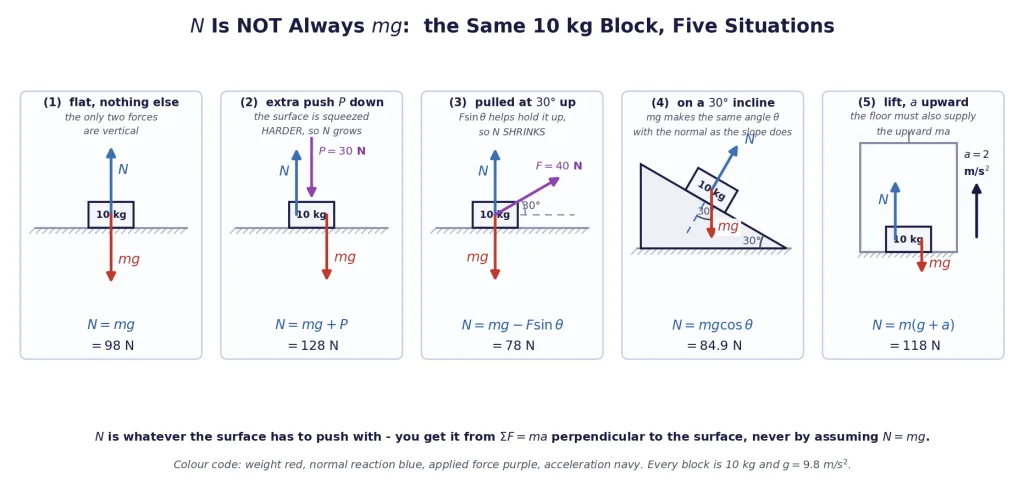
Case 1 — block on a horizontal surface, nothing else. Vertically: .
Case 2 — an extra vertical push downward. Vertically: . You are squeezing the block against the surface harder, so the surface pushes back harder.
Case 3 — pulled by a string at an angle above the horizontal. The pull has a vertical component that helps hold the block up. Vertically: . [JEE Tip] Push the block at an angle below the horizontal instead and the sign flips: . This is exactly why pulling a lawnmower is easier than pushing it — pulling reduces , and therefore reduces friction.
Case 4 — block resting on an incline of angle . Resolve the weight along and perpendicular to the slope. Perpendicular to the slope there is no acceleration, so . The component along the slope, N, is what tries to slide the block down. Notice that always on an incline, and as , which is right: a vertical wall presses on nothing.
Case 5 — block on the floor of a lift accelerating with . Now is genuinely not zero: . Use when the lift accelerates upward and when downward; in free fall and . This is the apparent weight, and Section 8 gives it the full treatment with the weighing-machine reading, the lift starting and stopping, and the snapped cable.
The one-line summary card
| Situation | Normal reaction | Compare with |
|---|---|---|
| Horizontal surface, nothing else | equal | |
| Extra push straight down | greater | |
| Pulled at above the horizontal | smaller | |
| Pushed at below the horizontal | greater | |
| On an incline of angle | smaller | |
| Lift accelerating up / down with | greater / smaller | |
| Freely falling lift | zero |
[NEET Important] And a reminder from Section 3 that pairs with this: and are not an action-reaction pair. They act on the same body. When they happen to be equal, that is the first law at work, not the third.
Tension: What an Ideal String Does
A string is such a simple object that it is easy to miss how many assumptions are buried in the symbol .
The definition
Key Point — tension: When a string is pulled taut, a restoring force is set up along it. The force with which the string pulls on whatever is attached to each of its ends is called the tension . It acts along the string, and it always PULLS the attached body toward the string.
There is an unexpected route to tension, and it is worth knowing. A string is really a spring with a colossal force constant: for an inextensible string, the force constant is very high. The restoring force in a string is called tension. Stretch it by even a hair and you get an enormous restoring force — which is exactly why it does not visibly stretch.
The ideal string, and what "ideal" buys you
Key Point — the ideal string, two assumptions:
- Massless (or "light"): its mass is negligible compared with everything else in the problem.
- Inextensible: its length never changes, so two bodies joined by it have accelerations of equal magnitude.
The consequence: the tension is the same at every point along the string. Plainly: it is customary to use a constant tension throughout the string. This assumption is true for a string of negligible mass.
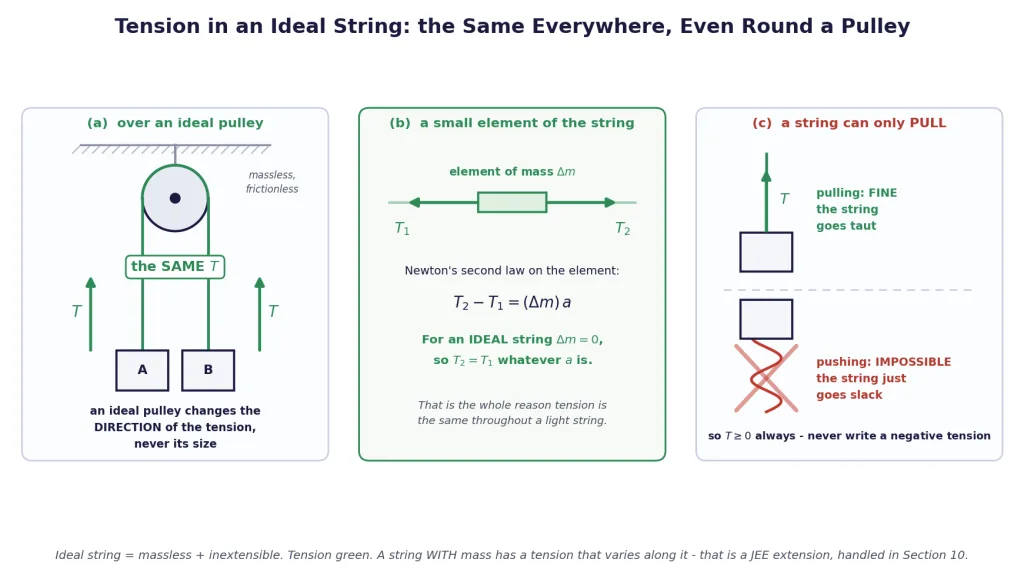
Why "massless" gives you constant tension — and this is the one-line proof, shown in panel (b) of the figure. Take a small element of the string of mass , pulled by one way and the other. Newton's second law on that element:
If the string is massless, , so — whatever the acceleration is. Set everywhere along the string and the tension is uniform from end to end.
[JEE Tip] Turn that argument round and you get the exception. If the string has mass, then , and the tension varies along the string — largest at the end being pulled and smallest at the far end. A heavy hanging rope has more tension at the top than at the bottom, because the top has to support more rope. That is a JEE-level extension and Section 10 handles it.
The ideal pulley
Key Point: An ideal pulley is massless and frictionless. A string passing over one has the same tension on both sides. The pulley changes the direction of the tension; it never changes its magnitude.
That is the whole point of a pulley: it lets you convert a downward pull into an upward one, or redirect a force round a corner, at no cost. A real pulley has mass and bearing friction, so the two tensions differ — that is a rotational-dynamics problem and belongs to Chapter 6.
A string can only pull
This sounds obvious and is constantly forgotten.
Key Point: A string can pull but can never push. Try to push with a string and it simply goes slack. Therefore always. If your algebra produces a negative tension, the string went slack and your model is wrong — not the arithmetic.
That is the string's version of the normal reaction's , and for the same reason: both describe a contact that can be broken.
The three habits that get tension right
- Draw the string's pull on each body separately, always pointing away from the body, along the string.
- Give each separate string its own symbol — , , . One continuous string has one tension; a different string has a different tension, even if it is in the same picture. Look at Example 6: two blocks hanging in a chain have two different tensions.
- A string over an ideal pulley is still one string, so it is still one — but a string that ends at a body and restarts on the other side of it is two strings.
[JEE/NEET] The most common single error: writing the same for the string above a hanging pair of blocks and the string between them. Those are two different strings, and Example 6 shows the two tensions coming out as 78.4 N and 29.4 N — nowhere near equal.
The Spring Force and Hooke's Law
The last of our four forces, and the only one that changes as the body moves.
The law
Compress or stretch a spring and it fights back: when a spring is compressed or extended by an external force, a restoring force is generated. This force is usually proportional to the compression or elongation (for small displacements).
Key Point — Hooke's law: The force exerted by a spring on the body attached to it is where is the displacement of the free end from the spring's natural (unstretched) length and is the spring constant (also called the force constant), measured in N/m. The minus sign says the force is opposite to the displacement.
What the minus sign actually means
It is not a decoration and it is not a sign convention you can drop. It encodes the single most important property of the spring force:
Key Point: The spring force is a restoring force. It always points back towards the natural length.
- Stretched (): is negative, so the spring pulls the block back IN.
- Compressed (): is positive, so the spring pushes the block back OUT.
- At natural length (): . The spring is not "relaxed but still pulling"; it exerts no force at all.
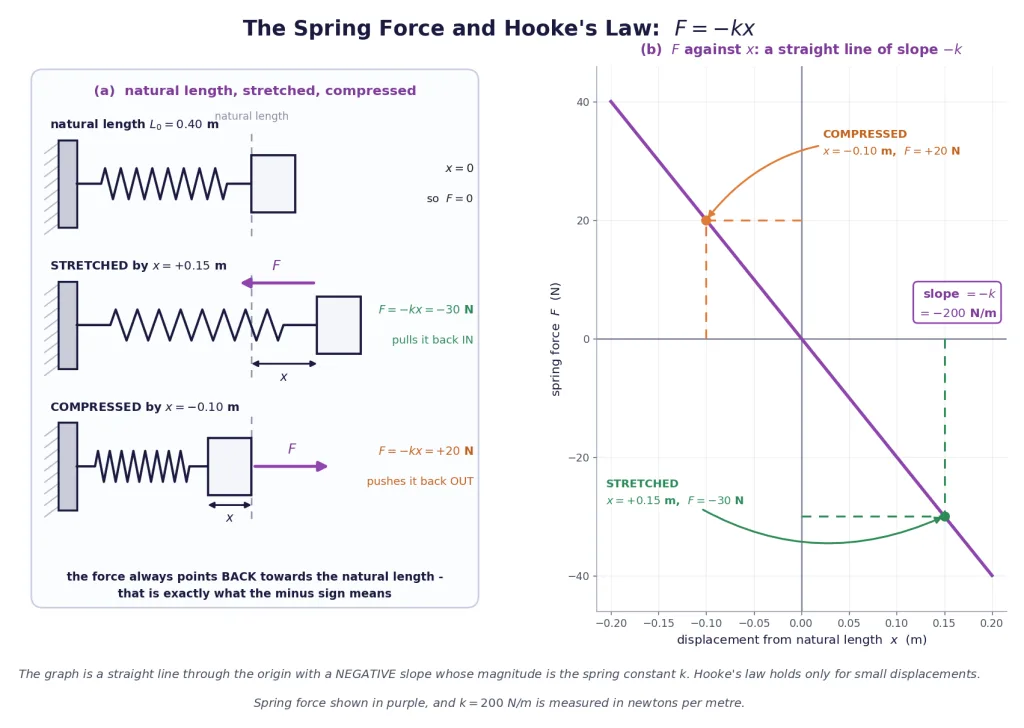
In the figure, N/m. Stretch it by 0.15 m and N, pulling inward. Compress it by 0.10 m and N, pushing outward. In both cases the arrow points back towards the dashed natural-length line.
[JEE Tip] For magnitudes only — which is all most problems need — just write and put the direction in by hand, towards the natural length. Use the signed form when you are doing components, or when the spring force appears in a differential equation (which is where Chapter 14, Oscillations, will pick this up).
The spring constant
Key Point: is the force needed per unit extension, in N/m. It measures the stiffness of the spring.
- A large means a stiff spring: a big force produces a small stretch.
- A small means a soft spring.
- is a property of the spring itself — its material, its wire thickness, its coil radius, and its length.
And this is where the earlier remark about strings suddenly makes sense: for an inextensible string, the force constant is very high. A string is the limit of a spring. That is why a string transmits a force without stretching, and why you never write for a string — you just call the force and treat it as an unknown.
[JEE Tip] depends on the length: a spring of natural length and constant , cut in half, gives two springs each of constant . Halving the length doubles the stiffness, because each half only has to take half the total stretch. Springs in series and in parallel, and spring-block systems with sudden changes, are Section 10's territory.
The graph, and the two things to read off it
Panel (b) of the figure plots against . It is a straight line through the origin with a negative slope:
Two exam-standard readings:
- The magnitude of the slope is . Given a graph, that is how you find the spring constant.
- The area under a force-extension graph is the work done, which for a spring is — the elastic potential energy. Chapter 5 does this properly; just note that the area is a triangle, so the is nothing mysterious.
Where Hooke's law stops working
Key Point: Hooke's law holds only for small deformations. Stretch a spring too far and the graph bends away from the straight line (the elastic limit), and beyond that the spring is permanently deformed and never returns to its natural length. Every problem in this chapter assumes you are safely inside the linear region.
And this is how a spring balance works
Hang a mass from a spring and it stretches until the spring force balances the weight:
The extension is proportional to the weight, so a linear scale printed alongside the spring reads weight directly. That is the whole design — which is also why, as Section N2 said, a spring balance measures weight and its readings change with .
The Four Forces on One Card, and the Mistakes to Avoid
The reference card
| Force | Symbol | Magnitude | Direction | Sign constraint |
|---|---|---|---|---|
| Weight | vertically down | always present | ||
| Normal reaction | an unknown - solve for it | perpendicular to the surface | , a push only | |
| Tension | an unknown - solve for it | along the string, away from the body | , a pull only | |
| Spring force | (magnitude) | back towards the natural length | , always restoring |
The middle column is the real lesson. Weight and the spring force come with formulas. Normal reaction and tension do not. and are unknowns that adjust themselves to whatever the situation demands, and you find them by writing Newton's second law and solving. Guessing them is the fastest way to a wrong answer.
The mistakes that cost marks
- Writing by reflex. It is true only on a horizontal surface with no other vertical force and no vertical acceleration. Check all three conditions before you use it.
- Confusing mass with weight. Mass is a scalar in kilograms; weight is a vector in newtons. "A weight of 5 kg" is not a sentence in physics.
- Thinking weight becomes zero in free fall. It does not. The apparent weight — the reading of the supporting balance — becomes zero. The Earth is still pulling with .
- Using the same for two different strings. One continuous string, one tension. Two strings, two symbols.
- Forgetting that and can only push and pull respectively. A negative answer for either means the contact broke or the string went slack, not that the arithmetic is fine.
- Dropping the minus sign in , and then being unable to say which way the spring pushes.
- Resolving on an incline the wrong way round. and the along-slope component is . If you ever get , check by putting : a flat surface must give , and does, while obviously does not.
- Mixing values of . Pick 9.8 or 10 as the question specifies, and stay with it.
A 30-second self-test
- A 2 kg block sits on a table. Someone presses down on it with 15 N. What is ? N.
- Same block, but now pulled by a 15 N string at above the horizontal. What is ? N.
- A spring of N/m is compressed by 5 cm. What force does it exert, and which way? 5 N, pushing outward, away from the compression.
- A rope holds a 3 kg lamp from the ceiling of a lift that is descending at a constant 4 m/s. What is ? Constant velocity means , so N. The 4 m/s is a distractor.
Where this goes next
You now have the vocabulary. The next three sections turn it into technique.
- Section 5 builds the free-body diagram into a disciplined method and does equilibrium of a particle, including Lami's theorem.
- Section 6 takes on friction, the other contact force — static, kinetic and rolling — and finally completes the contact-force pair with .
- Section 8 applies all of it to connected bodies, pulleys and lifts, where and stop being single unknowns and become systems of simultaneous equations.
- Section 10 picks up the JEE extensions flagged along the way: strings with mass, springs in series and parallel, and spring-block systems.
Solved Examples
A note on before we start: every example below uses m/s^2 on the Earth and m/s^2 on the Moon, and states which one it is using. No problem mixes two values.
Example 1: Mass and weight on a tour
A student has a mass of 70 kg. Find (a) her weight on the Earth, where m/s^2, and (b) her weight on the Moon, where m/s^2. (c) What is her mass on the Moon? (d) If she stands on a spring balance and on a beam balance in both places, what does each read?
Solution:
(a) Weight on the Earth.
(b) Weight on the Moon. The ratio is , so she weighs almost exactly one sixth as much.
(c) Mass on the Moon. 70 kg. Mass is the amount of matter in a body and the measure of its inertia. Moving the body does not change how much matter it contains. Mass is the same everywhere in the universe.
(d) The two balances.
- The spring balance measures the force stretching its spring, so it reads 686 N on the Earth (or "70 kg" on a scale pre-divided by 9.8) and 114.1 N on the Moon (which the same scale would misreport as about 11.6 kg).
- The beam balance compares her mass against standard masses, and both pans sit in the same , which therefore cancels. It reads 70 kg in both places.
Final Answer: (a) 686 N; (b) 114.1 N; (c) still 70 kg; (d) the spring balance reads differently in the two places, the beam balance reads 70 kg in both.
Takeaway: The whole distinction lives in that last line. A spring balance measures weight and a beam balance measures mass, and the difference only shows up when you change . This is why space agencies quote a spacecraft's mass, never its weight — the weight would be meaningless once it left the launch pad.
Example 2: A block with an extra push on it
A block of mass 10 kg rests on a horizontal floor. Take m/s^2. Find the normal reaction on the block (a) when nothing else acts, and (b) when a person presses down on it with a vertical force of 30 N. (c) In case (b), with what force does the block press on the floor?
Solution:
(a) Draw the FBD and resolve vertically. Two forces act: the weight downward and the normal reaction upward. The block is at rest, so :
(b) Add the push and redo the SAME step. Now three forces act vertically: up, down, and N down. Still :
(c) Now use the third law (Section 3). The floor pushes the block up with 128 N, so the block pushes the floor down with 128 N. That is the genuine action-reaction partner of .
Final Answer: (a) N; (b) N; (c) the block presses on the floor with 128 N.
Takeaway: Notice that the increase in is exactly the extra push, 30 N. The floor takes up whatever load is placed on it. And notice what did not happen: nobody looked up a formula. The same three-step routine — draw the FBD, resolve perpendicular to the surface, set — gives in every single case in this section.
Example 3: A block pulled by a string at an angle
A block of mass 10 kg on a horizontal floor is pulled by a light string with a force of 40 N directed at above the horizontal. Take m/s^2. Find (a) the normal reaction, and (b) the force at this angle that would just lift the block clear of the floor.
Solution:
Resolve the pull into components.
(a) Second law vertically. The block stays on the floor, so there is no vertical acceleration:
(b) The block leaves the floor exactly when contact is lost, that is when .
Final Answer: (a) N, considerably less than N; (b) a pull of 196 N at would just lift the block off.
Takeaway: Two lessons. First, the vertical component of the pull carries part of the load, so falls below — and since friction (Section 6) is proportional to , this is exactly why pulling a heavy suitcase by an inclined handle is easier than pushing it. Second, the condition "just leaves the surface" always means . Whenever a question says lifts off, loses contact, or is about to leave, write and the rest is algebra.
Example 4: A block on an incline
A block of mass 10 kg rests on a smooth plane inclined at to the horizontal. Take m/s^2. Find (a) the normal reaction on the block, and (b) the component of the weight along the plane.
Solution:
Choose axes intelligently. Take one axis along the slope and the other perpendicular to it. This is the single decision that makes incline problems easy, because then lies entirely along one axis and the acceleration lies entirely along the other.
Resolve the weight in those axes. The weight points straight down. The angle between and the inward normal to the slope equals the angle of the incline, . So:
(a) Second law perpendicular to the plane. The block does not leave the surface, so the perpendicular acceleration is zero:
(b) The along-slope component. Since the plane is smooth, nothing opposes this, and the block slides down with m/s^2.
Final Answer: (a) N; (b) the along-slope component of the weight is 49 N.
Takeaway: N is well below N, and it must be: only part of the weight presses into the slope. Two checks worth doing every time. Put : you should recover , and delivers it. Put : the surface is vertical, nothing presses on it, and gives . If your formula fails either check, you have swapped the sine and the cosine.
Example 5: The lift
A person of mass 60 kg stands on a weighing machine in a lift. Take m/s^2. Find the reading of the machine (that is, the normal reaction) when the lift is (a) accelerating upward at 2.0 m/s^2, (b) accelerating downward at 2.0 m/s^2, (c) moving with constant velocity, and (d) in free fall after the cable snaps. In each case, what is the person's actual weight?
Solution:
The FBD is the same every time. Two forces on the person: up from the machine and N down. Take upward as positive, so the second law reads where carries its own sign.
(a) Accelerating up, :
(b) Accelerating down, :
(c) Constant velocity, : It makes no difference whether the lift is going up, going down, or standing still — only the acceleration matters.
(d) Free fall, :
And the actual weight, in every one of the four cases: N. It never changed.
Final Answer: (a) 708 N; (b) 468 N; (c) 588 N; (d) 0 N. The true weight is 588 N throughout.
Takeaway: The machine never measures your weight. It measures the normal reaction, which is what we call your apparent weight — and in free fall that goes to zero even though gravity has not weakened by a hair. This is exactly the "weightlessness" astronauts experience: the space station and everything in it are in continuous free fall around the Earth. Section 8 gives the lift its full treatment, including starting and stopping and the maximum-load questions.
Example 6: Two blocks hanging in a chain
A block of mass 5.0 kg hangs from the ceiling by a light string. A second block of mass 3.0 kg hangs from the first by another light string. Take m/s^2. Find the tension in each string (a) when the system is at rest, and (b) when the whole system is being pulled upward with an acceleration of 2.0 m/s^2.
Solution:
Name the two tensions separately. Let be the tension in the upper string (ceiling to the 5 kg block) and the tension in the lower string (5 kg block to the 3 kg block). These are two different strings, so there is no reason on earth for them to be equal.
FBD of the lower block (3.0 kg): up, N down.
FBD of the upper block (5.0 kg): up, its own weight N down, and pulling down on it (the lower string pulls the upper block toward the lower block — Newton's third law at that knot).
(a) At rest, . From (1): N. Substituting into (2): N.
(b) Accelerating up at . From (1): N. From (2): N.
Cross-check both answers. The upper string carries the entire hanging system, of total mass 8.0 kg:
Final Answer: (a) N, N; (b) N, N.
Takeaway: — not even close. One string, one tension; a different string, a different tension. Writing a single for both is the commonest tension error there is. And notice the check in step 6: the upper string always supports everything below it, which gives you a free way to verify in any hanging chain.
Example 7: A string over an ideal pulley
A light inextensible string passes over a massless, frictionless pulley fixed to the ceiling. A block of mass 4.0 kg hangs from each end. Take m/s^2. Find (a) the acceleration of the system, (b) the tension in the string on each side, and (c) the force the string exerts on the pulley.
Solution:
Set up. Because the string is inextensible, if one block goes down by some amount the other goes up by the same amount, so both have accelerations of the same magnitude , in opposite directions. Because the string is light and the pulley ideal, the tension is the same on both sides; call it .
FBD of the left block (take down as positive for this one):
FBD of the right block (take up as positive for this one, since it moves the other way):
(a) Add (1) and (2): The system stays put, which is what equal masses on a pulley must do.
(b) Put into (1): And the same acts on the other side, by the ideal-pulley property.
(c) The force on the pulley. Both sides of the string pull downward on the pulley with each, so the total downward pull on the pulley is
Final Answer: (a) ; (b) N on both sides; (c) the string pulls the pulley down with 78.4 N.
Takeaway: Two habits from this. First, the ideal pulley delivers equal on both sides, which is what made the two equations combine so cleanly. Second, the answer to (c) is , not — a beginner's trap. The pulley feels both sides of the string. (Had the two masses been unequal, would not be zero and the force on the pulley would be with a different ; the unequal-mass Atwood machine is Section 8's job.)
Example 8: Force from a spring
A spring of force constant 250 N/m is stretched by 8.0 cm from its natural length. (a) What is the magnitude and direction of the force it exerts on the block attached to its free end? (b) What would it be if the spring were compressed by 8.0 cm instead? (c) What extension would produce a 40 N force?
Solution:
Convert the units first. cm m. This conversion is where most of the marks are lost, because is in newtons per metre.
(a) Apply Hooke's law. The magnitude is 20 N, and the minus sign means it is opposite to the displacement — the spring pulls the block back inward, towards the natural length.
(b) Compressed by the same amount means m: Same magnitude, 20 N, but the sign is now positive: the spring pushes the block outward, again towards the natural length.
(c) Set the magnitude to 40 N:
Final Answer: (a) 20 N, pulling inward; (b) 20 N, pushing outward; (c) an extension of 0.16 m, or 16 cm.
Takeaway: Parts (a) and (b) give the same magnitude and opposite directions, and both point back towards the natural length — that is the entire content of the minus sign. Part (c) shows the linearity: doubling the force from 20 N to 40 N doubles the extension from 8 cm to 16 cm, which is what makes the - graph a straight line.
Example 9: How a spring balance works
A mass of 2.5 kg is hung from a spring balance whose spring has a force constant of 500 N/m. Take m/s^2. Find the extension of the spring at equilibrium, and explain why the balance can carry a linear scale.
Solution:
FBD of the hanging mass. Two forces: the spring force pulling up and the weight pulling down. At equilibrium the net force is zero:
Substitute:
Why the scale can be linear. The relation says the extension is directly proportional to the weight hung on it. Equal steps in weight give equal steps in extension, so the markings can be evenly spaced — which is exactly what you see on a real spring balance.
Final Answer: The extension is 0.049 m, that is 4.9 cm.
Takeaway: This one equation is why a spring balance exists. It also settles a question from Section N2: the instrument responds to , so it is measuring a force, and its readings change with . Take this same balance to the Moon, hang the same 2.5 kg on it, and the extension drops to m, barely 0.8 cm.
Example 10: Finding the spring constant from measurements
A spring stretches by 4.0 cm when a force of 12 N is applied to it. Take m/s^2. Find (a) its spring constant, (b) the force needed to stretch it by 10 cm, and (c) the mass that must be hung from it to produce that 10 cm extension.
Solution:
(a) Read straight off the definition. Working with magnitudes: In words: this spring needs 300 N for every metre of stretch, or 3 N for every centimetre.
(b) Use the same constant at the new extension.
(c) That force must be supplied by a hanging weight, so N:
Final Answer: (a) N/m; (b) 30 N; (c) about 3.06 kg.
Takeaway: Two habits worth locking in. Convert centimetres to metres before touching — 4.0 cm is 0.040 m, and forgetting this scales your answer by 100. And note the shortcut hiding in part (b): since , going from 4 cm to 10 cm is a factor of 2.5, and N with no need for at all.
Example 11: Pushing a block at an angle below the horizontal
A block of mass 8.0 kg on a horizontal floor is pushed with a force of 50 N directed at below the horizontal. Take m/s^2. Find the normal reaction, and compare it with the case where the same force is applied horizontally.
Solution:
Resolve the applied force. Pushing downward at below the horizontal gives:
Second law vertically. The block stays on the floor, so , and the vertical forces are up, down, and down:
Compare with the horizontal case. A purely horizontal push has no vertical component, so it leaves N unchanged.
Final Answer: N, which is 25 N more than the 78.4 N you would get with a horizontal push.
Takeaway: Compare this with Example 3 and the pattern is complete. Pull at an angle above the horizontal and falls; push at an angle below it and rises. Since friction is proportional to (Section 6), that is the whole physics of why it is easier to pull a heavy crate than to push it — and why a lawnmower, which you must push downward at an angle, is such hard work.
Example 12: A body that weighs 98 N on Earth
A body weighs 98 N on the surface of the Earth, where m/s^2. (a) What is its mass? (b) What is its weight on the Moon, where m/s^2? (c) What is its weight inside a lift that is in free fall, and what does a spring balance attached to it read there?
Solution:
(a) Invert .
(b) Same mass, new .
(c) The free-fall case, and this is the part that catches people.
- The weight is still . The lift's motion has no effect whatsoever on how hard the Earth pulls the body.
- The spring balance reading is the normal reaction (or the spring's pull), which follows from the second law with :
Final Answer: (a) kg; (b) 16.3 N on the Moon; (c) the weight is still 98 N, but the spring balance reads zero.
Takeaway: Part (c) is the definitive statement of the mass-weight-apparent-weight distinction, and it is worth reciting: mass never changes, weight changes only when changes, and apparent weight changes whenever the body accelerates vertically. An astronaut floating in the space station has exactly the same mass she had on the launch pad, very nearly the same weight (the station is only 400 km up, where is still about 8.7 m/s^2), and an apparent weight of zero — because she and the station are falling together.