
Equilibrium of a Particle
Sections 1 to 4 gave you the laws and the vocabulary of forces. From here on the chapter is about technique — turning a physical situation into equations you can actually solve. And the cleanest place to start is the case where the arithmetic is easiest: when nothing accelerates.
The definition
Key Point — equilibrium of a particle: A particle is in equilibrium when the net external force on it is zero. Because a vector is zero only when every one of its components is zero, this single vector equation is really two scalar equations in a plane problem (three in space):
That is the whole idea. Everything else in this section is about setting up those two equations without making a mistake.
Why "particle", and what "concurrent" means
We say particle because we are treating the body as a point with no size. That matters more than it sounds: if a body has no size, every force acting on it must act at that same point. Forces that all act at a single point are called concurrent forces.
For concurrent forces, is the complete condition for equilibrium. For a real extended body you would also need the turning effects to balance — zero net torque — which is exactly what stops a ladder from rotating even when the forces on it add to zero. That is Chapter 7's job. In this chapter, whenever we say "equilibrium", we mean the translational condition .
[Board Important] A one-line answer worth memorising: for a particle, all forces are concurrent, so translational equilibrium alone is sufficient; an extended body needs rotational equilibrium too.
Static and dynamic equilibrium — both are equilibrium
Here is the thing students trip on. Zero net force means zero acceleration. It does not mean zero velocity. Section 1 made this point about the first law, and it pays off here:
| Type | What the body is doing | ||
|---|---|---|---|
| Static equilibrium | at rest, and staying at rest | ||
| Dynamic equilibrium | moving with constant velocity | constant, non-zero |
Key Point: Both cases obey exactly the same equation, . A parachutist drifting down at a steady 5 m/s and a lamp hanging still from the ceiling are doing the same physics. You write the same equations for both.
[JEE/NEET] This is a favourite trap. "A body moves with uniform velocity, therefore no force acts on it" is wrong — forces may act, but they must cancel. And "a body is momentarily at rest, therefore it is in equilibrium" is also wrong — a ball at the top of its flight has but downward, and it is not in equilibrium for even an instant.
Two forces, three forces, forces
The general condition specialises in some useful ways.
Two forces. If only and act, then The two forces are equal in magnitude, opposite in direction, and along the same line. A book resting on a table is the everyday example: up, down, equal and opposite. (And a reminder from Section 3 — that is not an action-reaction pair. They act on the same body.)
Three forces. If , and act, equilibrium requires Read this two ways, and both are useful:
- The resultant of any two must be equal and opposite to the third. So if you find by the parallelogram law, it must exactly cancel .
- The three vectors, drawn head to tail, form a closed triangle. Three forces that add to zero must therefore be coplanar as well as concurrent — you cannot close a triangle otherwise.
Any number of forces. The same picture generalises beautifully:
Key Point — the polygon law: A particle is in equilibrium under if and only if those vectors, drawn head to tail in any order, form a closed polygon with all arrows going the same way round.
The one form you will actually use
The triangle and polygon pictures are excellent for understanding and for quick checks. But for calculation, resolve into components every time: Two equations, so you can find at most two unknowns from one particle. If a problem has three unknowns, you will need a second body — a second free-body diagram — and that is the whole trick behind connected systems in Section 8.
The Free-Body Diagram: the Method
If you learn one skill from this chapter, make it this one. The free-body diagram (FBD) is what turns a messy picture of pulleys and inclines and strings into two clean equations. Every problem from here to the end of mechanics starts with one.
The idea is almost embarrassingly simple: look at exactly one body at a time, and draw only the forces acting on it. The difficulty is entirely in the discipline.
The five steps
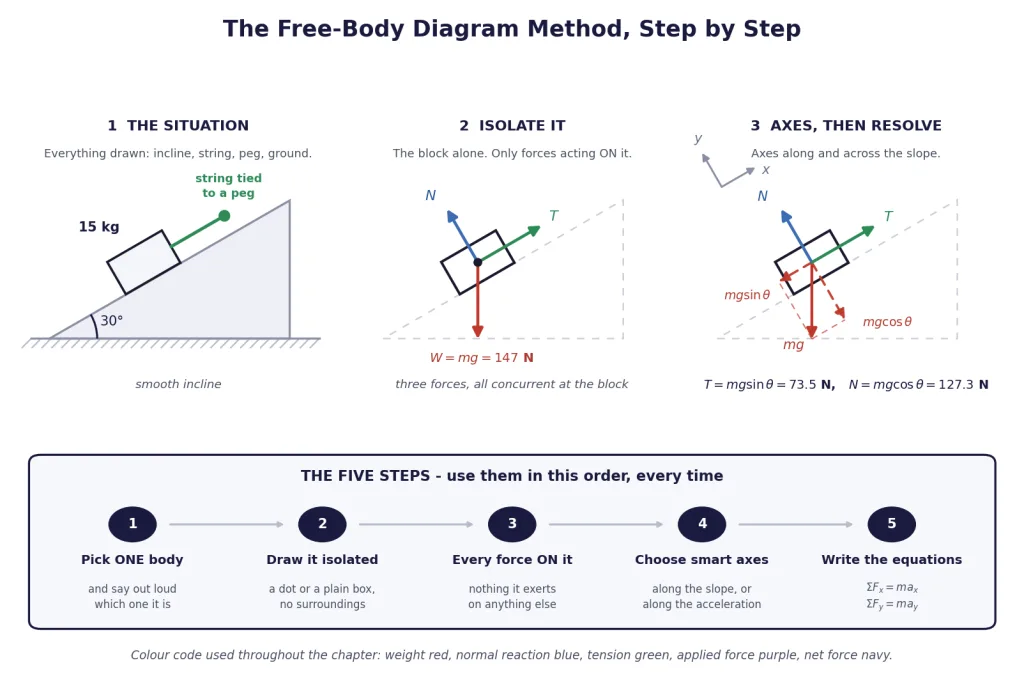
Key Point — the FBD recipe:
- Choose ONE body (or one system) to isolate, and say out loud which one it is.
- Draw it alone — a dot or a plain box — mentally erased from its surroundings. No incline, no string, no table.
- Draw every force acting ON it, and nothing else. Every arrow must start on the body.
- Choose axes that make life easy — along the incline for an incline problem, along the acceleration whenever there is one.
- Resolve and write and . In equilibrium the right-hand sides are zero.
Walking through the figure
The picture above is one problem in three stages. A 15 kg block sits on a smooth incline at , held by a string running up the slope. Take m/s^2.
Stage 1 — the situation. Everything is drawn: the wedge, the ground, the string, the peg. This is what the question gives you, and it is not a free-body diagram.
Stage 2 — isolate. Now the block, and only the block. Ask at each point of contact, "what touches it, and what does that contact do?"
- The Earth pulls it down: N, drawn in red.
- The surface touches it and pushes perpendicular to itself: , in blue.
- The string touches it and pulls along its own length: , in green.
Three contacts, three forces. Notice what is absent: no wedge, no ground, and no arrow for the force the block presses back on the wedge with.
Stage 3 — axes, then resolve. Take along the slope and perpendicular to it. Now and each lie entirely along one axis, and only the weight needs resolving, into down the slope and into the slope. The equations write themselves:
How to choose the axes
Step 4 is where a good student separates from a slow one. Two rules cover almost everything:
Key Point — choosing axes:
- If there is an acceleration, put one axis along it. Then has only one component and the other equation reads .
- If everything is in equilibrium, put one axis along whichever direction kills the most unknowns — usually along a surface, along a string, or along one of the forces you do not know.
On an incline, always take the axes along and perpendicular to the slope, never horizontal and vertical. If you use horizontal and vertical axes on an incline you will end up resolving , and the acceleration, which is three times the algebra for the same answer.
Two habits that pay for themselves
Say why each arrow is there. Every force on a real FBD has a source you can name: the Earth (weight), a surface in contact ( and friction), a string (), a spring, or something explicitly pushing or pulling. If you cannot name the source, delete the arrow.
Count contacts first, then draw. Go round the boundary of your isolated body. Every place something touches it contributes at most two forces — one perpendicular to the surface () and one parallel to it (friction, coming in Section 6). Then add weight, which acts without contact. That count is your checklist.
[JEE Tip] The FBD is also how you choose what to isolate. Want the tension inside a string joining two blocks? Then that string must be cut — isolate just one block, and appears as an external force on it. Want only the acceleration of the whole thing? Isolate the whole system, and the internal tensions vanish because they cancel in pairs. Picking the right body is half the skill.
What NOT to Draw on a Free-Body Diagram
More marks are lost to arrows that should not be there than to arrows that are missing. Here are the three that appear again and again.
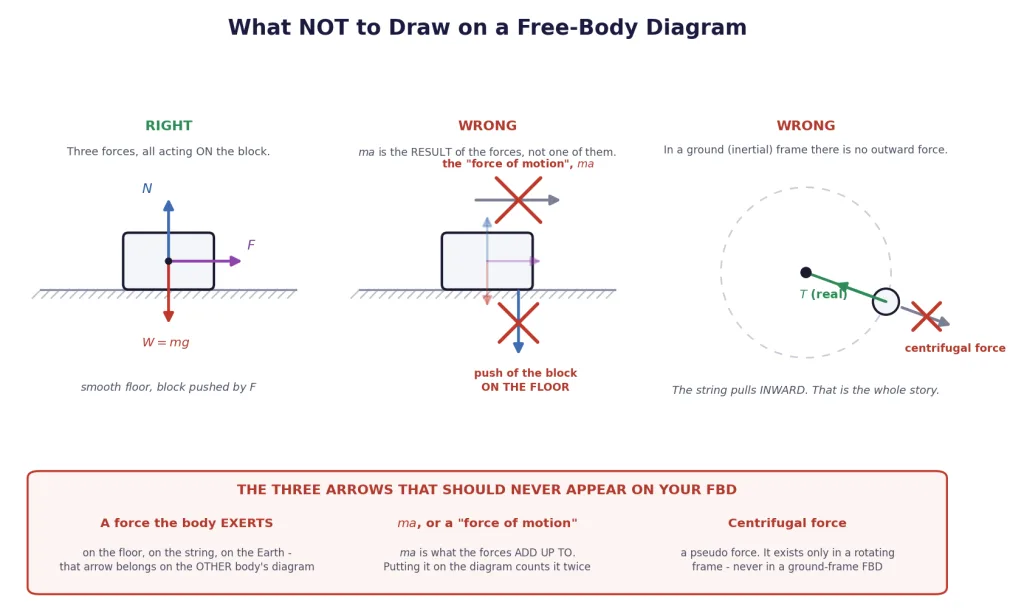
Wrong arrow 1: a force the body EXERTS on something else
A block rests on the floor. The floor pushes up on the block with ; the block pushes down on the floor with . Newton's third law says and are equal and opposite — and Section 3 hammered home why they never cancel: they act on different bodies.
So on the FBD of the block, you draw (upward, from the floor) and you must not draw . acts on the floor. It belongs on the floor's diagram, not the block's.
Key Point — the swap test: Before you draw any arrow, finish this sentence: "This is the force of __ on the body I have isolated." If the second blank is not your isolated body, the arrow does not belong.
Wrong arrow 2: , or "the force of motion"
There is no such thing as a "force of motion". A moving body does not carry a forward force with it — that was Aristotle's mistake, demolished back in Section 1.
And is not a force either. It is what the forces add up to: Drawing as one more arrow and then setting the total to counts the same thing twice, and produces equations like , which are simply wrong.
[NEET Important] If a question gives you the acceleration, mark it beside the diagram with a labelled arrow and the word "", clearly separated from the force arrows — many textbooks draw it in a different colour or outside the body. Never mix it in with the forces.
Wrong arrow 3: centrifugal force, in a ground frame
Whirl a stone on a string. In the frame of the ground, the only horizontal force on the stone is the tension, pulling inward. That inward force is what makes the stone turn instead of flying off straight; there is no outward force at all.
The outward "centrifugal force" is a pseudo force — a bookkeeping term you are allowed to add only when you deliberately work in a rotating (non-inertial) frame. Section 7 does circular motion properly in the ground frame, and Section 10 shows how pseudo forces work when you want them. In a normal ground-frame FBD, an outward arrow is a mistake.
The positive checklist
Wrong arrows are half the problem; missing arrows are the other half. Run this list every time:
| Ask | If yes, draw |
|---|---|
| Is the body in a gravitational field? | one weight , straight down |
| Does a surface touch it? | perpendicular to that surface, pushing away from it |
| Does a rough surface touch it? | friction parallel to the surface (Section 6) |
| Is a string attached? | along the string, away from the body — strings only pull |
| Is a spring attached? | back towards the natural length |
| Is something pushing or pulling it explicitly? | that applied force, in the stated direction |
And then a final sanity check, worth ten seconds:
- Does every arrow start on the body? Forces act on it, not near it.
- Can I name the source of each arrow? "The floor", "the Earth", "the string" — if the answer is "the motion" or "the inertia", delete it.
- Have I drawn any force the body exerts? Delete those too.
- Do the arrows make physical sense? pushes, never pulls. pulls, never pushes. Both are .
Lami's Theorem
When exactly three concurrent forces hold a particle in equilibrium, there is a shortcut that skips the resolving entirely.
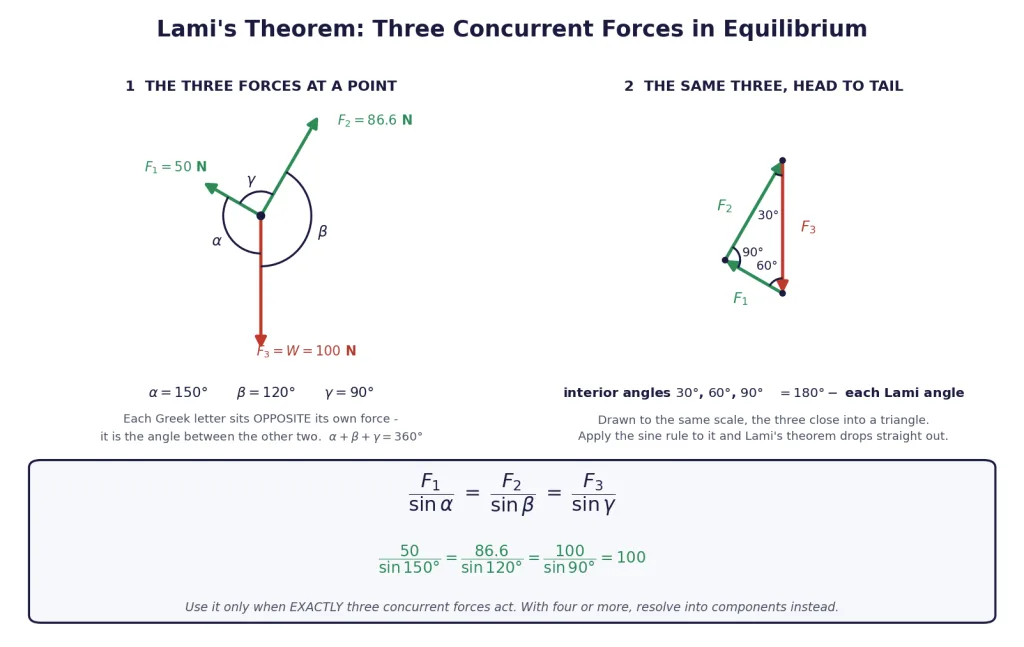
The statement
Key Point — Lami's theorem: If three concurrent, coplanar forces , , keep a particle in equilibrium, then each force is proportional to the sine of the angle between the other two: where is the angle opposite (that is, the angle between and ), is opposite , and is opposite . Since the three angles fill the space around the point, .
The word to underline is opposite. Getting the pairing wrong is the only real way to misuse this theorem. A quick self-check: the largest force must sit opposite the largest angle, exactly as in a triangle.
Where it comes from
The derivation is three lines, and it is worth knowing because it explains the pairing.
Step 1. The three forces add to zero, so drawn head to tail they close into a triangle — the right-hand panel of the figure. Call its interior angles , , , opposite the sides of length , , .
Step 2. Apply the sine rule to that triangle:
Step 3. Relate the triangle's interior angles to the angles between the actual force arrows. When you carry a vector round to draw it head to tail, its direction is preserved but the angle you see inside the triangle is the supplement of the angle between the arrows at the point: (Consistency check: , exactly as a triangle demands.)
Step 4. And since , the sine rule becomes which is Lami's theorem. It is the sine rule wearing a different hat.
The worked case from the figure
A 10 kg block ( m/s^2, so N) hangs from two strings that make and with the ceiling. The three forces at the knot are , and , with Two lines, no simultaneous equations. Resolving into components gives exactly the same pair of numbers — Example 3 and Example 4 do it both ways side by side.
When to use it, and when not to
| Situation | Use Lami? | Why |
|---|---|---|
| Exactly 3 concurrent coplanar forces, angles known | Yes | fastest route, one line per unknown |
| 3 forces but you need components anyway | either | resolving is just as quick |
| 4 or more forces | No | the theorem simply does not apply |
| Forces not concurrent (an extended body, torques) | No | needs rotational equilibrium too |
| Not in equilibrium () | No | the triangle does not close |
Key Point: Lami's theorem is a special-case shortcut, not a replacement for resolving. and work for three forces, four forces, seventeen forces, and for problems with acceleration. Lami works only for three forces in equilibrium. Learn the general method first; use the shortcut when it fits.
[JEE Tip] In an exam, if you can see three forces and the angles between them, Lami will typically save you 30 to 40 seconds. If you find yourself hunting for the angles, the geometry is fighting you — just resolve instead.
The Four Equilibrium Archetypes
Nearly every equilibrium question you will meet is one of four situations wearing a costume. Learn these four and you have covered the ground.
Archetype 1: a mass hanging from two strings
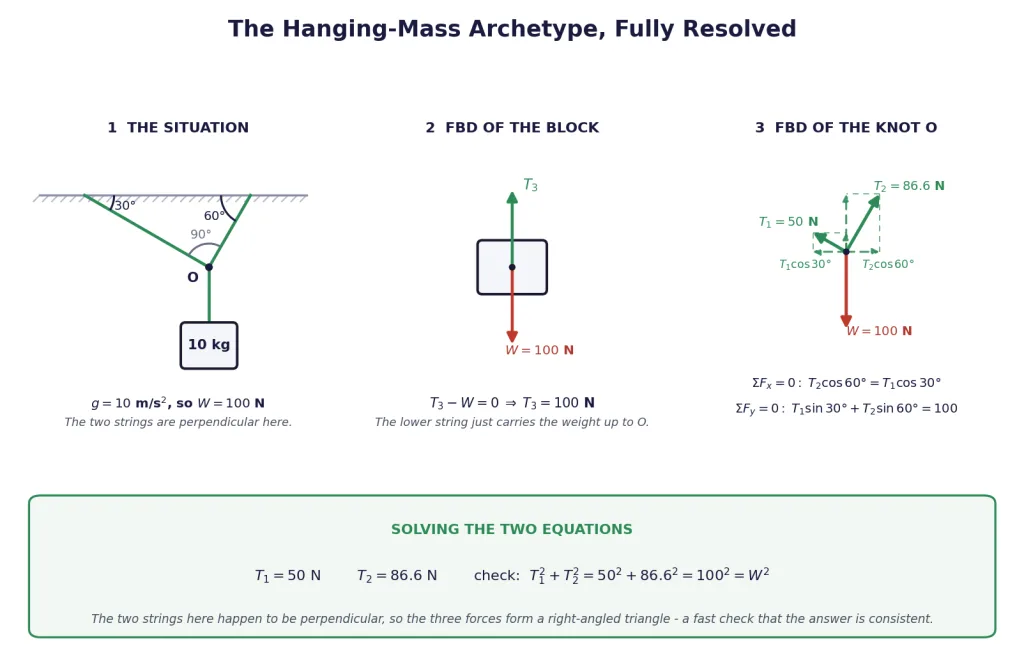
This is the archetype, and the figure shows why it needs two free-body diagrams, not one.
FBD of the block — two forces, up and down:
FBD of the knot O — three forces, , and the downward pull transmitted by the lower string. With the strings at angles and to the horizontal ceiling:
Solving those two gives the general result
Three consequences worth carrying in your head:
- The steeper string carries more. In the figure, and , and N beats N. More vertical means more of the weight.
- Symmetric case: with both strings at , .
- As (the strings pulled almost horizontal), and . You can never pull a loaded string perfectly straight. This is why a tightrope always sags, and why a tow rope pulled sideways from the middle can snap a car free — Example 9 puts numbers on it.
Archetype 2: a block on a smooth incline, held in place
Two versions, and they give different answers. Take a mass on a smooth incline of angle .
(a) String parallel to the incline. Axes along and across the slope:
(b) String (or push) horizontal. Now the horizontal force also presses the block into the slope. Resolving along and across the slope:
Key Point: In case (b), — a genuinely counter-intuitive result and a favourite MCQ. Squeezing the block against the slope horizontally makes the surface push back harder than the block's own weight. Compare with case (a), where .
Archetype 3: a sideways force on a hanging rope
A mass hangs from a rope; a horizontal force is applied at a point on the rope, pushing it sideways. This archetype appears constantly.
At there are three forces: the upper tension along the rope, the lower tension pulling straight down, and the applied sideways. If the upper rope makes angle with the vertical:
[JEE/NEET] Two facts about this result that examiners love. The angle depends only on the ratio — not on the length of the rope, and not on where along the rope you push. And if exactly, then and .
Archetype 4: a sign on a bracket
A shop sign of weight hangs from the end of a horizontal rod fixed to a wall, with a cable running from the wall down to the rod's end at angle to the rod. At the joint, three forces act: down, the cable tension along the cable, and the rod's push outward along the rod.
The lesson here is about direction, not algebra. A string can only pull, so tension always points away from the joint along the string. A rigid rod can also push, and a rod under compression pushes outward on the joint. Get that direction wrong and every sign in your equations flips. When is small — a nearly horizontal cable — becomes enormous, the same blow-up as in Archetype 1.
The four on one card
| Archetype | Set-up | The result |
|---|---|---|
| Two strings | mass hung at a knot, angles , to the horizontal | ; symmetric case |
| Incline, string along slope | smooth incline | , |
| Incline, horizontal string | smooth incline | , |
| Rope pushed sideways | force at a point on a hanging rope | , |
Mistakes That Cost Marks, and Where This Goes Next
The checklist
- Treating "at rest for an instant" as equilibrium. A ball at the top of its flight, or a block at the extreme of an oscillation, has but . Equilibrium is about acceleration, never about speed.
- Thinking uniform velocity means no forces. It means the forces cancel. A car cruising at a steady 80 km/h has a large engine thrust and an equally large resistance.
- Drawing the reaction the body exerts. The commonest wrong arrow of all. It belongs on the other body's diagram.
- Putting on the diagram. is the right-hand side of the equation, not one of the arrows on the left.
- Using horizontal and vertical axes on an incline. Legal, but three times the work. Go along and across the slope.
- Using Lami's theorem with four forces. It applies to exactly three concurrent forces. With four, resolve.
- Pairing the Lami angles wrongly. Each angle goes with the force opposite it — the angle between the other two.
- Assuming on an incline. Section 4 warned you: it is there, and when a horizontal force presses the block into the slope.
- Using one symbol for two different strings. One continuous string over a smooth pulley has one tension. Two separate strings need two symbols.
- Mixing values of . Use whichever the question specifies — 9.8 or 10 — and stay with it to the end.
A 60-second self-test
- A lift moves downward at a constant 3 m/s. Is the person inside in equilibrium? Yes — constant velocity means , so . Dynamic equilibrium.
- Three forces of 5 N, 12 N and 13 N hold a particle in equilibrium. What is the angle between the 5 N and the 12 N forces? They form a -- right triangle, so the angle opposite the 13 N force is — that is the angle between the 5 N and 12 N forces.
- A 2 kg mass hangs from two strings, each at to the vertical. Take m/s^2. Find each tension. Each string makes with the vertical, so , giving N.
- On the FBD of a book lying on a table, how many arrows should there be? Two — the weight down and the normal reaction up. Not three, and definitely not the book's push on the table.
Where this goes next
The FBD method you have just learned is the spine of everything that follows.
- Section 6 adds friction, the last common force and the one that makes FBDs interesting — because its magnitude is not given to you, it adjusts itself.
- Section 7 applies the same recipe to circular motion, where is not zero but points to the centre with magnitude .
- Section 8 takes the recipe to connected bodies, pulleys and lifts, where you draw one FBD per body and solve the equations together.
- Section 10 stretches it to non-inertial frames, where a pseudo force is deliberately added to the diagram — the one situation where an "extra" arrow is legitimate.
Solved Examples
Example 1: A rope pushed sideways
A mass of 6 kg is suspended by a rope of length 2 m from the ceiling. A force of 50 N in the horizontal direction is applied at the mid-point P of the rope. What angle does the upper part of the rope make with the vertical in equilibrium, and what is the tension in it? Take m/s^2 and neglect the mass of the rope.
Solution:
Two bodies, two diagrams. Isolate the 6 kg block first, then the point P.
FBD of the block. Two forces: the lower tension up and the weight down.
FBD of the point P. Three concurrent forces act here: the upper tension along the rope towards the ceiling, the applied force 50 N horizontally, and the lower rope pulling down with N. Let be the angle of the upper rope with the vertical. Resolving:
Divide to get the angle.
Square and add to get the tension.
Final Answer: with the vertical; N and N.
Takeaway: Notice what the answer does not contain: the length of the rope, and the position of P. As long as the rope is massless, pushing at the middle, a third of the way down or anywhere else gives the same angle — because the angle depends only on the ratio . Exactly this point is a standard one-mark follow-up question.
Example 2: The recipe end to end — a lamp on two symmetric strings
A 10 kg lamp hangs from the ceiling by two strings, each making with the horizontal ceiling. Take m/s^2. Find the tension in each string.
Solution:
Step 1 — choose the body. The knot where the two strings and the lamp meet.
Step 2 and 3 — isolate and draw. Three forces: up-left along one string, up-right along the other, and the pull of the lamp downward, which equals N.
Step 4 — axes. Horizontal and vertical are the natural choice here, because the geometry is symmetric about the vertical.
Step 5 — resolve and write.
Solve. Putting :
Final Answer: Each string carries a tension of 98 N.
Takeaway: Each string carries a tension equal to the whole weight, not half of it — because at to the horizontal each string is mostly pulling sideways, and those sideways pulls cancel each other while doing nothing to hold the lamp up. The general symmetric result is with measured from the horizontal, and makes exactly.
Example 3: Two strings at different angles, by components
A 10 kg block hangs from a knot supported by two strings, one making and the other with the horizontal ceiling. Take m/s^2. Find both tensions.
Solution:
The block first. The lower string carries the full weight up to the knot: N.
FBD of the knot. Let be in the string (up and to the left) and in the string (up and to the right).
From the first equation:
Substitute into the second:
Final Answer: N in the string; N in the string.
Takeaway: Two checks in five seconds. First, the steeper string () carries the larger tension — it is doing more of the lifting. Second, these two strings are perpendicular (), so the three forces form a right triangle and must satisfy : indeed . When a check like that is available, use it.
Example 4: The same problem in two lines, by Lami's theorem
Redo Example 3 using Lami's theorem: a 10 kg block ( m/s^2, N) hangs from a knot held by strings at and to the horizontal.
Solution:
- Find the three angles at the knot. Take directions measured anticlockwise from the horizontal. points along , along , and straight down along .
- Angle between and (this is the angle opposite ): . Call it .
- Angle between and (opposite ): . Call it .
- Angle between and (opposite ): . Call it . Check: .
Write Lami's theorem, each force over the sine of the angle opposite it:
Read off both answers.
Final Answer: N, N — identical to Example 3.
Takeaway: Same answer, roughly half the writing. The entire difficulty of Lami's theorem is the angle bookkeeping in step 1, so make it a habit: write down all three angles and check they sum to before you use any of them. If they do not, you have mis-measured one, and the theorem will hand you a confidently wrong number.
Example 5: Three forces of 3 N, 4 N and 5 N
A particle is in equilibrium under three concurrent coplanar forces of magnitudes 3 N, 4 N and 5 N. Find the angle between the 3 N and the 4 N forces.
Solution:
Use the closed-triangle picture. Three forces in equilibrium, drawn head to tail, close into a triangle whose sides are 3, 4 and 5.
Recognise the triangle. , so it is a right-angled triangle, with the right angle opposite the side of length 5.
Convert triangle angles to angles between the forces. The interior angles of the triangle are (opposite 3), (opposite 4) and (opposite 5). The angle between two force arrows is minus the interior angle at their junction, so the Lami angles are with sum , as required.
Pick out the one asked for. The angle between the 3 N and 4 N forces is the Lami angle opposite the 5 N force, which is .
Final Answer: The 3 N and 4 N forces are at to each other. (For completeness: the 4 N and 5 N forces are at , and the 5 N and 3 N forces at .)
Takeaway: Any Pythagorean triple of forces in equilibrium has this signature — the two smaller forces are perpendicular, and the largest is their equilibrant. Verify with Lami: and . Consistent.
Example 6: A block on a smooth incline, string along the slope
A 15 kg block rests on a smooth incline of , held by a light string running parallel to the incline. Take m/s^2. Find the tension in the string and the normal reaction.
Solution:
Isolate the block; three forces. Weight N down, normal reaction perpendicular to the slope, tension up along the slope.
Choose axes along and perpendicular to the slope. Then lies wholly along , wholly along , and only the weight needs resolving:
Along the slope:
Perpendicular to the slope:
Final Answer: N and N.
Takeaway: Two sanity checks. N is less than N, as it must be on any incline. And since and are perpendicular and together balance the weight, should equal : N. It does.
Example 7: The same block, but held by a HORIZONTAL string
A 10 kg block rests on a smooth incline of , now held by a string pulling horizontally. Take m/s^2. Find the tension and the normal reaction, and compare with the parallel-string case.
Solution:
Three forces: weight N vertically down, normal reaction perpendicular to the slope, tension horizontal, directed into the hill.
Keep the axes along and across the slope. Now it is the tension as well as the weight that needs resolving. With :
- has component up the slope and pressing into the slope.
- has component down the slope and into the slope.
Along the slope:
Perpendicular to the slope: Equivalently, N.
Final Answer: N and N.
Takeaway: Compare with a parallel string on the same slope, which would need only N and would give N. The horizontal string needs a bigger pull and produces a normal reaction greater than the weight itself. Pulling along the slope is the efficient direction; pulling horizontally wastes part of your effort squeezing the block into the surface. [JEE Tip] In Section 6 that extra will matter enormously, because friction is proportional to .
Example 8: A sign hanging from a bracket
A shop sign of weight 200 N hangs from the outer end of a light horizontal rod fixed to a wall. A cable runs from a point on the wall above down to that same end of the rod, making with the rod. Find the tension in the cable and the force in the rod.
Solution:
- Isolate the joint at the outer end of the rod, where the sign, the cable and the rod all meet. Three concurrent forces act there:
- the sign pulling straight down with 200 N,
- the cable tension along the cable, pulling up and towards the wall at above the horizontal,
- the rod's force . A rod under compression pushes the joint outward, horizontally away from the wall.
Vertical equation. The cable is the only thing with an upward component:
Horizontal equation. The cable pulls towards the wall, the rod pushes away from it:
Final Answer: The cable tension is 400 N and the rod is in compression with 346.4 N.
Takeaway: The cable carries twice the weight of the sign, because at only half of its pull is vertical. Push the cable closer to horizontal and it gets worse fast: at , N. This blow-up is why brackets and guy ropes are always anchored as steeply as the design allows. And note the direction logic — a string can only pull, a rod can push as well, and here it must push, or nothing would balance the cable's horizontal pull.
Example 9: Why a clothesline always sags
A wet cloth of mass 2 kg hangs from the middle of a clothesline. The line sags so that each half makes with the horizontal. Take m/s^2. Find the tension in the line, and explain what happens as you try to pull it straight.
Solution:
Isolate the point where the cloth hangs. Three forces: two tensions (equal, by symmetry) along the two halves of the line, each at above the horizontal, and the weight N down.
Horizontal: the two horizontal components cancel automatically by symmetry.
Vertical:
The limit. As the line is pulled tighter, , so and
Final Answer: N — about 5.7 times the weight it is carrying.
Takeaway: A perfectly horizontal loaded rope is impossible. If the rope were exactly straight, both tensions would be horizontal and could contribute nothing at all vertically, so the weight could not be supported. Some sag is not a defect; it is a requirement. The same physics explains why power lines droop, why a tightrope walker's wire bends visibly under them, and why yanking a rope sideways from the middle multiplies your force — the trick used to free a stuck car.
Example 10: Dynamic equilibrium — nothing is at rest, everything balances
Take m/s^2 throughout. (a) A parachutist of mass 80 kg descends at a constant 5 m/s. What is the total upward drag force on the parachute? (b) A lift of mass 500 kg moves downward at a constant 2 m/s. What is the tension in the cable?
Solution:
Identify the condition. In both parts the velocity is constant, so , so . Constant velocity is dynamic equilibrium, and the equations are the same as for a body at rest.
(a) FBD of the parachutist. Two forces: weight down, drag up.
(b) FBD of the lift. Two forces: weight down, cable tension up.
Final Answer: (a) drag N upward; (b) N.
Takeaway: Both speeds — 5 m/s and 2 m/s — are complete distractors, and so is the fact that the lift is going down. Neither the magnitude nor the direction of the velocity enters the equation; only the acceleration does, and it is zero. This is dynamic equilibrium, and it is exactly why terminal velocity exists: a falling body speeds up until the drag has grown to match , and from that instant on it falls at a steady speed. Section 8 will redo the lift with , where .
Example 11: Four forces — where Lami's theorem gives up
A 6 kg block rests on a smooth incline of , held by a string parallel to the slope. In addition, a horizontal force of 20 N pushes the block towards the incline. Take m/s^2. Find the tension and the normal reaction.
Solution:
Count the forces. Weight (60 N down), normal reaction , tension up the slope, and the applied 20 N horizontal. That is four concurrent forces — Lami's theorem does not apply. Resolve.
Axes along and across the slope, with . Resolve both the weight and the applied force:
Force Along the slope (up positive) Perpendicular (away from slope positive) Weight, 60 N down Applied, 20 N horizontal Tension Normal Along the slope:
Perpendicular to the slope:
Final Answer: N and N.
Takeaway: The horizontal push does two things at once, and you must account for both. Its up-slope component relieves the string, cutting the tension from 30 N to 12.68 N; its into-slope component increases the normal reaction from 51.96 N to 61.96 N. Push hard enough — N — and the string goes completely slack, which is precisely the horizontal-string case of Example 7. Push harder still and the algebra returns a negative , which really means the string cannot push and the block would slide up.
Example 12: An FBD is not only for equilibrium
A 5 kg block on a smooth horizontal floor is pulled by a string with a force of 20 N at above the horizontal. Take m/s^2. Find the acceleration and the normal reaction.
Solution:
Same recipe, one change. Isolate the block. Three forces: weight 49 N down, normal reaction up, applied 20 N at . The right-hand sides of the equations are no longer both zero.
Choose axes along the motion. Horizontal (the direction of the acceleration) and vertical .
Vertical: no acceleration, because the block stays on the floor.
Horizontal: this is where the acceleration lives.
Final Answer: m/s^2 horizontally; N.
Takeaway: The free-body diagram is not a tool for equilibrium problems only. It is the tool for all dynamics — you draw exactly the same arrows and simply write instead of on the right, and only in the direction where there actually is acceleration. Note also that N, well below N: the upward slant of the pull carries part of the weight. Section 6 will show that this single fact is why you pull a heavy suitcase rather than push it — less means less friction.