
What a Collision Is, and the One Thing That Never Changes
Two carrom coins click. A cricket ball meets a bat. A neutron slams into a uranium nucleus. Physically these look nothing alike, and yet one single statement covers all three — which is why collisions get their own section.
Key Point: A collision is an event in which two bodies exert large forces on each other for a very short time, producing a sudden change in their velocities.
Two words in there are doing all the work.
"Large." During contact, the forces are enormous — a cricket ball can experience several thousand newtons. These are called impulsive forces.
"Short." The contact lasts milliseconds or less. And that brevity is what makes collisions tractable.
Momentum is ALWAYS conserved. Say it loudly.
Key Point: In every collision — elastic, inelastic, one-dimensional, two-dimensional, sticky, explosive — the total linear momentum of the colliding bodies is conserved.
This is the anchor of the entire section. Here is why it holds.
Step 1: the collision forces are internal, and they come in third-law pairs. During the contact, body 2 pushes on body 1 with , and body 1 pushes back on body 2 with (Newton's third law, Chapter 4). Over the contact time these deliver impulses so Whatever momentum one body gains, the other loses. The total does not move.
Step 2: the external forces do not get a chance. Gravity, friction and air resistance are all still acting. But they are ordinary-sized forces acting for a tiny time, so the impulse they deliver during the collision is negligible next to the impulsive forces. Gravity on a 0.15 kg cricket ball is 1.5 N; the bat delivers several thousand. Over 2 ms, gravity changes the momentum by 0.003 kg m/s and the bat changes it by tens.
And notice that Step 1 says nothing about how the forces vary. They can rise, fall, spike and wobble in the most complicated way imaginable during the contact — the third law holds at every single instant, so the cancellation holds at every instant. This is exactly why we do not need to know what happened during the collision. We look only at before and after.
The one thing that is not guaranteed
Kinetic energy. During the impact the bodies deform, and some of the kinetic energy can go into heat, sound and permanent deformation. That energy is not destroyed — the total energy of the universe is fine — but it has left the mechanical account and it is not coming back.
[JEE/NEET] So the two questions to ask about any collision are:
- Is momentum conserved? Always yes.
- Is kinetic energy conserved? Only if the collision is elastic.
Get those two lines onto your answer sheet before you write anything else.
Elastic, Inelastic, Perfectly Inelastic
Sort collisions by what happens to the kinetic energy, and there are exactly three kinds.
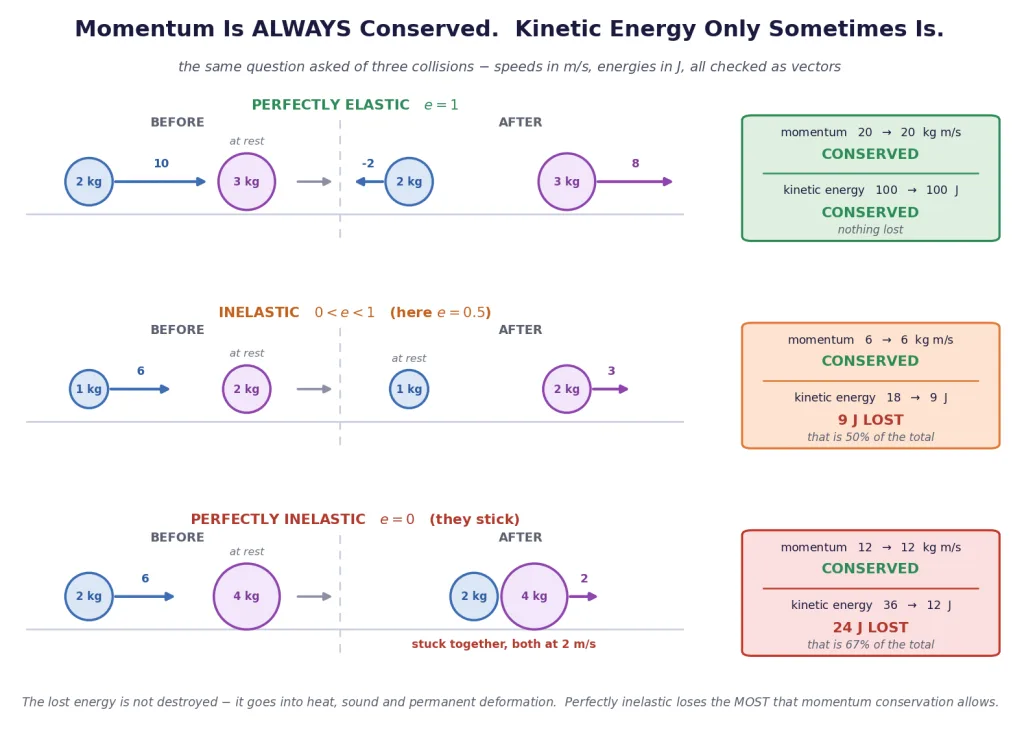
The classification
| Type | Momentum | Kinetic energy | Everyday example | |
|---|---|---|---|---|
| Perfectly elastic | conserved | conserved | steel balls, gas molecules, nuclei | |
| Inelastic | conserved | partly lost | nearly everything real | |
| Perfectly inelastic | conserved | maximum loss | bullet in a block, mud on a wall |
The symbol is the coefficient of restitution, which gets its own block shortly. For now read it as a score out of one for bounciness.
Key Point: Elastic means the bodies separate with the total kinetic energy they started with. Inelastic means some was lost. Perfectly inelastic means they move off together as one body, and the loss is the largest that momentum conservation permits.
The spring picture that makes this click
There is a lovely way to see what happens during an impact. Imagine a compressed spring between the two bodies.
As they approach, the "spring" squashes: kinetic energy is converted into stored elastic energy, and at maximum compression both bodies are moving at the same speed — that instant is common to every collision. Then the spring pushes them apart again.
- If the spring gives back everything it stored, the collision is elastic.
- If it gives back some, the collision is inelastic.
- If it gives back nothing and the bodies stay squashed together, the collision is perfectly inelastic.
Notice what this picture also tells you: even in a perfectly elastic collision, the kinetic energy is not constant during the contact. It dips while the bodies are deformed and returns fully by the end. Conservation of in an elastic collision is a statement about before and after, not about every instant.
Which collisions are truly elastic?
Almost none of the ones you can see. Two billiard balls come close; two hardened steel balls come closer. A rubber ball on a hard floor loses roughly a third of its energy each bounce.
Genuinely elastic collisions live at the microscopic scale: molecules in an ideal gas, and nuclear particles interacting through their force fields without touching at all. Those have no internal structure to absorb energy, so there is nowhere for it to go.
[NEET Important] A collision between two bodies that stick together is always perfectly inelastic, and it is never elastic — because if they move together they cannot be separating, so the restitution is zero.
Where the lost energy goes
Nowhere mysterious: heat in the deformed material, sound in the air, and permanent dents. Total energy is conserved always; mechanical energy is what leaks. This is the same distinction Section 4 drew when friction appeared.
Perfectly Inelastic Collisions: the Easy Case
Start with the simplest one, because there is only one unknown.
The setup. A body of mass moving at collides head-on with a body of mass moving at , and they stick together. Find their common velocity and the kinetic energy lost.
The common velocity
Momentum before must equal momentum after. After the collision the two bodies form one object of mass moving at :
Key Point:
That is it. One equation, one unknown, no energy needed. Whenever a question says "stick", "embed", "get lodged in", "move together" or "coalesce", write this line first.
The kinetic energy lost
Now compute both kinetic energies and subtract. Before:
After, with the common velocity substituted in:
Subtracting and simplifying — a page of algebra that collapses beautifully — gives
Key Point — the loss in a perfectly inelastic collision:
Three things are worth reading off that formula.
1. It is always positive. The bracket is squared and the masses are positive, so energy is always lost, never gained. Good — a collision that created energy would be alarming.
2. It depends only on the RELATIVE velocity . How fast the pair is drifting through the laboratory is irrelevant; only how fast they approach each other matters. Two cars at 50 km/h in the same direction barely scratch each other; the same two head-on is a catastrophe.
3. It is zero if . Of course — if they were already moving together, nothing happened.
The special case you will meet most
If the target starts at rest ():
That last fraction is worth its own line.
Key Point: When a moving body sticks to a stationary one, the fraction of kinetic energy lost is .
So a bullet embedding in a very heavy block () loses almost all its kinetic energy — that is why bullets stop things. And two equal masses sticking lose exactly half.
[JEE Tip] Two equal masses approaching head-on at the same speed stick and stop dead. Momentum before is zero, so momentum after is zero, so — and 100% of the kinetic energy is gone. That is the largest loss possible in any collision, and it does not violate anything: momentum, which was zero, is still zero.
The One-Dimensional ELASTIC Collision
Now the case with two unknowns and two conservation laws. This is the derivation that produces the formulas every exam quotes.
The setup. Masses and move along a line with initial velocities and , collide elastically, and leave with and .
Two equations
Momentum:
Kinetic energy (only because it is elastic):
The trick that avoids the quadratic
Do not solve these by substituting one into the other — you will drown. Instead, group each equation by body.
From (1):
From (2):
Factor the differences of squares in the second:
Now divide the second by the first. The bracketed factors cancel and you are left with a beautifully simple statement:
Key Point — the relative-velocity result: In a perfectly elastic collision, the relative velocity of separation equals the relative velocity of approach. The bodies separate exactly as fast as they came together.
This one line replaces the messy energy equation, and it is linear. Solve it together with (1) — two linear equations, two unknowns — to get:
Key Point — the general 1D elastic results:
The version you will use nine times out of ten
Put (target initially at rest):
Memory hook: the first has the difference of the masses on top, the second has twice the first mass, and both share the same denominator .
Three special cases, and what each one means
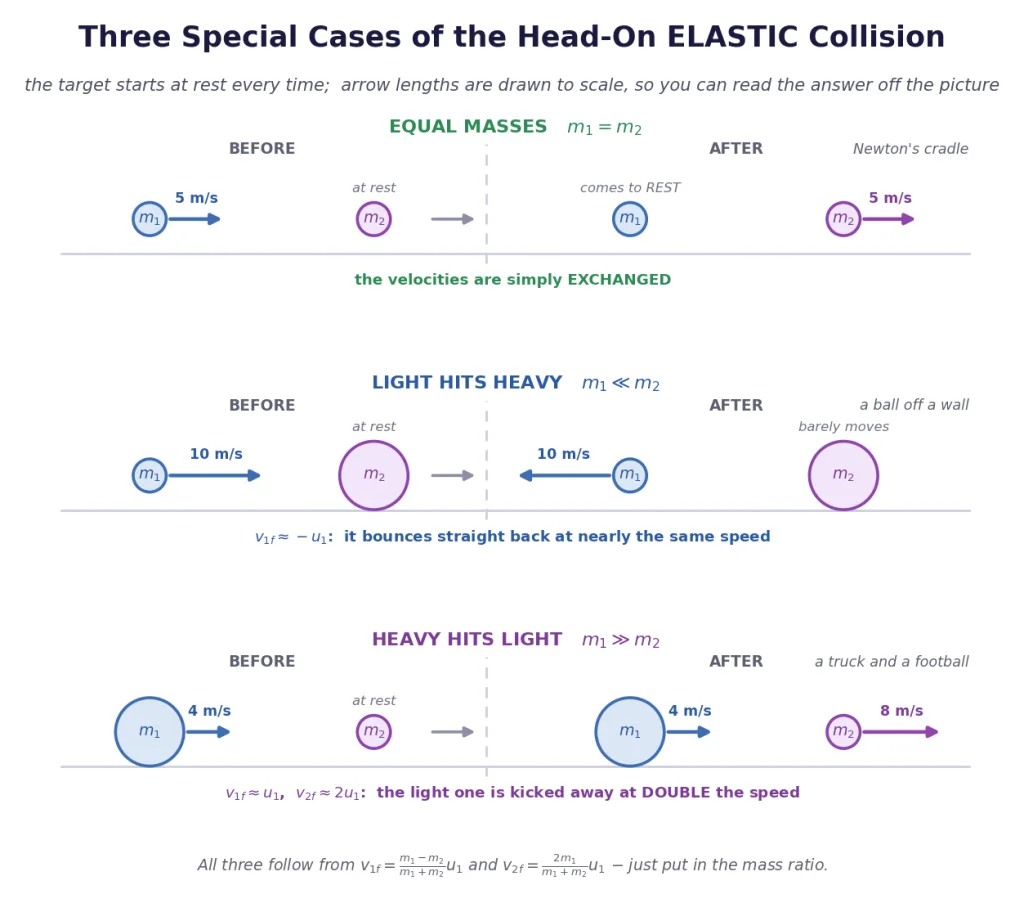
Case 1: equal masses, . The difference term vanishes: The velocities are exchanged. The incoming body stops dead and the target moves off with the incoming speed. This is exactly what a Newton's cradle does, and why a well-struck cue ball stops when it hits the object ball square. With both bodies moving, the general result still swaps them: and .
Case 2: light hits heavy, . Then and : The light body bounces straight back at nearly its original speed and the heavy one barely stirs. A ball off a wall. The wall is attached to the Earth, so is effectively the whole planet.
Case 3: heavy hits light, . Now and : The heavy body ploughs on unaffected and the light one is kicked away at DOUBLE the speed. A truck meeting a football; a bat meeting a ball.
[JEE/NEET] That factor of 2 in case 3 is asked constantly, and the intuition is worth having: in the frame of the heavy body, the light one arrives at , bounces back at , and so in the laboratory frame it ends up at .
The Coefficient of Restitution
Real collisions sit between the two extremes, and we need a number for where. That number is .
Key Point — definition: is a dimensionless number between 0 and 1, and it depends on the materials of the two bodies.
Reading the scale
| Collision | What happens | |
|---|---|---|
| perfectly elastic | separates as fast as it approached; no KE lost | |
| inelastic | separates more slowly; some KE lost | |
| perfectly inelastic | does not separate at all; maximum KE lost |
Look at : it says , which is exactly the relative-velocity result we derived for the elastic case. And says — the bodies move together. The definition contains both extremes as special cases, which is what makes it so useful.
Solving any collision with
Given , you have two linear equations — momentum and restitution — for two unknowns. That is the whole method.
[JEE Tip] The general solution, worth knowing but not worth memorising, is Set and you recover the elastic formulas above; set and you recover the common velocity. The energy lost is which is the perfectly-inelastic loss multiplied by — zero when , maximum when . Very tidy.
The ball dropped on the floor
This is the standard experiment, and the standard exam question.
Drop a ball from height . It arrives at the floor with speed and rebounds with speed , rising to where .
The floor does not move, so the relative velocities are just the ball's speeds:
Key Point:
The second follows because each bounce multiplies the height by the same factor . A ball with dropped from 5 m rises to m, then to m, then to m, and so on.
And is exactly the fraction of kinetic energy retained, since . So a ball with keeps 36% of its energy per bounce and loses 64%.
[Board Important] Two things students mix up:
- — the square root of the height ratio, not the ratio itself.
- The speeds ratio is ; the heights ratio is ; the energies ratio is also .
Typical values. Glass on glass about 0.95; a superball about 0.9; a tennis ball about 0.75; a cricket ball about 0.5; a lump of clay 0.
Collisions in Two Dimensions
Not every collision is head-on. When the centres do not line up, the bodies fly off at angles and the problem becomes two-dimensional — but nothing conceptually new happens, because momentum is a vector, and a vector equation is just several scalar equations wearing a coat.
Momentum, component by component
Take moving along the axis at into a stationary , and let them leave at angles above and below the axis:
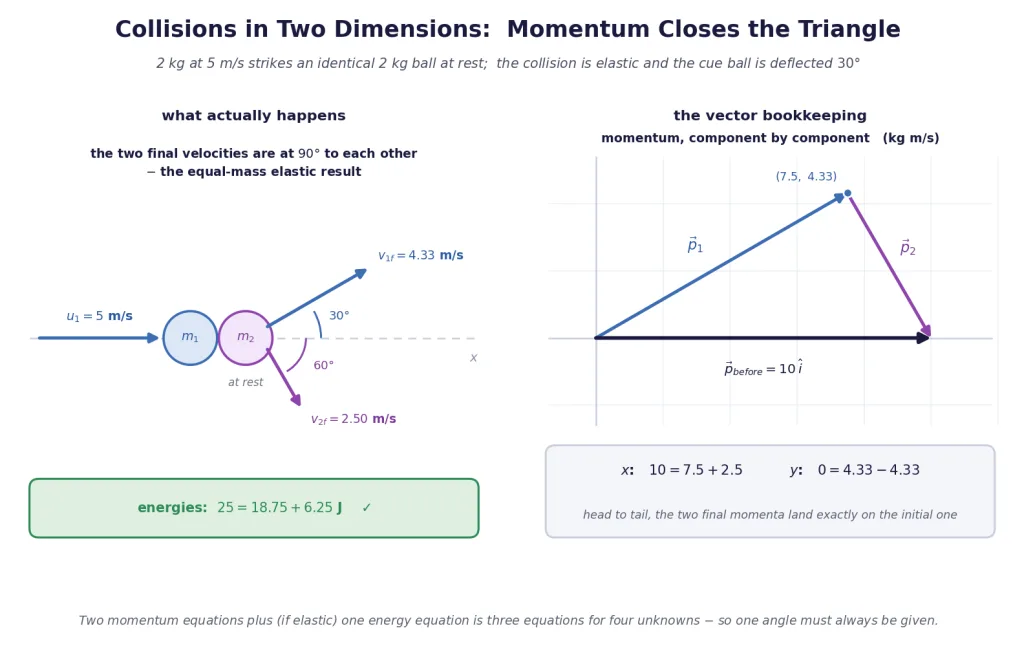
Drawn head to tail, the two final momentum vectors land exactly on the initial one: a closed triangle. That picture is often faster than the algebra.
Counting equations, and why you always need one more fact
Here is the honest bookkeeping.
| Count | |
|---|---|
| Unknowns: , , , | 4 |
| Momentum equations ( and ) | 2 |
| Energy equation, only if elastic | 1 |
| Total equations | 3 |
Key Point: Even for an elastic 2-D collision you are one equation short. One extra piece of information — almost always a scattering angle — must be supplied by the question, measured by a detector, or fixed by the geometry of the impact.
Why the direction never appears. Choose your axes so that the two final velocities define the - plane. Conservation of the -momentum then forces the whole collision to stay in that plane, since it started with none.
The neutron moderator
Now the payoff, and it is a genuinely important piece of physics.
In a nuclear reactor, a neutron born from fission travels at about m/s. At that speed it barely interacts with uranium-235. To sustain the chain reaction it must be slowed to roughly m/s. How do you slow a neutron? Bounce it off something.
From the elastic formulas with the target at rest, the fraction of the neutron's kinetic energy handed to the target is
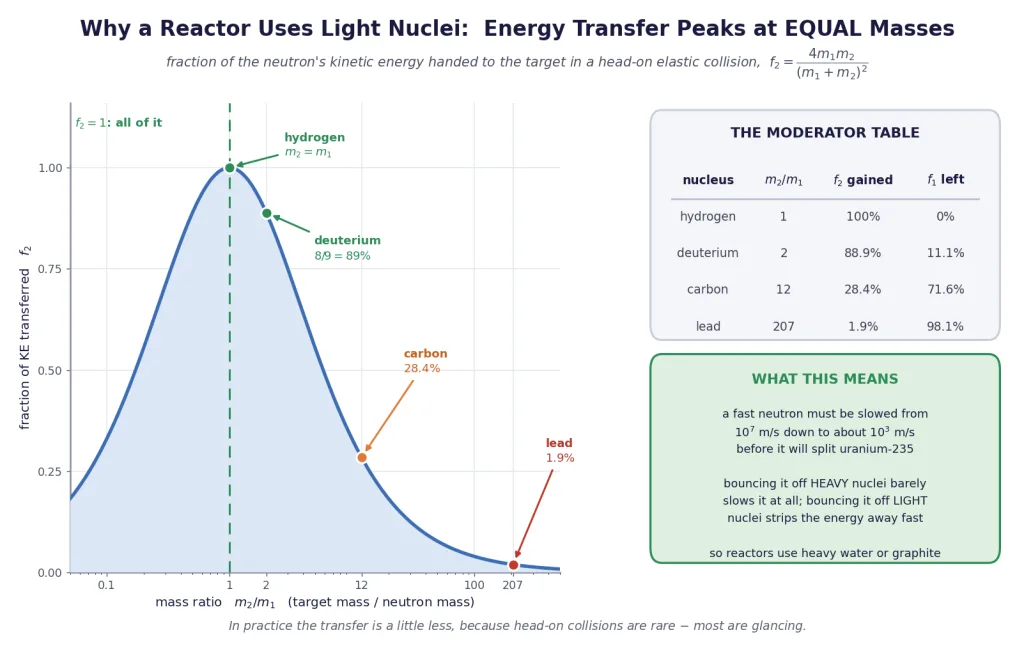
That expression is maximum when , where it equals 1 — a head-on collision with an equal mass hands over everything. Move away from equal masses in either direction and the transfer collapses.
| Moderator nucleus | Fraction taken | Fraction left | |
|---|---|---|---|
| hydrogen | 1 | 100% | 0% |
| deuterium (heavy water) | 2 | 11.1% | |
| carbon (graphite) | 12 | 28.4% | 71.6% |
| lead | 207 | 1.9% | 98.1% |
Key Point: This is why reactors use heavy water or graphite as moderators — light nuclei, close in mass to the neutron, strip its energy away in a handful of collisions. Lead would be useless: a neutron would need hundreds of bounces.
In practice the transfer is a bit less than the table says, because perfectly head-on collisions are rare; most are glancing.
Equal masses at right angles
One last elegant result, and it is a favourite.
Two equal masses collide elastically, one initially at rest, and the collision is glancing rather than head-on. Then in vector form, momentum gives Squaring (that is, dotting with itself): But kinetic energy conservation with equal masses says . Comparing the two lines forces
Key Point: When two equal masses undergo a glancing elastic collision with one initially at rest, they move off at exactly to each other. So if one is deflected by , the other must go off at on the other side.
Every carrom and billiards player knows this in their hands. Section 9 develops oblique collisions properly — components along and perpendicular to the line of impact, and successive collisions. What is here is what the Boards and NEET require.
Solved Examples
Every numerical problem in this set uses m/s, and no problem mixes values.
Example 1: A perfectly inelastic collision
A 2 kg block moving at 6 m/s collides head-on with a 4 kg block at rest on a smooth floor, and the two stick together. Find (a) their common velocity, (b) the kinetic energy before and after, and (c) the energy lost and what fraction that is.
Solution:
(a) Momentum conservation is the only law you need, because they stick:
Check the momentum both ways. Before: kg m/s. After: kg m/s.
(b) Kinetic energies:
(c) Loss: J, which is of the original.
Cross-check with the formula: And the fraction predicted is .
Final Answer: 2 m/s; 36 J becomes 12 J; 24 J lost, which is 67%.
Takeaway: Momentum is conserved; kinetic energy is not. Notice that 24 J vanished from the mechanical account without anything at all happening to the momentum — the two quantities are independent, and confusing them is the single biggest source of error in this topic. The lost 24 J went into heat, sound and denting the blocks.
Example 2: A perfectly elastic collision
A 2 kg ball moving at 10 m/s collides elastically and head-on with a 3 kg ball at rest. Find the final velocities and verify both conservation laws.
Solution:
Use the standard results with :
Read the signs. is negative: the 2 kg ball bounces back, because it hit something heavier than itself. The 3 kg ball moves forward at 8 m/s.
Check momentum. Before: kg m/s. After: kg m/s.
Check kinetic energy. Before: J. After: J.
Check the relative velocity. Approach: m/s. Separation: m/s. Equal, so .
Final Answer: m/s (rebounds), m/s.
Takeaway: Do all three checks — momentum, energy, restitution — on any elastic collision you solve. They take ten seconds and they catch sign errors instantly. [JEE Tip] The rule of thumb: hit something heavier and you bounce back; hit something lighter and you carry on forwards.
Example 3: Equal masses exchange velocities
(a) A 1 kg ball at 5 m/s hits an identical stationary ball elastically. (b) Two identical balls approach each other at 4 m/s and 2 m/s and collide elastically. Find the final velocities in each case.
Solution:
(a) With , the difference term vanishes: The first ball stops dead; the second moves off at 5 m/s.
(b) Both moving. Take rightwards as positive, so and m/s. The general formulas with give They have simply swapped velocities.
Check (b). Momentum before: . After: . Energy before: J. After: J.
Final Answer: (a) 0 and 5 m/s (b) and m/s — the velocities are exchanged.
Takeaway: Equal masses colliding elastically simply trade velocities. This is the physics of Newton's cradle: lift one ball, release it, and exactly one ball flies off the far end at the same speed. Lift two and exactly two leave — because only that outcome conserves both momentum and energy.
Example 4: A ball bouncing off a wall
A 0.2 kg ball moving at 10 m/s strikes a rigid wall head-on and rebounds elastically. Find its velocity after the collision and the impulse delivered to the wall. Comment on whether momentum is conserved.
Solution:
The wall is effectively infinitely massive (), so from case 2 of the elastic results, The ball comes back at the same speed.
Change in the ball's momentum: So the wall delivered an impulse of magnitude 4 kg m/s to the ball, and by the third law the ball delivered 4 kg m/s to the wall.
Is momentum conserved? Yes — but you must include the wall. The wall (and the Earth it is bolted to) picks up exactly kg m/s. Because its mass is enormous, its velocity change is unmeasurably small, and its kinetic energy gain is essentially zero. That is why the collision counts as elastic even though the ball's momentum changed.
Final Answer: m/s; impulse of magnitude 4 kg m/s.
Takeaway: [NEET Important] "Momentum is not conserved when a ball bounces off a wall" is a classic trap statement. Momentum is always conserved — you simply have to draw a big enough system boundary. Note also that the impulse is , twice what it would be if the ball merely stopped; that is why a bouncing hailstorm damages a roof more than a sticking snowfall of the same mass.
Example 5: Heavy hits light — the factor of two
A 10 kg block moving at 4 m/s collides elastically and head-on with a 0.01 kg ball at rest. Find the final velocities.
Solution:
Substitute into the standard results:
Compare with the limiting predictions: m/s and m/s. Both are accurate to about 0.2%.
Check momentum. Before: kg m/s. After: kg m/s.
Final Answer: 3.99 m/s and 7.99 m/s, i.e. essentially and .
Takeaway: A heavy body barely notices a light one, and kicks it away at twice its own speed. The intuition: sit on the heavy body. From there the light one arrives at and bounces back at ; add the heavy body's own to get back to the ground frame and you have . This is why a cricket ball leaves the bat far faster than the bat is moving.
Example 6: Slowing down neutrons in a reactor
In a nuclear reactor a neutron of speed m/s must be slowed to about m/s to have a good chance of fissioning uranium-235. Show that light nuclei are effective moderators, and compare deuterium (), carbon () and lead ().
Solution:
Take an elastic head-on collision with the target at rest. The neutron's final speed is so the fraction of kinetic energy it keeps is
Since the collision is elastic, everything else went to the target:
Deuterium, :
Carbon, :
Lead, :
The maximum. equals 1 when and falls off on both sides, so the transfer is greatest for equal masses.
Final Answer: Deuterium takes 88.9% of the neutron's energy per head-on collision, carbon 28.4%, lead only 1.9%.
Takeaway: This is why reactors are moderated with heavy water or graphite and never with lead. A neutron loses nearly nine-tenths of its energy in a single head-on hit on deuterium, so a handful of collisions does the job; with lead it would need hundreds. In practice the numbers are a little lower because most collisions are glancing rather than head-on.
Example 7: The billiard table — equal masses, glancing impact
Two billiard balls of equal mass collide elastically, one initially at rest. The struck ball moves off at to the original direction. Find the angle at which the first ball moves.
Solution:
Momentum conservation in vector form, with equal masses so the cancels:
Dot each side with itself:
Kinetic energy conservation with equal masses:
Compare the last two lines. The extra term must vanish: (Neither final speed is zero, since both balls are moving.)
Therefore:
Final Answer: ; the two balls separate at right angles.
Takeaway: [JEE/NEET] The general result is worth memorising on its own: two equal masses in a glancing elastic collision, one initially at rest, always separate at . Every carrom and billiards player uses it without knowing the algebra. Note that the argument never needed the actual speeds — only that the masses are equal and the collision elastic.
Example 8: A bouncing ball and the coefficient of restitution
A ball is dropped from a height of 5 m onto a hard floor and rebounds to 1.8 m. Taking m/s, find (a) the coefficient of restitution, (b) the impact and rebound speeds, and (c) the height after the third bounce.
Solution:
(a) Use the height formula:
(b) Speeds, from : Check: .
(c) After bounces, , so after three:
Final Answer: (a) (b) 10 m/s down, 6 m/s up (c) 23.3 cm.
Takeaway: The speeds are in the ratio , the heights in the ratio . Since , that is also the fraction of kinetic energy the ball keeps — it loses 64% on every bounce, which is why a ball dies out so quickly. [Board Important] Remember the square root in ; writing is the standard mistake.
Example 9: A collision with a given
A 1 kg block moving at 6 m/s collides head-on with a 2 kg block at rest. The coefficient of restitution is 0.5. Find the final velocities and the kinetic energy lost.
Solution:
Write the two linear equations. Momentum: Restitution:
Solve. From the second, . Substitute:
Check momentum. Before: 6 kg m/s. After: kg m/s.
Kinetic energies:
Cross-check with the formula:
Final Answer: , m/s; 9 J lost.
Takeaway: Momentum plus restitution is two linear equations in two unknowns — no quadratic, no energy equation. This is the fastest route for any collision where is given, and it works for and as well. Note the coincidence that the first block happened to stop; that is specific to these numbers, not a rule.
Example 10: A two-dimensional collision, checked as vectors
A 2 kg ball moving at 5 m/s along the axis strikes an identical 2 kg ball at rest. The collision is elastic and the first ball is deflected above the axis. Find both final velocities and verify both conservation laws component by component.
Solution:
Use the equal-mass right-angle result. They must separate at , so the second ball goes off at below the axis.
With the two final velocities perpendicular and the masses equal, resolving the initial velocity along the two final directions gives
Check the -momentum:
Check the -momentum:
Check the kinetic energy:
Final Answer: 4.33 m/s at above the axis and 2.50 m/s at below it.
Takeaway: In two dimensions, always resolve and check BOTH components separately. A solution that conserves -momentum but not -momentum is not a solution at all. Notice that the two energies here, 18.75 J and 6.25 J, are in the ratio — the geometry decides the share.
Example 11: The ballistic pendulum
A 10 g bullet travelling at 400 m/s embeds itself in a 2 kg wooden block hanging at rest from a string. Taking m/s, find (a) the speed of the block immediately after, (b) the height it swings to, and (c) the fraction of kinetic energy lost.
Solution:
(a) The embedding is perfectly inelastic, so use momentum conservation alone. Note the collision is over long before the string does anything.
(b) Now switch laws. After the collision nothing is lost, so use energy conservation for the swing:
(c) Kinetic energies:
Final Answer: (a) 1.99 m/s (b) 19.8 cm (c) 99.5% of the kinetic energy is lost.
Takeaway: [JEE Tip] This problem is the classic two-stage trap, and the rule is absolute: momentum for the collision, energy for the swing — never energy for the collision. A student who writes gets a wildly wrong height, because 99.5% of that energy never made it past the impact. And the loss being so nearly total is exactly why the bullet stops: from Section 7's fraction .
Example 12: Working backwards to find
A 4 kg block moving at 5 m/s collides head-on with a 6 kg block at rest. After the collision the 4 kg block continues forward at 1 m/s. Find (a) the velocity of the 6 kg block, (b) the coefficient of restitution, and (c) the kinetic energy lost.
Solution:
(a) Momentum conservation:
(b) Coefficient of restitution:
(c) Kinetic energies:
Sanity check. lies strictly between 0 and 1, so the collision is inelastic but not perfectly so — consistent with energy being lost but the blocks not sticking together.
Final Answer: (a) 2.67 m/s (b) (c) 26.67 J lost, about 53%.
Takeaway: Momentum is the only law you can use to get the missing velocity — kinetic energy is not available, because you do not yet know it was conserved (and it was not). Once both final velocities are known, and follow. A good final check is that comes out between 0 and 1: if you get you have manufactured energy somewhere and made a sign error.