
Kinetic Energy: The Energy of Motion
Section 1 left you with a number, , and an obvious question: what does that number do to the body? To answer it we need one new quantity.
A moving body can do work. A flowing stream turns a mill wheel. Wind fills a sail and drives a ship. A hammer drives a nail. In every case, something moving is able to push something else through a distance — and that capacity is what we call kinetic energy.
Key Point — kinetic energy: A body of mass moving with speed has kinetic energy It is the energy a body possesses by virtue of its motion, and it is measured in joules, the same unit as work.
The second form, with the dot product, is worth noticing. Section 1 told you that , so the two expressions are the same thing — but the dot-product form makes it obvious that comes out as a scalar even though velocity is a vector.
Three properties, all examined
1. It is a scalar. has magnitude but no direction. A car doing 20 m/s north and a car doing 20 m/s south have identical kinetic energies. When several bodies move, their kinetic energies simply add as numbers — never head to tail.
2. It can never be negative.
Key Point: always. Mass is positive and is positive whichever way the body is moving, so is zero for a body at rest and positive for everything else. Work can be negative; kinetic energy cannot. A negative answer for means an arithmetic error, every single time.
3. It goes as the SQUARE of the speed. This is the property that does all the interesting work in this chapter.
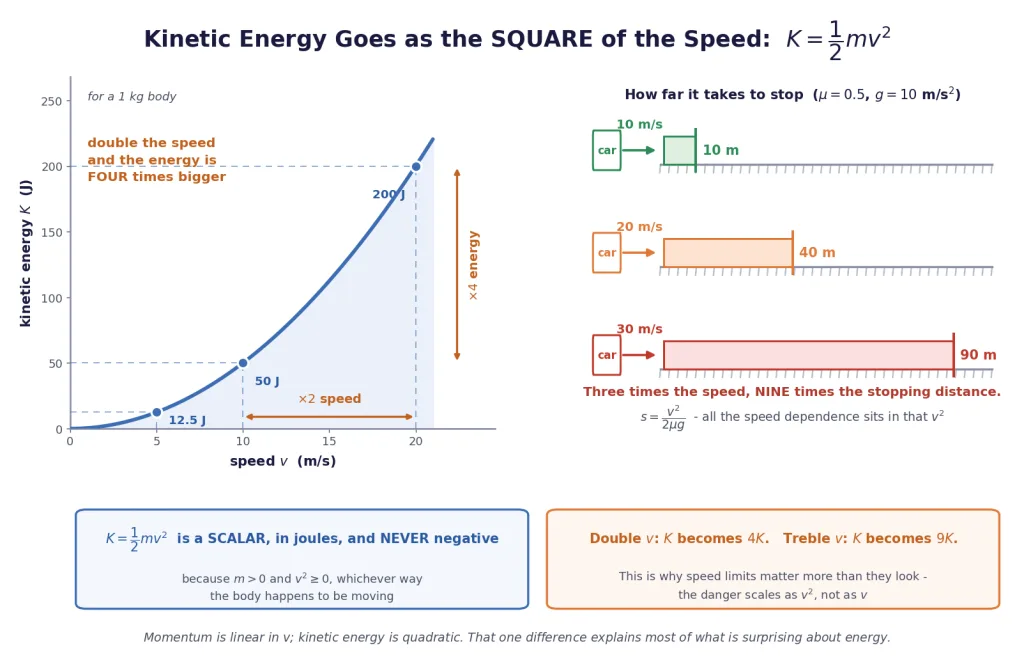
The dependence, and why it matters
Double the speed and does not double — it goes up by a factor of four. Treble it and goes up nine times. The graph is a parabola, not a straight line, and it steepens as you move right.
The most familiar consequence is on the road. In Chapter 2 you found the stopping distance from , and in Chapter 4 you found the retarding force ; putting them together gives which depends on , not . A car at 30 m/s needs nine times the stopping distance of a car at 10 m/s, not three times. That single fact is behind every speed limit ever set — and it is nothing more than the in the kinetic energy.
[JEE/NEET] Look out for the mirror-image trap. Momentum is , linear in : double the speed, double the momentum. Kinetic energy is quadratic. Questions that pair the two are testing exactly whether you keep that difference straight.
Some typical kinetic energies
| Body | Approximate |
|---|---|
| An air molecule at room temperature | J |
| A falling raindrop (1 g at 50 m/s) | 1.25 J |
| A cricket ball bowled at 40 m/s (160 g) | 128 J |
| A 50 g bullet at 200 m/s | 1000 J |
| A 1000 kg car at 20 m/s | J |
| A large aircraft at cruising speed | J |
Notice how wide that range is — thirty orders of magnitude — and how quickly the numbers grow once mass and speed are both large.
Kinetic energy is frame-dependent
Velocity is measured relative to a frame, so kinetic energy is too.
A 60 kg passenger walks forward at 2 m/s inside a train travelling at 10 m/s. In the train's frame his kinetic energy is J. To an observer on the platform his speed is 12 m/s, so his kinetic energy is J — thirty-six times larger.
Key Point: Both numbers are correct. Kinetic energy has no absolute value; it depends on the frame in which the velocity is measured. Section 1 said the same about work, and that is no accident — the two quantities are about to be tied together, and the tie has to hold in every inertial frame.
The Work-Energy Theorem
Now we connect the two. This is the central result of the chapter, and everything from Section 3 onwards is built on it.
The derivation
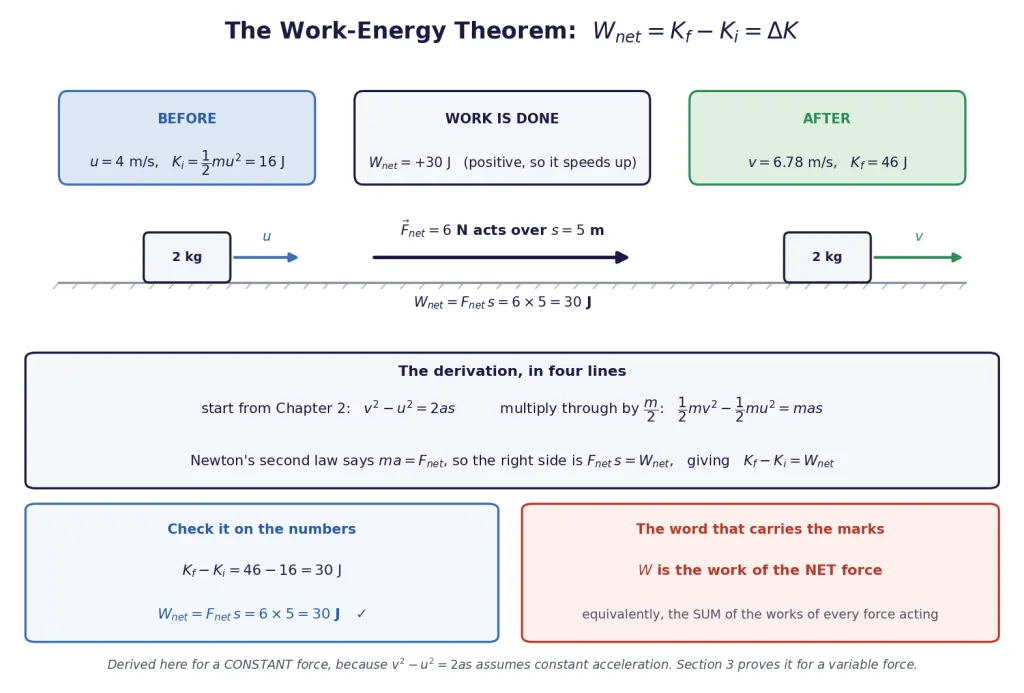
Start with a relation you have had since Chapter 2, for motion in a straight line under constant acceleration : where and are the initial and final speeds and the distance travelled.
Now multiply both sides by :
Look at what is on each side.
- The left side is : the change in the quantity "half the mass times the square of the speed" from its initial to its final value. That is the change in kinetic energy.
- On the right, Newton's second law says . So the right side is — a force times the distance moved along it, which is exactly the work done by the net force.
Therefore
In three dimensions
Nothing essential changes. The vector version of the same kinematic relation is and multiplying by turns the right-hand side into , which is again the work done by the net force. The dot product from Section 1 is doing the work here: it is what lets an equation between vectors collapse into an equation between scalars.
The statement
Key Point — the work-energy theorem: The work done by the NET force on a body equals the change in its kinetic energy.
Three readings of the same line, all worth having:
- Positive net work speeds a body up. .
- Negative net work slows it down. .
- Zero net work leaves the speed unchanged — which is precisely why a body in uniform circular motion, with a centripetal force doing no work, keeps a constant speed.
The word "NET" is doing all the heavy lifting
Key Point — the mistake that costs the most marks: The in the theorem is the work done by the net force, or equivalently the sum of the works done by all the forces acting. It is not the work done by the applied force alone. If friction, gravity and a push all act, all three works go into the sum, each with its own sign.
Section 1 gave you both routes and showed they agree: Use whichever is cleaner. When several forces are given individually, adding their works is usually easier; when you can see the resultant at a glance, use the resultant.
Worked in miniature. A 2 kg block moving at 4 m/s is pushed by a net force of 6 N through 5 m.
- J.
- J.
- So J, giving m/s.
Check it the old way: m/s^2, so and m/s. Same answer, as it must be — the theorem is not new physics, it is Newton's second law rearranged.
Key Point: The work-energy theorem is not independent of Newton's second law. It is best described as a scalar form of the second law. Everything it tells you, the second law could have told you — just usually with far more effort.
One limitation, handed over
The derivation above used , and that relation assumes a constant acceleration, which means a constant force. So what has been proved here is the theorem for a constant force.
The result turns out to hold for any force, constant or varying, but proving that needs calculus — you write and integrate. That proof, together with and the area under the force-displacement graph, is Section 3's job. For everything in this section, the forces are constant.
What the Theorem Does and Does Not Tell You
A powerful tool used carelessly gives confident wrong answers. Here is the honest specification.
What it will NOT do for you
1. It cannot give you a direction. is an equation between scalars. It will tell you that a body ends up moving at 6 m/s; it will not tell you which way. For direction you must go back to forces and vectors, or to momentum. A common exam trap: a body is projected at an angle, and you are asked for its velocity at some height. Energy gives you the speed only; you need the horizontal component separately to get the direction.
2. It relates work to the CHANGE in kinetic energy, not to itself. The theorem says . It says nothing whatever about how big is on its own. A body that gains 30 J of kinetic energy may have started with 10 J or with 10 000 J; the theorem does not care and does not tell you.
3. It does not tell you the time taken. Work involves force and displacement, never time. If a question asks "how long did it take", you will need kinematics or impulse as well. (Power, in Section 6, is the quantity that brings time back in.)
What it WILL do for you, and why it is worth learning
1. It works even when you do not know the force. This is the theorem's finest trick.
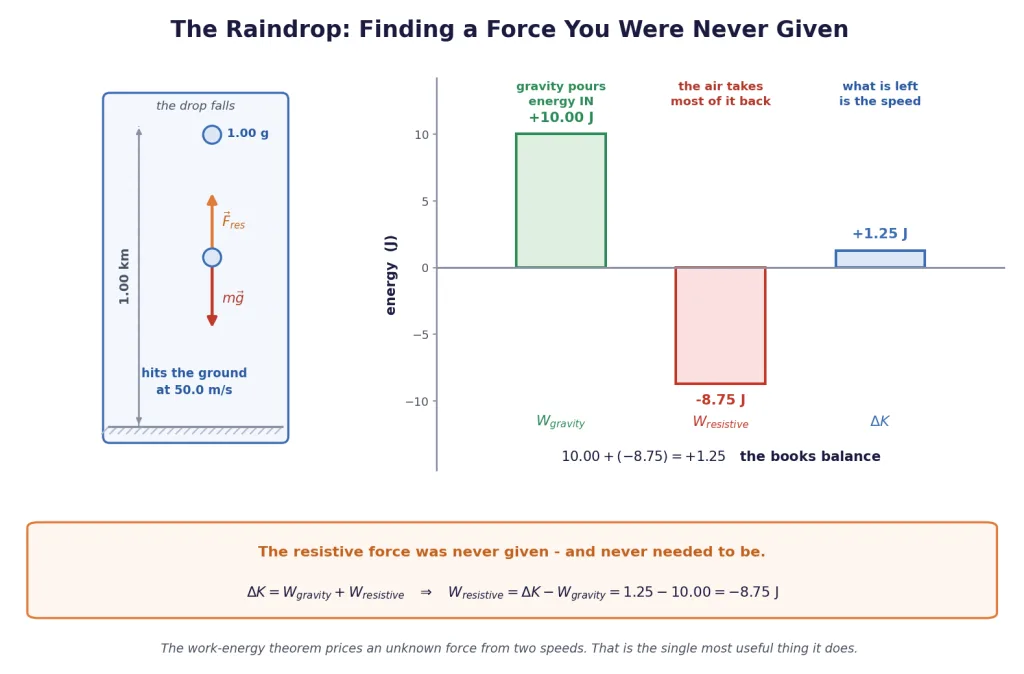
A 1.00 g raindrop falls 1.00 km and hits the ground at 50.0 m/s. Air resistance acts on it, and we have no idea what that force is — it varies with speed in a complicated way, and the problem never tells us. It does not matter:
- The change in kinetic energy is J.
- The work done by gravity is J, with m/s^2.
- The theorem says , so
We have just priced an unknown force using nothing but two speeds and a height. No force law, no differential equation, no calculus. That is what makes this theorem worth having.
2. It is enormously faster when you know the speeds but not the time. Any problem of the form "starts at this speed, ends at that speed, over this distance" is an energy problem. Reaching for and kinematics will get the same answer, slowly.
3. It holds in every inertial frame. Work is frame-dependent, and kinetic energy is frame-dependent, and they are frame-dependent in exactly the matching way, so the equation between them survives. (It can even be extended to non-inertial frames, provided you include the work done by the pseudo-forces — that is a JEE Corner topic.)
When to reach for energy, and when for forces
| The question asks for | Use |
|---|---|
| Speed after a given distance | energy — |
| Speed after a given time | forces and kinematics, or impulse |
| An unknown resistive or retarding force | energy, if two speeds are known |
| The direction of the final velocity | forces or components; energy cannot |
| Stopping distance | energy — fastest route by far |
| Acceleration at an instant | forces |
| Anything with a variable force and a graph | energy (Section 3) |
The recipe
Every work-energy problem in this section fits the same five lines. Use them as a checklist:
- Draw the free-body diagram and list every force.
- Compute the work done by each, with its sign, using . Perpendicular forces give zero — write it down and move on.
- Add them to get .
- Write and from the speeds you know.
- Set and solve for the one thing you do not know.
[Board Important] Step 2 is where marks are lost. Every force gets a line, even the ones that contribute nothing, so that the examiner can see you checked them.
Kinetic Energy and Momentum:
Chapter 4 gave you momentum, . This chapter has given you kinetic energy. They describe the same motion, so there must be a relation between them — and there is.
The derivation, both directions
Start from and substitute :
Key Point — the two forms: where is the magnitude of the momentum. Both are standard and both get used.
Getting the second from the first is just rearranging: , so .
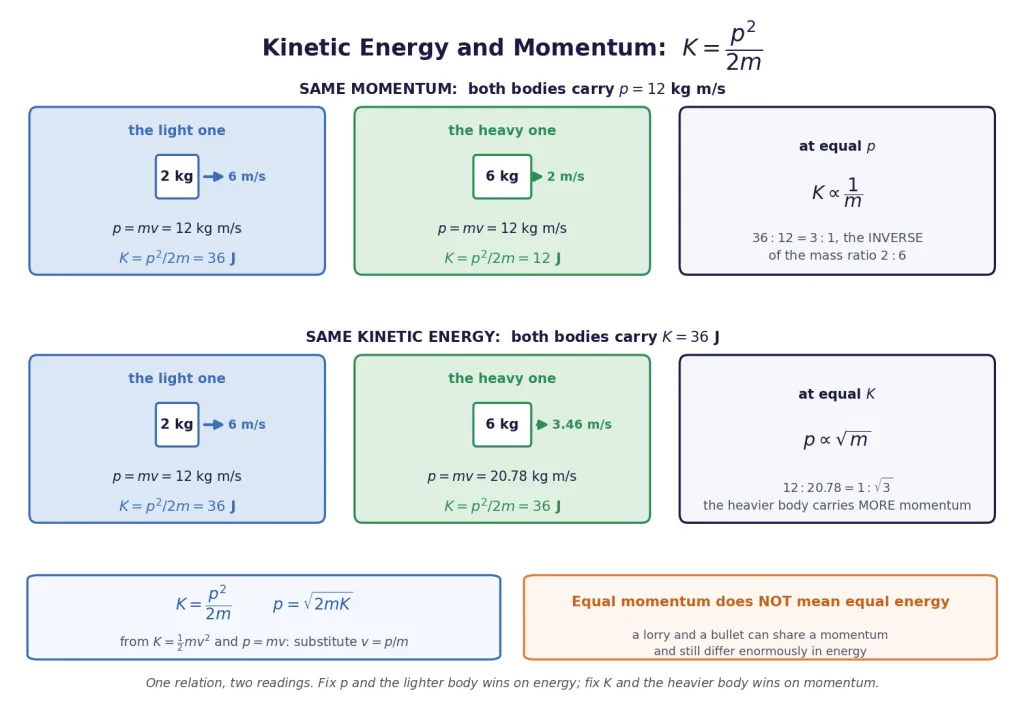
The two comparisons everyone is asked about
Case A: two bodies with the SAME momentum. Then with fixed, so
Key Point: At equal momentum, . The LIGHTER body has the GREATER kinetic energy, and the ratio of kinetic energies is the inverse of the ratio of masses.
A 2 kg body and a 6 kg body both carrying kg m/s have J and J. Masses in the ratio ; kinetic energies in the ratio . Exactly inverted.
Case B: two bodies with the SAME kinetic energy. Then with fixed, so
Key Point: At equal kinetic energy, . The HEAVIER body has the GREATER momentum, and the ratio of momenta is the square root of the ratio of masses.
The same two bodies each carrying J have kg m/s and kg m/s. Masses in the ratio ; momenta in the ratio .
[JEE Tip] These two results are the single most reliably examined consequence of , and they point in opposite directions. Say them to yourself as a pair: equal momentum, lighter body wins on energy; equal energy, heavier body wins on momentum.
Percentage changes
Because at fixed mass, percentage changes do not carry across unchanged, and that catches people out.
| Change | Consequence at fixed |
|---|---|
| doubles | doubles, becomes (a 300% increase) |
| increases by 50% | becomes times, a 125% increase |
| increases by 300% | becomes , so doubles: a 100% increase |
| increases by 10% | increases by |
| increases by 21% | increases by |
The habit that gets these right every time: turn the percentage into a factor first. "Increases by 300%" means the new value is times the old, not 3 times. Then square or square-root the factor as needed, and convert back at the end.
A summary card
| Quantity | Symbol | Type | Sign | In terms of the other |
|---|---|---|---|---|
| Momentum | vector | direction of | ||
| Kinetic energy | scalar | never negative |
Two bodies can share a momentum and differ enormously in energy — a lorry crawling and a bullet flying can have the same — which is exactly why Section 7 will need both quantities to sort out collisions.
Putting It to Work
Four standard applications. Each follows the same five-line recipe, and between them they cover most of what gets set in an exam.
1. Stopping distance of a vehicle
A car of mass moving at speed brakes on a road with coefficient of friction . Only friction does work on it, and it does negative work.
Key Point: The mass cancels. A loaded lorry and an empty scooter with the same stop in the same distance from the same speed. And the distance goes as — the single most important road-safety fact in this chapter.
2. A bullet penetrating a block
A bullet of mass hits a fixed block at speed and stops after penetrating a depth . The resistance is the only force doing significant work: which is the average resisting force. Two consequences worth knowing:
- The penetration depth is proportional to . Halve the speed and the bullet goes only a quarter as deep.
- If the bullet emerges with some kinetic energy left, use the full form rather than alone.
3. A body on a rough incline
A block slides a distance down a slope of angle with coefficient of kinetic friction . Three forces, and Section 1 already told you their works:
Notice again that the mass cancels. And notice the condition hiding in the bracket: if the bracket goes negative, which is the algebra's way of telling you the block would never have started sliding — Chapter 4's angle of repose, showing up in an energy equation.
4. A force you were never given
Covered in the block above with the raindrop, and it is worth repeating as a method, because it is the most useful thing here:
Key Point — the unknown-force recipe: If you know the speeds at the start and end, and the works of every force except one, then gives you the missing work directly, and dividing by the distance gives the average unknown force. You never need to know what that force actually is.
Signs, one last time
The commonest source of wrong answers in this section is a sign, so here is the discipline:
- Work done by a retarding force (friction, air resistance, a brake, a plank resisting a bullet) is negative.
- Work done against such a force is the positive of that number. Never mix the two prepositions inside one equation.
- , always in that order. A body slowing down has , and its must therefore come out negative too. If it does not, you have a sign error somewhere.
- itself is never negative. If yours is, stop and find the slip.
Where this goes next
Everything in this section assumed the force was constant. That is a real restriction: a spring's force grows as you stretch it, air resistance grows with speed, a rocket's thrust changes as it burns fuel.
Section 3 removes the restriction. Work becomes an integral, , which is the area under the force-displacement graph — and the work-energy theorem comes through the generalisation completely unchanged. That is the surprise: turns out to be far more general than the constant-force derivation that produced it here.
Solved Examples
Where a is needed, this set uses m/s^2 and says so in the problem. Several problems need no at all.
Example 1: The raindrop and the unknown resistive force
A raindrop of mass 1.00 g falls from a height of 1.00 km and hits the ground with a speed of 50.0 m/s. It falls under gravity and an opposing resistive force whose exact form is unknown. Taking m/s^2, find (a) the work done by the gravitational force and (b) the work done by the unknown resistive force.
Solution:
The change in kinetic energy — assume the drop starts from rest:
(a) The work done by gravity. The weight is downward, the displacement is m downward, so the angle is :
(b) Now the theorem. Only two forces act, so the net work is the sum of their works:
Final Answer: J and J.
Takeaway: Read step 3 again, because it is the point of the whole example. We never needed to know the resistive force. We were told it depends on speed in some undetermined way — and it did not matter, because two speeds and a height were enough. Notice also how much energy the air removed: gravity supplied 10 J, the air took back 8.75 J, and only 1.25 J survived as motion. That is why raindrops fall at a sedate 50 m/s rather than the 141 m/s that free fall from 1 km would give.
Example 2: The skidding cyclist — work on the cycle and on the road
A cyclist comes to a skidding stop in 10 m. During this process the force on the cycle due to the road is 200 N and is directly opposed to the motion. (a) How much work does the road do on the cycle? (b) How much work does the cycle do on the road?
Solution:
(a) The stopping force and the displacement are exactly opposite, so and : It is this negative work that removes the cyclist's kinetic energy and brings him to a halt: by the theorem, J, so he must have started with 2000 J of kinetic energy.
(b) By Newton's third law, the cycle pushes on the road with an equal and opposite 200 N. But the road does not move, so its displacement is zero:
Final Answer: (a) J; (b) zero.
Takeaway: Forces come in equal and opposite pairs; works do not. The two works here are J and — nowhere near equal and opposite — because the two bodies underwent completely different displacements. Note also what part (a) hands you for free: the cyclist's initial kinetic energy was 2000 J, so if you were told his mass you could recover his speed. [Board Important] " need not be zero even though " is a standard two-mark answer.
Example 3: The bullet and the plywood
In a ballistics demonstration a police officer fires a bullet of mass 50.0 g with speed 200 m/s at a sheet of soft plywood 2.00 cm thick. The bullet emerges with only 10% of its initial kinetic energy. What is its emergent speed?
Solution:
Initial kinetic energy:
Final kinetic energy is 10% of that:
Recover the speed from :
The percentage speed reduction:
Final Answer: The bullet emerges at 63.2 m/s, a reduction of about 68%, not 90%.
Takeaway: This is the dependence catching people out. Losing 90% of the ENERGY is not losing 90% of the SPEED. Since , the speed falls only by a factor , so 31.6% of the speed survives and the reduction is 68.4%. Anyone who divides 200 by 10 and answers 20 m/s has confused the two. [JEE/NEET] Whenever a question quotes a fraction of the energy, take the square root to get the fraction of the speed.
Example 4: Stopping distance, and what happens when you double the speed
A 1000 kg car travelling at 20 m/s brakes to a halt on a road with . Take m/s^2. Find (a) the stopping distance, and (b) the stopping distance if the same car had been travelling at 40 m/s.
Solution:
(a) Only friction does work (gravity and the normal reaction are perpendicular to the motion, so they contribute nothing):
Apply the theorem. The car ends at rest, so :
(b) At 40 m/s, rather than repeating the arithmetic, use the general result. Cancelling from : Doubling multiplies by four: (Check directly: m.)
Final Answer: (a) 40 m; (b) 160 m.
Takeaway: Two facts sit inside , and both are worth memorising. The mass cancels, so a fully loaded truck and an empty one stop in the same distance on the same road. And the distance goes as , so an extra 20 m/s costs you an extra 120 m of road. That is not a small effect — 160 m is a stretch of highway longer than a football pitch and a half.
Example 5: A bullet fired into a block
A bullet of mass 20 g moving at 300 m/s strikes a fixed wooden block and comes to rest after penetrating 10.0 cm. Find (a) the average resistive force offered by the wood, and (b) how far the same bullet would penetrate if it were fired at 150 m/s.
Solution:
(a) Initial kinetic energy: The bullet stops, so and J.
The resistance is the only force doing work along the 0.100 m, and it opposes the motion:
(b) At half the speed, the kinetic energy is a quarter: J. With the same resisting force,
Final Answer: (a) 9000 N; (b) 2.5 cm.
Takeaway: 9000 N from a 20 g bullet — that is the weight of a 900 kg mass, produced by a small piece of metal, because all its energy is dumped over a mere 10 cm. Part (b) is the law again: half the speed, quarter the depth, not half the depth. [JEE Tip] The general result is for a constant resisting force, and questions love to ask for the depth at or . Square the speed factor.
Example 6: A block released on a rough incline
A 2 kg block is released from rest and slides 5 m down a rough incline of . Take , m/s^2, and . Find its speed at the bottom of that 5 m.
Solution:
- List the three forces and their works over the 5 m along the slope.
- Gravity. The vertical drop is m, so
- Normal reaction. Perpendicular to the motion:
- Friction. First N, so N, acting up the slope against the motion:
Net work:
Apply the theorem. The block starts from rest, so :
Final Answer: m/s.
Takeaway: Compare the effort with the Chapter 4 route: find , find , resolve along the slope, get m/s^2, then . Same answer, but the energy route never needed the acceleration at all. Note also that the mass cancels if you work symbolically — — so the 2 kg was a distractor. [NEET Important] If that bracket ever comes out negative, the block cannot slide at all: is Chapter 4's angle of repose showing up in an energy equation.
Example 7: Equal momentum, then equal kinetic energy
Two bodies of mass 2 kg and 6 kg are in motion. (a) If they have the same momentum of 12 kg m/s, find the kinetic energy of each and the ratio of their kinetic energies. (b) If instead they have the same kinetic energy of 36 J, find the momentum of each and the ratio of their momenta.
Solution:
(a) Use with kg m/s fixed: The ratio of kinetic energies is the inverse of the ratio of masses.
(b) Use with J fixed:
Final Answer: (a) 36 J and 12 J, in the ratio ; (b) 12 and 20.78 kg m/s, in the ratio .
Takeaway: The two halves point in opposite directions, and that is exactly what makes this a favourite question. At equal momentum the lighter body carries more energy; at equal energy the heavier body carries more momentum. Learn them as a pair, and derive each from the right form of the relation — for part (a), for part (b).
Example 8: Percentage changes
(a) The kinetic energy of a body increases by 300%. By what percentage does its momentum increase? (b) The momentum of a body increases by 50%. By what percentage does its kinetic energy increase? (c) A car's speed increases by 10%. By what percentage does its kinetic energy increase?
Solution:
Turn every percentage into a factor first. "Increases by 300%" means the new value is times the old.
(a) With and fixed, : So the momentum doubles, an increase of 100%.
(b) With and fixed, : An increase of , that is 125%.
(c) With :
Final Answer: (a) 100%; (b) 125%; (c) 21%.
Takeaway: The single habit that makes all three easy: convert to a factor, apply the power, convert back. Never try to scale the percentages directly — a 50% rise in is emphatically not a 100% rise in , and a 300% rise in is not a 300% rise in . [JEE Tip] For small changes there is a shortcut worth knowing: since , a small fractional change in produces roughly twice that fractional change in . A 10% rise in speed gives about 20% more energy — and the exact answer, 21%, confirms it.
Example 9: A block pushed across a rough floor
A 2 kg block, initially at rest on a rough horizontal floor, is pushed by a constant horizontal force of 10 N for 4.0 s. Take and m/s^2. Find (a) the distance travelled, (b) the work done by the applied force, (c) the work done by friction, (d) the net work, and (e) the final kinetic energy. Verify the work-energy theorem.
Solution:
First the friction and the acceleration, because we need the distance and only the time is given:
(a) Distance in 4.0 s from rest:
(b) Work by the applied force, along the motion:
(c) Work by friction, opposing the motion: Gravity and the normal reaction are perpendicular, so each does zero.
(d) Net work:
(e) Final kinetic energy. The final speed is m/s, so and since , J . Verified.
Final Answer: (a) 20 m; (b) J; (c) J; (d) J; (e) 100 J, equal to .
Takeaway: This one needed kinematics first, because the question gave a time and work needs a distance. That is the honest limitation from the notes: the work-energy theorem never mentions time, so a time-based question always needs one kinematic step to convert. Once you have the distance, though, the energy accounting is quick — and the agreement in step 6 is the theorem doing exactly what it promises.
Example 10: Kinetic energy depends on the frame
A 60 kg passenger walks forward along the aisle of a train at 2 m/s. The train travels at 10 m/s along a straight track. Find his kinetic energy (a) in the frame of the train, (b) in the frame of the ground, and (c) in the frame of the ground if he turns round and walks towards the rear at the same 2 m/s.
Solution:
(a) In the train's frame his speed is simply 2 m/s:
(b) On the ground, velocities add, and both are forward:
(c) Walking towards the rear, the two velocities subtract:
Final Answer: (a) 120 J; (b) 4320 J; (c) 1920 J.
Takeaway: Three different numbers for the same man walking the same way — and all three are correct. Kinetic energy is frame-dependent, because velocity is. Compare (b) and (c): turning round changes his ground-frame kinetic energy by 2400 J while his own effort is identical. Section 1 showed that work is frame-dependent in exactly the same way, and that is what keeps valid in every inertial frame. [JEE Advanced] Choose your frame at the start of a problem and never mix frames inside one energy equation.
Example 11: A ball thrown upward against air resistance
A ball of mass 0.2 kg is thrown vertically upward at 20 m/s and rises to a maximum height of 15 m. Take m/s^2. Find (a) the work done by gravity during the rise, (b) the work done by air resistance, and (c) the average resistive force.
Solution:
The change in kinetic energy. It starts at 20 m/s and is momentarily at rest at the top:
(a) Work by gravity. The weight is N downward and the displacement is 15 m upward, so :
(b) Work by air resistance, from the theorem. Only two forces act:
(c) The average resistive force. Air resistance opposes the motion throughout the 15 m rise, so
Final Answer: (a) J; (b) J; (c) 0.67 N.
Takeaway: A sanity check first: without air the ball would have risen to m, so losing 5 m of height to the air is entirely plausible. Both works are negative here — gravity and drag are both fighting the upward motion, which is why the ball stops in the first place. And once again the resistive force was never given; two speeds and a height were enough. [NEET Important] On the way down the drag reverses direction while gravity does not, so the work done by drag stays negative but the work done by gravity becomes positive — which is why the ball returns slower than it left.
Example 12: A block dragged by a slanted force
A 5 kg block, initially at rest on a rough horizontal floor, is pulled 4 m by a 30 N force applied at above the horizontal. Take , m/s^2, and . Find the final speed of the block.
Solution:
Vertical equilibrium first, because the pull lifts as well as drags: Note this is not N.
Kinetic friction:
The four works over the 4 m:
Net work:
Apply the theorem, starting from rest:
Final Answer: m/s.
Takeaway: Step 1 is the whole examination. Writing N gives N, J and a final speed of 4.73 m/s — plausible-looking and wrong by 11%. Whenever the applied force has a vertical component, recompute before you touch friction. Notice too the shape of the solution: the theorem turned a four-force problem into one line of arithmetic in step 5, with no acceleration and no time anywhere in sight.