
Thirty Questions. Thirty Minutes. Go.
Section 11 taught you the NEET way through Work, Energy and Power — the verbatim statements, the force-versus-energy chooser, the plug-and-play formula cards, the templates, the elimination habits. This section finds out whether any of it survives contact with a clock.
There is no new physics below. There are 30 questions built the way NEET builds them, and one rule that matters more than the rest: you are being tested on pace, not on cleverness. If a question here takes you four lines of algebra, you have misread it.
How to attempt this set
Key Point: Blank sheet, pen, timer. Attempt all 30 questions in one unbroken sitting and do not read a single explanation until your last answer is written. A drill you pause to check is a reading exercise, and reading exercises do not build speed.
| The setup | What it is |
|---|---|
| Number of questions | 30 |
| Marking scheme | correct, incorrect, unattempted |
| Maximum score | marks |
| Minimum possible score | marks |
| Suggested time limit | 30 minutes (NEET pace: 45 Physics questions in about 45 minutes, so roughly a minute each) |
| Take as | 10 m/s^2 throughout |
| Useful values | , , , , 1 kWh J |
| Allowed | a rough sheet and your memory |
| Not allowed | calculator, formula sheet, or a glance back at Sections 1 to 11 |
[Important] The 30-minute limit is the entire exercise. Most students can get 27 of these right given an hour — and an hour is exactly what the real paper will not give you. Finishing in 30 minutes with 24 correct puts you in far better shape than taking 55 minutes to get 27. Keep the timer where you can see it, and the moment a question passes 60 seconds, mark your best surviving option and move on.
Here is the arithmetic that makes that instruction safe. A blind guess among four options is worth , essentially nothing. But once you have eliminated two options, a guess between the survivors is worth marks on average. Eliminate first, then commit. Leave blank only what you could not narrow down at all.
What this set covers
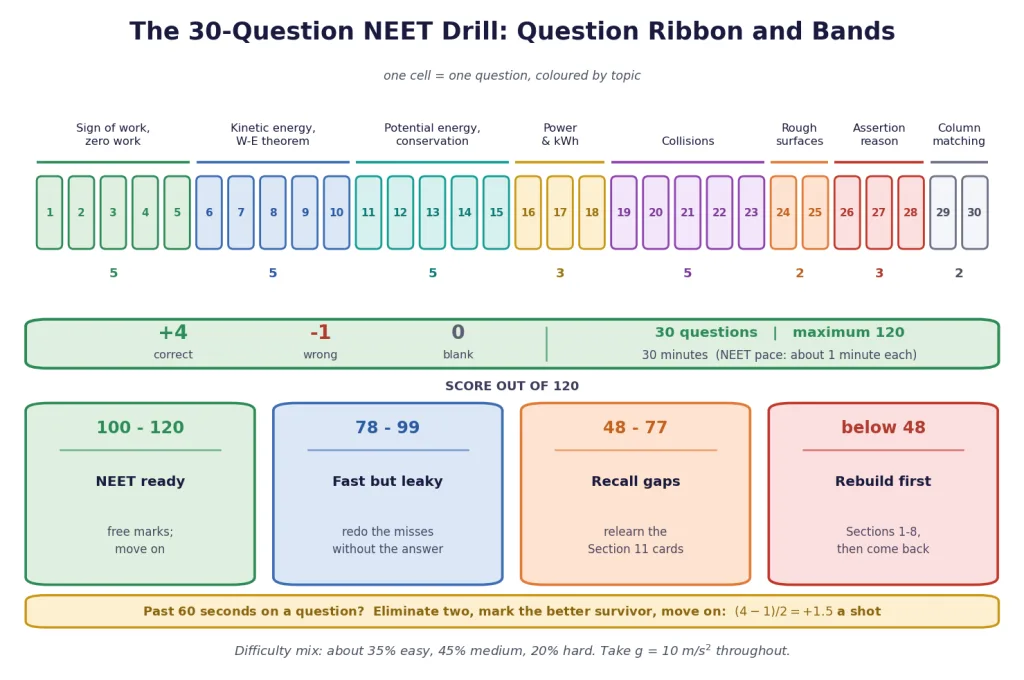
| Topic | Questions | How many |
|---|---|---|
| The sign of work, zero-work situations, work by a constant force | Q1 to Q5 | 5 |
| Kinetic energy and the work-energy theorem in single-step form | Q6 to Q10 | 5 |
| Gravitational and spring potential energy, conservation of mechanical energy | Q11 to Q15 | 5 |
| Power, including the kilowatt-hour | Q16 to Q18 | 3 |
| Collisions: elastic versus inelastic, common velocity, restitution, bouncing | Q19 to Q23 | 5 |
| Energy on rough surfaces | Q24 to Q25 | 2 |
| Assertion-reason | Q26 to Q28 | 3 |
| Column matching | Q29 to Q30 | 2 |
That weighting is not arbitrary — it is how NEET actually samples this chapter. Collisions alone are 5 of the 30, because in the real paper they are the most reliably repeated item from Work, Energy and Power, and the one where a single formula recalled correctly is worth a whole mark in twenty seconds. The last five drill the two formats NEET uses and JEE does not: three assertion-reason items and two column matches. If you have never sat one of those under time pressure, they are the questions here most likely to cost you marks.
[Important] Notice what is not in this set. No potential-energy-curve calculus, no oblique collisions, no constant-power integration, no chain-on-a-table or block-on-a-wedge problems, and no integration beyond reading an area off a straight-line graph. Those live in Sections 9 and 10 and belong to JEE. Every question below can be finished with one formula card from Section 11, one definition, or one right-angled triangle. If you find yourself wanting calculus, you are solving a question that is not on this page.
The difficulty mix is deliberately NEET-calibrated: roughly 35% easy, 45% medium and 20% hard.
Mark It Honestly, Then Read Your Own Answer Sheet
Score with the real scheme: for every correct answer, for every wrong one, for every blank. No half marks for "I nearly had that one". The number you end up with is the number that means something.
The bands
| Your score (out of 120) | Verdict | What to do next |
|---|---|---|
| 100 to 120 | NEET ready. Over 80% on a full-length set, inside the time. | This chapter is now free marks for you. Revisit only the items you missed, then move to the next chapter. |
| 78 to 99 | Fast but leaky. You know the material; something leaks on the way to the answer sheet. | Almost always a misread question or a dropped , not a gap. Redo every wrong question without the explanation first, and count how many you fix alone. |
| 48 to 77 | Recall gaps. The speed is not the problem; the lookup is. | Go back to Section 11's cards — the work card, the energy-conservation card, the spring card, the power card, the collision card — and learn them as flashcards. Then re-attempt this set cold. |
| Below 48 | Rebuild first. | Work Sections 1 to 7 properly, then Section 8's worked examples, then Section 11. Re-attempting this set today would teach you nothing except the answer key. |
Sort your mistakes into three piles
Do this before you read a single explanation. It is the most useful ten minutes in this section.
- Did not know it. A statement you had never learnt precisely, a formula you could not recall, the difference between what is conserved in an elastic and in an inelastic collision. Cheapest to fix — it is a memory job, and it takes an evening.
- Knew it, computed it wrong. You dropped the from or , you forgot that kinetic energy goes as the square of the speed, or you used where belonged in a bouncing-ball question. Slow down for four seconds on the final line.
- Knew it, answered a different question. You gave the work done by gravity when it asked for the work done against it; the energy stored in the spring when it asked for the energy lost; the height after the first bounce when it asked for the total. NEET's distractors are built specifically to reward this mistake.
Key Point: Two students both score 88. The first has four pile-1 mistakes and a syllabus gap that revision closes in a day. The second has nine pile-3 mistakes and a reading habit that will follow them into the exam hall. Pile 3 is the expensive one — count it before you explain it away.
The nine recall facts this set keeps testing
- Work is a scalar with the sign of : positive below , zero at exactly , negative above it. A force perpendicular to the motion does no work no matter how large it is.
- — the net work, and goes as . Double the speed and you quadruple the kinetic energy and the stopping distance.
- . Equal momenta means the lighter body has more kinetic energy; equal kinetic energies means the heavier body has more momentum.
- upward, for a spring, and the spring stores the same energy whether it is stretched or compressed by , because is squared.
- is constant only when every force doing work is conservative. The instant friction appears, switch to .
- Power is on average and at an instant, measured in watts. The kilowatt-hour is a unit of energy, not of power, and kWh J.
- Momentum is conserved in every collision; kinetic energy only in an elastic one. Perfectly inelastic means they move off together, and that is when the loss is the largest possible.
- , with elastic and perfectly inelastic. For a ball bouncing on the floor, speeds scale by and heights by , so .
- On a rough floor the whole kinetic energy becomes heat: , so and the mass cancels.
One more pass, then move on
Every question below has a full step-by-step explanation, and most of them name the shortcut that would have got you there faster. Read the explanation even for the questions you got right — on a paper this tight, the difference between a 20-second method and a 70-second method decides whether you finish Physics at all.
[Important] When you are done, do not immediately re-attempt the set. You would be scoring your memory of the answer key, not your physics. Leave it a week, then sit it again cold with the same 30-minute timer. The second score is the honest one.