
The Scalar Product: Two Vectors In, One Number Out
Chapter 4 solved motion by tracking forces instant by instant. This chapter is about a completely different way of getting answers — following the energy instead. But before any of that, we need one piece of mathematics, and it has to come first.
You already know how to add and subtract vectors. Now we need to multiply them. There are two ways, and they give completely different kinds of thing:
- the scalar product (or dot product) takes two vectors and gives back a scalar — a plain number;
- the vector product (or cross product) takes two vectors and gives back a new vector. That one waits for Chapter 6.
Here we need only the first.
(If you worked through the JEE Corner of Chapter 3, you have met the dot product already as a borrowed tool. Here it gets a numbered subsection of its own, so this is the full Board-level treatment — read it properly even if the symbol looks familiar.)
The definition
Key Point — the scalar product: For two vectors and separated by an angle , where and are the magnitudes and is the angle between the two vectors when they are drawn tail to tail. The result is a scalar — it has a size and a sign, but no direction.
Read that last sentence again, because it is the whole point. has a direction. has a direction. has none. Two arrows go in; one number comes out.
The sign of that number is decided entirely by , since and are magnitudes and can never be negative. So the dot product is positive for a sharp angle, zero for a right angle, and negative for an obtuse angle — a fact we are about to lean on very heavily.
What it means geometrically
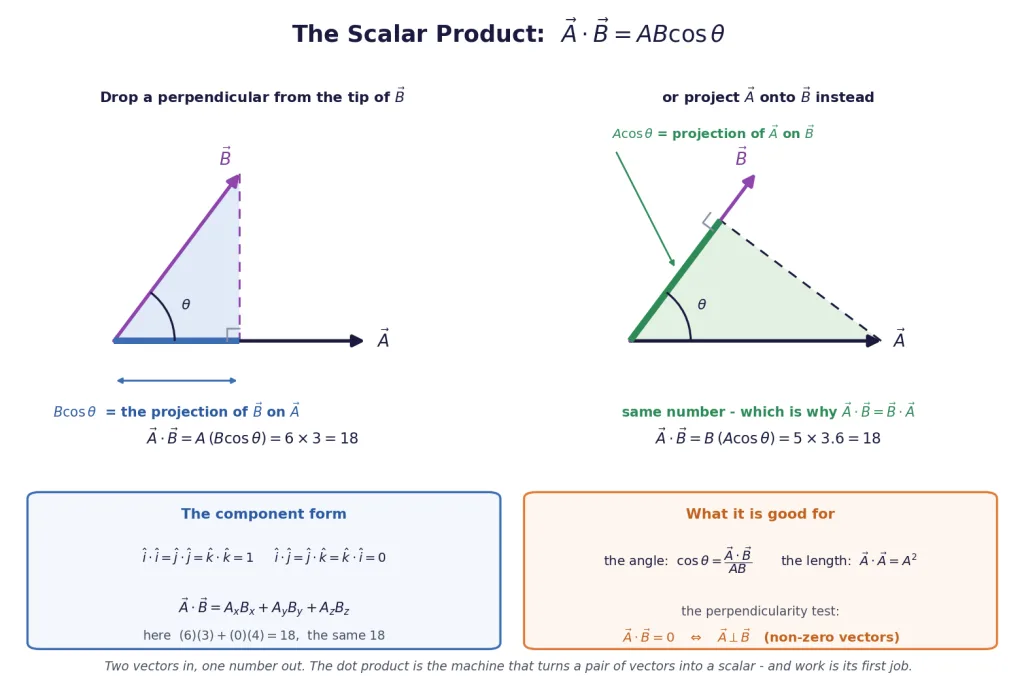
Group the definition two ways:
Now is exactly the length you get by dropping a perpendicular from the tip of onto the line of — it is the projection, or component, of along . So:
Key Point — the geometric reading: is (the magnitude of ) (the component of along ). Equally, it is (the magnitude of ) (the component of along ). The dot product is a machine for extracting the part of one vector that lies along another.
That single sentence is why work is a dot product. When a force drags a body along, only the part of the force along the motion does anything useful. The dot product is the tool that picks that part out.
The properties you must know
| Property | Statement | Why it matters |
|---|---|---|
| Commutative | order never matters | |
| Distributive | lets you split a net force into pieces | |
| Scalars pull out | is any real number | |
| Self product | since and |
That last one is quietly useful: . The dot product of a vector with itself is the square of its magnitude, never a vector.
The unit vectors, and the component form
Apply the definition to the unit vectors , , along the three axes. Each has magnitude 1, and any two different ones are at :
Now write and , multiply out using the distributive law, and every cross term dies:
Key Point — the component form: Multiply matching components, add. No angle, no cosine, no trigonometry at all.
Setting recovers something you already know: which is just Pythagoras in three dimensions.
The two jobs this does for you
1. It finds the angle between two vectors. Rearranging the definition: Compute the top by components, compute the two magnitudes, divide. This is the standard way to get an angle in three dimensions, where drawing a picture is hopeless.
2. It tests for perpendicularity.
Key Point — the perpendicularity test: For two non-zero vectors, because . This is the fastest check in all of vector algebra — no drawing, no angle, just multiply and add.
[JEE Tip] The words "non-zero" matter. has three possible causes: , or , or the two are perpendicular. In every physics question you will meet, the vectors are real and non-zero, so a zero dot product means a right angle — but state the condition if a proof asks for it.
A quick-reference card
| Example | |||
|---|---|---|---|
| , the largest possible | vectors parallel | ||
| sharp angle | |||
| vectors perpendicular | |||
| obtuse angle | |||
| , the most negative possible | vectors antiparallel |
Notice the range: can be anything from to , and nothing outside. If a calculation ever hands you a dot product bigger in size than the product of the magnitudes, you have made an arithmetic slip.
Work: What a Force Actually Achieves
Now the physics. A constant force acts on a body while the body undergoes a displacement in a straight line. How much has that force achieved?
Not "how big is the force" — a force pressing on a wall achieves nothing. Not "how far did the body go" — a body coasting freely goes far with no force at all. What matters is how much of the force lay along the direction the body actually moved. And extracting that component is precisely what the dot product does.
Key Point — work done by a constant force: where is the magnitude of the force, the magnitude of the displacement, and the angle between them. Equivalently, work is the product of the displacement and the component of the force along that displacement.
Two equivalent readings, both worth carrying:
- — the component of the force along the motion, times the distance moved;
- — the force, times the component of the displacement along the force.
Work is a scalar
This surprises people every year, so let us be blunt about it.
Key Point: is a vector. is a vector. But is a SCALAR. Work has magnitude and sign but no direction. There is no such thing as "work towards the east".
Never write . Never put an arrow on a work symbol. And when you add up several works, you add them like ordinary numbers, respecting signs — not like vectors, head to tail.
The joule
Key Point — the SI unit of work: the joule (J), named for James Prescott Joule. One joule is the work done by a force of 1 N moving a body through 1 m in the direction of the force.
The dimensional formula follows straight from :
Work and energy have the same dimensions and the same unit — which is the first hint of what is coming. Energy is measured in joules because energy is what work transfers.
For a feel for the size: lifting a 1 kg book from the floor to a table 1 m high costs about 10 J. A cricket ball bowled at 40 m/s carries about 130 J.
Other units you may meet
| Unit | In joules | Where it is used |
|---|---|---|
| erg | J | the CGS unit |
| electron volt (eV) | J | atomic and nuclear physics |
| calorie (cal) | J | heat |
| kilowatt hour (kWh) | J | your electricity bill |
[Board Important] The kilowatt hour is a unit of energy, not of power, despite the "watt" in its name. Section 6 comes back to it.
"Calculate the work done" is an incomplete instruction
Examiners love this point.
Key Point: Work is always done by a specified force, on a specified body, over a specified displacement. In any problem where more than one force acts — which is almost all of them — the phrase "the work done" means nothing until you say by which force. Get into the habit of writing , , , , never a bare .
The everyday meaning is not the physics meaning
In ordinary speech, "work" means effort, tiredness, sweat. In physics it means something much narrower, and the two part company constantly:
- A man holds a heavy suitcase for ten minutes without moving. His muscles burn energy, his arm aches — and he does zero work on the suitcase, because it has not moved. (His body does plenty of internal work, alternately contracting and relaxing muscle fibres. That is a fact about him, not about the suitcase.)
- A student stares at a physics problem for two hours. Enormous mental effort, zero physical work.
- A block slides across a frictionless table. Nobody is pushing it, so no force is doing any work on it — and yet it travels metres.
Key Point: In physics, effort is not work and tiredness is not work. Work requires a force and a displacement, with a component of one along the other. If either is missing, the work is zero no matter how hard it felt.
Work depends on the frame of reference
Here is a subtlety worth ten marks. Displacement is measured relative to a frame, and different frames disagree about it. Since contains the displacement, different observers can compute different values for the same work.
A passenger slides a 10 N book 2 m along the table of a moving train. In the train's frame the displacement is 2 m, so J. To an observer on the platform, the train also carried the book 20 m forward in that time, so the displacement is 22 m and J.
Neither observer is wrong. Force is the same in all inertial frames; displacement is not; so work is not either. The same will turn out to be true of kinetic energy in Section 2 — and, reassuringly, the relation between them survives intact in every inertial frame.
The Three Signs of Work
This is the heart of the section. Everything else here is machinery; this is the idea that gets examined.
Look again at . The magnitudes and are never negative. So the entire sign of the work is carried by , and therefore by the angle between the force and the displacement.
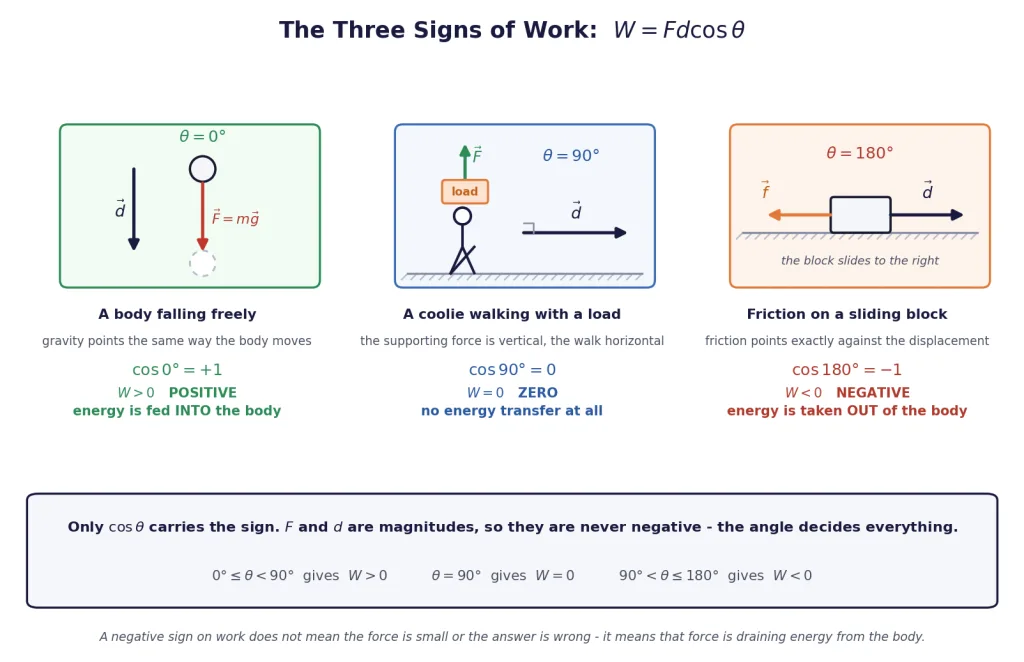
Case 1: , positive work
When the angle is sharp, and . The force has a component along the motion; it is helping the body move.
Key Point: Positive work means the force is feeding energy into the body. It speeds it up (unless something else is draining energy at the same rate).
Everyday cases:
- Gravity on a falling body. Both the weight and the displacement point straight down, so , and . This is the maximum possible work for a given force and distance.
- A horizontal push on a box that slides forward. again.
- A suitcase pulled by a strap slanted at . Now , so only is doing anything. The work is — still positive, just less than if you pulled horizontally.
- The engine force on an accelerating car, and the tension in a rope hauling a bucket up a well.
Case 2: , zero work
, so exactly, no matter how enormous the force.
Key Point — the most examined line in this section: A force perpendicular to the displacement does NO work. Not "a little work". None.
The next block gives this its own treatment, because it is worth it.
Case 3: , negative work
When the angle is obtuse, and . The force has a component opposing the motion.
Key Point: Negative work means the force is taking energy out of the body. It slows it down.
Everyday cases:
- Friction on a sliding block. Kinetic friction always points exactly opposite to the sliding, so , and . This is the most negative work possible for a given force and distance.
- Gravity on a body moving upward. The weight points down, the displacement up: and .
- Air resistance on any moving body — a falling raindrop, a swinging pendulum, a cricket ball in flight.
- The braking force on a car, and the resistance of a plank on a bullet entering it.
Key Point — what a minus sign does NOT mean: A negative work is not a small work, not a mistake, and not "work done in the negative direction" (work has no direction). It means that force removed energy from the body. A friction force doing J of work has taken 140 J away.
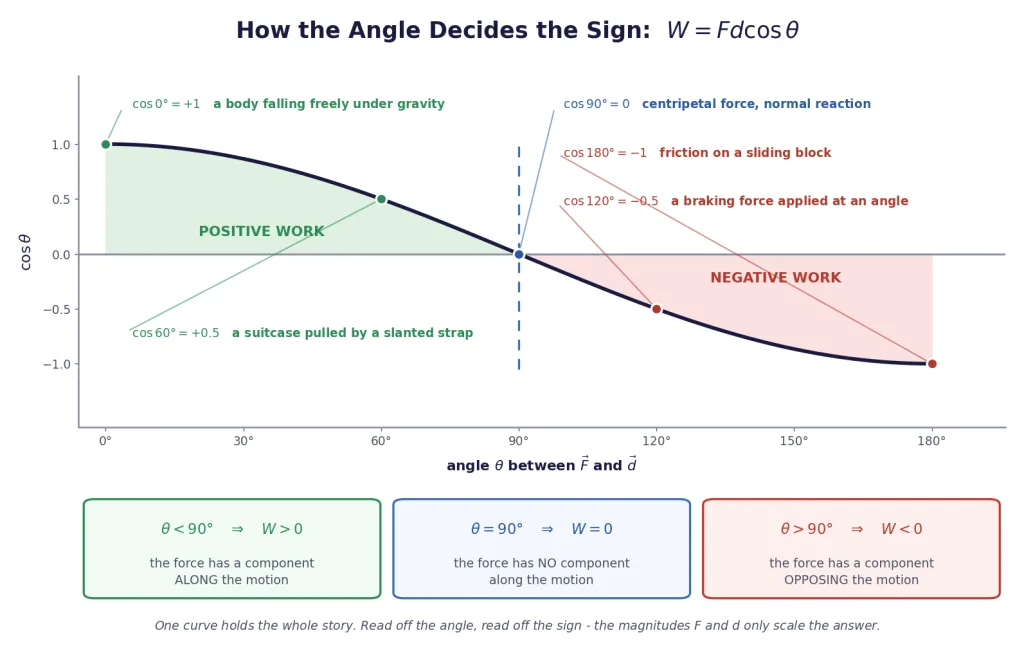
Reading the curve
The graph plots against from to , which is the full range of possible angles between two vectors. Three things to take away:
- It crosses zero exactly once, at . That is the boundary between helping and hindering, and it is a sharp one.
- It is symmetric about that crossing. A force at and a force at do works of equal size and opposite sign.
- The extremes are , at and . So for a given and , the work always lies between and .
[Board Important] A favourite two-mark question: state whether the work done is positive, negative or zero, and why. The answer is always the same three steps — identify the force, identify the displacement, compare their directions. Write the angle down. Then read off the sign.
| Situation | Force | Sign of | |
|---|---|---|---|
| Bucket lifted out of a well by a rope | tension, up | positive | |
| The same lift, work done by gravity | weight, down | negative | |
| Block sliding down a rough incline, by friction | friction, up the slope | negative | |
| Block sliding down a rough incline, by gravity | weight, down | for a slope | positive |
| Box pushed at constant velocity on a rough floor, by the push | applied, forward | positive | |
| A pendulum brought to rest by air | drag, opposite to motion | negative | |
| Satellite in a circular orbit, by gravity | gravity, towards Earth | zero |
Zero Work: Three Different Reasons
Students routinely lump these together. They are not the same, and a question that says "explain why no work is done" wants the right reason.
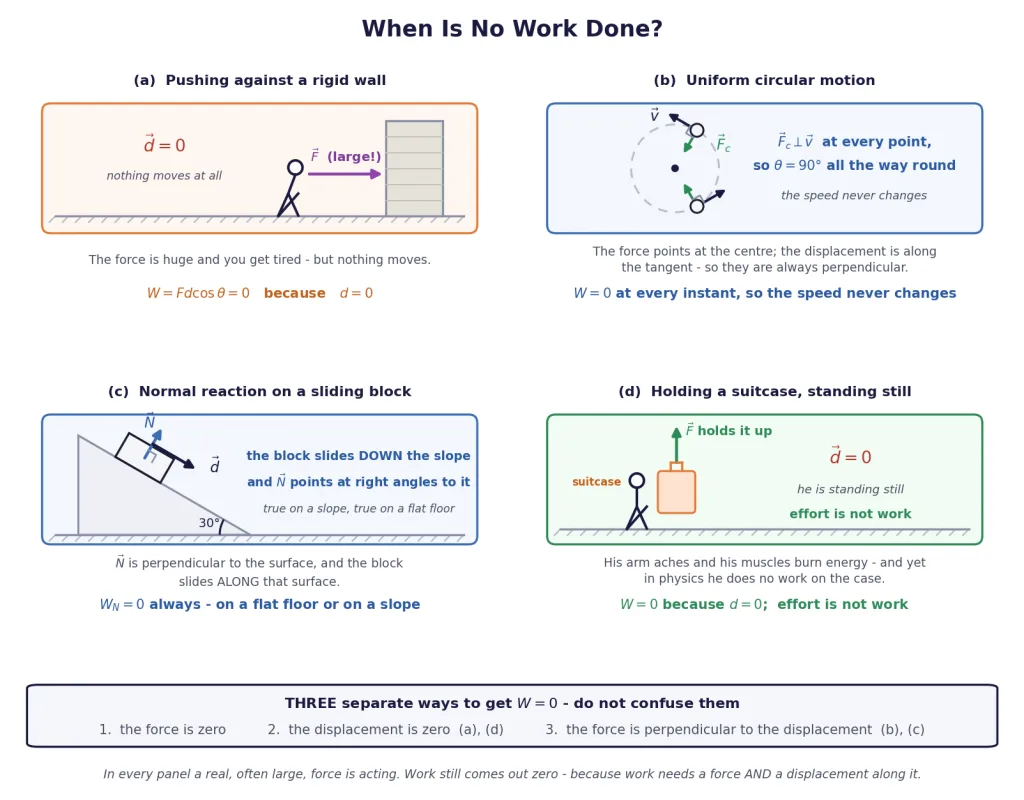
Key Point — vanishes in exactly three ways:
- — no force at all.
- — no displacement, however large the force.
- , i.e. — the force is perpendicular to the displacement.
Reason 1: zero force
A block glides across a perfectly smooth horizontal table. Horizontally there is no force on it at all, so no horizontal force does any work — and yet it may travel a long way. Motion without work is entirely possible; it is Newton's first law in a new costume.
Reason 2: zero displacement
- You push against a rigid brick wall as hard as you can. The force is huge. The wall does not move. , so . Your muscles are alternately contracting and relaxing and your internal energy really is being used up — which is why you get tired — but the work done by you on the wall is zero.
- A weightlifter holds a 150 kg barbell steady overhead for 30 s. He is exerting about 1500 N. The bar does not move. He does no work on the bar during those 30 s. (Lifting it up there was a different story — that took real work.)
- A man stands still holding a suitcase. Same thing.
Reason 3: force perpendicular to displacement
This is the important one, and the one JEE and NEET return to year after year.
(a) The centripetal force does no work in uniform circular motion. In circular motion the velocity is always tangential and the centripetal force always points at the centre — radially inward. They are perpendicular at every single instant, so and throughout.
Key Point: The centripetal force changes the direction of the velocity but never its magnitude. That is exactly why a body in uniform circular motion keeps a constant speed: nothing is doing any work on it, so nothing can change its kinetic energy.
Concrete cases: a stone whirled on a string (the tension does no work), the Moon in its near-circular orbit (the Earth's gravity does no work over a full orbit), an electron in a magnetic field (the magnetic force never does work on a charge — you will meet this in Class 12), and a car on a level circular track (friction supplies the centripetal force and does no work).
(b) The normal reaction usually does no work. is by definition perpendicular to the surface, and a body sliding along that surface moves parallel to it. Perpendicular force, parallel displacement, , . This is true on a flat floor and equally true on an inclined plane, which is why never appears in an energy calculation for a sliding block.
(The word "usually" is doing honest work there. If the surface itself moves — a block on an accelerating trolley, a lift floor pushing a passenger upward — then can do work, because the displacement is then not parallel to the surface. For every problem in this chapter, though, .)
(c) A coolie carrying a load on a level platform does no work against gravity. He supports the load with an upward force; he walks horizontally. Force vertical, displacement horizontal, , so the work he does against gravity is zero. Same for a man walking with a suitcase, and same for gravity itself acting on any body moving horizontally.
(He is not doing nothing at all: he had to lift the load onto his head in the first place, and he does small amounts of work each stride as the load bobs up and down. But the headline answer — no work against gravity over level ground — is correct and is what an examiner wants.)
One more trap: Newton's third law does not pair up the work
A skidding cyclist makes this point beautifully, and it is worth stating on its own.
A cyclist skids to a stop in 10 m. The road pushes on the cycle with 200 N opposing the motion, so the road does J of work on the cycle. By Newton's third law the cycle pushes back on the road with 200 N. How much work does the cycle do on the road? Zero — because the road does not move.
Key Point: Forces come in equal and opposite pairs. Works do not. always, but need not be zero, because the two bodies can undergo completely different displacements.
Work Done by Several Forces
Real bodies have several forces on them at once — weight, normal reaction, an applied pull, friction. Each of them does its own work, with its own sign. How do they combine?
Since work is a scalar, they simply add, as ordinary signed numbers:
And there is a second, equivalent route. Because the displacement is the same for all of them (they all act on the same body over the same journey), the distributive law of the dot product gives
Key Point — two roads, one destination: The sum of the works done by all the individual forces equals the work done by the net force. Use whichever is easier: add up the separate works when the forces are given individually, or find the resultant first when it is simpler.
That equality is not a coincidence — it is the distributive property of the dot product wearing a physics costume. And notice how much it depends on all the forces sharing one displacement. If they acted on different bodies moving differently, no such shortcut would exist.
A worked catalogue
Take a 10 kg block dragged 10 m along a rough floor by a 50 N force pulling at above the horizontal, with and m/s^2. Four forces act. Here is the full account (the details are Example 5 below):
| Force | Magnitude | Angle with | Work |
|---|---|---|---|
| Applied pull | 50 N | J | |
| Friction | 14 N | J | |
| Normal reaction | 70 N | ||
| Weight | 100 N | ||
| Net | 26 N horizontal | J |
Two checks worth making every time:
- The sum of the column is J.
- The net horizontal force is N, and J.
They agree, as they must.
Notation that will save you marks
Write out a small table like the one above for every multi-force problem. Three habits inside it:
- Name the force in every . J, not " J".
- Carry the sign explicitly. Do not write "work done against friction is 140 J" in the same line as works done by forces — mixing "by" and "against" is where sign errors breed. "Work done against friction" is the negative of "work done by friction".
- Check the perpendicular ones are zero before you compute anything. On a horizontal floor, and contribute nothing, which usually halves the arithmetic.
Where this is heading
You now have a number, , for every journey. It is a single scalar that packages up all the forces and the whole displacement into one quantity.
The obvious next question is: what does that number physically do to the body? Positive work speeds it up, negative work slows it down — we have said so several times without proving it. Making that precise requires a new quantity, the kinetic energy, and a relation between the two.
That relation is the work-energy theorem, and it is Section 2's job. Turn the page.
Solved Examples
Every mechanics problem in this set uses m/s^2, stated where it appears. The pure vector problems need no at all.
Example 1: The angle between two vectors from their components
Find the angle between the force unit and the displacement unit. Also find the projection of on .
Solution:
Compute the dot product by components. Multiply matching components and add:
Get the two magnitudes, using :
Now use the geometric form. Since ,
The projection of on is , and the cleanest way to get it is to divide the dot product by the magnitude of the vector you are projecting onto:
Final Answer: , and the projection of on is 2.26 unit.
Takeaway: Look at the structure of the calculation. The component form did the hard work (step 1), and the geometric form turned it into an angle (step 3). That two-step dance — components to get the number, cosine formula to get the angle — is how every "find the angle between" question is done. Note also that both vectors happen to have the same magnitude here; that is a coincidence of the numbers, not something you may assume.
Example 2: Dot product, angle, and a perpendicularity condition
Given and : (a) find ; (b) find the angle between them; (c) find so that is perpendicular to .
Solution:
(a) Components: Already informative: the product is negative, so the angle must be obtuse.
(b) Magnitudes: Obtuse, exactly as the sign predicted.
(c) Perpendicular means zero dot product:
Final Answer: (a) ; (b) ; (c) .
Takeaway: Read the sign of the dot product before you compute anything else — it tells you immediately whether the angle is acute, right or obtuse, and gives you a free check on the final answer. Part (c) is the standard way perpendicularity is examined: never try to visualise it, just set the dot product to zero and solve.
Example 3: Work by a constant force at an angle
A force of 50 N is applied to a body at to the horizontal, and the body moves 10 m horizontally. Find the work done by this force.
Solution:
Identify the three quantities. N, m, — and is the angle between the force and the displacement, which is what the question has given.
Apply the definition:
Final Answer: J.
Takeaway: Only N of that 50 N force is doing anything; the other component, N, points vertically and the body does not move vertically, so it contributes nothing. Pull at instead and the same 50 N over the same 10 m would deliver 500 J — twice as much. Angle costs you work.
Example 4: Work from vectors, when the displacement must be found first
A constant force N acts on a particle which moves from the point m to the point m. Find (a) the work done and (b) the angle between the force and the displacement.
Solution:
The displacement is the change in position, not the final position. This is the step people skip:
Work is the dot product:
(b) For the angle, get the two magnitudes:
Final Answer: (a) J; (b) .
Takeaway: Two traps in one problem. First, — using alone gives J, which is wrong. Second, notice that the work came out positive even though one term in the sum was negative; only the total matters, not the individual terms. The angle is acute, consistent with .
Example 5: All four forces on a dragged block
A 10 kg block is dragged 10 m along a rough horizontal floor by a 50 N force applied at above the horizontal. Take , m/s^2, and . Find the work done by each force, and the total work.
Solution:
Vertical equilibrium first, to get . The upward pieces are and the vertical component of the pull; the downward piece is the weight: Note that is not here — the slanted pull is helping to carry the block.
Kinetic friction:
Now take the four forces one at a time.
- Applied pull, at to the displacement:
- Friction, at to the displacement:
- Normal reaction, at (vertical force, horizontal motion):
- Weight, also at :
Add them up:
Check by the net force. Horizontally, N along the motion, so
Final Answer: J, J, , and J.
Takeaway: This is the template for every multi-force work problem, and the two-route check in step 5 is free insurance. The single commonest error is writing N and hence N, which throws the friction work out by 60 J. Whenever a force is applied at an angle, recompute from vertical equilibrium before you touch friction.
Example 6: The coolie — lifting versus carrying
A coolie lifts a 20 kg load from the ground onto his head, 1.5 m up, and then walks 50 m along a level platform. Take m/s^2. Find (a) the work he does in lifting the load, (b) the work done by gravity during the lift, and (c) the work he does against gravity while walking.
Solution:
(a) The lift. Moving the load at steady speed means his upward force equals the weight, N, and the displacement is 1.5 m upward, so :
(b) Gravity during the lift. The weight is 200 N downward while the load moves upward, so :
(c) The walk. He supports the load with a vertical force while it moves horizontally, so :
Final Answer: (a) J; (b) J; (c) zero.
Takeaway: Compare (a) and (c). Lifting the load 1.5 m costs 300 J; carrying it 50 m costs nothing at all in the physics sense — thirty-three times the distance, zero work. That is the sharpest illustration in the chapter of how far the physics meaning of "work" is from the everyday one. Note too that in the lift, , which fits the load moving at constant speed. [NEET Important] "A coolie carrying a load on a horizontal road does no work against gravity" is a standard one-mark answer — the reason is .
Example 7: A block sliding down a rough incline
A 2 kg block slides 4 m down a rough incline of . Take , m/s^2, and . Find the work done by (a) gravity, (b) the normal reaction, (c) friction, and (d) the total work done on the block.
Solution:
(a) Gravity. The weight is N straight down; the displacement is 4 m down the slope. The angle between "straight down" and "down a slope" is , so Faster route: only the vertical drop matters, and the block descends m, so J. Same answer, less trigonometry.
(b) Normal reaction. is perpendicular to the slope, the motion is along the slope:
(c) Friction. First find from equilibrium perpendicular to the slope: Friction acts up the slope while the block moves down it, so :
(d) Total:
Final Answer: (a) J; (b) ; (c) J; (d) J.
Takeaway: Three habits are on display. Use with the vertical drop — it never involves an angle and never goes wrong. Write immediately, without calculation. And get from the perpendicular direction before touching friction. The total being positive tells you the block is speeding up as it slides, which is what you would expect on a slope with only modest friction.
Example 8: The stone on a string — a force that does nothing
A 0.5 kg stone is whirled in a horizontal circle of radius 1 m at a constant speed of 4 m/s. Find (a) the tension in the string, (b) the work done by the tension in one complete revolution, and (c) the work done by the tension in a quarter revolution.
Solution:
(a) The tension supplies the centripetal force:
(b) One complete revolution. Two independent arguments give the same answer, and both are worth knowing:
- By the angle: at every instant the tension points at the centre and the displacement is along the tangent, so and . The work is zero over every tiny step, hence zero over any journey at all.
- By the net displacement: after a full revolution the stone is back where it started, so .
- (c) A quarter revolution. Now the net displacement is not zero — it is m across the circle. But the first argument still holds: the force is perpendicular to the motion at every instant, so
Final Answer: (a) N; (b) zero; (c) zero.
Takeaway: Part (c) is the test of whether you have really understood. The "it returns to the start" argument is a coincidence of the full revolution and fails for a quarter turn; the perpendicularity argument works for any arc, however short. Use the perpendicularity argument. And notice the consequence: an 8 N force acts on this stone continuously and never changes its speed, because a force that does no work can never change the kinetic energy. [JEE/NEET] The same reasoning applies to gravity on a satellite in a circular orbit and to the magnetic force on a moving charge.
Example 9: The sign of the work — a catalogue
State whether the work done is positive, negative or zero in each case, with the angle: (a) by a man lifting a bucket out of a well with a rope; (b) by gravity on that bucket during the same lift; (c) by friction on a body sliding down a rough incline; (d) by an applied force on a body moving at uniform velocity on a rough horizontal plane; (e) by air resistance on a swinging pendulum as it comes to rest; (f) by gravity on a body sliding down a smooth incline.
Solution:
(a) The rope tension is up; the bucket moves up. , . Positive.
(b) The weight is down; the bucket moves up. , . Negative. (And equal in magnitude to (a) if the lift is at constant speed.)
(c) Friction on a sliding body always opposes the sliding, so it acts up the slope while the body moves down. . Negative.
(d) The applied force is along the motion. . Positive. Uniform velocity does not mean zero work — it means the total is zero, because friction is doing an equal and opposite negative work.
(e) Air resistance always opposes the motion. at every instant. Negative.
(f) The weight has a component down the slope, along the motion. is acute (it equals minus the slope angle). Positive.
Final Answer: (a) positive, (b) negative, (c) negative, (d) positive, (e) negative, (f) positive.
Takeaway: Part (d) is the one that catches people. "Moving at uniform velocity" tempts you to say "no work", but the question asks about the work done by the applied force, which is unambiguously positive. It is the total work that is zero here. [Board Important] Always re-read which force the question is asking about — this is exactly why "calculate the work done" is an incomplete instruction.
Example 10: Work depends on the frame of reference
A passenger in a train pushes a book with a constant horizontal force of 10 N, sliding it 2 m along the table in the direction of the train's motion. During the same time the train travels 20 m forward along the track. Find the work done by the passenger's push (a) as measured in the train's frame, and (b) as measured by an observer standing on the platform.
Solution:
(a) In the train's frame, the displacement of the book is simply 2 m, along the force:
(b) On the platform, the book moved 2 m relative to the train and the train carried it 20 m, both in the same direction, so its displacement is The force is the same 10 N (force is frame-independent between inertial frames), so
Final Answer: (a) 20 J; (b) 220 J.
Takeaway: Both answers are correct. Work is frame-dependent, because displacement is, even though the force is not. This does not break physics: Section 2 will show that kinetic energy is frame-dependent in exactly the matching way, so the relation between work and energy holds in every inertial frame. [JEE Tip] When a problem involves a moving platform, lift or trolley, decide your frame first and stay in it — mixing the ground displacement with the trolley-frame force is a guaranteed wrong answer.
Example 11: Three forces, one displacement
Three forces N, N and N act simultaneously on a particle which undergoes a displacement m. Find the work done by each force and the total work, and verify it against the work done by the net force.
Solution:
Each force separately:
Add, as ordinary signed numbers (work is a scalar):
Now the other route. Add the forces as vectors first:
Final Answer: J, J, J, and J.
Takeaway: Notice what got added as vectors and what got added as numbers. Forces are vectors, so step 3 adds components. Works are scalars, so step 2 just adds signed numbers. Mixing the two up — trying to add works head to tail, or adding force magnitudes without direction — is a classic slip. The agreement between the two routes is the distributive law of the dot product doing its job.
Example 12: Constant velocity means zero total work
A 5 kg block is dragged 10 m across a rough horizontal floor at constant velocity by a horizontal force. Take and m/s^2. Find the work done by (a) the applied force, (b) friction, (c) gravity and the normal reaction, and (d) all the forces together.
Solution:
Constant velocity means zero acceleration, hence zero net force. Horizontally, therefore, the applied force exactly balances friction:
(a) The applied force is along the motion:
(b) Friction is exactly opposite:
(c) Gravity and the normal reaction are both vertical while the motion is horizontal:
(d) Total:
Final Answer: (a) J; (b) J; (c) both zero; (d) zero.
Takeaway: Read part (d) carefully: the total work is zero, but two individual works of 100 J each are certainly not. Energy really is flowing — 100 J went in from you and 100 J came out as heat at the sliding surface — and the block's speed is unchanged because those two exactly cancel. Whenever a question says "at constant velocity", "at steady speed" or "slowly", you may immediately write and expect the total work to vanish. [JEE/NEET] This is also the standard setting for the phrase work done against friction, which here is J — the negative of the work done by friction. Watch the preposition.