
How to Use This Section
Sections 1 to 7 taught you the physics. This section is where you find out whether you actually own it.
What follows is 42 fresh worked problems — new numbers, new framings, and combinations the theory sections deliberately did not attempt. They run roughly easy to hard and they are grouped by idea, so if one skill is shaky you can attack it directly.
| Examples | Topic | Section to revise if you get stuck |
|---|---|---|
| 1 to 5 | Scalar product, the sign of work, work by a constant force | Section 1 |
| 6 to 11 | Variable forces: F-x graph areas and honest integration | Section 3 |
| 12 to 17 | The work-energy theorem: stopping, penetrating, inclines | Section 2 |
| 18 to 24 | Potential energy, conservation of mechanical energy, reasoning questions | Section 4 |
| 25 to 28 | Springs: energy stored, compression, spring plus gravity, spring plus friction | Section 5 |
| 29 to 33 | Power: pumps, windmills, lifts, solar panels, kWh | Section 6 |
| 34 to 39 | Collisions: elastic, inelastic, restitution, two dimensions | Section 7 |
| 40 to 42 | Genuinely hard, two or three skills chained together | everything |
How to work them
Read the problem, close the page, and solve it yourself. Then compare. Reading a worked solution feels like learning and is not; the only thing that transfers to an exam hall is having done it with your own pen.
Key Point: Three habits run through almost every solution below, and they matter more than any single formula. (1) Decide first whether the question wants forces or energy — if it mentions speed at two places and never asks about time, it is an energy question. (2) Write the energy equation as a full sentence of bookkeeping: , and put every term in it, even the zeros. (3) Check the sign of every work term against before you move on; a lost minus sign is the single most expensive error in this chapter.
[Board Important] Every example states the value of it uses. Some problems are cleaner with 9.8 m/s^2 and others with 10 m/s^2. Both appear below, always stated, and never mixed inside one problem. In an exam use whatever the paper says; if it says nothing, write down what you assumed.
Solved Examples
Example 1: A force with components you never use
A body constrained to move along the -axis is subject to a constant force What is the work done by this force in moving the body a distance of 4 m along the -axis?
Solution:
Write the displacement as a vector. "4 m along the -axis" means with no or component at all. That is the whole trick of this question.
Take the dot product, remembering and :
Where did the other two components go? Nowhere useful. The and components of are perpendicular to the motion, so they do zero work. They are not zero forces — they are being cancelled by whatever constraint (a groove, a rail, a wire) holds the body on the -axis, and that constraint force does no work either.
A sanity variation. If the same body had instead moved 4 m along the -axis, the answer would be J — negative, because the component points the other way.
Final Answer: J.
Takeaway: Only the component of the force along the displacement ever appears in the work. [JEE/NEET] When a question hands you a three-component force and a one-component displacement, you are being tested on exactly one thing: whether you take the dot product or panic and compute .
Example 2: Is this force speeding the particle up or slowing it down?
A particle is acted on by a constant force N while it travels in a straight line from the point A m to the point B m. Find (a) the work done, (b) whether the particle is speeding up or slowing down, (c) the component of the force along the direction of motion, and (d) the angle between the force and the displacement.
Solution:
The displacement is B minus A, not either point on its own:
(a) Work:
(b) The sign answers it immediately. Negative work means the net force is draining kinetic energy. If this is the only force acting, the particle is slowing down, and by the work-energy theorem its kinetic energy has fallen by exactly 15 J over that path.
(c) The component of along the motion is the work per unit distance travelled. First the magnitudes: Negative, meaning that component points backwards along the path. The remaining N of the force is perpendicular to the motion and does nothing at all to the speed — it only bends the path.
(d) The angle, from :
Consistency check. and and — three statements that must always agree. If any one of them had come out with the opposite sign, there is an arithmetic slip to find.
Final Answer: (a) J; (b) slowing down; (c) N; (d) .
Takeaway: [JEE Tip] A force does three separate things and you should learn to read them off separately. Its component along changes the speed (positive speeds up, negative slows down); its component perpendicular to changes only the direction and does zero work. Here 2.89 N of the 7 N is slowing the particle, and the other 6.38 N is just steering.
Example 3: Positive, negative or zero — six quick verdicts
State whether the work done is positive, negative or zero, and say why: (a) by the tension in the rope while a bucket is lowered into a well at constant speed; (b) by the normal force from the floor on a person standing in a lift that is moving upward; (c) by static friction on a suitcase resting on the floor of a truck that is accelerating forward; (d) by gravity on a satellite in a circular orbit, over one full orbit; (e) by air resistance on a shuttlecock over its entire flight; (f) by a porter's hands on a trunk he is holding still on his shoulder while standing on a platform.
Solution:
(a) Negative. The tension points up the rope, the bucket moves down, . Constant speed means exactly, and — precisely cancelling the done by gravity, which is why .
(b) Positive. The normal force is up and the displacement is up, . Note this does not depend on whether the lift is accelerating, decelerating or moving uniformly — only on the direction of the displacement.
(c) Positive. This one catches people out. The suitcase does not slide, so static friction is the only horizontal force acting on it, and it must point forward to accelerate the suitcase along with the truck. The suitcase moves forward too, so and the work is positive. Static friction is perfectly capable of doing positive work.
(d) Zero. In a circular orbit the gravitational pull is always along the radius and the velocity is always along the tangent, so at every instant. Zero work, which is exactly why the orbital speed is constant.
(e) Negative. Air resistance always opposes the velocity, at every instant of the flight, up and down alike. It is the reason a shuttlecock returns to the ground with less speed than it left with.
(f) Zero. No displacement, so no work — no matter how tired his arms get. His muscles burn chemical energy in maintaining tension, but that is physiology, not mechanics.
Final Answer: (a) negative, (b) positive, (c) positive, (d) zero, (e) negative, (f) zero.
Takeaway: [NEET Important] Run the same two-step check every time: what direction is the force and what direction is the displacement. Case (c) is the standard trap — students assume friction is always negative work because it is usually dissipative, but static friction on a body that is carried along does positive work on it.
Example 4: A crate on a rope — every force audited
A 20 kg crate is dragged 12 m along a rough horizontal floor by a rope held at above the horizontal, with a tension of 80 N. Take and m/s^2. The crate starts from rest. Find the work done by each force, the net work, and the final speed.
Solution:
Normal force first — the slanted rope lightens the crate. Vertically there is no acceleration, so
Kinetic friction:
Work by the tension ():
Work by friction ():
Work by gravity and by the normal force: both are vertical, the displacement is horizontal, so both are zero.
Net work and final speed:
Cross-check by forces. m/s^2, and m/s. Same answer, different route.
Final Answer: J, J, , J, final speed 6.03 m/s.
Takeaway: [JEE Tip] Do the vertical equation before the horizontal one. The upward component of the tension reduces , which reduces friction — a slanted pull is easier than a horizontal pull of the same size for two separate reasons, and examiners love the students who spot the second one.
Example 5: Four kinds of work over ten seconds
A body of mass 2 kg, initially at rest, moves under a horizontal applied force of 7 N on a table with coefficient of kinetic friction 0.1. Take m/s^2. Compute over the first 10 s (a) the work done by the applied force, (b) the work done by friction, (c) the work done by the net force, (d) the change in kinetic energy — and interpret.
Solution:
Friction force:
Acceleration (7 N pushes, 1.96 N resists):
Distance in 10 s, from rest:
(a) Work by the applied force:
(b) Work by friction (opposite to the motion):
(c) Work by the net force:
(d) Change in kinetic energy. The final speed is m/s, so
The interpretation the question is fishing for. Notice : the works of the individual forces add up as ordinary numbers, because work is a scalar. And exactly — that is the work-energy theorem, verified numerically rather than quoted.
Final Answer: (a) 882 J, (b) J, (c) 635 J, (d) 635 J.
Takeaway: This one problem contains the whole of Sections 1 and 2. The work done by each force is a separate quantity; only the sum equals . [Board Important] Part (d) is not a new calculation, it is a check — and writing "which agrees with (c), verifying the work-energy theorem" is worth a mark in almost every board scheme.
Example 6: A piecewise F-x graph, read as four signed areas
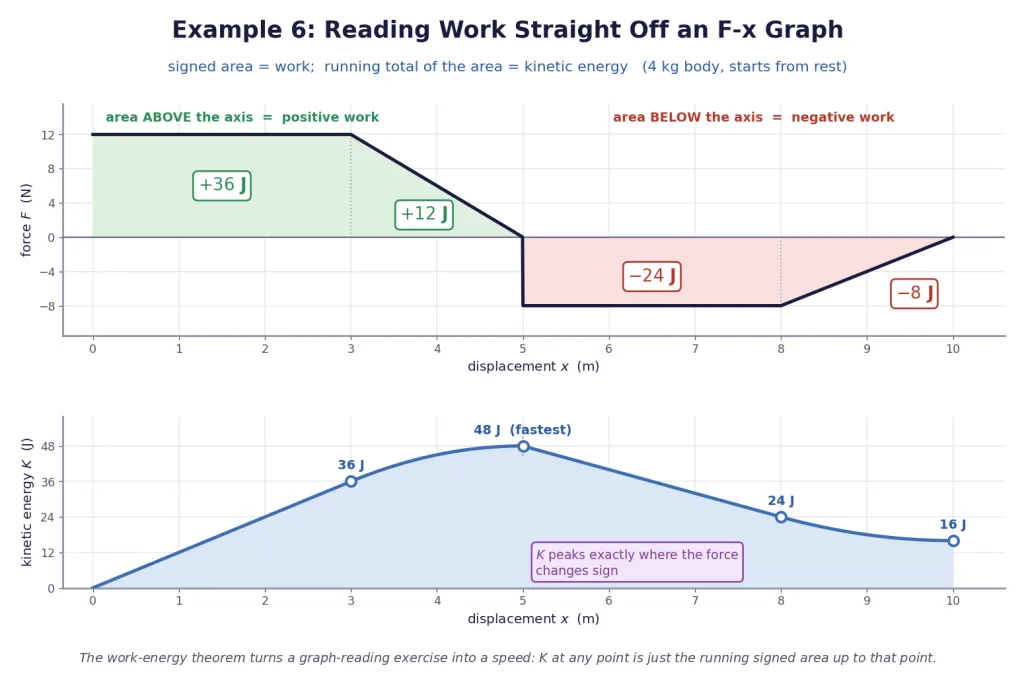
A 4 kg body starts from rest at on a smooth horizontal floor. The force on it along its direction of motion is: N from to 3 m; then falling linearly from N to 0 between 3 m and 5 m; then N from 5 m to 8 m; then rising linearly from N back to 0 between 8 m and 10 m. Find the kinetic energy at m and at m, and the speed at each.
Solution:
Chop the graph into shapes whose areas you know.
Interval Shape Signed area = work 0 to 3 m rectangle J 3 to 5 m triangle J 5 to 8 m rectangle , below the axis J 8 to 10 m triangle , below the axis J Kinetic energy at 5 m. The body started from rest, so equals the running total of the area:
Kinetic energy at 10 m:
Where is it fastest? At m — the exact point where the force changes sign. Up to there every scrap of area was positive and was climbing; past there the area is negative and falls. The lower panel of the figure shows this as a clean peak.
Does it ever stop? No. The total negative area available beyond 5 m is only J, less than the 48 J it carries, so it leaves the region still moving at 2.83 m/s.
Final Answer: J and m/s at m; J and m/s at m.
Takeaway: [JEE/NEET] For an F-x graph, work is the signed area and kinetic energy is the running total of that area. The body is fastest wherever crosses zero going from positive to negative — you can read the answer off the graph before writing a single number.
Example 7: When the graph is a curve — the semicircular force
The force on a 1.5 kg body, plotted against its displacement, is a semicircle: it rises from 0 at to a peak of 2 N at m and falls back to 0 at m, the curve being newtons. The body starts from rest at . Find the total work done and the final speed.
Solution:
Recognise the shape. That equation is the upper half of a circle of radius 2 centred at . You do not need calculus for a circle — you need geometry.
Area of a semicircle of radius : Careful with the units: the "radius" is 2 m along one axis and 2 N along the other, so the area comes out in newton-metres, which are joules.
Final speed:
What a crude estimate would have given. Four trapezium strips of width 1 m, using at (that is ), give an underestimate of about 13%, because the trapezium chords cut inside a curve that bulges outward. Thinner strips close the gap; the exact geometry closes it instantly.
Final Answer: J, final speed 2.89 m/s.
Takeaway: Before you integrate, look at the shape. Rectangles, triangles, trapezia, semicircles and quarter-circles all have areas you already know, and exam graphs are built out of exactly those. Integration is the fallback, not the first move.
Example 8: An honest integration, then the work-energy theorem
A 2 kg particle moves along the -axis under a force newtons, with in metres. At m its speed is 2 m/s. Find its speed at m.
Solution:
The force varies with position, so the work is an integral:
Integrate term by term:
Substitute the limits. At : . At : .
Apply the work-energy theorem. The initial kinetic energy is J, so
Final speed:
Final Answer: 8.19 m/s.
Takeaway: [JEE Tip] Substitute the lower limit as carefully as the upper one. Forgetting the here gives 68 J and a plausible-looking 8.25 m/s, which is wrong and looks right — the most dangerous kind of error.
Example 9: When you are given , not
A body of mass 0.5 kg travels in a straight line with velocity , where in SI units. What is the work done by the net force during its displacement from to m?
Solution:
Do not hunt for the force. The work-energy theorem needs only two speeds.
Speed at the two ends. At , . At m,
Work equals the change in kinetic energy:
The longer route, for reassurance. The force is and Identical, and three times the work.
Final Answer: J.
Takeaway: When the question gives you speed as a function of position and asks for work, go straight to . Finding first is legal, longer, and offers two extra chances to make a mistake. Use only when the force itself is what you are asked for.
Example 10: A force that fades, reverses, and finally stops the body
A 3 kg block, at rest at on a smooth horizontal floor, is acted on by a force newtons, with in metres. Find (a) where the block is moving fastest and that speed, (b) its speed at m, and (c) where it momentarily comes to rest.
Solution:
(a) The speed peaks where the force changes sign. when , that is at m. Before that the force pushes forward, after that it pushes backward.
Work up to m: (Geometry check: the graph is a straight line from 20 N down to 0 over 5 m, a triangle of area J. It agrees.)
(b) Speed at m:
(c) It stops when the total work done on it since the start returns to zero: The positive triangle from 0 to 5 m is exactly cancelled by the negative triangle from 5 m to 10 m — they are congruent.
Final Answer: (a) fastest at m, 5.77 m/s; (b) 4.62 m/s at m; (c) it stops at m.
Takeaway: [JEE Tip] Two graph facts solve this entire problem without integration. Maximum speed happens where crosses zero; the body stops where the positive and negative areas balance. Symmetry did part (c) in one line.
Example 11: Friction that gets worse as you go
A 2 kg block slides onto a patch of floor where the coefficient of kinetic friction grows with distance as , with measured in metres from the edge of the patch. The block enters at 6 m/s. Take m/s^2. How far into the patch does it get?
Solution:
The friction force is now a function of position:
Work done by friction over a distance (negative, since friction opposes motion):
Set that equal to the kinetic energy it must destroy:
Solve: (The negative root is rejected — the block went forward.)
Sanity check against the constant- cases. If had stayed at its entry value 0.10, the block would have gone m. If had been 0.10 + 0.05(6.72) = 0.436 throughout, it would have gone only m. The true answer, 6.72 m, sits between the two, as it must.
Final Answer: 6.72 m.
Takeaway: A variable friction coefficient is just a variable force — nothing new. [JEE Tip] Bracketing your answer between the two constant- extremes takes ten seconds and catches sign errors, dropped factors and wrong roots.
Example 12: A truck braking, level and then downhill
A 1500 kg truck is travelling at 90 km/h when the driver brakes; the brakes and tyres together provide a constant retarding force of 7500 N. Take m/s^2. Find the stopping distance (a) on a level road and (b) down a slope of 1 in 10, that is with .
Solution:
Convert once, at the start. km/h m/s.
Kinetic energy to be destroyed:
(a) On the level, the braking force is the only force doing work:
(b) Downhill, gravity helps the truck instead of the driver. The component of weight along the slope is pointing down the slope, so the net retarding force is N:
Interpret it. A gentle 1-in-10 gradient — barely noticeable to look at — stretches the stopping distance by 24%. That is 15 extra metres, which is roughly four car lengths.
Final Answer: (a) 62.5 m, (b) 77.7 m.
Takeaway: [Board Important] On a slope the gravitational term joins the energy equation, and it changes sign between uphill and downhill. Writing the full bookkeeping line makes the sign automatic; guessing it does not.
Example 13: A bullet in wood, three ways
A 12 g bullet moving at 500 m/s strikes a fixed wooden block and comes to rest after penetrating 25 cm. Assume the resistance is constant. Find (a) the average resistive force, (b) how far the same bullet would penetrate if fired at 250 m/s, and (c) the speed with which it would emerge from a plank of the same wood only 10 cm thick.
Solution:
(a) All the kinetic energy is destroyed by the resistive force: That is about 51,000 times the bullet's own weight — which is why wood stops bullets and gravity is irrelevant over 25 cm.
(b) Halve the speed and you quarter the energy, so you quarter the depth:
(c) Through a 10 cm plank, the wood only gets to remove so the bullet leaves with
Note what did not halve. The bullet lost 40% of its energy but only 23% of its speed, because .
Final Answer: (a) 6000 N, (b) 6.25 cm, (c) 387 m/s.
Takeaway: Penetration depth goes as the square of the speed (), which is the same rule as stopping distance for a car. [NEET Important] Double the muzzle speed and you need four times the thickness of armour.
Example 14: How many planks can the bullet get through?
A bullet loses one quarter of its speed while passing through one plank. How many such planks can it pass through completely before it stops?
Solution:
Translate speed into energy — that is where the trap is. After one plank , so The bullet lost , that is 43.75% of its energy, not 25%.
Each plank of the same wood removes the same amount of energy, because the resistive force and the thickness are the same:
Number of planks the initial energy can pay for:
Read that answer correctly. The bullet has enough energy for 2.29 planks, so it gets completely through 2 planks and buries itself part-way into the third. After two planks its remaining energy is , i.e. it is still moving at of its original speed.
Final Answer: 2 planks completely; it stops inside the third.
Takeaway: [JEE Tip] "Loses a quarter of its speed" and "loses a quarter of its energy" are completely different statements. Convert to energy first, then count. And when the count is fractional, the answer is the integer below it — you cannot pass through 0.29 of a plank.
Example 15: Up a rough incline, and back down again
A 4 kg block is projected up a rough incline of with an initial speed of 12 m/s. Take and m/s^2. Find (a) how far up the incline it travels, (b) the speed with which it returns to the starting point, and (c) the total heat generated.
Solution:
Going up, gravity and friction both oppose the motion, so they add:
(a) Distance up, from :
Coming down, friction reverses (it always opposes the current motion) so now it fights gravity:
(b) Speed on return, over the same 9.67 m:
The tidy general result. Dividing the two energies, and m/s. It agrees.
(c) Heat generated = friction force total path length : Check: the block came back to the same place with less kinetic energy, and the shortfall is Identical, as it must be.
Final Answer: (a) 9.67 m, (b) 6.75 m/s, (c) 197 J.
Takeaway: Friction always opposes the motion, so it flips direction at the top while gravity does not. [JEE/NEET] That single asymmetry is why the block returns slower — and it is why the round-trip work of friction is never zero, which is exactly the statement that friction is non-conservative.
Example 16: The raindrop that falls 500 m
A raindrop of radius 2 mm falls from a height of 500 m. It falls with decreasing acceleration until, at half its original height, it reaches its terminal speed and moves uniformly thereafter. It reaches the ground at 10 m/s. Take the density of water as 1000 kg/m^3 and m/s^2. Find the work done by gravity in each half of the journey, and the work done by the resistive force over the whole journey.
Solution:
Mass of the drop, from its volume:
Work done by gravity in the first 250 m:
Work done by gravity in the second 250 m: exactly the same, J. Gravity does not care that the drop is now moving at constant speed — the force and the drop are both still there, and the displacement is the same.
Total work by gravity: J.
Work done by the resistive force, from the work-energy theorem over the whole 500 m. The drop starts from rest, so
Read that number. Of the 0.164 J that gravity supplied, all but 0.0017 J was scraped away by the air — about 99%. The drop arrives with almost none of the energy gravity gave it, which is precisely why rain does not hurt.
Final Answer: J in each half (0.164 J in total) by gravity; J by the resistive force.
Takeaway: [Board Important] The second half is the interesting part: at terminal speed , so the resistive work in that half is exactly — the air removes energy at precisely the rate gravity supplies it. Constant speed does not mean no work; it means the works cancel.
Example 17: Electron versus proton — which one is faster?
An electron and a proton are detected in a cosmic-ray experiment, the electron with kinetic energy 10 keV and the proton with 100 keV. Which is faster, and what is the ratio of their speeds? Take kg, kg and eV J.
Solution:
Convert the energies.
Speed from :
The ratio:
The one-line route, which is the one to use in an exam:
Final Answer: The electron is faster, by a factor of about 13.5.
Takeaway: [NEET Important] Ten times less energy and the electron still wins, because it is roughly 1833 times lighter and speed depends on . The mass ratio beats the energy ratio here. Always compare , never alone, when the question is about speed.
Example 18: A pendulum that loses 5% of its energy
The bob of a pendulum of length 1.5 m is released from a horizontal position. It dissipates 5% of its initial energy against air resistance. Take m/s^2. With what speed does it arrive at the lowest point?
Solution:
Set the zero of potential energy at the lowest point. Released from the horizontal, the bob starts a full string-length above that point, so it begins with
Only 95% of that survives as kinetic energy:
The mass cancels — it always does in these problems:
Compare with the frictionless case: m/s. Losing 5% of the energy costs only 2.5% of the speed, because .
Final Answer: 5.28 m/s.
Takeaway: [Board Important] "Dissipates 5% of its energy" means multiply the energy by 0.95, not the speed. A percentage loss quoted for energy always becomes a smaller percentage loss in speed, by roughly a factor of two for small losses.
Example 19: Ramp, rough patch, ramp — where does it finally stop?
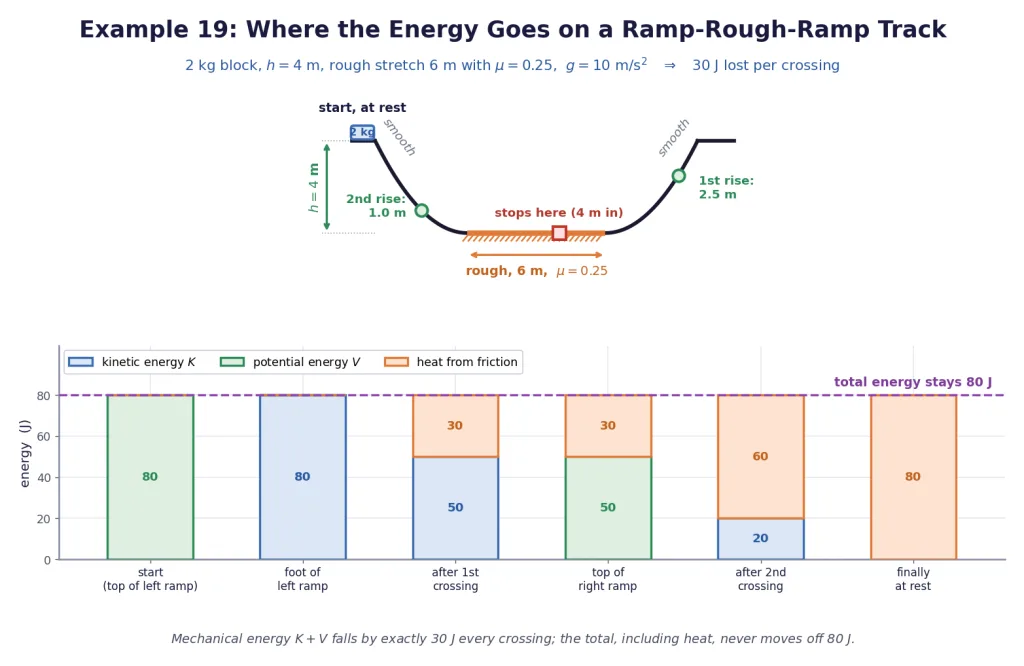
A 2 kg block is released from rest at the top of a smooth curved ramp of height 4 m. At the bottom it crosses a rough horizontal stretch 6 m long with , then runs up a second smooth ramp. Take m/s^2. How high does it rise on each ramp, and where does it finally come to rest?
Solution:
Energy at the start, taking the horizontal stretch as the zero level: All of it is kinetic at the foot of the first ramp.
Cost of one crossing of the rough stretch: Fixed — the same 30 J every single time, whichever way it is going.
After the first crossing: J. It runs up the right-hand ramp until all of that is potential energy:
Back down and across again: J, so on the left ramp it reaches
Third pass: it starts across with only 20 J, and a full crossing costs 30 J. So it does not make it. It travels into the rough stretch and stops there — 4 m from the left-hand end, 2 m short of the right-hand end.
Audit the whole thing. The total path swept over the rough patch must satisfy J, giving m. And m. The books balance.
Final Answer: 2.5 m on the right ramp, 1.0 m on the left ramp, and it finally stops 4 m into the rough stretch from the left-hand end.
Takeaway: [JEE Tip] With a rough patch of fixed length, do not simulate every trip — compute the total sliding distance in one line and then divide it up. That is a 20-second answer instead of a two-minute one, and it is self-checking.
Example 20: Two bodies, one string, energy instead of forces
A 3 kg block on a rough horizontal table () is connected by a light inextensible string over a frictionless pulley at the edge of the table to a 2 kg block hanging freely. The system is released from rest. Take m/s^2. Find the speed of the blocks after the hanging block has fallen 1.5 m.
Solution:
Why energy works here. The string is inextensible, so both blocks always have the same speed, and the tension does J on one block and J on the other. Those cancel exactly, so the tension never enters the energy equation — which is the whole point of using energy on a connected system.
Energy supplied by gravity (only the hanging block descends):
Energy taken by friction (only the table block slides, through the same 1.5 m):
What is left becomes kinetic energy of both blocks:
Cross-check with Newton's laws. m/s^2, and m/s. Same.
Final Answer: 2.90 m/s.
Takeaway: [JEE Tip] For connected bodies, the string's tension does zero net work on the system, so energy conservation gives you the speed in one line without ever finding . Remember the — the commonest error here is to give the kinetic energy to only one of the two blocks.
Example 21: The dieter, and how much fat she burns
A person trying to lose weight lifts a 10 kg mass one thousand times, to a height of 0.5 m each time. Assume the potential energy lost each time she lowers the mass is dissipated. Take m/s^2. (a) How much work does she do against the gravitational force? (b) Fat supplies J per kilogram, converted to mechanical energy with 20% efficiency. How much fat does she use up?
Solution:
(a) One lift costs ; a thousand lifts cost a thousand times that: The lowering is free, by the problem's own assumption — she does no useful work coming down, and the energy she put in is simply dumped.
(b) Only 20% of the energy in the fat becomes mechanical work, so each kilogram of fat delivers
Fat burned:
Feel the number. A thousand lifts — a serious hour in the gym — burns about six and a half grams of fat. To lose one kilogram this way she would need roughly 155,000 lifts. This is why dieticians talk about food intake rather than exercise alone.
Final Answer: (a) 49,000 J; (b) about 6.45 g of fat.
Takeaway: [Board Important] Efficiency always goes in the denominator when you work backwards from useful output to fuel input. And note the physics lesson buried in the arithmetic: fat is an extraordinarily dense energy store, about J/kg, some eight times better than TNT.
Example 22: One projectile, three energy questions
A 0.4 kg stone is thrown vertically upward at 30 m/s. Take m/s^2 and put at the point of projection, and ignore air resistance. Find (a) the maximum height, (b) the height at which its kinetic energy is three times its potential energy, and (c) its speed at half the maximum height.
Solution:
Total mechanical energy, fixed for the whole flight:
(a) At the top all of it is potential:
(b) together with gives , so J: Notice that means — you could have written 11.5 m directly.
(c) At , the potential energy is half the total, so the kinetic energy is the other half: which is — at half the height, the speed is of the launch speed, never half.
Final Answer: (a) 45.9 m, (b) 11.5 m, (c) 21.2 m/s.
Takeaway: [NEET Important] Because but , height splits linearly and speed does not. Half the height means half the kinetic energy and of the speed; a quarter of the height means the kinetic energy is three times the potential energy. Memorise those two, they appear constantly.
Example 23: Four questions with no numbers
(a) The casing of a rocket in flight burns up due to friction. At whose expense is the heat energy obtained — the rocket's or the atmosphere's? (b) Comets move in highly elliptical orbits, and the gravitational force is generally not perpendicular to the comet's velocity, yet the work done by gravity over a complete orbit is zero. Why? (c) An orbiting satellite loses energy to atmospheric drag, so why does its speed increase as it spirals inward? (d) In one case a man walks 2 m carrying a 15 kg mass on his hands; in another he walks the same 2 m pulling a rope that passes over a pulley with a 15 kg mass hanging at the other end. In which case is the work done greater?
Solution:
(a) The rocket's. The atmosphere is essentially at rest; it is the rocket that has enormous kinetic energy, and friction converts that into heat. The rocket slows and its casing burns. If you doubt it, ask which body's energy decreased — energy has to come out of something.
(b) Because gravity is conservative. The work done by a conservative force around any closed path is zero, and one complete orbit is a closed path. Over the inward half of the orbit gravity does positive work and the comet speeds up; over the outward half it does exactly the same amount of negative work and the comet slows down. The two cancel, which is why comets return with the speed they left.
(c) Because it falls as it loses energy. For a circular orbit of radius , the total energy is while the kinetic energy is . Drag makes more negative, so shrinks — and as shrinks, grows. The potential energy falls twice as fast as the kinetic energy rises, so the books still balance. The satellite ends up faster and lower, with less total energy.
(d) The second case takes more work — in fact the first takes none at all. Carrying a mass horizontally: the force he applies is vertical (upward, equal to ), the displacement is horizontal, , so . Pulling the rope: he moves 2 m, so the hanging mass rises 2 m, and he does
Final Answer: (a) the rocket's; (b) closed path plus conservative force gives zero; (c) it falls, and rises as falls; (d) the second case, 294 J against zero.
Takeaway: [Board Important] Part (d) is the chapter's headline in one image: carrying is not working. Part (b) is the definition of a conservative force being used as a tool, and part (c) is the single most counter-intuitive fact in orbital mechanics — drag speeds a satellite up.
Example 24: The reasoning audit — twelve statements to get right
Set A — choose the correct alternative. (a) When a conservative force does positive work on a body, its potential energy increases / decreases / is unaltered. (b) Work done by a body against friction always results in a loss of its kinetic / potential energy. (c) The rate of change of total momentum of a many-particle system is proportional to the external force / sum of the internal forces. (d) In an inelastic collision, the quantities that do not change are the total kinetic energy / total linear momentum / total energy.
Set B — true or false, with reasons. (a) In an elastic collision of two bodies, the momentum and energy of each body is conserved. (b) The total energy of a system is always conserved, no matter what forces are present. (c) Work done over a closed loop is zero for every force in nature. (d) In an inelastic collision the final kinetic energy is always less than the initial kinetic energy.
Set C — what happens during the contact. (a) In an elastic collision of two billiard balls, is the total kinetic energy conserved during the short time of contact? (b) Is the total linear momentum conserved during that time? (c) What are the answers for an inelastic collision? (d) If the potential energy of the two balls depends only on the separation of their centres, is the collision elastic or inelastic?
Solution:
A(a) decreases. By definition , so positive work means goes down. Think of a falling body: gravity does positive work, potential energy drops.
A(b) kinetic energy. Friction acts on a moving body and destroys its motion; potential energy depends on position, which friction does not directly touch.
A(c) external force. Internal forces cancel in third-law pairs, so .
A(d) total linear momentum and total energy. Both are conserved in every collision. Only the kinetic energy changes in an inelastic one.
B(a) False. In an elastic collision the momentum and the kinetic energy of the system are conserved; each individual body's momentum and energy certainly change — that is what a collision is.
B(b) True, provided you count all forms of energy: heat, sound, deformation. Mechanical energy alone is not always conserved; total energy always is.
B(c) False. It is zero only for conservative forces. Friction over a closed loop does negative work every step of the way, so the loop total is emphatically not zero.
B(d) Usually true, but not always. The standard statement is true for ordinary inelastic collisions. There are "super-elastic" explosive collisions — a bomb that detonates on impact, a spring that is released — in which stored energy is converted into kinetic energy and the final kinetic energy is larger. The expected answer is "true", and the honest answer adds the caveat.
C(a) No. During contact the balls are deformed, and some kinetic energy is temporarily stored as elastic potential energy. Kinetic energy is conserved only when compared before and after — never at every instant during the squash.
C(b) Yes. Momentum conservation holds at every single instant, because the internal contact forces are always a third-law pair, however violent.
C(c) For an inelastic collision: momentum is still conserved at every instant (same reason), and kinetic energy is not conserved either during or after.
C(d) Elastic. A potential energy that depends only on separation is conservative — the energy stored in the squash is fully returned as the balls separate, so no kinetic energy is lost.
Final Answer: As listed in steps 1 to 12.
Takeaway: [NEET Important] Two lines to carry into any exam: momentum is conserved at every instant of every collision, and kinetic energy conservation, when it applies at all, applies only to the before-and-after comparison, never during the contact.
Example 25: A spring, from one force reading
A spring exerts a restoring force of 80 N when it is stretched 0.20 m from its natural length. Find (a) the spring constant, (b) the energy stored at that stretch, and (c) the extra work needed to stretch it further, from 0.20 m to 0.30 m.
Solution:
(a) Hooke's law relates the force to the stretch, one point is enough:
(b) Energy stored is the area of the triangle under the F-x line — half the base times the height, or equivalently : Notice this is also . The average force over the stretch is 40 N, not 80 N, because the force built up from zero.
(c) The extra work is the difference of two stored energies, never :
Sit with that for a moment. The first 20 cm of stretch cost 8 J; the next 10 cm — half the distance — cost 10 J, which is more. Every extra centimetre of a spring is dearer than the one before it, because the force you are working against keeps growing.
Final Answer: (a) 400 N/m, (b) 8 J, (c) 10 J.
Takeaway: [JEE/NEET] Spring force is linear in but spring energy is quadratic, so you can never take a difference of extensions and square it. The rule is — square first, subtract second. And is a useful cross-check whenever you have been given the force.
Example 26: A block dropped onto a vertical spring
A 2 kg block is released from rest 0.40 m above the top of a vertical spring of constant 800 N/m standing on the floor. Take m/s^2. Find (a) the maximum compression of the spring and (b) the maximum speed of the block during the fall.
Solution:
(a) At maximum compression the block is momentarily at rest, so all the gravitational energy released has gone into the spring. If the compression is , the block has fallen a total of :
Solve the quadratic: (The negative root is discarded.)
(b) Maximum speed happens where the acceleration is zero, not at the moment of contact and not at maximum compression. That is where the spring force balances the weight:
Energy at that point, measured from the release point:
A useful reference point. The block hits the spring at m/s. So it is still speeding up, slightly, for the first 2.5 cm of the compression — because until the spring is pushing up with less than its weight.
Final Answer: (a) 0.169 m, (b) 2.87 m/s at a compression of 0.025 m.
Takeaway: [JEE Tip] Two traps in one problem. The block keeps falling after it touches the spring, so the height dropped is , not . And maximum speed is where the net force vanishes, not where the spring is most compressed — at maximum compression the speed is zero.
Example 27: A spring on a rough floor
A 0.5 kg block slides along a rough horizontal floor () at 4 m/s and runs straight into a spring of constant 200 N/m fixed to a wall. Take m/s^2. Find (a) the maximum compression and (b) the speed with which the block leaves the spring.
Solution:
The friction force is constant throughout:
(a) Going in, the kinetic energy pays for the spring AND the friction over the compression distance :
Energy now stored in the spring: Of the original 4 J, J went to friction on the way in.
(b) Coming out, the spring's energy has to pay friction again over the same 0.195 m:
Audit. Total heat J, and J. Balanced.
Final Answer: (a) 0.195 m, (b) 3.80 m/s.
Takeaway: Friction is charged twice — once in, once out — because it depends on the path length, not the displacement. [JEE Tip] The spring, being conservative, returns everything it stored; friction returns nothing. That contrast is the entire content of Section 4 in one problem.
Example 28: A spring gun firing up an incline
A spring of constant 1200 N/m is compressed 0.15 m and used to launch a 0.6 kg block up an incline of . Take m/s^2, , . How far up the incline does the block travel from the launch point if the incline is (a) smooth and (b) rough with ?
Solution:
Energy stored in the spring:
(a) Smooth incline — all of it becomes gravitational potential energy. If the block travels along the slope, it rises :
(b) Rough incline — friction takes a share as well:
Compare. A modest cuts the distance by 21%. The friction term is of the gravity term — which tells you at a glance that friction matters much more on gentle slopes than on steep ones.
Final Answer: (a) 3.75 m, (b) 2.96 m.
Takeaway: [Board Important] Write one energy line covering the whole journey rather than finding a launch speed and then a deceleration. The spring energy goes in on the left, and everything that consumes it — height gained and heat generated — goes on the right. Fewer steps, fewer places to lose a factor.
Example 29: The pump in the building
A pump on the ground floor of a building can pump up water to fill a tank of volume 30 m^3 in 15 min. The tank is 40 m above the ground and the pump is 30% efficient. Take m/s^2 and the density of water as 1000 kg/m^3. How much electric power does the pump consume?
Solution:
Mass of water lifted:
Useful work done against gravity:
Time in seconds — this is where marks are lost:
Useful (output) power:
Electric (input) power — divide by the efficiency:
Sense-check the direction. Input must be larger than output; 43.6 kW is larger than 13.1 kW. If your answer had come out smaller, you multiplied by the efficiency instead of dividing.
Final Answer: About 43.6 kW.
Takeaway: [Board Important] , so input output . The other classic slip in this question is leaving the time in minutes, which makes the answer 60 times too big.
Example 30: The windmill
The blades of a windmill sweep out a circle of area . (a) If the wind blows with velocity perpendicular to the circle, what mass of air passes through in time ? (b) What is the kinetic energy of that air? (c) If the windmill converts 25% of the wind's energy into electricity, with m^2, km/h and air density 1.2 kg/m^3, what electrical power is produced?
Solution:
(a) In time the wind sweeps out a cylinder of cross-section and length :
(b) Kinetic energy of that slug of air: Note the cube of the speed — one power of from the kinetic energy and one more from the rate at which air arrives.
(c) Convert first: km/h m/s. Then the power available in the wind is
Electrical output at 25%:
The is the whole story of wind power. Double the wind speed and the available power goes up eight times. A site with 20% more wind is worth 73% more energy, which is why turbine siting is such a serious business.
Final Answer: (a) ; (b) ; (c) 4.5 kW.
Takeaway: [JEE Tip] The mass-flow trick — "how much stuff arrives per second" — turns every flowing-fluid power problem into a one-liner: , and then for kinetic energy or for lifting.
Example 31: Solar panels for a family, and the bill
A family uses 8 kW of power. (a) Direct solar energy arrives on a horizontal surface at an average rate of 200 W per square metre. If 20% of it can be converted to useful electrical energy, how large an area is needed to supply 8 kW? (b) Compare this with the roof of a typical house. (c) As a follow-up: how many units (kWh) would that family consume in 30 days, and what would it cost at Rs 7 per unit?
Solution:
(a) Useful electrical power per square metre:
Area needed:
(b) That is a square about m. A typical house roof is perhaps m, so this family would need roughly twice the roof of an average house — feasible for a bungalow, impossible for a flat.
(c) Energy in 30 days. Power in kilowatts multiplied by time in hours gives kilowatt-hours directly:
A reality note worth making. The "8 kW" in this question means 8 kW continuously, day and night, which is 192 units a day. A real Indian household uses more like 300 units a month, so the honest answer to (b) is that a real family needs a far smaller array — a few tens of square metres.
Final Answer: (a) 200 m^2; (b) about twice a typical roof; (c) 5760 kWh, costing Rs 40,320.
Takeaway: [Board Important] Keep power (kW, a rate) and energy (kWh, an amount) rigidly separate. Solar panels are rated in power; the electricity bill charges for energy. The bridge between them is always , and a "unit" on your bill is exactly one kilowatt-hour, or J.
Example 32: Two power proportionalities
(a) A body initially at rest undergoes one-dimensional motion with constant acceleration. The power delivered to it at time is proportional to: (i) , (ii) , (iii) , (iv) . (b) A body moves unidirectionally under a source of constant power. Its displacement in time is proportional to: (i) , (ii) , (iii) , (iv) .
Solution:
(a) Constant acceleration. Then is constant and grows linearly, so Answer (ii).
(b) Constant power. Now is fixed and , so the force shrinks as the body speeds up. Start from the work-energy theorem:
Integrate the speed to get the displacement: Answer (iii).
Why they cannot both be right. Constant acceleration and constant power are incompatible: if is constant, must grow; if is constant, must fall. A real car is closer to constant force at low speed (traction-limited) and constant power at high speed (engine-limited).
Final Answer: (a) is (ii), ; (b) is (iii), .
Takeaway: [JEE Tip] Commit the constant-power trio to memory: , , . Section 9 pushes these further, including what happens when a resistive force sets a top speed.
Example 33: A crane, and the difference between average and instantaneous power
A crane lifts an 800 kg load from rest with a constant upward acceleration of 0.5 m/s^2 for 4.0 s. Take m/s^2. Find (a) the tension in the cable, (b) the instantaneous power delivered by the crane at s, and (c) the average power over those 4 s.
Solution:
(a) Newton's second law, upward positive:
(b) Instantaneous power is , and at s the speed is m/s:
(c) Average power is total work over total time. The load rises
The relation between them. is exactly half of at the end. That is not a coincidence: the force is constant and the speed grows linearly from zero, so the power grows linearly from zero, and the average of a straight line from 0 to is . You can also get it as W.
Final Answer: (a) 8240 N, (b) 16.5 kW, (c) 8.24 kW.
Takeaway: [NEET Important] Average power is not the power at the average time unless the power varies linearly — here it happens to be, which is why the neat factor of 2 appears. The safe habit is always and , computed separately.
Example 34: Three ball bearings
Two identical ball bearings, in contact with each other and resting on a frictionless table, are hit head-on by a third identical ball bearing moving with speed . If the collision is elastic, what is the result?
Solution:
Write down what must be true. Let the three balls each have mass . Whatever happens, Dividing out : the final speeds must satisfy and .
Test the tempting wrong answer — the incoming ball stops and the other two move off together at each. Momentum: ✓. Kinetic energy: , but we needed ✗. Half the kinetic energy has vanished, so this cannot be an elastic collision.
Test the correct answer — the incoming ball and the middle ball both stop, and the far ball moves off with speed . Momentum: ✓. Kinetic energy: ✓. Both books balance.
Why physically. Equal masses in an elastic head-on collision simply exchange velocities. Ball 1 hands its velocity to ball 2 and stops; ball 2 instantly hands it to ball 3 and stops; ball 3 leaves. This is the Newton's-cradle result, and it is the reason a cradle releases exactly as many balls as you lift.
Final Answer: The struck pair stays put except for the far ball, which moves off with speed ; the incoming ball stops.
Takeaway: [NEET Important] In an elastic collision both conservation laws must hold — checking only momentum lets in impostors. The "two balls at " outcome conserves momentum perfectly and is still impossible.
Example 35: Bob A stops dead
The bob A of a pendulum, released from to the vertical, hits another bob B of the same mass at rest on a table. The collision is elastic. How high does bob A rise after the collision?
Solution:
Speed of A just before impact. Falling through a height , You do not actually need the number, but keep it in view.
Apply the equal-mass elastic result. For with the target at rest, A stops completely and B leaves with all of A's speed.
So how high does A rise? It has zero kinetic energy at the lowest point, so it rises through zero height. A simply hangs there at the bottom of its swing.
Check the books. Momentum: ✓. Kinetic energy: ✓. Nothing was lost — all of it just changed owner.
Final Answer: Bob A rises to zero height; it stops at the lowest point.
Takeaway: [JEE/NEET] Equal masses, elastic, one at rest the velocities are exchanged. It is the single most useful special case in the chapter, and it converts this problem from a page of algebra into one sentence.
Example 36: A molecule bouncing off a wall
A molecule in a gas container hits a horizontal wall with speed 200 m/s at to the normal, and rebounds with the same speed. Is momentum conserved in the collision? Is the collision elastic or inelastic?
Solution:
Set up components. Let the normal to the wall be the -axis. Before the collision the molecule has and after it, the same but m/s (it bounces back along the normal, and rebounding at the same angle with the same speed is what "same speed" plus a smooth wall implies).
Is the molecule's momentum conserved? No. Its -momentum reverses; the change in magnitude is directed away from the wall.
Is momentum conserved overall? Yes. The wall (and, through it, the container and the Earth) picks up exactly of momentum in the opposite direction. Momentum conservation applies to the whole system, and here the system is not just the molecule. This is the origin of gas pressure.
Elastic or inelastic? The speed is unchanged, so The collision is elastic. No kinetic energy was lost.
Final Answer: The molecule's own momentum is not conserved (the wall supplies an impulse); the momentum of the molecule-plus-wall system is. The collision is elastic.
Takeaway: [NEET Important] "Is momentum conserved?" is an incomplete question until you say for which system. For a single body hitting an external wall, no; for the closed system including the wall, always yes. And equal speeds in and out is the definition of elastic for a bounce off a fixed surface.
Example 37: The trolley that leaks sand
A trolley of mass 300 kg carrying a sandbag of 25 kg moves uniformly at 27 km/h on a frictionless track. Sand then starts leaking out through a hole in the floor at 0.05 kg/s. What is the speed of the trolley after the entire sandbag has emptied?
Solution:
Convert: km/h m/s.
Ask the only question that matters: is there a horizontal external force? The track is frictionless, gravity is vertical, the normal force is vertical. There is none. So the horizontal momentum of the whole system — trolley plus every grain of sand, wherever it now is — is constant.
What does each grain do as it leaves? It simply falls through the hole. It carries away its own horizontal velocity of 7.5 m/s, and it exerts no horizontal push on the trolley as it goes. The trolley is not throwing the sand backward; it is dropping it.
Therefore the trolley's speed does not change at all:
The time is a red herring. Emptying 25 kg at 0.05 kg/s takes 500 s. Nothing about the answer depends on it.
Final Answer: 7.5 m/s — unchanged.
Takeaway: [JEE Tip] Leaking is not thrusting. A rocket speeds up because it ejects mass backwards relative to itself; a leaking trolley does not, because the sand leaves with the trolley's own velocity. Watch for this distinction — it is the standard trap in variable-mass questions.
Example 38: One collision, three levels of elasticity
A 3 kg ball moving at 8 m/s collides head-on with a 5 kg ball at rest on a smooth floor. Find the final velocities and the kinetic energy lost if the collision is (a) perfectly elastic, (b) perfectly inelastic, (c) partially elastic with .
Solution:
Set the baseline. Before the collision,
(a) Elastic, from the standard results: The lighter ball bounces back, as it always does off a heavier target. Check momentum: ✓. Check energy: J ✓. Nothing lost.
(b) Perfectly inelastic — they move off together:
(c) With , use momentum plus the restitution equation: Substituting : m/s, m/s.
Put the three side by side.
Case (m/s) (m/s) (J) Loss (J) elastic, 6 96 0 0.5 4.5 51 45 perfectly inelastic, 3 3 36 60 Momentum is 24 kg m/s in every row. Only the energy column moves.
Final Answer: (a) m/s and 6 m/s, no loss; (b) both at 3 m/s, 60 J lost; (c) 0.5 m/s and 4.5 m/s, 45 J lost.
Takeaway: [JEE/NEET] One picture to carry away: momentum is fixed by the collision, decides how the energy is split. As falls from 1 to 0 the two bodies end up closer and closer in velocity, and the energy loss climbs to its maximum at — which is why the perfectly inelastic case is the most destructive one possible.
Example 39: A two-dimensional collision, audited as vectors
A 2 kg puck sliding at 6 m/s along the -axis on frictionless ice strikes a 4 kg puck at rest. After the collision the 2 kg puck is found to be moving at 2 m/s along the direction — that is, deflected through . Find the velocity of the 4 kg puck, and the kinetic energy lost.
Solution:
Momentum before, as a vector:
Momentum of the 2 kg puck after:
Subtract to get the 4 kg puck's momentum — momentum is conserved component by component:
Divide by its mass: at an angle below the -axis.
Verify both components explicitly.
Kinetic energy audit: So this collision is inelastic, even though nothing stuck together.
Final Answer: m/s, i.e. 3.16 m/s at below the -axis; 12 J of kinetic energy is lost.
Takeaway: [JEE Tip] In two dimensions momentum is two separate scalar equations, energy is one, and they are not interchangeable. Always find the unknown velocity from momentum first, then compute the kinetic energies and report the loss — never assume the collision is elastic because the problem did not say otherwise.
Example 40: Four skills in one problem
A 1 kg block is released from rest at the top of a smooth quarter-circle track of radius 2 m. At the bottom it slides across a rough horizontal stretch 2 m long with , then collides with and sticks to a 3 kg block at rest. The combined pair then slides on a smooth floor into a spring of constant 500 N/m. Take m/s^2. Find the maximum compression of the spring.
Solution:
Stage 1 — the smooth track (energy conservation). The block falls a height equal to the radius:
Stage 2 — the rough stretch (work-energy theorem with friction).
Stage 3 — the collision (momentum, NOT energy). This is the step where students lose the problem. A perfectly inelastic collision destroys kinetic energy, so you must switch to momentum here: Kinetic energy lost in the collision: J, that is 75%. (For a body sticking to one three times heavier, the surviving fraction is — a useful check.)
Stage 4 — the spring (energy again, floor now smooth).
Follow the energy all the way down: 20 J at the bottom of the track, 14 J after friction, 3.5 J after the collision, 3.5 J stored in the spring. Of the original 20 J, 6 J became heat on the floor and 10.5 J was destroyed in the collision.
Final Answer: The maximum compression is 0.118 m, about 11.8 cm.
Takeaway: [JEE Advanced] The whole difficulty of a multi-stage problem is knowing which law applies to which stage. Smooth track: energy. Rough patch: energy with a friction term. Collision: momentum only. Spring: energy again. Using energy conservation across the collision would have given 0.237 m — twice the right answer.
Example 41: A force that fades against friction that does not
A 5 kg block, at rest on a rough horizontal floor with , is pulled by a horizontal force whose magnitude varies with position as newtons, in metres from the start. Take m/s^2. Find (a) the maximum speed and where it occurs, and (b) where the block finally comes to rest, and whether it stays there.
Solution:
The friction force is constant, since throughout:
Net force while the block moves forward:
(a) Maximum speed is where the net force vanishes: Work done up to there:
(b) It stops where the total net work returns to zero: Again a symmetry: the net force is a straight line crossing zero at 8.75 m, so the positive and negative areas balance at exactly twice that.
Does it stay stopped? At m the applied force is N, that is 5 N pointing backwards. The maximum static friction is about N. Since , friction can hold it. The block stays put.
A caution about the friction term. Once the block stops, friction stops being N forward-opposing; it becomes a static force that adjusts itself. That is why step 5 uses a comparison, not the kinetic value.
Final Answer: (a) 5.53 m/s at m; (b) it stops at m and remains there.
Takeaway: [JEE Advanced] Two habits are being tested. Fold the constant friction into the net force before you integrate — it saves an entire term. And when a body stops, always check whether it stays stopped by comparing the residual applied force with ; examiners award the mark for that check.
Example 42: A ballistic pendulum, from bullet to tension
A 40 g bullet travelling at 250 m/s embeds itself in a 1.96 kg wooden block hanging at rest from a light string of length 2.0 m. Take m/s^2. Find (a) the speed of the block just after impact, (b) the fraction of the kinetic energy lost, (c) the angle through which the string swings, and (d) the tension in the string immediately after the impact.
Solution:
(a) The collision is perfectly inelastic — use momentum. The string is vertical, so it exerts no horizontal impulse during the very short impact:
(b) Energy audit: A light bullet in a heavy block is about as destructive as a collision gets — almost all of the energy goes into splintering and heating the wood.
(c) After the impact, energy IS conserved (the string is smooth and inextensible, so tension does no work):
(d) Tension immediately after impact. The block is at the lowest point moving in a circle of radius 2.0 m, so the net upward force must supply the centripetal acceleration: That is 2.25 times the weight — a string rated only for the static load would snap.
Final Answer: (a) 5.0 m/s, (b) 98%, (c) , (d) 45 N.
Takeaway: [JEE Advanced] This is the classic two-phase problem: momentum for the collision, energy for the swing, and never the other way round. The reason you may use energy conservation for the swing but not for the impact is that the impact converts kinetic energy into heat in a few milliseconds, while the swing has no dissipative force at all. Ask "is anything being destroyed here?" at every phase boundary.