
What JEE Adds to Work, Energy and Power
Sections 1 to 7 gave you the core chapter, and that core is genuinely good. But JEE — Main and especially Advanced — asks a set of questions the core never quite sets up. This section builds that machinery from scratch.
The seven things this section teaches
| # | Skill | Why JEE loves it |
|---|---|---|
| 1 | Reading a potential energy curve | One graph encodes the force, every equilibrium, its stability, and the whole allowed range of motion |
| 2 | The vertical circle by energy | Two lines instead of the page of force analysis you did in Chapter 4 |
| 3 | Work done by pseudo forces | Lets you solve in the accelerating frame, which is often the easy frame |
| 4 | Constrained systems: pulleys, movable wedges | The string does zero net work, so tension disappears from the equation |
| 5 | Chains and ropes with the centre-of-mass shortcut | Turns a nasty integral into |
| 6 | Constant-power motion, with and without drag | and are near-annual visitors |
| 7 | Oblique collisions and the result; successive bounces | Two beautiful results that collapse a page of algebra into one line |
And running underneath all of it: three traps that cost more marks in this chapter than any calculation error. They get their own block at the end.
Two conventions, fixed now
Potential energy is throughout this chapter. Most JEE coaching material writes ; they are the same thing, and you should read both without blinking.
Every problem states its . Where the numbers are cleaner with 10 m/s^2 this section uses 10; where a result is exact it is left symbolic. The two are never mixed inside one problem.
Key Point: The single idea that unifies this whole section is that energy methods do not care about the details of the path or the internal forces — they only care about the endpoints and about which forces are conservative. Every technique below is a different way of exploiting that indifference.
[Exam Tip] Before you start any problem in this section, ask two questions. Is anything non-conservative acting? (If yes, mechanical energy is not conserved and you need a term.) Is my frame inertial? (If no, you need the pseudo-force term.) Answering those two before writing anything is worth more than any formula on this page.
Potential Energy Curves: Everything from One Graph
Give a JEE Advanced examiner a graph of and they can ask you six questions from it. Here is how to answer all six.
The one relation that generates everything
For a conservative force in one dimension,
Read that as a sentence: the force is the negative slope of the potential energy curve.
That minus sign is the whole game. Where the curve slopes upward (), the force is negative — it pushes the body back to the left. Where the curve slopes downward, the force pushes it to the right. In both cases:
Key Point: A body on a potential energy curve is always pushed downhill, exactly as a ball on a real hill would be. If you can read a hillside, you can read a graph. The steeper the slope, the bigger the force; where the curve is flat, the force is zero.
Equilibrium: where the slope is zero
But "equilibrium" is not one thing. Sit a marble at the bottom of a bowl and it stays; sit it on top of an upturned bowl and the faintest nudge sends it away. The second derivative tells them apart:
| Shape of | Type | What a small displacement does | |
|---|---|---|---|
| a minimum, a valley | STABLE | the force pushes the body back | |
| a maximum, a hilltop | UNSTABLE | the force pushes the body further away | |
| over a range | flat | NEUTRAL | no force either way; it just stays put |
[Advanced] Learn the physical reason, not just the rule. Displace a body a little to the right of a minimum. It has climbed the curve, so has increased, so the slope there is positive, so is negative — back toward the minimum. A stable equilibrium is a place the potential energy is trying to get back to.
The total-energy line, and where the body may go
Now draw a horizontal line at the total energy across the same axes. Since the body can only be where the line is above the curve:
- : allowed. The vertical gap between the line and the curve is the kinetic energy. Wide gap, fast body.
- : a turning point. , the body is momentarily at rest and then reverses. It is not in equilibrium — the force there is generally not zero.
- : the classically forbidden region. The body simply cannot be found there. (Quantum mechanics famously disagrees, which is what tunnelling is, but that is Class 12.)
The worked example, in a figure
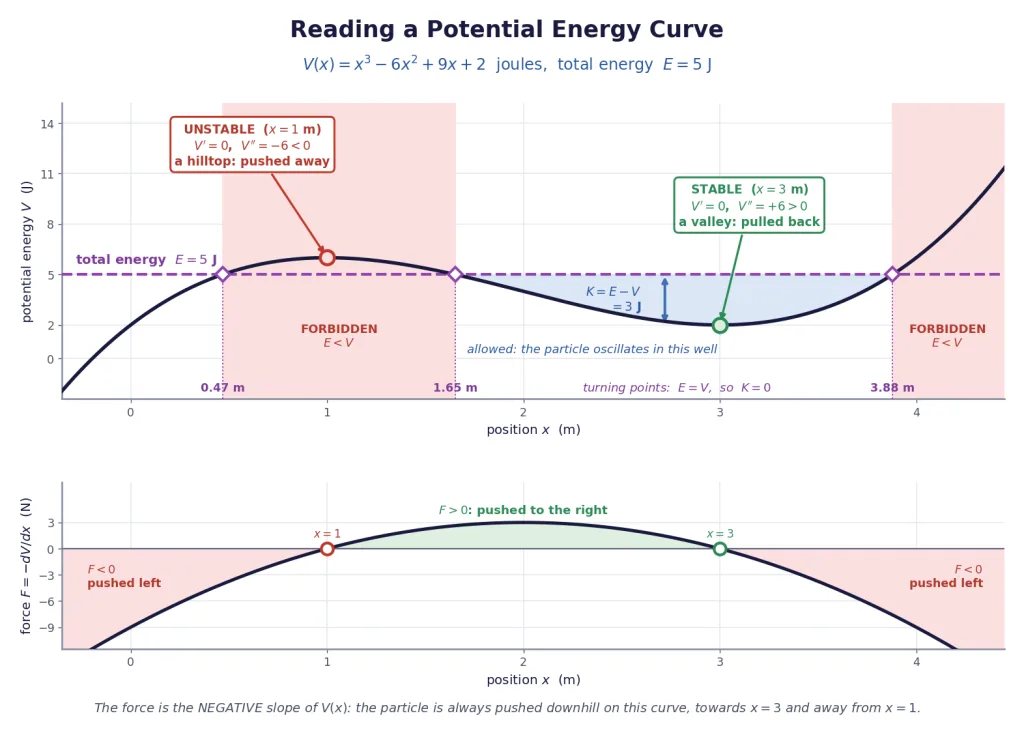
Take joules, with in metres, and give the particle a total energy of 5 J.
Step 1 — differentiate and find the equilibria.
Step 2 — classify them. At : , a maximum, unstable. At : , a minimum, stable.
Step 3 — the energies at those points. J (the top of the barrier), J (the bottom of the well).
Step 4 — turning points, where . Solving numerically gives
Step 5 — read off the motion. A particle released inside the well oscillates between 1.65 m and 3.88 m, fastest at m where J. It cannot reach m from the left, because the region from 0.47 m to 1.65 m is forbidden at this energy. To escape the well to the left it would need J — enough to clear the barrier top.
The five questions you can now answer instantly
- Force at any : minus the slope. Read it off.
- Where is it fastest? At the deepest point of inside the allowed region.
- Where does it turn around? Where the line meets the curve.
- Which equilibria are stable? The valleys.
- How much energy to escape? The height of the barrier above the current level.
[Advanced] A special favourite: the particle is released from rest at . Released from rest means there, so — the total-energy line is drawn through that point on the curve, and is automatically one of the turning points. Half the difficulty of these questions is realising you have just been handed .
The Vertical Circle, Done in Two Lines
Chapter 4, Section 10 solved the vertical circle with forces: free-body diagram at the top, free-body diagram at the bottom, the condition . It works and you should be able to do it. This is the faster route, and it is the one to use under exam pressure.
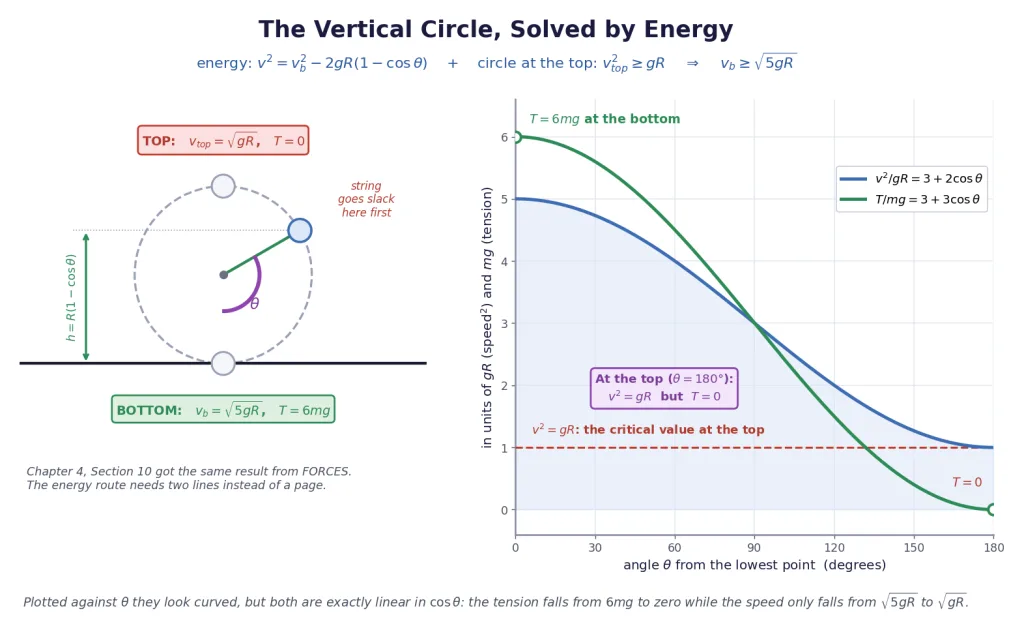
The two ingredients
Ingredient 1 — energy conservation. The tension is always perpendicular to the velocity, so the string does no work, and mechanical energy is conserved. Measuring from the lowest point, the bob is a height above the bottom, so
Ingredient 2 — the circle must actually be a circle. At the top, both the weight and the tension point toward the centre: A string can pull but never push, so , which forces
Putting them together
Set in the energy equation: . Then
Two lines. That is the whole derivation.
The general expressions, worth memorising
At any angle from the bottom, for a bob just completing the circle ():
Check the ends: at , and ; at , and . Both correct.
Key Point: For any speed, not just the critical one, the tension difference between the lowest and highest points is always It does not depend on the speed or the radius at all. This is a one-line answer to a whole family of questions.
The three zones (the marks live here)
| Speed at the bottom | What happens |
|---|---|
| completes the full circle | |
| the string goes slack somewhere above the horizontal; the bob leaves the circle and becomes a projectile | |
| never rises above the horizontal; oscillates like a pendulum |
[Advanced] The middle case is the one that separates candidates. The bob leaves the circle where , which happens at , and thereafter it is an ordinary projectile with the velocity it had at that instant. Chapter 4 derived that; here just remember that energy gives you the speed at the leaving point in one line.
And a rod is a different animal. A light rod can push as well as pull, so there is no condition. All you need is that the bob reaches the top with , which gives — a smaller requirement than the string's . Read the question: string or rod changes the answer.
Work and Energy in a Non-Inertial Frame
Here is a question that sounds like a paradox. A block sits still on the floor of a lift accelerating upward. In the ground frame the normal force does positive work and the block gains kinetic energy. In the lift frame the block never moves, so nothing does any work and the kinetic energy is zero throughout. Which is right?
Both. Work and kinetic energy are frame-dependent quantities, and the work-energy theorem holds separately in each frame — provided that, in an accelerating frame, you remember to include the work done by the pseudo force.
The rule
Key Point: In a frame accelerating with acceleration , every body of mass experiences a pseudo force . With that force added to the list, Newton's second law works normally — and so does the work-energy theorem:
The pseudo force is not a "fake" force in any way that matters for the bookkeeping. It does real work in that frame, and that work goes into real kinetic energy in that frame.
The one warning
where is the displacement as measured in the accelerating frame, not in the ground frame. Mixing a ground-frame displacement with a pseudo force is the single most common error here.
Worked both ways, side by side
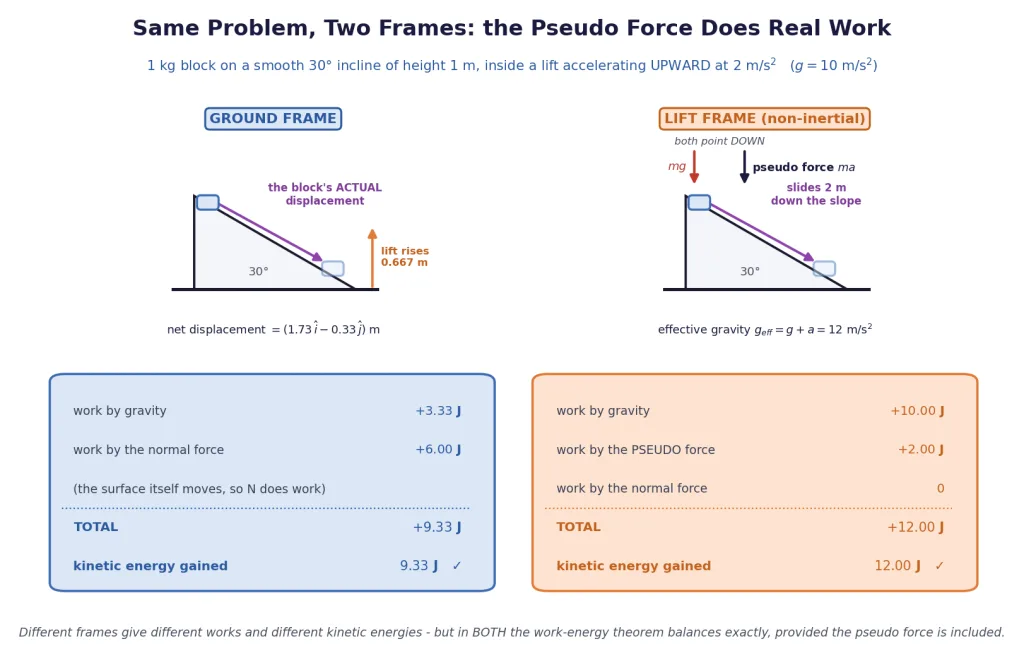
A 1 kg block slides from rest down a smooth incline of vertical height 1 m (so 2 m along the slope), and the whole incline sits on the floor of a lift accelerating upward at 2 m/s^2. Take m/s^2.
Route 1 — the lift frame (easy). In this frame the block simply slides down a fixed incline, but under an effective gravity because the real weight (down) and the pseudo force (also down, since the frame accelerates up) add. So Bookkeeping: J, J, (perpendicular to the relative displacement). Total 12 J . ✓
Route 2 — the ground frame (honest, and instructive). The trip takes s, in which the lift itself rises 0.667 m. The block's real displacement is therefore m — it only drops a third of a metre, not a full metre. Its real velocity is m/s, so J.
Now the works. Gravity: J. And the normal force — which is no longer zero, because the surface itself is moving — turns out to be J. Total: J. ✓
What that comparison teaches
| Ground frame | Lift frame | |
|---|---|---|
| kinetic energy gained | 9.33 J | 12.00 J |
| work by gravity | J | J |
| work by the normal force | J | |
| work by the pseudo force | (none exists) | J |
| theorem balances? | yes | yes |
Every single number differs. Both are correct. The work-energy theorem is frame-covariant: it holds in each frame with that frame's own quantities.
[Advanced] Notice the trap hiding in the ground-frame column: the normal force did J of work. In every problem you have met so far the normal force did none, because the surface was stationary and was perpendicular to the motion. A normal force does zero work only when the surface it acts on is at rest. On a moving lift floor, a moving wedge, or a conveyor belt, it does work — and forgetting that is what makes the ground-frame route feel "wrong".
Constrained Systems: Strings, Movable Wedges and Chains
Why the string disappears
Two blocks connected by a light inextensible string over a smooth pulley. The tension pulls backward on the block that is moving forward, and forward on the one moving backward — and because the string is inextensible, the two ends move through equal distances. So
Key Point: An ideal string does zero net work on the system. That means you can write energy conservation for the whole system and the tension never appears. You get the speed without ever computing — which is usually the entire point.
The same argument covers a light rod, a smooth pulley, and any contact that neither stretches nor dissipates.
The other half of the constraint is that the speeds are related. For a simple pulley they are equal. For a movable pulley the free end moves twice as fast as the load. For a rope at an angle to a body's velocity, only the component along the rope shortens it, so . Chapter 4, Section 10 built all of these; here you simply use them, then write one energy equation.
The movable wedge: both bodies have kinetic energy
A block of mass slides down a smooth wedge of mass that is itself free to slide on a smooth floor. Now the wedge recoils, and both bodies are moving, so both appear in the energy equation. Two conservation laws do the whole job:
Horizontal momentum (no horizontal external force on the block-plus-wedge system):
Mechanical energy (everything is smooth):
Write the block's velocity as wedge velocity plus velocity relative to the wedge, and the relative velocity is along the slope:
Grinding those together gives the standard result, which is worth carrying:
Sanity check it: as the wedge cannot move, the denominator becomes , and — the fixed-incline answer. Good.
[Advanced] The two errors here are (a) forgetting the wedge's kinetic energy, and (b) writing the block's velocity as if it were along the slope in the ground frame. It is not — the slope itself is running away underneath it. Relative velocity is along the slope; absolute velocity is not.
Chains and ropes: use the centre of mass
A chain problem looks like it needs an integral, and it does — but the integral always collapses to the same thing.
Key Point: For a uniform chain, the gravitational potential energy is exactly that of a point particle of the whole mass placed at the centre of mass. So the work needed to rearrange a chain is and nothing else.
Example — pulling a hanging chain up. A uniform chain of mass and length lies on a table with a fraction of its length hanging over the edge. The hanging piece has mass and its centre of mass is below the edge. Pulling it all onto the table lifts that centre of mass through :
For this is ; for it is . The is why the last quarter of a hanging chain is so much more expensive to lift than the first.
Example — a chain sliding off the edge. Same chain, released. Initially the centre of mass of the whole chain sits at some height; finally, when the chain hangs vertically, the centre of mass of the whole is below the edge. Take the difference, set it equal to , and you have the speed — with no integral in sight, because every link has the same speed at every instant.
And the friction version. How much can hang before it slips? The hanging weight must be held by friction on the part still on the table: A neat, memorable result: with , exactly one fifth of the chain can hang.
Constant-Power Motion, and Oblique Elastic Collisions
Constant power, revisited properly
Section 6 introduced this; JEE pushes it further. A body of mass starts from rest on a frictionless surface driven at constant power .
Speed. All the energy delivered becomes kinetic energy:
Distance. Integrate the speed:
Acceleration. Differentiating : , which is infinite at and falls away thereafter. That is the mathematical signal that no real engine can hold constant power right down to rest — at low speed a car is limited by tyre grip (constant force), and only at higher speed by engine power.
And the version with drag. Add a constant resistive force . Then The acceleration vanishes when , giving the terminal (top) speed which the body approaches but never reaches. Separating variables gives the time to reach a speed :
[Exam Tip] Memorise the three proportionalities — , , — and the top speed . Between them they answer almost every constant-power question ever set.
Oblique elastic collisions: the theorem
Now the prettiest result in the chapter.
The setup. A body of mass moving with velocity collides elastically with an identical body at rest. The collision need not be head-on. What is the angle between the two final velocities?
The derivation, entirely in vectors. Momentum conservation: Square both sides — that is, take the dot product of each side with itself:
Kinetic energy conservation, for equal masses, says , that is
Compare the two lines. Everything cancels except
Key Point: For an elastic collision between equal masses with one initially at rest, the two bodies always fly apart at exactly — whatever the impact parameter, whatever the speed. (The one exception is the perfectly head-on case, where one body stops and the "angle" is undefined.)
This is why a billiards player can predict where the cue ball goes: it always leaves at a right angle to the object ball. The billiard-table problem worked in Section 7 is one instance of this theorem; here you have the proof.
The consequence for the speeds. If the incident body is deflected by , the target leaves at on the other side, and which automatically satisfies — kinetic energy conservation, built in.
All three conditions are load-bearing. Unequal masses: no . Inelastic: the angle closes to less than (the more energy lost, the more the two velocities converge — at they become parallel). Target already moving: the theorem does not apply.
[Advanced] A standard use: "After an elastic collision between equal masses the angle between the final velocities is found to be ." You should immediately answer that the collision cannot have been elastic, or the masses were not equal, or the target was not at rest. The result is a test, not just a formula.
Successive Collisions, and the Three Traps
The bouncing ball, all of it
A ball is dropped from rest at height onto a floor with coefficient of restitution . Everything about the rest of its life follows from one fact: each bounce multiplies the speed by .
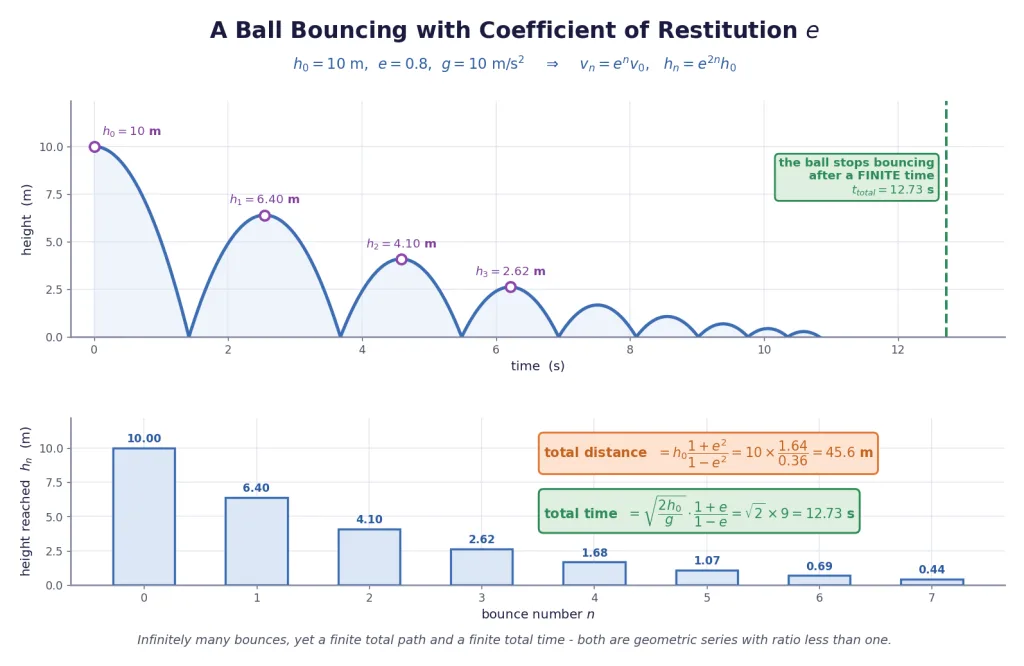
Speeds and heights. The impact speed is , so
Total distance travelled. The first drop is ; every bounce after that contributes an up and a down, so : The bracket is a geometric series with first term and ratio , summing to . So
Total time. The first fall takes . Each subsequent flight is up and down, taking :
The philosophical bit, which examiners enjoy. There are infinitely many bounces, and yet both sums are finite. The ball genuinely stops bouncing after a definite time — because the times shrink geometrically. With m and : total distance 45.6 m, total time 12.73 s, and after that the ball is simply lying still on the floor.
[Exam Tip] Note carefully: speeds carry one power of , heights carry two. Half of all mistakes on this topic are that one confusion. And in the distance formula the exponent is ; in the time formula it is . They are different formulas; do not average them together from memory.
The Three Traps
These cost more marks than any algebra.
Trap 1: the work done by friction is NOT the heat generated
This is the big one. There are two different quantities:
When one surface is fixed — a block on the ground — the two happen to be equal in magnitude, and you can get away with confusing them for the whole of Class 11. When both surfaces move, they differ, and the question is designed to catch you.
Consider a block being dragged across a plank that is itself free to slide. The block goes 15 m; the plank goes 1.67 m; the friction between them is 5 N.
| Quantity | Value |
|---|---|
| work by friction on the block | J |
| work by friction on the plank | J |
| sum of the two works | J |
| relative sliding distance | m |
| heat generated | J |
The heat equals the sum of the two friction works (with a sign flip), which is times the relative slide — never times either body's own displacement. Notice too that friction did positive work on the plank; friction is not obliged to be negative.
Key Point: . Always. If the problem has two moving surfaces and you used one body's displacement, you have the wrong answer.
Trap 2: "conservation of mechanical energy" applied where it does not hold
Mechanical energy is conserved only when every force doing work is conservative. A single friction force, a single inelastic collision, a single air-drag term anywhere in the problem and the correct statement becomes
The specific danger point is a collision in the middle of an energy problem. A collision is a non-conservative event unless it is stated to be elastic. So: energy before the collision, momentum through the collision, energy after. Section 8's Example 40 shows what using energy across the collision does to the answer — it doubles it.
Trap 3: kinetic energy is frame-dependent, so pick one frame and stay in it
depends on , which depends on the observer. A 60 kg passenger asleep in a train has zero kinetic energy in the train's frame and 1.2 MJ in the ground frame. Neither is wrong.
So "the kinetic energy lost in the collision" must be evaluated in one frame throughout. Compute and in the same frame, or your answer is meaningless.
The reassuring fact — and it is worth knowing, because it saves work — is that although and separately depend on the frame, their difference does not: for a perfectly inelastic collision, where is the reduced mass and is a relative velocity — and relative velocities are the same in every inertial frame. The energy lost is a physical fact about the deformation; it cannot depend on who is watching.
[Advanced] That formula, , is the fastest route to any perfectly-inelastic energy-loss question and it is worth memorising outright.
Solved Examples
Example 1: A full potential energy curve, start to finish
A particle of mass 0.5 kg moves along the -axis under the potential energy (a) Find all the equilibrium positions and classify each. (b) Find the force on the particle at m. (c) The particle has total energy 5 J and is somewhere in the well. Find its turning points and its maximum speed. (d) What is the minimum total energy it would need to escape the well?
Solution:
(a) Equilibria: set the slope to zero.
Classify with the second derivative. At : , a maximum — unstable equilibrium. At : , a minimum — stable equilibrium.
The energies there: J (the barrier top) and J (the bottom of the well).
(b) Force at m: Positive, so the force pushes the particle toward — downhill on the curve, exactly as it should from a point between a hilltop at 1 and a valley at 3.
(c) Turning points: solve . This cubic has three real roots, which numerical solution gives as A particle inside the well is trapped between the two right-hand roots: it oscillates between m and m. The stretch from 0.47 m to 1.65 m is classically forbidden at this energy.
Maximum speed at the bottom of the well, m:
(d) To escape, the particle must clear the barrier at m, whose top sits at J. So it needs With J it is 1 J short and is trapped forever.
Final Answer: (a) m unstable, m stable; (b) N; (c) turning points 1.65 m and 3.88 m, m/s at m; (d) 6 J.
Takeaway: [Advanced] The whole problem is one differentiation, one second derivative and one root-find. Draw the curve roughly as you go — a cubic with a hump at and a dip at — and every answer becomes something you can see rather than something you have to trust.
Example 2: Forbidden regions from a potential-energy graph
(a) The potential energy of a particle in linear simple harmonic motion is with N/m. Show that a particle of total energy 1 J must turn back at m. (b) Take four standard potential-energy shapes, each with a fixed total energy marked on the vertical axis: (i) a flat region that steps up to a height for , with ; (ii) a well dipping down to , with marked above zero; (iii) a periodic run of humps and valleys, with below the tops of the humps; (iv) a flat trough with a step of height on either side, with . In each case, state the regions where the particle cannot be found and the minimum total energy it must have.
Solution:
(a) Turning points are where all the energy is potential. Set :
Why "turn back" and not "stop". At m the kinetic energy is zero, so the particle is momentarily at rest — but the force there is N, pointing back toward the origin. Zero speed with a non-zero force means it reverses. Beyond m we would need , which is impossible, so that whole region is classically forbidden.
(b) The general recipe for any of the four graphs. For a total energy marked on the vertical axis:
- the particle cannot be found wherever ;
- the minimum total energy it can possibly have is the lowest value of anywhere on the graph, because at that point and it can go no lower.
- Applied to the four shapes in turn.
- A step up to for , with : forbidden for ; minimum energy 0. Physical picture: a particle approaching a potential step, or a ball rolling at a kerb.
- A well that goes down to , with marked above zero: nowhere is forbidden in the region shown; the minimum possible energy is , at the bottom of the well.
- A periodic hump-and-valley shape with below the humps: the particle is trapped in one valley and cannot cross the humps; minimum energy is the value at a valley floor. This is a particle in a crystal lattice.
- A pair of steps of height on either side of a flat trough: forbidden outside the trough if ; minimum energy is the trough level.
Final Answer: (a) m, from . (b) forbidden wherever ; minimum energy is the global minimum of .
Takeaway: [Board Important] These two parts are the standard introduction to reading a potential energy curve, and they are the ancestors of every JEE Advanced question. Two rules cover both: , and the minimum possible energy is the bottom of the curve.
Example 3: The vertical circle, by energy alone
A 0.5 kg bob on a light string of length 1.2 m is whirled in a vertical circle. Take m/s^2. For the case where it just completes the circle, find (a) the speed at the lowest point, (b) the speed and tension at from the lowest point, (c) the tension at the lowest and highest points, and verify that their difference is .
Solution:
(a) The critical condition. "Just completes the circle" means the string is on the verge of going slack at the top, so and . Energy conservation from bottom to top gives :
(b) Speed at from the bottom. The bob has risen m:
Tension there. The string is at to the vertical, so the component of the weight along the string (pointing away from the centre) is , and
(c) At the lowest point (, ):
At the highest point (): Zero, as the critical condition demanded.
The difference:
Final Answer: (a) 7.75 m/s; (b) 6.93 m/s and 22.5 N; (c) 30 N and 0, differing by N.
Takeaway: [Exam Tip] The tension at the bottom is six times the weight for a bob that only just completes the circle — a number worth carrying, because it is why swinging a bucket of water over your head puts a surprising strain on your arm. And the difference holds for any speed, not just the critical one, so it is a free equation in almost every vertical-circle question.
Example 4: The same slide, in two frames
A 1 kg block is released from rest at the top of a smooth incline of vertical height 1 m. The incline is bolted to the floor of a lift which is accelerating upward at 2 m/s^2. Take m/s^2. Find the block's speed at the bottom of the incline (a) relative to the lift, using the pseudo force, and (b) relative to the ground, and verify the work-energy theorem in both frames.
Solution:
Geometry. With height 1 m and angle , the slope length is m.
(a) In the lift frame, the block also feels a pseudo force N pointing downward (opposite to the frame's upward acceleration). Real weight and pseudo force add:
Work-energy check in the lift frame. The block drops 1 m relative to the lift:
(b) In the ground frame we need the time. From : In that time the lift itself rises m and reaches 1.63 m/s.
Add the velocities as vectors. Relative to the lift the block moves down the slope at 4.90 m/s, i.e. m/s. Adding the lift's :
The ground-frame displacement, added the same way: m. The block only descends a third of a metre in the ground frame, because the lift carried it up while it slid down.
Ground-frame works. The normal force is N, perpendicular to the slope, and the displacement is not perpendicular to it (the surface moved), so
Final Answer: 4.90 m/s relative to the lift, and m/s (speed 4.32 m/s) relative to the ground. The theorem balances in both frames — at 12 J and 9.33 J respectively.
Takeaway: [Advanced] Two lessons. Work and kinetic energy are frame-dependent, and the theorem holds separately in each frame. And in the ground frame the normal force did real work, because the surface it acts on was itself moving — the standard reason students think the ground-frame answer "must be wrong". When you have a choice, solve in the accelerating frame; it is almost always shorter.
Example 5: A block on a wedge that runs away
A 1 kg block is released from rest at the top of a smooth wedge of mass 3 kg and height 0.8 m. The wedge is free to slide on a smooth floor. Take m/s^2. Find the speed of the wedge and of the block when the block reaches the bottom.
Solution:
- Identify what is conserved. The floor and the wedge face are both smooth and the only external forces (gravity and the floor's normal) are vertical. So:
- horizontal momentum of the block-plus-wedge system is conserved (it starts at zero, so it stays zero);
- mechanical energy is conserved (nothing dissipates).
Set up the velocities. Let the wedge move with velocity (negative, i.e. backwards) and let the block's velocity relative to the wedge be down the slope. Then in the ground frame
Horizontal momentum, set to zero:
Energy conservation. J goes into both bodies. Substituting and collecting gives the standard result
The wedge's speed:
The block's actual speed in the ground frame:
Audit both laws. Momentum: ✓ Energy: J ✓
Final Answer: The wedge moves at 0.96 m/s (backwards) and the block at 3.64 m/s.
Takeaway: [Advanced] Three things go wrong here and only here. (1) The wedge has kinetic energy too — it must appear in the energy equation. (2) The block's velocity is along the slope only relative to the wedge; in the ground frame it is not. (3) Compare with the fixed-wedge answer, m/s: the block ends up slower than that (3.64 m/s), because some of the released energy went to the wedge.
Example 6: A chain on a table
A uniform chain of mass 4 kg and length 2 m lies on a smooth table with one quarter of its length hanging over the edge. Take m/s^2. (a) How much work must be done to pull the hanging part back onto the table? (b) If instead the chain is released, with what speed does the last link leave the table? (c) If the table were rough with , what is the greatest fraction that could hang without the chain slipping?
Solution:
(a) Use the centre of mass. The hanging piece is 0.5 m long with mass kg, and its centre of mass is 0.25 m below the table top. Pulling it up raises that centre of mass by 0.25 m: (The integral route, , gives the same 2.5 J — the centre-of-mass shortcut simply does the integral for you.)
(b) Released, the chain slides off. Take the table top as the zero of potential energy. Initially: only the 1 kg hanging piece has any potential energy, and its centre of mass is at m: Finally, when the whole chain has just left the table, all 4 kg hangs vertically with its centre of mass at m:
Every link has the same speed, because the chain is inextensible, so the whole 4 kg shares one kinetic energy:
(c) With friction, balance the hanging weight against the friction on the table. If a length hangs, So at most 20%, that is 0.4 m, can hang. With a quarter (25%) hanging, this chain would already be sliding.
Final Answer: (a) 2.5 J; (b) 4.33 m/s; (c) 20% of its length.
Takeaway: [Advanced] A chain is just a point mass at its centre of mass, as far as gravitational potential energy is concerned — so replaces every integral. And in part (c) note what dropped out: the mass and the length both cancel, leaving a fraction that depends on alone.
Example 7: Constant power, with and without drag
A 200 kg go-kart starts from rest and its motor delivers a constant 10 kW. (a) Find its speed at s and the distance covered, assuming no resistance. (b) Now include a constant resistive force of 100 N: find the top speed, and the time taken to reach 50 m/s. Compare with the frictionless case.
Solution:
(a) Speed. With no resistance, all the energy delivered becomes kinetic energy:
Distance, by integrating that speed: A useful check: the average speed over the trip is m/s, which is of the final speed — exactly what demands.
(b) Top speed with drag. The kart stops accelerating when the driving force equals the resistance:
Time to reach 50 m/s. Now , so
Compare. Frictionless, reaching 50 m/s would take So a resistive force of just 100 N — a tenth of the kart's weight in newtons and one hundredth of the peak driving force at 1 m/s — stretches the time by 54%. It gets worse the closer you approach : the last few metres per second take almost forever.
Final Answer: (a) 22.4 m/s, having covered 74.5 m; (b) top speed 100 m/s, and 38.6 s to reach 50 m/s against 25 s without drag.
Takeaway: [Exam Tip] Carry four facts: , , , and . The top speed of any vehicle is just its power divided by the resistance it must overcome — which is why doubling a car's top speed needs roughly eight times the engine, since drag itself grows as .
Example 8: Two protons, and the right angle
A proton moving at m/s collides elastically with another proton at rest. The incident proton is deflected through . Find the speed of each proton after the collision and the direction of the target proton. Take , .
Solution:
Use the theorem before you use algebra. Equal masses, elastic, one at rest, so the two final velocities are at to each other. The incident proton went off at on one side, so the target proton goes off at
The speeds follow immediately. With the final velocities perpendicular, the momentum triangle is right-angled, and
Verify momentum, component by component (masses are equal, so they divide out):
Verify kinetic energy: Nothing lost, as an elastic collision requires.
Final Answer: m/s at and m/s at on the opposite side — the two paths at .
Takeaway: [Advanced] Once you know the theorem, an oblique elastic collision between equal masses has no algebra left in it at all — the answer is a right-angled triangle of velocities with as the hypotenuse. This is exactly what you see in a cloud-chamber photograph of proton-proton scattering, and it is how physicists confirmed those collisions were elastic.
Example 9: A ball bouncing forever, in a finite time
A ball is dropped from a height of 10 m onto a floor for which the coefficient of restitution is 0.8. Take m/s^2. Find (a) the speed just before the first impact, (b) the height reached after the third bounce, (c) the total distance the ball travels before coming to rest, and (d) the total time it spends bouncing.
Solution:
(a) Impact speed from a 10 m drop:
(b) Each bounce multiplies the speed by and the height by : (The speed leaving the third bounce is m/s — consistent, since m.)
(c) Total distance. The first drop is ; every bounce after that contributes an up and a down:
(d) Total time. The first fall takes s, and the th flight (up and down) takes :
The point worth pausing on. There are infinitely many bounces, yet the ball is finished in 12.7 s having covered 45.6 m. Both sums converge because the ratios (0.64 for distance, 0.8 for time) are less than 1. After 12.7 s the ball is genuinely at rest — all of its original 98% has been ground into heat and sound in the floor.
Final Answer: (a) 14.14 m/s; (b) 2.62 m; (c) 45.6 m; (d) 12.7 s.
Takeaway: [Exam Tip] Speeds carry , heights carry — and therefore the distance series has in it while the time series has . Writing the two formulas out side by side once, and noticing that difference, is worth more than trying to recall which is which under exam pressure.
Example 10: The trap — friction's work is not the heat
A 2 kg block rests on a 6 kg plank which lies on a frictionless floor. The coefficient of friction between block and plank is 0.25; take m/s^2. A horizontal force of 20 N is applied to the block for 2.0 s. Find (a) how far each body moves, (b) the work done by friction on each body, and (c) the heat generated — and show that the heat is not equal to the magnitude of the work friction did on the block.
Solution:
First, do they move together? If they did, the common acceleration would be m/s^2, which would require a friction force of N on the plank. But the maximum available is Only 5 N is available, so they slip, and the friction is kinetic at 5 N.
Accelerations, separately.
(a) Distances in 2.0 s, both from rest: Relative sliding: m.
(b) Work done by friction on each. On the block friction acts backward through the block's own 15.0 m: On the plank friction acts forward (it is what drags the plank along) through the plank's own 1.67 m:
(c) Heat generated is the friction force times the relative sliding distance: And notice: J. The heat is the sum of the two friction works, not either one alone.
The full energy audit, which settles it.
So the two numbers differ: the work friction did on the block is 75.0 J in magnitude; the heat is 66.7 J. They are 8.3 J apart, and that 8.3 J is exactly the energy friction delivered to the plank rather than destroying.
Final Answer: Block 15.0 m, plank 1.67 m; J on the block and J on the plank; heat J, which is not 75.0 J.
Takeaway: [Advanced] Burn this in: . Friction can do positive work (it did, on the plank), and the heat generated is never simply times one body's displacement unless the other surface is fixed. Every "find the heat produced" question with two moving bodies is testing exactly this.
Example 11: Kinetic energy is frame-dependent; the energy LOST is not
A 2 kg body moving at 10 m/s catches up with and sticks to a 3 kg body moving at 5 m/s in the same direction. Find the kinetic energy lost (a) in the ground frame and (b) in a frame moving at 5 m/s in the same direction. Comment.
Solution:
(a) Ground frame. Momentum first:
Kinetic energies:
(b) In a frame moving at 5 m/s, subtract 5 from every velocity. The bodies now approach at 5 m/s and 0 m/s: (which is , as it must be).
Kinetic energies in this frame:
Compare the two columns.
Quantity Ground frame Moving frame 137.5 J 25 J 122.5 J 10 J loss 15 J 15 J The kinetic energies differ by a factor of five. The loss is identical.
Why it had to be. The energy lost in a perfectly inelastic collision is The formula contains only the relative velocity, and relative velocities are the same for every inertial observer. The heat produced in the deformation is a physical fact about the bodies; it cannot depend on who is watching.
Final Answer: 15 J in both frames, even though is 137.5 J in one and 25 J in the other.
Takeaway: [Advanced] Two rules. Evaluate and in the same frame — mixing them is meaningless and is the trap. And learn : it gives the energy loss of any perfectly inelastic collision in one line, from the relative velocity alone, in any frame you like.