
Power: How Fast the Work Gets Done
Everything so far in this chapter has asked how much. How much work, how much kinetic energy, how much was stored. Not once have we asked how long it took — and that turned out to be a feature, because energy methods are blind to time.
But the real world cares about time enormously. Here is the thing: a small motor can lift a piano onto a roof. Give it a rope, a pulley and long enough, and it will do exactly the same 20 000 J of work as a big motor. It will just take an hour instead of a minute. That difference has a name.
Key Point: Power is the time rate at which work is done, or at which energy is transferred. It answers how fast, never how much.
Average power
This is the workhorse. It says nothing about what happened moment to moment — only what the whole job averaged out to.
Instantaneous power
Squeeze that time interval down to nothing and you get the power right now:
An engine's power varies continuously as you press the accelerator; is what the tachometer is really tracking.
Running that backwards gives a third way to compute work, alongside the two Section 3 gave you:
Power is a SCALAR
is a scalar, is a scalar, so is a scalar. It can be positive (energy flowing into the body) or negative (energy flowing out — brakes, drag, friction), but a negative power has no direction, only a direction of flow. [NEET Important] "Power is a vector because involves vectors" is a classic wrong option. The dot product of two vectors is a scalar.
The watt
Key Point: The SI unit of power is the watt (W), named after James Watt. Dimensionally, .
A watt is small. Your body idling burns about 100 W. A ceiling fan is 75 W. That is why kilowatts (kW W), megawatts (MW W) and gigawatts (GW W) do most of the real work in engineering.
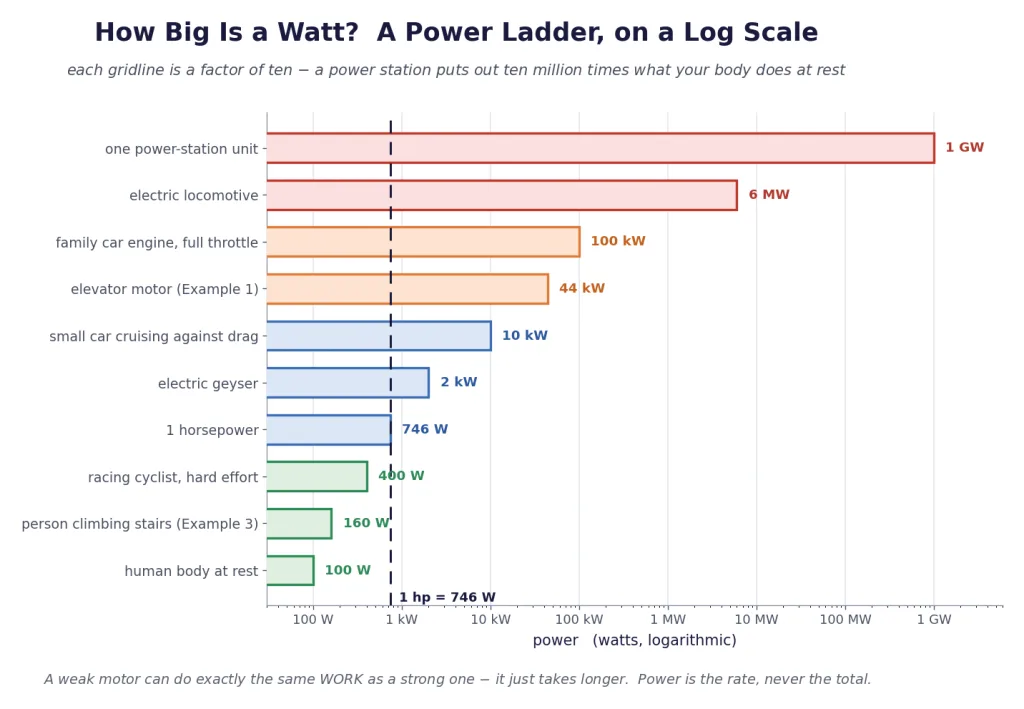
The Distinction Students Blur
| Work / energy | Power | |
|---|---|---|
| Question it answers | how much? | how fast? |
| Unit | joule (J) | watt (W) |
| Symbol | , , | |
| Dimensions | ||
| Depends on time? | no | yes |
Two machines that do the same work can have wildly different powers. A lift raising 500 kg through 10 m does 50 000 J of work whether it takes 20 s or 40 s — but the powers are 2500 W and 1250 W. Halve the speed and you halve the power for exactly the same job.
— the Formula You Will Actually Use
is fine for a whole job. But for a body moving right now, there is a far more useful form, and it drops straight out of the definitions.
The derivation, in three lines
From Section 1, the work done by a force over a small displacement is
Divide both sides by the time in which it happened:
And is the instantaneous velocity. So:
Key Point: where is the angle between the force and the velocity — not the displacement over the whole journey, the velocity at this instant.
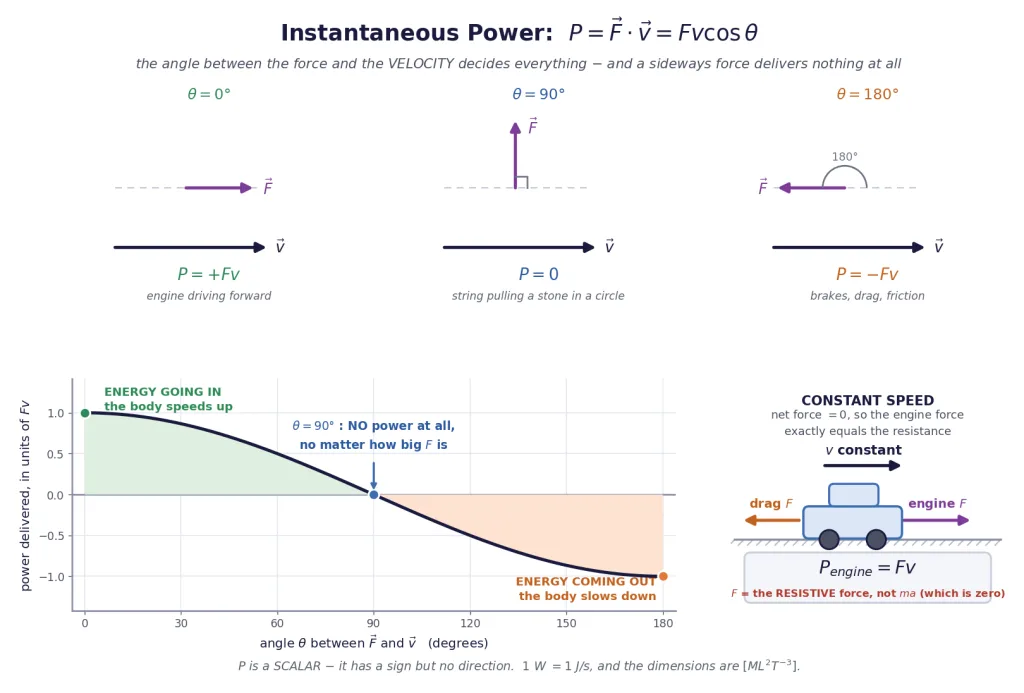
The three cases, and what each one is
| Physically | |||
|---|---|---|---|
| , maximum | engine driving the car forward | ||
| between and | positive | a force at an angle, partly helping | |
| zero | tension on a stone whirled in a circle | ||
| between and | negative | partly resisting | |
| , most negative | brakes, drag, friction |
The case deserves a moment. A force perpendicular to the velocity delivers no power at all, however large it is. The Earth's gravity on a satellite in a circular orbit does zero work and zero power — which is exactly why the satellite's speed never changes. Same for the normal force on a block sliding along a floor, and the tension in a conical pendulum's string. This is the same idea Section 1 raised about zero work, now dressed for time.
The vehicle result you will use constantly
A car cruises at a constant speed along a level road against a total resistance (friction plus air drag) of magnitude .
Constant speed means zero acceleration, which means zero net force. So the engine's driving force must be exactly equal to the resistance:
Key Point: For a vehicle moving at constant speed, where is the resistive force it is fighting. All the engine's power is going into heat and swirling air; none is going into kinetic energy, because the speed is not changing.
[JEE/NEET] This is the one people get wrong by trying to use . At constant speed , so — but the engine is certainly not delivering zero power. The force in is the one the engine applies, and it equals the resistance.
Three more things worth carrying
1. Power is not the same as force. Doubling the speed at constant resistance doubles the power. Doubling the resistance at constant speed also doubles the power. But an engine of fixed power that meets more resistance simply goes slower, because .
2. In terms of momentum. Since , you can also write . Rarely needed, occasionally elegant.
3. Power and kinetic energy. Section 3 showed . Compare with and you get the neat statement: the net power delivered to a body is the rate at which its kinetic energy grows.
The Other Units: Horsepower, and the Kilowatt-Hour Trap
The watt is the SI unit, but two others are unavoidable — one because engines are still advertised in it, the other because it appears on every electricity bill in the country.
Horsepower
James Watt needed to sell steam engines to people who owned horses, so he invented a unit they would understand.
Key Point:
That is roughly three-quarters of a kilowatt. So a "100 hp" car engine is W kW. Motorbikes, cars, pumps and generators are still routinely rated in hp.
The kilowatt-hour — and this is the important one
Here is the trap, and it is set for you in every Board paper and most NEET papers.
Key Point: The kilowatt-hour is a unit of ENERGY, not of power.
Look at where it comes from. Power time energy. A kilowatt is a power; an hour is a time; multiply them and you have an energy, in the same family as the joule. The name sounds like a power because "kilowatt" is in it, and that is exactly why students get it wrong.
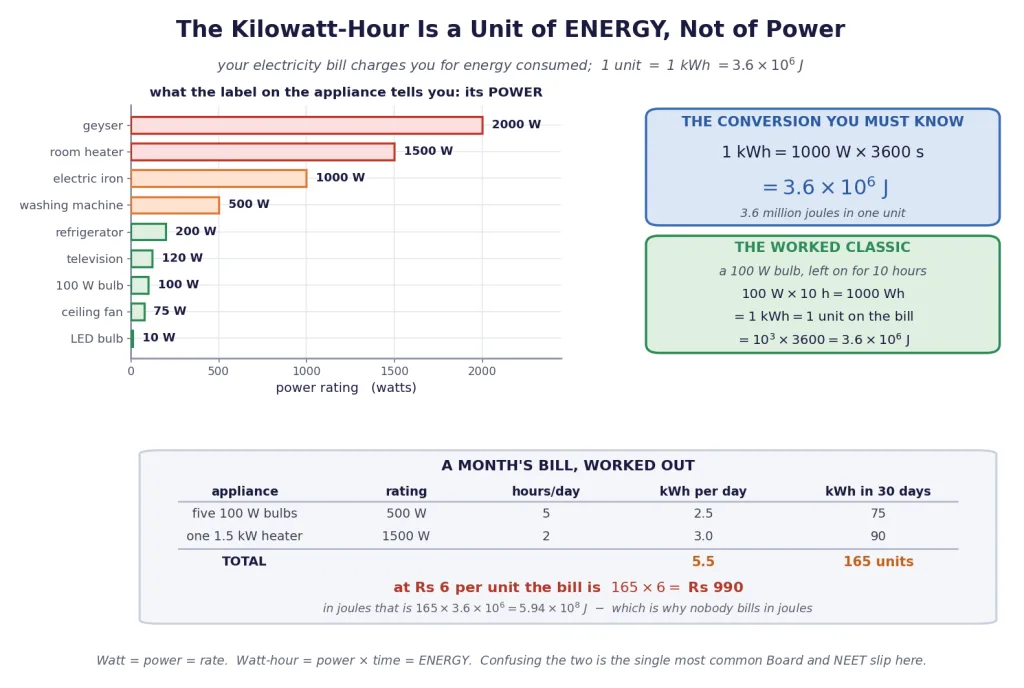
Why your electricity bill uses it
The electricity company does not charge you for how fast you use energy. It charges you for how much energy you consumed — which is exactly power time.
One kilowatt-hour is called one unit on the bill. Here is the example to remember:
A 100 W bulb burning for 10 hours costs you exactly one unit. Memorise that sentence; it converts a whole class of questions into arithmetic.
The three-step routine for any bill question
- Get every appliance's power in kilowatts. (Divide watts by 1000.)
- Multiply by the hours it runs. That gives kWh — the energy.
- Add them up, multiply by the days, then by the rate per unit.
If a question asks for joules instead of rupees, multiply the total kWh by at the very end. Never in the middle — the numbers get ugly for no reason.
The units table, all in one place
| Unit | It measures | Value |
|---|---|---|
| watt (W) | power | J/s |
| kilowatt (kW) | power | W |
| horsepower (hp) | power | W |
| megawatt (MW) | power | W |
| joule (J) | energy | N m |
| kilowatt-hour (kWh) | energy | J |
| 1 "unit" on a bill | energy | kWh |
[Board Important] The question "Is kWh a unit of power or of energy? Justify." is worth two marks and is asked constantly. The answer: energy, because it is a power multiplied by a time, and kWh J.
Where Power Shows Up: Engines, Lifts, Pumps and People
Four standard situations cover almost every power question you will ever be set. Each is one line once you have decided which form of the formula to use.
1. A vehicle at constant speed
Already derived: with the total resistance. If a car needs 500 N to hold 72 km/h 20 m/s, then
If the engine's power is fixed and the resistance rises (a headwind, a rougher road), the speed drops to .
2. Raising a load
Lifting a mass through a height in a time at a steady speed requires the lifting force to equal , so
If there is friction in the machinery as well, the motor must supply enough for both: This is exactly the elevator worked as Example 1 below.
3. Pumping water — the mass-flow idea
A pump does not lift one lump of water; it lifts a stream. So work in terms of the mass delivered per second.
If the pump raises a mass of water per time to a height :
And if the water also leaves with speed , the pump must supply its kinetic energy too:
Key Point — the full pump formula: where is the density, the cross-section of the pipe and the speed of flow. The is just "volume per second times density".
[JEE Tip] Read the question carefully. If the water is merely delivered to a tank and comes to rest, drop the term. If it comes out as a jet, keep it.
Efficiency. Real machines waste some input. If a pump is efficient, An 80% efficient pump that must deliver 500 W of useful power draws W.
4. A person climbing stairs
Straight . A 60 kg student climbing 4 m in 15 s develops
Which is about a fifth of a horsepower, and a good reminder of how modest human power really is. A trained cyclist can sustain perhaps 400 W; a sprinter can hit 1500 W for a couple of seconds and no longer.
The choosing rule
| The question gives you | Use |
|---|---|
| total work and total time | |
| a force and a speed at one instant | |
| a mass raised through a height in a time | |
| a flow rate and a height | |
| power constant, want or later | the next block |
[JEE Tip] Motion Under Constant Power
Here is the pattern that separates a JEE answer from a Board answer, and it is asked directly and constantly.
The setup. A body of mass starts from rest on a frictionless surface. Its engine delivers a constant power . Find how the speed and the distance grow with time.
Why you cannot just use
Because the acceleration is not constant. Constant power means , so as grows, must shrink:
At the start the body is barely moving, so the force — and the acceleration — is enormous. As it speeds up, the acceleration dies away. Every constant-acceleration formula from Chapter 2 is off the table.
The derivation
Start from with :
Integrate both sides from rest at :
That intermediate line is worth pausing on: it is just the work-energy theorem wearing different clothes. Constant power for time delivers work , and all of it becomes kinetic energy. So:
Key Point:
Now integrate once more to get the distance:
Key Point:
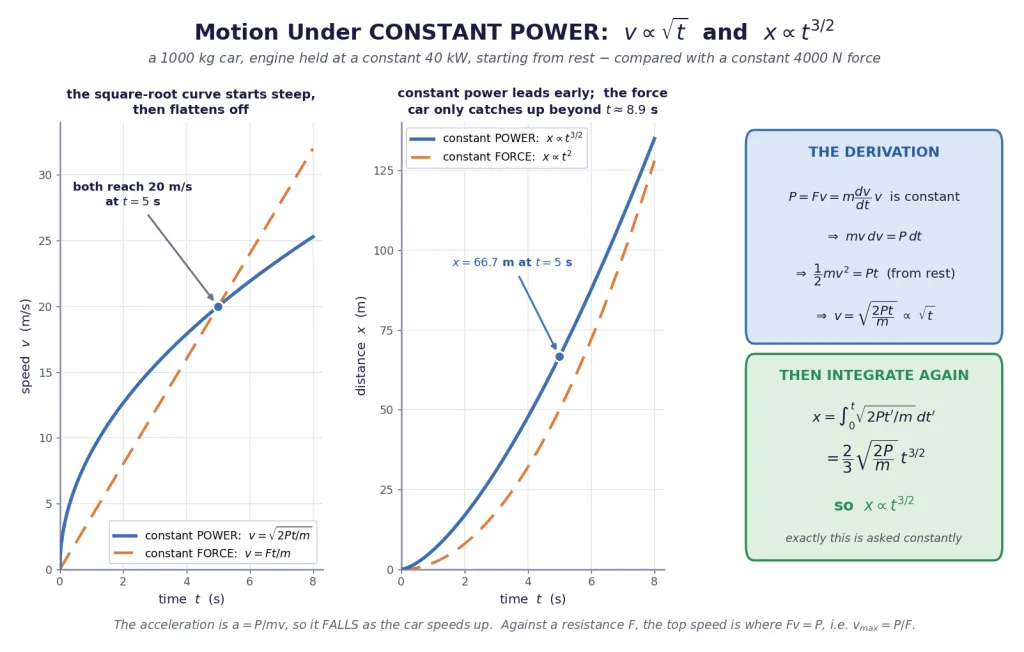
Compare the two cases side by side
| Constant force | Constant power | |
|---|---|---|
| acceleration | constant, | , falls as grows |
| speed | ||
| distance | ||
| kinetic energy |
[JEE Tip] The exponents and are the whole question in most MCQs. Remember them as a pair: halve the exponent chain of the constant-force case and you are close. And the fastest route to is always — write that line and you have the answer in one step.
The top speed against a resistance
A real car is not on a frictionless surface. Suppose it fights a constant resistive force while its engine holds a constant power . The car accelerates while the engine force exceeds , and stops accelerating when the two are equal:
Key Point: With constant power and constant resistance, a vehicle approaches a maximum speed and never exceeds it. At that speed all the engine's power is going into fighting the resistance, and none into acceleration.
A 60 kW engine against 1500 N of resistance tops out at m/s km/h. That is why a more powerful engine gives a higher top speed, and why anything that raises drag — a roof rack, an open window — lowers it.
Section 9 pushes this further, into constant-power problems with varying resistance. What is here is what the Boards and NEET need, and it is what JEE Main asks.
Solved Examples
Every numerical problem in this set uses m/s and hp W, and no problem mixes values.
Example 1: The power an elevator motor must deliver
An elevator carrying a maximum load of 1800 kg (elevator plus passengers) moves up with a constant speed of 2 m/s. The frictional force opposing the motion is 4000 N. Find the minimum power the motor must deliver, in watts and in horsepower.
Solution:
Work out the total downward force the motor has to overcome. Two things pull down on the elevator: its weight, and friction (which opposes the upward motion, so it acts downward):
The speed is constant, so the acceleration is zero and the motor's upward force must exactly balance that 22 000 N. Nothing extra is needed for acceleration.
Apply :
Convert to horsepower:
Cross-check by energy. In 10 s the elevator rises 20 m, so the motor does J. Divide by 10 s: 44 000 W.
Final Answer: 44 kW, or about 59 hp.
Takeaway: The word "minimum" in the question is doing real work: it tells you to assume constant speed, so no power is wasted on acceleration. And notice friction had to be added to the weight, not subtracted — it opposes the motion, and the motion is upward. [Board Important] This exact problem appears in Board papers with the numbers changed.
Example 2: Instantaneous power is not average power
A 2 kg body is dropped from rest. Taking m/s, find (a) the instantaneous power delivered by gravity at s and (b) the average power over those 3 s.
Solution:
(a) Instantaneous. After 3 s the speed is m/s, and gravity is parallel to the velocity (), so
(b) Average. In 3 s the body falls m, so gravity does
Check the work figure against the kinetic energy: J.
Final Answer: (a) 600 W (b) 300 W.
Takeaway: The average power is exactly half the final instantaneous power. That is not a coincidence — for a constant force acting on a body starting from rest, grows linearly, so grows linearly from 0, and the average of a straight line from 0 to 600 is 300. [JEE/NEET] If a question says "power" without saying which, and the force is constant and the body starts from rest, the factor of 2 is the trap.
Example 3: A student on the stairs
A 60 kg student climbs 20 steps, each 0.20 m high, in 15 s. Find the average power developed, in watts and in horsepower.
Solution:
Total height: m.
Work done against gravity:
Average power:
In horsepower: hp.
Final Answer: 160 W, about 0.21 hp.
Takeaway: Only the vertical height counts, because gravity is vertical — the horizontal tread of each step contributes nothing. Note also how weak a human is: about a fifth of one horsepower, sustained. A horse really can out-work you.
Example 4: A car at constant speed
A car moves at a constant 72 km/h against a total resistive force of 500 N. Find the power delivered by the engine, in watts and in horsepower.
Solution:
Convert first: km/h m/s.
Constant speed means zero net force, so the engine's driving force equals the resistance, 500 N.
Apply :
Final Answer: 10 kW, about 13.4 hp.
Takeaway: At constant speed, every joule the engine produces goes into heat and stirred-up air; none goes into kinetic energy, because the speed is not changing. Students who reach for here get and conclude the engine needs no power — which would be lovely, and is wrong.
Example 5: The electricity bill
A house runs five 100 W bulbs for 5 hours a day and a 1.5 kW room heater for 2 hours a day. At Rs 6 per unit, find the bill for 30 days.
Solution:
Bulbs. Five 100 W bulbs make 500 W 0.5 kW. In 5 hours:
Heater. 1.5 kW for 2 hours:
Daily total: kWh, i.e. 5.5 units per day.
In 30 days: units.
The bill: Rs 990.
Final Answer: 165 units, costing Rs 990.
Takeaway: Work in kilowatts and hours all the way through and the answer lands in kWh with no conversion at all. Only convert to joules if the question asks: J — a number nobody would want on a bill, which is the whole reason the kWh exists.
Example 6: kWh to joules
A 60 W bulb is left on for 8 hours. Find the energy consumed (a) in kWh and (b) in joules.
Solution:
(a) In kWh. The power is kW, so
(b) In joules. Multiply by :
Check the direct route: J.
Final Answer: 0.48 kWh J.
Takeaway: Two routes, one answer. [Board Important] The direct route needs the time in seconds to give joules, because a watt is a joule per second. Mixing hours into and calling the result joules is a guaranteed lost mark.
Example 7: A pump raising water
A pump lifts 200 kg of water per minute to a height of 15 m. Find (a) the useful power output and (b) the input power if the pump is 80% efficient. Take m/s.
Solution:
(a) Useful power. The work done per minute is J, delivered in 60 s: Or think of it as a flow: kg of water per second, each kilogram needing J, giving W.
(b) Input power at 80% efficiency:
Final Answer: (a) 500 W (b) 625 W.
Takeaway: Efficiency always makes the input BIGGER than the output — you must put in more than you get out. If your "input" comes out smaller, you have multiplied by instead of dividing. The 125 W difference is going into heating the motor, the bearings and the water.
Example 8: A pump delivering a jet
Water flows through a pipe of cross-section 10 cm at 5 m/s and is delivered to a tank 10 m above the pump, leaving the pipe at that same 5 m/s. Taking the density of water as 1000 kg/m and m/s, find the power of the pump.
Solution:
Mass delivered per second. Convert the area first: cm m.
Energy each kilogram needs. It must be raised 10 m and given a speed of 5 m/s:
Multiply:
Final Answer: 562.5 W.
Takeaway: Two terms, two jobs: 500 W to lift the water and 62.5 W to get it moving. [JEE Tip] Only keep the term when the water genuinely leaves with speed. If it fills a tank and settles, that kinetic energy is dissipated and the question usually wants only the term — read the wording.
Example 9: Power as a dot product
A force N acts on a body whose instantaneous velocity is m/s. Find the instantaneous power delivered, and say what its sign means.
Solution:
Take the dot product component by component:
Interpret the sign. is negative, so the force is taking energy out of the body — the angle between and is obtuse, and the body is slowing down under this force.
Check with the angle form. N and m/s, so Just past , which is exactly why the power is small and negative.
Final Answer: W; the force is removing energy from the body.
Takeaway: The component form is far quicker than finding magnitudes and an angle — use it whenever the vectors are given in form. And notice how a force of over 6 N against a speed of over 4.5 m/s delivered only 1 W: they were nearly perpendicular, and near almost nothing gets through.
Example 10: A car under constant power
A car of mass 1000 kg starts from rest on a frictionless road with its engine held at a constant 40 kW. Find (a) its speed after 5 s and (b) the distance it has covered in that time.
Solution:
(a) Use the energy form, which is the fastest route. Constant power for time does work , and on a frictionless road all of it becomes kinetic energy:
(b) For the distance, integrate the speed. From part (a), , so With and :
Sanity check on the acceleration. At s, m/s — and it was far larger at the start, which is exactly why grows as rather than linearly.
Final Answer: (a) 20 m/s (b) 66.7 m.
Takeaway: [JEE Tip] Learn the pair and , and get from in one line. A useful corollary: to go four times as long gives twice the speed and eight times the distance. Exactly this proportionality is asked constantly.
Example 11: The top speed of a car
A car's engine delivers a constant 60 kW. The total resistance to its motion is a constant 1500 N. Find the car's maximum speed.
Solution:
The car stops accelerating when the engine's driving force has fallen to equal the resistance. With constant power, the driving force is , which shrinks as grows.
Set them equal:
In km/h: km/h.
Final Answer: 40 m/s, or 144 km/h.
Takeaway: At the top speed the engine's entire 60 kW is being spent fighting resistance, and none of it is left over to accelerate. [NEET Important] Note the shape of the answer: . Double the power and you double the top speed only if the resistance stays the same — in reality air drag grows with speed, so the gain is much smaller. That is why doubling a car's engine power does not double its top speed.
Example 12: A force that grows with time
A force newtons (with in seconds) acts on a 2 kg body initially at rest on a smooth horizontal surface. Find (a) the instantaneous power at s and (b) the average power over the first 2 s.
Solution:
Get the velocity first. , so At s: m/s.
(a) Instantaneous power at s. The force there is N, and it is along the motion:
(b) Average power. The work done is the kinetic energy gained:
Cross-check by integrating the power. , so
Final Answer: (a) 18 W (b) 4.5 W.
Takeaway: The average power is only a quarter of the final instantaneous power here, because grew as rather than linearly. [JEE Tip] There is no universal ratio between and — it depends entirely on how the force varies. Compute each from its own definition: , .