
The Spring: a Variable Force You Already Know
Section 3 built the machinery for a force that changes as you move, and Section 4 built the idea of stored energy. Now they meet, in the single most useful example in the whole chapter: the spring.
You met the spring force in Chapter 4, Section 4, when Hooke's law appeared alongside the other contact forces. Let's recall it in one line and then push straight on into the energy.
Key Point — Hooke's law: For an ideal spring, where is the displacement of the free end from the natural (unstretched) length, is the spring constant measured in N/m, and the minus sign says the force always points back towards .
The three things in that formula that students get wrong
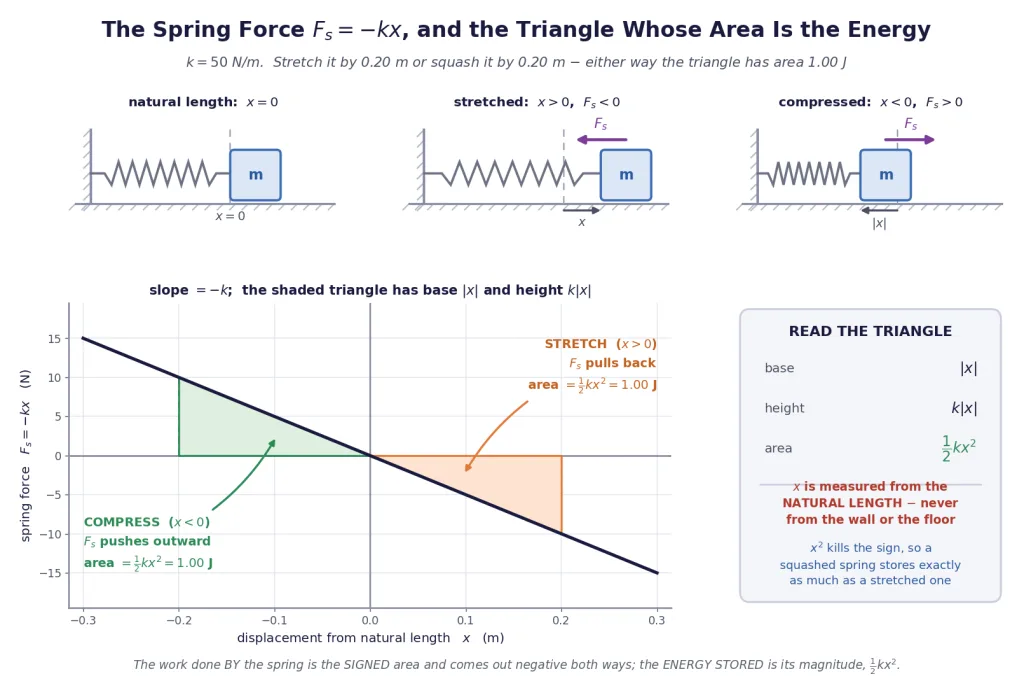
1. is measured from the natural length. Not from the wall. Not from the floor. Not from where the block happens to be sitting. If a spring of natural length 30 cm has been stretched to 38 cm, then m, not 0.38 m. Get this wrong and every energy you compute afterwards is wrong.
2. The minus sign is not decoration — it makes the force restoring. Stretch the spring () and is negative, i.e. it pulls the block back inwards. Compress it () and is positive, i.e. it pushes the block back outwards. Whichever way you disturb it, the spring fights to return to its natural length. That is exactly the behaviour that will produce oscillation later.
3. measures stiffness. A large means a stiff spring — a car suspension spring might have in the tens of thousands of N/m. A small means a soft spring — the one in a ballpoint pen is a few hundred. The unit of is N/m, and dimensionally .
The graph is a straight line through the origin
Plot against and you get a straight line of slope passing through the origin. That is the whole content of Hooke's law, drawn.
And here is why that picture matters so much in this chapter. Section 3 taught you that work is the area under the force-displacement graph. The area under a straight line is a triangle, and triangles are easy. So a spring is a variable force whose work you can find by geometry alone, in one line, with no calculus. We will do it both ways in a moment and get the same answer.
| Quantity | Symbol | SI unit | Notes |
|---|---|---|---|
| spring constant | N/m | large = stiff, small = soft | |
| displacement from natural length | m | signed: stretch, compress | |
| spring force | N | always points back to | |
| stored energy | J | coming up next, never negative |
A word on "ideal". We assume the spring is light (its own mass is negligible, so no kinetic energy is hiding in the coils) and perfectly elastic (it obeys at every extension and loses nothing to internal friction). Real springs stop obeying Hooke's law if you stretch them too far — beyond the elastic limit they deform permanently. Everything in this section lives inside the elastic limit.
Proving the Spring Force Is Conservative
Section 4 gave you the test. A force is conservative if the work it does depends only on the endpoints and not on the route — equivalently, if the work around any closed path is zero. Gravity passed that test. Friction failed it badly.
Let's put the spring force through the same test. And notice: we will not assume the answer. We will compute the work honestly and then look at what we got.
The work done by the spring, from to
The spring force is , which changes with position, so from Section 3 the work is an integral, not a product:
Now stop and read that result rather than just filing it away.
Key Point: The work done by the spring depends on and only. It contains no information whatever about how the block travelled between them — fast or slow, straight there or wandering out to m and back first. Only the two endpoints appear.
That is precisely condition one for a conservative force.
The closed path gives exactly zero
Take the block out to some and bring it back to the same . Then , and
Zero. Exactly zero, not approximately. Go out and come back a hundred times and the spring has done no net work at all. Compare that with friction, which would have bled energy on every single leg of that journey, out and back, because friction always opposes the motion and so always does negative work.
Key Point: The spring force (i) depends on position alone, (ii) does work that depends only on the endpoints, and (iii) does zero work around any closed path. The spring force is conservative.
And therefore a potential energy exists
Section 4 established the payoff: every conservative force gets its own potential energy, defined so that
Compare that with what we just derived:
Line them up term by term. must be and must be . The potential energy has fallen straight out of the work integral, and the next block makes it official.
[JEE Tip] Whenever an exam asks you to show that some force is conservative, this is the template: integrate it between two general points and check that only the endpoints survive. It works for , for , for — and it visibly fails for anything containing the direction of motion, such as .
Elastic Potential Energy:
A stretched spring is loaded. Let go of it and it hands the energy straight back. That stored energy is the elastic potential energy, and we can get its formula two completely different ways — which is a good habit, because if two independent routes agree, you are probably right.
Route 1: the area of a triangle (no calculus)
To stretch the spring slowly from to , you must pull with a force that exactly balances the spring at every instant, so your applied force is . Plot that against displacement and you get a straight line rising from to .
The work you do is the area under it, and the area is a triangle:
That work did not become kinetic energy — you moved the block infinitely slowly, so it ends at rest. It went into storage.
Route 2: the integral
Same answer. Good.
Key Point — elastic potential energy: Taking at the natural length, It is measured in joules, it is a scalar, and it is never negative — sees to that.
Check it against
Section 4's other big relation says the force is minus the slope of the potential energy. Differentiate:
The circle closes. [Board Important] Examiners like this one-line verification; it costs you a single line and shows you understand where came from.
It is a parabola, and it is symmetric
is a parabola with its minimum at — the natural length is the bottom of an energy valley, which is exactly why the natural length is the equilibrium position.
And here is the fact that catches out more students than any other in this topic:
Key Point: . A spring compressed by 5 cm stores exactly as much energy as the same spring stretched by 5 cm. Squashing a spring stores energy just as surely as pulling it does.
Students expect compression to somehow "un-store" energy, or to give a negative . It does not. The destroys the sign. Both cost you the same to set up, and both give it back.
Stretching is not linear in — it is quadratic
Take a spring with N/m.
| Stretch | Work done to get there from natural length | Extra work for this stage |
|---|---|---|
| 0 to 0.10 m | J | 1 J |
| 0 to 0.20 m | J | 3 J |
| 0 to 0.30 m | J | 5 J |
Each extra 10 cm costs more than the last, because the spring is fighting harder every centimetre. Double the stretch and you quadruple the stored energy — that is the speaking, and it is a favourite one-line MCQ.
Signs: Work Done BY the Spring vs Work Done ON It
This is where marks are lost. Not in the physics — in the bookkeeping. Two different quantities look almost identical and differ only by a minus sign, and if you grab the wrong one your energy equation comes out backwards.
Let's settle it once, carefully.
Work done BY the spring
This is , the thing we integrated in the last-but-one block:
Read it physically:
- Moving away from the natural length (): the spring force opposes the motion, so it does negative work and goes up. The spring is being charged.
- Moving back towards the natural length (): the spring force is along the motion, so it does positive work and goes down. The spring is discharging into kinetic energy.
Work done ON the spring by you
When you stretch the spring slowly — so slowly that the block never picks up any speed — your applied force must match the spring at every instant, . Then
Key Point: For a slow stretch or compression, . The two works are equal and opposite. The spring's negative work and your positive work cancel, the block gains no kinetic energy, and every joule you put in is parked in the spring.
The table to memorise
| The block moves | by the spring | by you (slow) | |
|---|---|---|---|
| (stretch) | |||
| (compress) | |||
| (release) | |||
| (release) | |||
| , general |
Look down the first two rows. The spring does negative work whether you stretch it or squash it, because both take the block away from the natural length, and the restoring force is always pointing the other way.
How to never get this wrong in an exam
Read the question's verb.
- "Find the work done by the spring …" answer , and it will be negative if you moved away from the natural length.
- "Find the work required to stretch / work done in stretching / energy stored …" answer , always positive.
- "Find the potential energy of the spring …" , always positive.
[JEE/NEET] A classic trap: "The work done in stretching a spring from to ." Students write and move on. Wrong — the question wants the change: Three times what the first stretch cost. Always subtract; never assume the spring started at its natural length.
The Block-Spring System: Energy Passed Back and Forth
Now put a block on the end and let go. This is the situation that makes the whole chapter worth learning, because tracking forces here would mean solving a differential equation, while tracking energy takes one line.
The setup. A block of mass rests on a smooth horizontal surface, attached to a light spring of constant whose other end is fixed to a wall. Pull the block out to and release it from rest.
Write down the total energy once
At the instant of release, the block is at rest, so all the energy is in the spring:
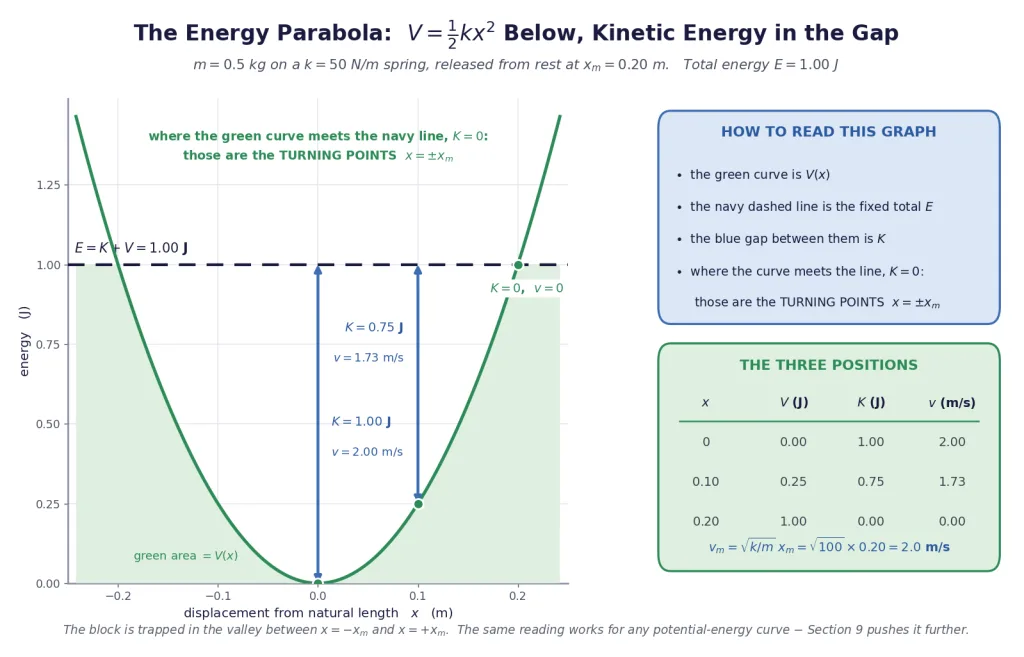
The surface is smooth and the normal force and weight are both perpendicular to the motion, so the only force doing work is the spring — and the spring is conservative. Mechanical energy is therefore conserved, and at any later position with speed :
Key Point — the block-spring energy equation:
is called the amplitude: the largest displacement the block ever reaches.
Everything you need follows from that one line
Speed at any position. Rearranging,
Maximum speed, at the natural length. The speed is largest when , because that is where is smallest and so is biggest:
Turning points, at . Set and you get . At those two points the block is momentarily at rest with every joule back in the spring, and then the restoring force sends it the other way. It never gets beyond because there simply is not enough energy.
Where is ? Put to get . [NEET Important] This one is asked verbatim.
Watch the energy change hands
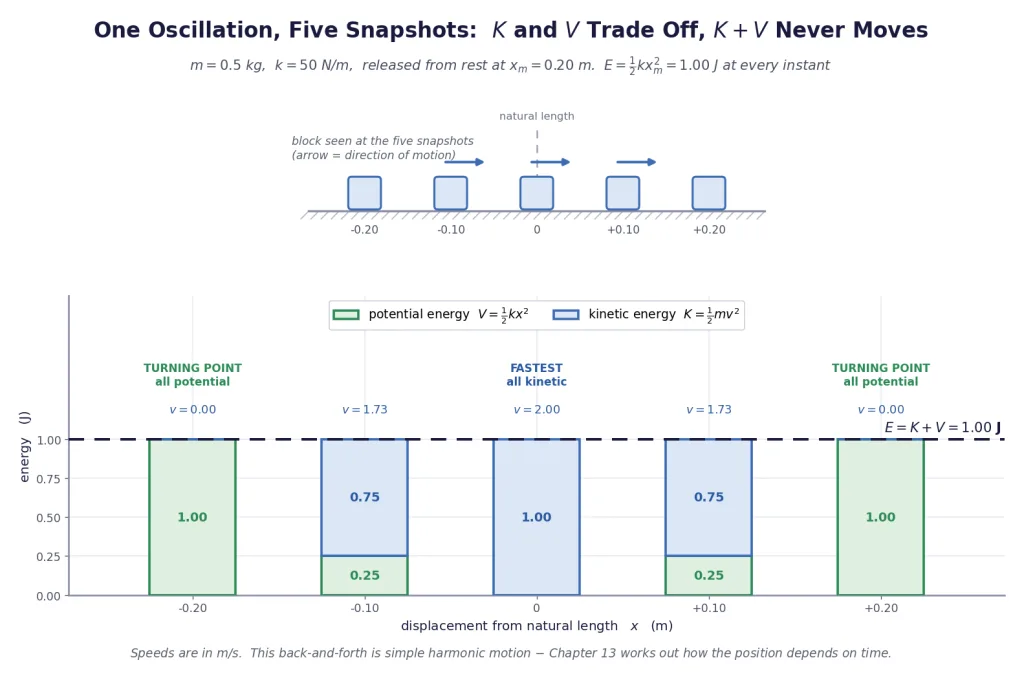
For a 0.5 kg block on a 50 N/m spring released at m, the total is J:
| (m) | (J) | (J) | (m/s) |
|---|---|---|---|
| 1.00 | 0.00 | 0.00 | |
| 0.25 | 0.75 | 1.73 | |
| 0.00 | 1.00 | 2.00 | |
| 0.25 | 0.75 | 1.73 | |
| 1.00 | 0.00 | 0.00 |
Read down the two middle columns. As one falls the other rises by exactly the same amount, and the sum never budges from 1.00 J. That is conservation of mechanical energy caught in the act.
Notice too that the block passes m and m at the same speed, 1.73 m/s. It must — depends on , so symmetric positions have symmetric energies.
One sentence about what comes next
Released from rest at , the block runs to , comes back, and repeats forever. That back-and-forth is simple harmonic motion, and working out as a function of time is the business of Chapter 13. Everything in this chapter is timeless: energy tells you the speed at a position, never the clock reading. If a question asks when, you need Newton's second law or Chapter 13 — not this section.
When the Floor Is Rough: the Crash-Test Template
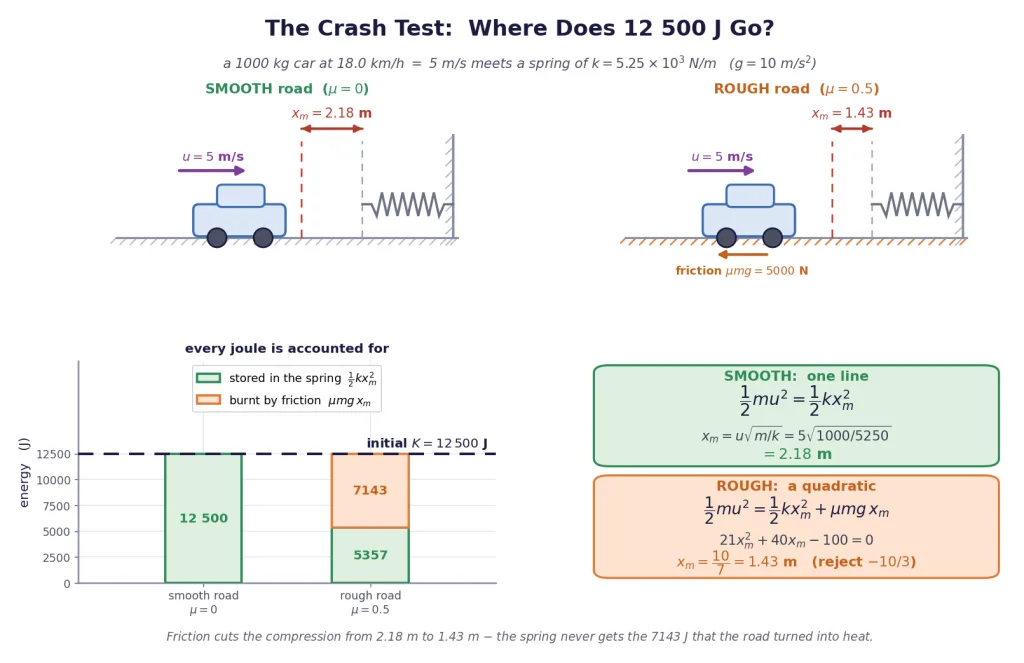
Everything so far assumed a smooth surface. Add friction and the spring is still conservative — friction is the guilty party, not the spring — but mechanical energy is no longer conserved. Section 4 gave the honest bookkeeping, and we just apply it:
where is the work done by the non-conservative forces. For sliding friction over a distance , : always negative, always path-dependent.
The template, in three lines
A body of mass arrives with speed , compresses a spring by , and stops. Take the moment of first contact and the moment of maximum compression.
Smooth floor. All the kinetic energy ends up in the spring:
Rough floor. The kinetic energy now has to cover two bills — the spring and the heat:
Key Point: Rearranged, that is a quadratic in : Solve it, and reject the negative root — a compression cannot be negative. The physical root is always the one with the sign in front of the square root.
Two things worth noticing before you ever plug in numbers:
- The friction term is linear in while the spring term is quadratic. That is why you get a quadratic, and why there is no shortcut around it.
- The answer must come out smaller than the smooth-floor answer. Friction has eaten part of the budget, so the spring gets less and compresses less. If your quadratic gives you more than , you have made a sign error. Use this as a free check every time.
Careful about the distance friction acts over
Friction is charged over the path length, not the displacement. In the compression phase the car slides forward , so the heat is . If the question then asks how far the car bounces back, friction charges you again over that return leg — and it acts backwards this time too, because friction always opposes the current motion. [JEE Tip] For a there-and-back journey of one-way length , the friction loss is , not zero. Contrast that with the spring, which gives back everything on the return leg.
[JEE Tip] Two springs instead of one
You will meet combinations. The two results are worth carrying:
| Arrangement | Effective constant | Which is stiffer? |
|---|---|---|
| Parallel (side by side, same extension) | stiffer than either | |
| Series (end to end, same force) | softer than either |
The one-line reasoning: in parallel both springs stretch by the same and their forces add, so . In series both carry the same force and their extensions add, so .
Once you have , everything in this section applies unchanged: , , and so on. Section 9 pushes this much further — springs cut in half, springs with masses at both ends, and the energy distribution between two springs in series. We stop at the two formulas.
Solved Examples
Every numerical problem in this set uses m/s, and no problem mixes values.
Example 1: The crash test on a smooth road
To simulate car accidents, manufacturers drive cars into spring-loaded barriers. A car of mass 1000 kg moving at 18.0 km/h on a smooth road hits a horizontally mounted spring of spring constant N/m. Find the maximum compression of the spring.
Solution:
Convert the speed first. Always. km/h m/s. (Handy: 36 km/h = 10 m/s.)
Kinetic energy of the car at first contact:
At maximum compression the car is momentarily at rest, so all of that has become spring potential energy. The road is smooth, so nothing was lost on the way:
Solve for :
Final Answer: m.
A note on the answer usually printed with this problem. The printed answers to this classic pair of problems do not close with the stated spring constant. The commonly quoted 2.00 m is what you get from N/m, not from the N/m the question actually states — a long-standing arithmetic slip. We use the value as stated, which gives 2.18 m. Learn the method; if an exam quotes the older wording you will recognise both numbers.
Takeaway: One line of physics — "all the kinetic energy goes into the spring" — and one line of algebra. Note what we never needed: the time of the collision, the force at any instant, the deceleration. Energy is blind to time, which is exactly what makes it cheap.
Example 2: The same crash test, now with friction
Repeat Example 1 with a coefficient of friction between the car and the road. Take m/s.
Solution:
Which forces do work now? The spring (conservative) and friction (not). So mechanical energy is not conserved, and we use the work-energy theorem instead:
Put in each piece over the compression . The car goes from speed to rest, so . The spring does . Friction does . Hence In words: the car's kinetic energy is split between the spring and the heat.
Numbers. J and N. So
Tidy it up. Divide throughout by 125:
Solve the quadratic. The two roots are
Reject the negative root. A compression of m is meaningless: the car was moving towards the spring, so must be positive. The algebra offers it because the quadratic knows nothing about which way the car was going.
Check the energy budget closes.
Sanity check. m is less than the m of Example 1, exactly as it must be.
Final Answer: m; the spring receives 5357 J and 7143 J becomes heat.
The answer commonly printed for this problem, 1.35 m, again follows from N/m. With the stated N/m the answer is m.
Takeaway: This is the flagship problem of the section and its shape is worth memorising: , a quadratic, reject the negative root, then check the two energies add back to the original . Notice that friction here swallowed 57% of the car's energy — more than the spring got. That is the whole point of a crumple zone.
Example 3: The second stretch always costs more
A spring has N/m. Find the work required (a) to stretch it from its natural length to 0.10 m, and (b) to stretch it further from 0.10 m to 0.20 m.
Solution:
(a) From 0 to 0.10 m. The work done on the spring equals the change in its stored energy:
(b) From 0.10 m to 0.20 m. Subtract; do not start from zero:
Final Answer: 1 J and 3 J.
Takeaway: The same 10 cm of stretch cost three times as much the second time. [JEE/NEET] The ratio for successive equal stretches runs (the odd numbers), because grows as and consecutive squares differ by consecutive odd numbers. If you ever write "the work to stretch from to is ", you have made the single commonest error in this section.
Example 4: Compression stores just as much as extension
A spring of constant 800 N/m is (a) stretched by 5 cm and (b) compressed by 5 cm. Find the potential energy stored in each case.
Solution:
(a) Stretched, m:
(b) Compressed, m:
Final Answer: 1 J in both cases.
Takeaway: does not care about the sign, so a spring stores energy whether you pull it or squash it, and stores the same amount for the same magnitude of . This is a favourite one-line MCQ. The associated trap: "which stores more, a spring stretched 5 cm or compressed 5 cm?" — the answer is neither, they are equal.
Example 5: The full block-spring problem
A block of mass 0.5 kg on a smooth horizontal surface is attached to a spring of constant 50 N/m. It is pulled 0.20 m from the natural length and released from rest. Find (a) the total energy, (b) the maximum speed and where it occurs, (c) the speed at m, and (d) the position where .
Solution:
(a) Total energy — fix it once at the moment of release, when the block is at rest:
(b) Maximum speed is at , the natural length, where and so : Cross-check with the formula: m/s.
(c) At m:
(d) Where : each must be half the total, so J: which is m.
Final Answer: (a) 1.00 J (b) 2.0 m/s at (c) 1.73 m/s (d) m.
Takeaway: The method never changes: fix once from the easiest instant, then at any other point compute whichever of and is easy and subtract. Note that at m — half the amplitude — the block already has 75% of its energy as kinetic, not 50%. Energy does not share out linearly with position.
Example 6: Work done by the spring, both ways round
A spring of constant 100 N/m has its free end moved from m to m. Find the work done by the spring. Then find it for the return trip, and for the round trip.
Solution:
Use : Positive, because the block moved towards the natural length — the spring force and the displacement point the same way, so the spring is giving energy out.
Return trip, 0.05 m back to 0.20 m: Negative — moving away from the natural length, the spring resists and takes energy back in.
Round trip: J exactly.
Final Answer: J, then J, and J for the closed path.
Takeaway: The round trip giving exactly zero is the definition of a conservative force in action. Do the same journey against friction and you would lose energy on both legs — out and back — because friction always opposes whichever way you are currently going.
Example 7: The spring gun
A spring of constant 1000 N/m is compressed by 0.10 m and used to launch a 0.20 kg block along a smooth horizontal floor. Find the launch speed.
Solution:
Energy stored in the compressed spring:
The floor is smooth, so all of it becomes kinetic energy as the spring returns to its natural length and the block leaves:
Final Answer: 7.07 m/s.
Takeaway: A compressed spring is a loaded gun — and the launch speed goes as , so doubling the compression doubles the speed but quadruples the energy. That is why toy dart guns pull back so far.
Example 8: Spring gun onto a rough floor
The 0.20 kg block from Example 7 is launched at 7.07 m/s onto a rough floor of coefficient . How far does it slide before stopping? Take m/s.
Solution:
All 5 J must be turned into heat by friction before the block can stop.
Friction force: N.
Heat produced over a distance : . Set it equal to the energy available:
Check with kinematics. m/s, so m.
Final Answer: 10 m.
Takeaway: Notice how the mass vanished: gives , independent of mass. [NEET Important] Whenever gravity or friction alone stops a body, the mass cancels — a heavy block and a light block launched at the same speed slide equally far.
Example 9: The hanging spring — why the answer is , not
A 2 kg mass is attached to a vertical spring of constant 500 N/m hanging from a ceiling. Find the extension (a) when the mass is lowered slowly to its equilibrium position, and (b) when the mass is simply released from rest at the natural length. Take m/s.
Solution:
(a) Lowered slowly. "Slowly" means the mass never picks up speed, so it is in equilibrium at every instant and the spring force balances the weight:
(b) Released from rest. Now nothing balances anything. The mass accelerates downwards, shoots past the equilibrium point, and comes momentarily to rest at the lowest point of its swing. Between the start and that lowest point, , so energy conservation gives (the drop releases gravitational energy , all of which is parked in the spring). Cancel one :
How fast is it moving as it passes the equilibrium point? There, J, so
Final Answer: (a) 4 cm (b) 8 cm — exactly twice as far.
Takeaway: [JEE Tip] This is one of the most-set traps in the whole chapter. is the equilibrium extension; is the maximum extension after a sudden release. The mass then oscillates about the equilibrium point with amplitude . Read the question: "gently lowered" ; "released" or "dropped" .
Example 10: Reading a spring from its energy
It takes 10 J of work to stretch a certain spring by 0.10 m from its natural length. Find (a) the spring constant and (b) the extra work needed to stretch it from 0.10 m to 0.20 m.
Solution:
(a) Invert the energy formula:
(b) Subtract the two stored energies:
Final Answer: (a) 2000 N/m (b) 30 J.
Takeaway: Three times the first 10 J again — the pattern from Example 3, now with different numbers. [Board Important] Notice the useful inverse form : any question that gives you an energy and an extension gives you for free.
Example 11: Two springs, in parallel and in series
Springs of constants 200 N/m and 300 N/m are combined (a) in parallel and (b) in series. Find in each case, and the energy stored when the combination is stretched by 0.10 m.
Solution:
(a) Parallel — both stretch by the same , forces add:
(b) Series — both carry the same force, extensions add:
Sanity check on the series result the long way. Apply 12 N to the combination: the first stretches m, the second m, total 0.10 m. So N/m.
Final Answer: (a) 500 N/m, 2.5 J (b) 120 N/m, 0.6 J.
Takeaway: Parallel is always stiffer than either spring; series is always softer than either. If your series answer comes out bigger than the smaller , you have added instead of adding reciprocals. [JEE Tip] For identical springs of constant : parallel gives , series gives . Section 9 goes further, including what happens when you cut a spring in half (its doubles).
Example 12: A block runs into a spring
A 1.2 kg block slides along a smooth floor at 3 m/s and runs into a spring of constant 300 N/m fixed to a wall. Find (a) the maximum compression, (b) the maximum force the spring exerts on the block, and (c) the maximum deceleration.
Solution:
(a) At maximum compression the block is momentarily at rest: Equivalently m.
(b) The force is largest exactly at maximum compression, since :
(c) Deceleration there:
Final Answer: (a) 0.190 m (b) 56.9 N (c) 47.4 m/s.
Takeaway: The maximum force and the maximum compression happen at the same instant — the instant the block is at rest. Students often assume the force is largest at first contact; it is actually zero there, because at first contact. [JEE/NEET] A softer spring (smaller ) compresses more but delivers a smaller peak force. That is the entire engineering principle behind crumple zones, packaging foam and running shoes.