
Potential Energy: Energy Stored by Position
Section 2 gave you kinetic energy — energy a body has because it is moving. Now for the other kind, and it is stranger: energy a body has because of where it is.
Think of it this way. Pull a bowstring back and let go: the arrow leaves at enormous speed. Where did that kinetic energy come from? The bow was not moving. It was bent. Lift a hammer above a nail and it has no speed at all, yet release it and it arrives with plenty. Something was stored while it was up there, waiting.
Key Point: Potential energy is the energy a body possesses by virtue of its position or configuration. It is stored energy — energy that can be recovered as kinetic energy when whatever is holding the body in place is removed.
The standard examples are worth keeping: a stretched bowstring, a compressed spring, and — spectacularly — the Earth's crust. Rock along a fault line is held under strain like a compressed spring, and when it finally slips, that stored potential energy is released as an earthquake.
The notation
Potential energy is written . It is also written — the same quantity under a different letter, so do not let the switch confuse you in an exam.
Gravitational potential energy near the Earth
Let us make this concrete for the force you meet most: gravity. Take a ball of mass and raise it slowly through a height . Take upward as positive, and take as constant — legitimate as long as is tiny compared with the Earth's radius , which for anything in this chapter it is.
While the ball goes up, the gravitational force points down and the displacement points up, so the angle between them is and gravity does negative work:
Meanwhile, an external agency (your hand) pushes up through the same height and does of work. That work does not appear as kinetic energy — the ball is barely moving. It has been stored.
Key Point — gravitational potential energy: The potential energy of a body at height is defined as the negative of the work done by gravity in raising it to that height: Its unit is the joule, the same as work and kinetic energy, and its dimensions are .
The stored energy comes straight back out
Now release the ball. It falls, and just before it hits the ground, kinematics from Chapter 2 gives
Multiply both sides by :
Read the two sides. On the left is the kinetic energy the ball arrives with. On the right is exactly the potential energy it had at the top. Every joule that was stored has been handed back as motion. Nothing was created and nothing was lost.
One warning that matters
Potential energy is a property of a system, not of a lone body. It is really the energy of the ball-and-Earth arrangement — but since the Earth never noticeably moves, we get away with saying "the potential energy of the ball", and everyone does.
More importantly, the idea only works for a special class of forces. You cannot define a potential energy for friction, and the next-but-one heading explains exactly why.
Only CHANGES in Potential Energy Are Real
Here is the thing that trips up more students than any other part of this topic, and it deserves settling once and properly.
Ask yourself: what is the potential energy of a 1 kg book lying on a table? Is measured from the tabletop? The floor? The ground outside? Sea level? Each choice gives a different answer, and there is no way to decide between them. So which is right?
All of them. And it does not matter.
Why it does not matter
Look back at where came from. It was defined through the work gravity does, and work involves a change of position. Nothing in physics ever asks for on its own; every equation you will meet contains , the change:
Whatever constant you add to every height cancels in the subtraction. Shift the origin down by 3 m and both and go up by — and is untouched.
Key Point: Only differences in potential energy are physically meaningful. The zero level is entirely your choice. Choose whatever makes the arithmetic easiest, state it clearly at the top of your answer, and then be consistent.
The practical rules
| Situation | The convenient zero |
|---|---|
| A body dropped to the ground | the ground |
| A pendulum | the lowest point of the swing |
| A block sliding down an incline | the foot of the incline |
| A body thrown up and caught | the point of projection |
| A block on a table falling off | the floor, or the tabletop — pick one and say so |
And negative potential energy is perfectly respectable. If you put the zero at the tabletop, a book on the floor 0.8 m below has , a negative number. That is not a mistake and it is not "less than no energy" — it just means the book is below your chosen reference. [Board Important] Marks are lost for inconsistency, never for the choice itself. Write "taking at the ground" and you have protected yourself.
Worked in miniature
A 1.2 kg book is moved from a table 0.8 m above the floor to a shelf 2.0 m above the floor, with m/s. Three students choose three different zero levels:
| Zero at | at the table | at the shelf | |
|---|---|---|---|
| the floor | J | J | J |
| the table | J | J | |
| the shelf | J | J |
Three completely different tables of numbers. One identical answer. That is the whole point.
Potential energy is not a vector
One quick reassurance, because the negative signs invite the doubt: is a scalar, like and . A negative carries no direction; it simply means "below the reference level". Add potential energies as ordinary numbers.
Conservative Forces, and Why Friction Is Not One
Not every force can be given a potential energy. The ones that can are called conservative, and there are three equivalent ways of recognising them. Any one of the three implies the other two, so in a problem you use whichever is easiest to test.
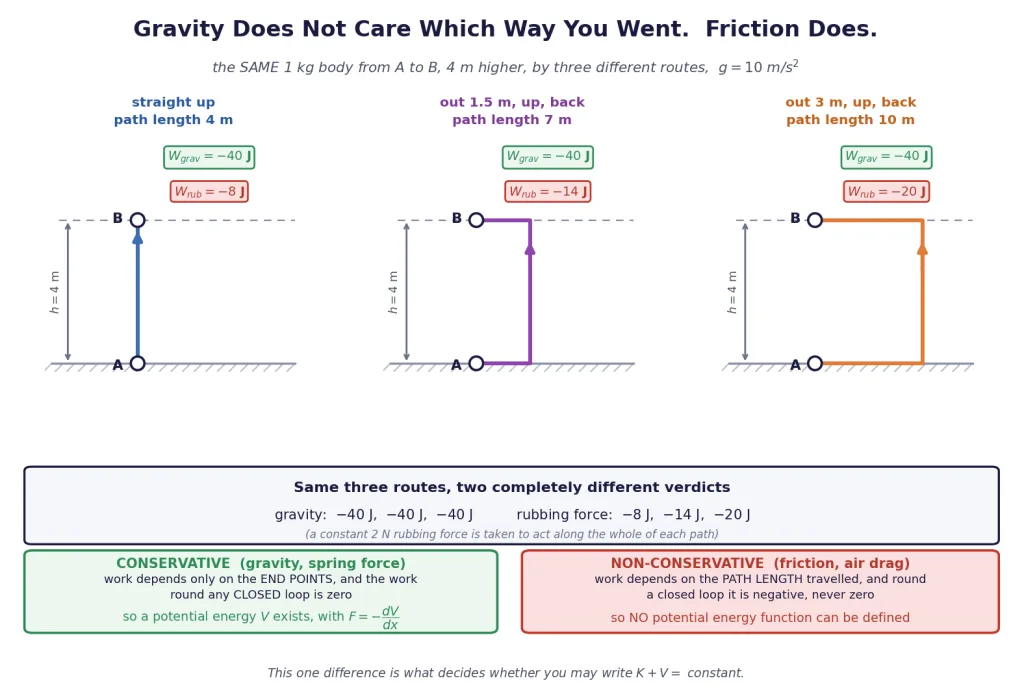
Test 1: the work is independent of the path
Take a body from point A to point B by any route you like. If the work done by the force is the same for every route, the force is conservative.
Look at the figure. A 1 kg body is raised 4 m from A to B, taking m/s, by three routes of path length 4 m, 7 m and 10 m. Gravity does J on every one of them, because the horizontal legs are perpendicular to gravity and contribute exactly nothing. Only the 4 m of height counted.
Test 2: the work around any closed loop is zero
Go from A to B and back to A. If the force is conservative, whatever work it did on the way out, it undoes on the way back, and the total for the round trip is zero. Lift a book and lower it: gravity does then , total zero.
This follows from Test 1 immediately: if the work depends only on the end points, and the start and end points are the same, the work has to be zero.
Test 3: the force is the negative gradient of a potential energy
This is the mathematical version, and the one JEE likes.
Key Point: A force is conservative if there exists a function such that Equivalently, in differential form, , and over a finite stretch
Where this comes from. Section 3 established . Section 1 established that potential energy is minus the work done by the force. Put them together — define so that its drop equals the work done — and differentiating gives . The minus sign is the physics: a conservative force always pushes a body towards lower potential energy, the way a ball rolls downhill.
Check it on gravity. With , which is the weight, magnitude , pointing downward — the negative direction, since we took up as positive. The formula recovers exactly the force we started from. [JEE Tip] Given any , differentiate and flip the sign to get the force. This is a guaranteed one-mark step in a longer problem.
And now friction
Run the same three tests on friction and every one of them fails.
Look at the figure again. A 2 N rubbing force acting along the path does J on the direct route, J on the medium route and J on the long one. The work depends on how far you actually slid, not on where you started and finished.
- Test 1 fails: three routes, three different answers.
- Test 2 fails: go out and come back and friction opposes you both times, so the round trip gives a negative total, never zero. You cannot get the energy back by retracing your steps.
- Test 3 fails: since the work is not a function of position alone, no can exist whose difference reproduces it.
Key Point: Friction and air drag are non-conservative. Their work depends on the path length, so no potential energy function can be defined for them. Writing "" in a solution is meaningless.
The catalogue
| Force | Conservative? | Potential energy |
|---|---|---|
| Gravity near the Earth | Yes | |
| The spring force | Yes | (Section 5) |
| Gravitation in general | Yes | (Chapter 7) |
| The electrostatic force | Yes | Chapter 12 |
| Friction | No | none exists |
| Air resistance and viscous drag | No | none exists |
| The push of your hand, a rocket thrust | No | none exists |
[NEET Important] The one-line reason friction is non-conservative — "because the work done by friction depends on the path followed, not only on the end points" — is a direct one-mark answer, and it is asked almost every year in some form.
The Conservation of Mechanical Energy
Everything so far has been setting up for this. It is the most useful single result in Class 11 mechanics.
The derivation, in four lines
Take a body moving through a small displacement under a conservative force .
The work-energy theorem (Section 3, valid for any force) says the change in kinetic energy is the work done:
Because the force is conservative, a potential energy function exists with
The right-hand sides are identical, so the left-hand sides must be:
Rearrange:
A quantity whose change is zero is a constant.
Key Point — the principle of conservation of mechanical energy: The total mechanical energy of a system is conserved if the forces doing work on it are conservative. Between any two points of the motion,
The sum is called the total mechanical energy. and each change from point to point — often dramatically — but their sum does not move.
Read carefully
That minus sign is the entire physics. It says a body speeds up by exactly as much as its potential energy falls. Not more. Not less. Energy is traded, never created.
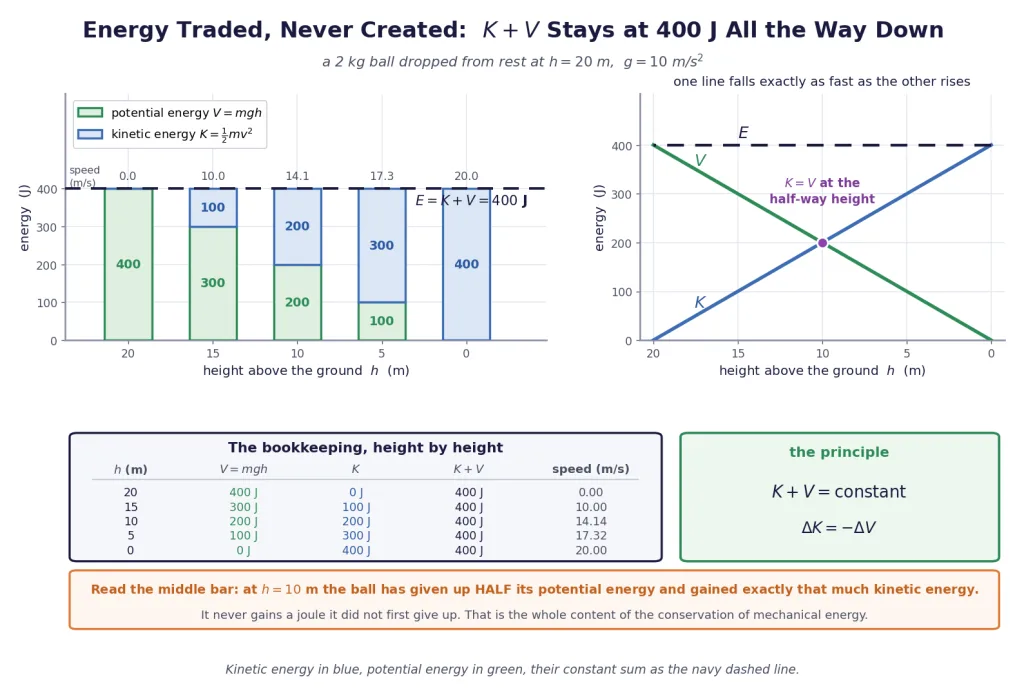
The figure follows a 2 kg ball dropped from 20 m with m/s, so J.
| Height | Speed | |||
|---|---|---|---|---|
| 20 m | 400 J | 0 | 400 J | 0 |
| 15 m | 300 J | 100 J | 400 J | 10.00 m/s |
| 10 m | 200 J | 200 J | 400 J | 14.14 m/s |
| 5 m | 100 J | 300 J | 400 J | 17.32 m/s |
| 0 | 0 | 400 J | 400 J | 20.00 m/s |
Read the green bars shrinking and the blue bars growing by precisely the same amount at every stage. At the half-way height the ball has given up half its potential energy and has exactly that much kinetic energy — at , a result worth remembering because it is asked constantly.
The conditions, stated plainly
The principle is not universal. Before you write constant, check:
- Only conservative forces do work. Gravity and springs are fine; friction and drag are not.
- Forces that do no work may be present freely. The tension in a pendulum string and the normal reaction on a slide are both perpendicular to the motion at every instant, so they do no work and do not spoil anything. This is why the principle survives on tracks and strings.
- No external agency is adding energy. A hand pushing, an engine driving, a rocket burning — all break it.
Why you would ever want it
Because it converts a hard problem into a one-line equation. In Chapter 4 you would find the acceleration, then integrate it, then hunt for the speed. Here you write down the energy at the start, the energy at the end, set them equal, and solve.
[JEE Tip] Energy conservation gives you speeds at positions. It cannot give you times, and it cannot give you directions — it is one scalar equation. If a question asks "how long does it take", the energy method has nothing to say and you must go back to forces.
Three Standard Applications
1. A body released from a height
Drop a body from rest at height , take at the ground, and equate the energy at the top with the energy at the bottom:
Notice what vanished: the mass cancelled. A cannonball and a marble dropped from the same height arrive at the same speed. At an intermediate height the same equation gives , which is the familiar kinematic result — as it must be, since energy conservation is Newton's second law in disguise.
2. A body sliding down a smooth incline — and the beautiful bit
Release a block from rest at the top of a frictionless incline of height . Two forces act:
- The normal reaction is perpendicular to the surface, and therefore perpendicular to the motion at every instant. It does no work.
- Gravity is conservative.
So mechanical energy is conserved, and it does not matter one bit that the block travelled along a slope rather than falling:
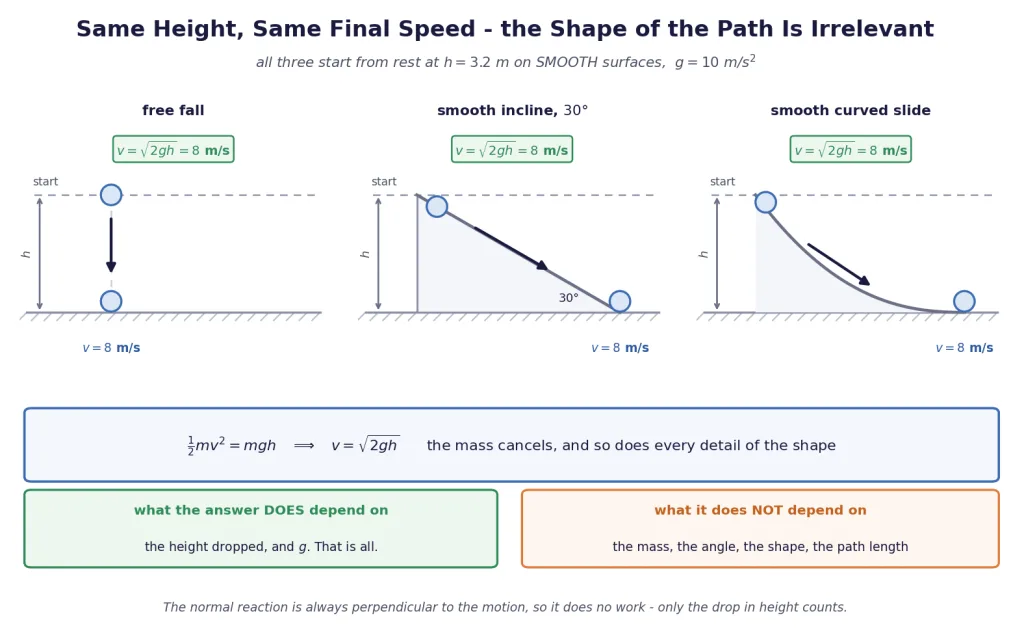
Key Point: For a body released from rest and sliding down any smooth surface, the speed at the bottom is , where is the vertical height dropped. It does not depend on the mass, the angle of the incline, the length of the slope, or the shape of the path.
This is genuinely remarkable. A ramp, a ramp, a curved playground slide and a straight vertical drop all deliver the same 8 m/s from a height of 3.2 m. The steeper ramp gives a bigger acceleration but over a shorter distance, and the two effects cancel exactly. Try proving that with forces and kinematics and you will appreciate the energy method.
[JEE/NEET] The word to hunt for is smooth. If the surface is rough, this result is wrong and you need the friction bookkeeping in the next block.
3. The pendulum
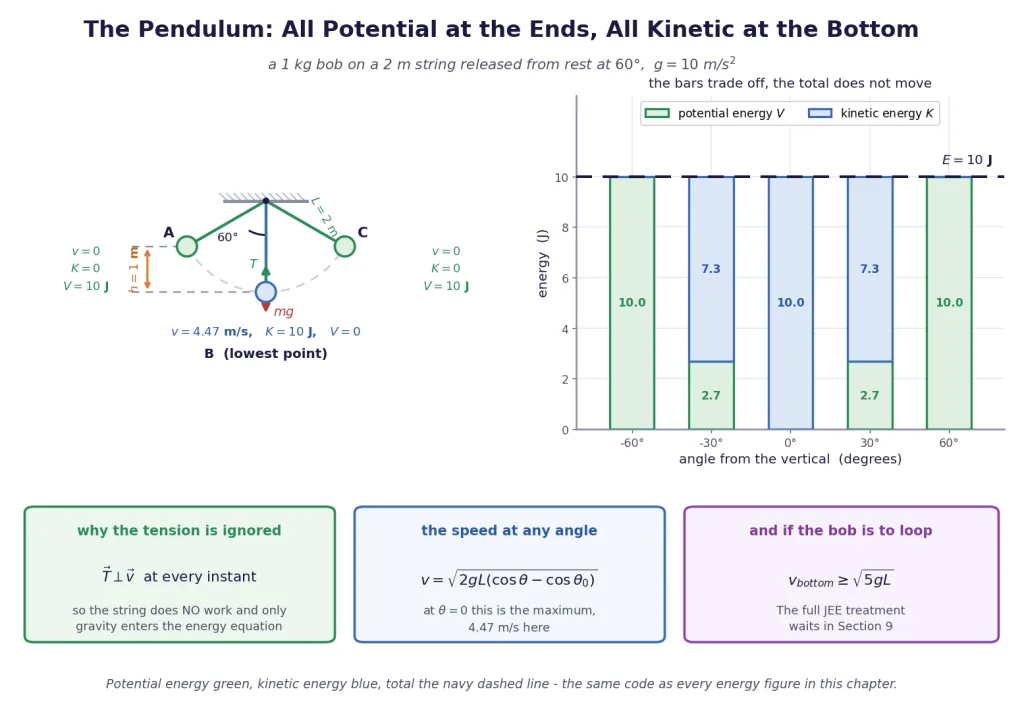
A bob on a light string is the cleanest demonstration there is. Two forces act on it:
- Tension, always along the string, always perpendicular to the velocity — so it does zero work, always.
- Gravity, conservative.
Mechanical energy is therefore conserved, and the whole motion becomes a trade:
- At the extremes the bob is momentarily at rest: , all the energy is potential.
- At the lowest point the bob is at the reference height: , all the energy is kinetic, and the speed is greatest.
- Everywhere in between, the two share the total in some ratio.
Taking at the lowest point and releasing from an angle , the height above the bottom at angle is , so
For the special case of release from the horizontal (), this gives at the bottom.
The vertical circle, lightly. If instead the bob is given a horizontal speed at the lowest point and is to just complete a full vertical circle, the string goes slack exactly at the top, where gravity alone supplies the centripetal force: Conserving energy between the bottom and the top, which is higher:
That is the standard result, and Example 4 works the whole of this pendulum problem through. The full JEE treatment of the vertical circle — the tension at every angle, the conditions for the string to go slack partway up, and the cases where the bob leaves the track — belongs to Section 9. Here we only need the energy line.
When Friction Is Present: The Honest Bookkeeping
Every result above carried the word smooth. Real surfaces are not. So what do you do when friction acts?
Mechanical energy is not conserved
Say it plainly: with friction in the picture, is not constant. It falls. The body arrives slower than energy conservation would have predicted, and the missing joules are gone from the mechanical account.
But they are not gone from the universe. They have become heat — the surfaces are warmer, imperceptibly but measurably. Rub your palms together and you can feel it happening.
The correct equation
The work-energy theorem never stopped being true; it applies to all forces. Split the work into the conservative part and the rest: Since by definition,
Key Point — with non-conservative forces: The change in mechanical energy equals the work done by the non-conservative forces. For friction of magnitude acting over a path length , that work is , so and the mechanical energy lost, , appears as heat.
The here is the path length actually travelled, not the straight-line displacement — which is exactly the non-conservative property from the previous block showing up in the algebra.
Total energy is still conserved
This is the point to be careful about, and it matters.
Energy itself is never lost. What friction destroys is the usefulness of the energy, not the energy. A block sliding to rest on a rough floor has not annihilated its kinetic energy; it has spread it into the disordered jiggling of countless molecules, from which you cannot get it back. The conservation of energy in this widest sense is one of the deepest laws in physics, and it has never been observed to fail.
The recipe for a friction problem
- Choose a zero level for and write it down.
- Compute at the start.
- Compute at the end, leaving the unknown in.
- Write , using the path length for .
- Solve.
Worked in miniature. A 3 kg block slides from rest down a smooth curved track of height 5 m and then along a rough floor with . How far does it go? Take m/s and on the floor.
- Start: , J.
- End (at rest on the floor): , .
- So J, and this must equal with N.
- , giving m.
Notice that the mass cancels if you keep it symbolic: gives , independent of the mass entirely.
Two errors that cost marks
- Using the displacement instead of the path length. If a block slides 3 m forward and 3 m back, friction has acted over m even though the displacement is zero. The heat generated is , not zero.
- Writing anyway. If the word "rough" appears anywhere in the question, that line is wrong. Add the term.
Where this goes next
You now have the complete energy toolkit for gravity. Two extensions follow:
- Section 5 does the same job for the spring, deriving from and working the block-spring energy exchange.
- Section 9 takes the general potential energy curve and reads equilibrium points off it, classifying them as stable, unstable or neutral from and the sign of , along with turning points and forbidden regions.
Solved Examples
Every numerical problem in this set uses m/s, and no problem mixes values. The pendulum problem is symbolic and needs no numerical .
Example 1: Following a falling ball all the way down
A 0.5 kg ball is dropped from rest at a height of 20 m. Taking at the ground and m/s, find , and at heights 20 m, 10 m and 0, and the speed with which it lands.
Solution:
The total energy, fixed once at the start:
At m: the ball is at rest, so and J. Sum: 100 J.
At m: the potential energy is so the kinetic energy must be whatever is left:
At the ground: , so J and
Cross-check with kinematics: m/s. Agreed.
Final Answer: , and J at 20, 10 and 0 m; the sum is 100 J throughout; the landing speed is 20 m/s.
Takeaway: At m — exactly half the drop — the ball has . [NEET Important] "At what height is the kinetic energy equal to the potential energy?" always has the answer for a body dropped from rest, whatever the mass. Note also how the calculation ran: fix once, then at any point compute the easy one of and and subtract.
Example 2: The zero level is yours to choose
A 1.2 kg book is lifted from a table 0.8 m above the floor to a shelf 2.0 m above the floor. Taking m/s, find the increase in its gravitational potential energy, using (a) the floor as the zero level, (b) the table, and (c) the shelf.
Solution:
(a) Zero at the floor.
(b) Zero at the table. The table is now at and the shelf at m:
(c) Zero at the shelf. The table is now m below the reference, so its potential energy is negative:
Final Answer: J in all three cases.
Takeaway: Three sets of numbers, one answer. The zero level is a bookkeeping convenience with no physical content. Notice too that part (c) produced a negative potential energy and nothing broke — a negative simply means "below the level I chose". [Board Important] Always open with "taking at …". It costs one line and secures the method mark.
Example 3: Smooth incline, and the angle that does not matter
A block is released from rest at the top of a smooth incline of vertical height 5 m. Find its speed at the bottom if the incline makes an angle of (a) and (b) with the horizontal. Take m/s.
Solution:
Which forces do work? The normal reaction is perpendicular to the motion at every instant, so it does none. The incline is smooth, so there is no friction. Only gravity does work, and it is conservative — so mechanical energy is conserved.
Energy equation, with at the foot of the incline:
(a) and (b) are the same calculation. The angle never entered. Both give 10 m/s.
Check the case the hard way. Along the slope, m/s and the slope length is m, so For : m/s and m, giving m/s. Both agree.
Final Answer: 10 m/s in both cases.
Takeaway: Step 4 shows why the angle cancels: a steeper slope gives a larger acceleration over a shorter distance, and the product is the same either way. [JEE/NEET] For a smooth surface, only the vertical drop matters. The instant the word "rough" appears, this stops being true, because friction acts along the path and the path length differs between angles.
Example 4: The bob on a string completing a vertical circle
A bob of mass is suspended by a light string of length . It is given a horizontal velocity at the lowest point A such that it completes a semi-circular trajectory in the vertical plane, with the string becoming slack only on reaching the topmost point C. Obtain expressions for (i) , (ii) the speeds at B (level with the centre) and C, and (iii) the ratio .
Solution:
Which forces act? Gravity and the tension. The tension does no work, because the displacement of the bob is always perpendicular to the string. So the potential energy is associated with gravity alone, and the total mechanical energy is conserved.
Set at A, the lowest point. Then at A the energy is entirely kinetic:
At C, the top, the bob is at height and the string has just gone slack, so and gravity alone provides the centripetal force:
The energy at C:
(i) Equate the two expressions for :
(ii) At B, level with the centre, the bob is at height : And from step 3.
(iii) The ratio of the kinetic energies:
Final Answer: , , , and .
Takeaway: At C the string is slack and the bob's velocity is horizontal, pointing to the left. One consequence is worth spelling out: if the string were cut at that instant, the bob would fly off as a horizontal projectile, exactly like a rock kicked off a cliff; otherwise it simply carries on round. As a concrete instance, with m and m/s: m/s, m/s, m/s. The full vertical-circle machinery — the tension at a general angle, and what happens when the launch speed is too small — is Section 9's.
Example 5: From the potential energy to the force
A particle moves along the -axis in a region where its potential energy is joules, with in metres. Find (a) the force on it at m and (b) the work done by that force as the particle moves from m to m.
Solution:
(a) Differentiate and flip the sign: At m: The minus sign says the force points in the direction, back towards — towards lower potential energy, as a conservative force always does.
(b) The work by the shortcut. For a conservative force the work is minus the change in potential energy:
Check it by integrating the force directly, as Section 3 would: The two routes agree, which is precisely the content of .
Final Answer: (a) N; (b) J.
Takeaway: Step 2 versus step 3 is the whole reason conservative forces are worth naming. When a force is conservative you never have to integrate — subtracting two values of does the job. [JEE Tip] Remember which way the sign goes: , and . Both minus signs, both easy to drop, both worth a mark.
Example 6: The same three routes, gravity versus friction
A 2 kg body is taken from the floor to a shelf 3 m above it, with m/s. Find the work done by gravity if it goes (a) straight up, (b) up a smooth ramp 6 m long, and (c) 4 m horizontally along the floor and then straight up. What is in each case?
Solution:
(a) Straight up. The force N points down, the 3 m displacement points up, so :
(b) Up the ramp. Only the component of the weight along the slope does work, N, opposing the 6 m of motion:
(c) The L-shaped path. On the 4 m horizontal leg the weight is perpendicular to the displacement, so it does zero work; on the 3 m vertical leg it does J:
The potential energy change is minus the work done by gravity, and is therefore the same every time:
Final Answer: J on all three routes, and J on all three.
Takeaway: Three routes of length 3 m, 6 m and 7 m, and gravity returns the identical answer because only the 3 m of height ever mattered. That is Test 1 for a conservative force, demonstrated. [Board Important] Contrast this with friction: had the floor and ramp been rough with a 4 N rubbing force, the losses would have been J, J and J — three different numbers for three different path lengths.
Example 7: A rough incline, done properly
A 2 kg block slides from rest down a rough incline of length 4 m inclined at , with . Find its speed at the bottom and the heat generated. Take m/s and at the foot of the incline.
Solution:
The height dropped: so the potential energy released is
The friction force. The normal reaction on an incline is :
The work done by friction, over the 4 m of path actually travelled:
Apply :
The speed:
Check with forces. m/s, so m/s. Agreed.
Final Answer: m/s, and J of mechanical energy has become heat.
Takeaway: Compare with the smooth case: without friction the block would have arrived at m/s. Friction removed 43% of the energy and 25% of the speed. [JEE/NEET] The bookkeeping line is the one to memorise; everything else is arithmetic. And note that m is the length of the slope, not the 3.46 m of horizontal displacement.
Example 8: The vertical circle, the short version
A small ball on the end of a light string is whirled in a vertical circle of radius 2 m. Take m/s. Find (a) the minimum speed it can have at the top and (b) the corresponding speed at the bottom.
Solution:
(a) At the top, at the critical condition, the string is on the point of going slack, so the tension is zero and gravity alone supplies the centripetal force:
(b) Conserve energy between the bottom and the top, which is m higher, with at the bottom:
In symbols this is the standard pair: and . Check: m/s.
Final Answer: (a) 4.47 m/s at the top; (b) 10 m/s at the bottom.
Takeaway: Two ingredients, one from each chapter: the circular-motion condition at the top (Chapter 4) and energy conservation between top and bottom (this section). Neither alone is enough. [JEE Tip] is worth memorising outright, but be sure you can derive it, because Section 9 asks the harder versions — a rod instead of a string (where the answer becomes ), and what happens when the ball leaves the track partway up.
Example 9: A pendulum released from the horizontal
A pendulum bob on a 1.5 m string is released from rest with the string horizontal. Take m/s and at the lowest point. Find its speed (a) at the lowest point and (b) when the string makes with the vertical.
Solution:
(a) At release the bob is a full string-length above the lowest point, so it falls through m:
(b) At from the vertical, the bob is a height above the lowest point: so it has fallen m from its release point:
Or use the general formula with so :
Final Answer: (a) 5.48 m/s; (b) 3.87 m/s.
Takeaway: The bob has covered two-thirds of its angular swing at but has only of its final kinetic energy, so of its final speed. Energy and angle are not proportional. [NEET Important] The height above the lowest point is — this single expression converts every pendulum angle into a height, and it is the only geometry the problem needs.
Example 10: Thrown upward — where does equal ?
A 0.2 kg ball is thrown vertically upward at 20 m/s. Taking m/s and at the point of projection, find (a) the maximum height, (b) the height at which its kinetic and potential energies are equal, and (c) its speed there.
Solution:
The total energy, fixed at launch:
(a) At the highest point the ball is momentarily at rest, so all 40 J is potential:
(b) means each is half the total, so J:
(c) The speed there, from J:
Final Answer: (a) 20 m; (b) 10 m; (c) 14.14 m/s.
Takeaway: at — the same half-way result as the dropped ball in Example 1, and for the same reason: is linear in , so half the height means half the energy. The speed there is not half of 20 m/s but m/s, because goes as . [NEET Important] Half the energy means of the speed, never half.
Example 11: Smooth slide, then a rough floor
A 3 kg block starts from rest at the top of a smooth curved track 5 m high, slides down, and then travels along a rough horizontal floor with until it stops. Take m/s. How far along the floor does it go, and how much heat is produced?
Solution:
Down the smooth track, mechanical energy is conserved, so at the bottom which is of course just J.
Along the rough floor, friction is the only force doing work:
Apply the bookkeeping from start (top of the track) to finish (at rest on the floor). Taking on the floor:
The heat produced is the mechanical energy lost: 150 J.
Note the mass cancels. Symbolically, gives independent of the mass entirely.
Final Answer: It slides 25 m and 150 J of heat is produced.
Takeaway: Step 3 did the whole problem in one line by comparing the very start with the very end and never asking what happened in between. That is the energy method at its best. [JEE Tip] Step 5 is worth internalising: for a smooth drop of height onto a rough floor of coefficient , the stopping distance is always , whatever the mass.
Example 12: Where did the energy go?
A 5 kg object is dropped from a height of 10 m and lands with a speed of 8 m/s. Taking m/s, find how much mechanical energy was lost to air resistance, and comment.
Solution:
The mechanical energy at the start, with at the ground:
The mechanical energy at the end:
The loss: so J and 340 J has gone to air resistance.
What it would have been without air. In free fall the object would have arrived at instead of 8 m/s. Only 32% of the energy survived as kinetic energy.
Final Answer: 340 J was lost to air resistance; free fall would have given 14.14 m/s rather than 8 m/s.
Takeaway: Two things worth holding on to. First, we never needed to know the drag force — an unknown, speed-dependent, thoroughly nasty function — because we only compared the two ends. Second, and this is the point to press: the 340 J is not destroyed. It has warmed the air and the object. Mechanical energy was not conserved; total energy was. Write that sentence in a Board answer and it will earn its mark.