
Close the Book. Start the Clock.
Sections 1 to 9 taught you this chapter — the scalar product and the three signs of work, kinetic energy and the work-energy theorem, work as the area under an - graph, potential energy and , the spring, power, collisions, forty-two worked problems, and the JEE-only extensions. This section asks a different question: can you use any of it with a timer running?
There is no new theory below. There are 30 questions built to the JEE Main pattern, and a marking scheme designed to punish the habit this chapter rewards most cruelly — reaching for before deciding which forces are doing work.
The rules of engagement
Key Point: This is not a reading exercise. Blank sheet, pen, timer. Attempt all 30 questions in one unbroken sitting and do not open a single explanation until the last answer is written.
| The setup | What it is |
|---|---|
| Number of questions | 30 |
| Marking scheme | correct, incorrect, unattempted |
| Maximum score | marks |
| Minimum possible score | marks |
| Suggested time limit | 35 minutes (JEE Main pace is a little over a minute per question) |
| Take as | 10 m/s^2 unless a question says otherwise |
| Useful values | , , , , , , |
| Allowed | rough sheet, your own head |
| Not allowed | calculator, formula sheet, a glance back at Sections 1 to 9 |
[Exam Tip] That is not decoration. Four wild guesses that land one lucky hit earn mark for four minutes of work — a terrible trade. But a question narrowed to two options returns marks on average, which is a very good one. Narrow first, then commit. Leave blank only what you could not narrow at all.
What this set covers
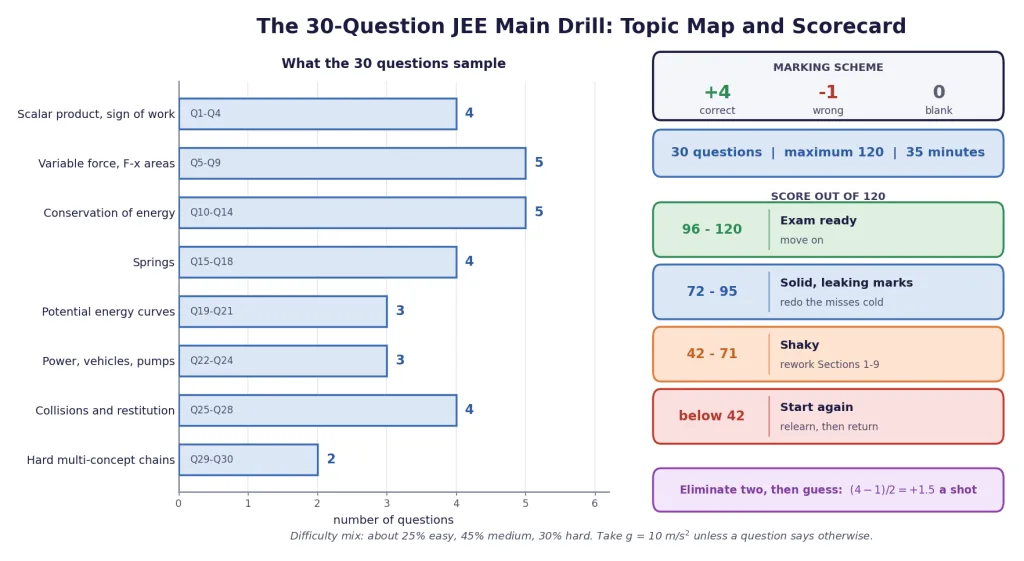
| Topic | Questions | How many |
|---|---|---|
| Scalar product, the sign of work, work by a constant force | Q1 to Q4 | 4 |
| Variable force: - areas, honest integration, the WE theorem | Q5 to Q9 | 5 |
| Conservation of mechanical energy: tracks, loops, inclines, friction | Q10 to Q14 | 5 |
| Springs: compression, block-spring speed, spring with gravity, spring with friction | Q15 to Q18 | 4 |
| Potential energy curves: equilibrium, turning points, force from the slope | Q19 to Q21 | 3 |
| Power: constant power, vehicles, pumps | Q22 to Q24 | 3 |
| Collisions: elastic, restitution, oblique, successive bounces | Q25 to Q28 | 4 |
| Hard multi-concept chains | Q29 to Q30 | 2 |
That spread mirrors how JEE Main actually samples Work, Energy and Power. Energy conservation and variable-force work are 10 of the 30, because between them they carry the most marks from this chapter in the real paper. Springs and collisions take another 8, and they are the questions where a confident wrong answer is easiest to produce — a spring problem solved with instead of , or a collision "solved" by conserving kinetic energy that was never conserved.
The difficulty mix is roughly 25% easy, 45% medium and 30% hard. A handful will feel brutal. They are meant to.
[Exam Tip] Before you start, write three lines at the top of your sheet: which forces do work?, is any of it conservative?, and is the kinetic energy conserved here, or only the momentum? Those three questions decide the method for almost every problem below, and choosing the method is where the marks in this chapter are actually won.
Scoring Yourself Honestly
Mark your sheet with the real scheme — , , — and total it. No half marks for "I knew that one really". The number you get is the number that matters.
The bands
| Your score (out of 120) | Verdict | What to do next |
|---|---|---|
| 96 to 120 | Exam ready. 80% or more on a hard set, inside the time. | Move on. This chapter will not cost you marks. Revisit only the specific items you missed. |
| 72 to 95 | Solid, but leaking marks. | Almost always slips rather than gaps — a sign dropped on , friction forgotten on the way back, a spring energy written as . Redo every wrong question without the explanation first. |
| 42 to 71 | Shaky. The ideas are there; the execution is not. | For each wrong answer go back to the section that owns it (use the topic map above) and rework its solved examples before re-attempting. |
| Below 42 | Start again. | Work Sections 1 to 7 properly, then Section 8's forty-two examples, then Section 9. Re-attempting this set now teaches you nothing but the answer key. |
Read your own answer sheet
Before you touch a single explanation, sort your mistakes into three piles. This is the most valuable ten minutes in the whole section.
- Method errors — you used energy where you needed forces, or forces where energy would have taken four seconds. You tried to conserve mechanical energy on a rough track. You conserved kinetic energy across an inelastic collision. You integrated when the graph area was sitting right there. These are the expensive ones, because the whole solution is wrong from line one.
- Execution errors — right method, wrong arithmetic. The classic three in this chapter: dropping the in , forgetting that kinetic energy goes as the square of the speed, and integrating as instead of .
- Reading errors — the question asked for the work done by friction, not the heat generated; the spring's maximum compression, not its compression at maximum speed; the speed at the top of the loop, not the bottom; the energy lost, not the energy left.
Key Point: In this chapter pile 3 is dominated by four traps: work done by a force versus work done against it, the sign of when a body is lowered, the difference between and , and whether a collision conserves kinetic energy at all. Check which of the four caught you, every single time.
The seven habits this set is drilling
- Name the forces before you name the formula. Write down every force acting, put a tick beside each one that does work, and only then decide between , and .
- A perpendicular force does no work, ever. Normal reaction on a flat slide, tension in a circular path, the magnetic force later on. That single line collapses half the algebra in a typical problem.
- For a variable force, the area under the - graph is the work — signed. Areas below the axis subtract. If the graph is a straight line or a triangle, do not integrate; if it is a curve you know, do.
- Mechanical energy is conserved only when every force doing work is conservative. The moment friction, air drag or a hand appears, switch to and keep negative for friction.
- A spring stores , and is measured from the natural length. Not from the wall, not from the equilibrium position of a hanging mass unless you are careful to add the gravitational term too.
- In every collision the momentum is conserved. The kinetic energy is not, unless the question says elastic. Write momentum first, then decide what your second equation is: , a given , or "they stick together".
- Check the size of the answer. A speed at the bottom of a rough slide cannot exceed ; the energy stored in a spring cannot exceed the kinetic energy that went into it; a body cannot come out of a collision faster than the relative speed allows.
[Exam Tip] Every explanation below is a full step-by-step solution, so this set doubles as revision. Read the explanation even for the questions you got right — several of these have a two-line route and a two-page route, and it is the two-line route you will need in the hall.