
Why One Formula Was Never Going to Be Enough
Sections 1 and 2 gave you two clean results:
Both of them carry a piece of small print that is easy to miss. They assumed the force stayed the same throughout the motion. The moment changes as the body moves, "" stops meaning anything, because there is no single to multiply by.
And a constant force is the rare case
Look around for a genuinely constant force and you will struggle.
| Situation | How the force behaves |
|---|---|
| A stretched spring | grows with the extension, |
| Air drag on a falling drop | grows with the speed, roughly or |
| A hand pushing a heavy trunk | starts strong, fades as you tire |
| Gravity far from the Earth | falls off as |
| A magnet pulling a nail | rises sharply as the nail gets close |
| A bat striking a ball | zero, then enormous, then zero again in 5 ms |
Weight near the ground and the tension in an ideal string dragging a block at steady speed are about the only honest constants in the Class 11 syllabus. Everything else varies. So we need a definition of work that survives a changing force — and, pleasingly, the fix is the most natural idea in calculus.
The trick: chop the journey up
Here is the thing. A force that varies over 10 m may still be essentially constant over 1 mm. So take the total displacement from to and slice it into a large number of tiny intervals, each of width .
Over one such slice, starting at position , the force barely budges. Treat it as the constant value , and the old formula applies perfectly well to that slice alone:
Now add up the slices. The total work is
This is an approximation, and you can see exactly where the error comes from: within each slice we pretended a changing force was constant. But notice what happens as the slices get thinner. The pretence gets closer and closer to the truth, and the error shrinks towards nothing.
Key Point: Take the limit as the slices become infinitesimally thin, and the approximation becomes exact. That limit of a sum is the definite integral:
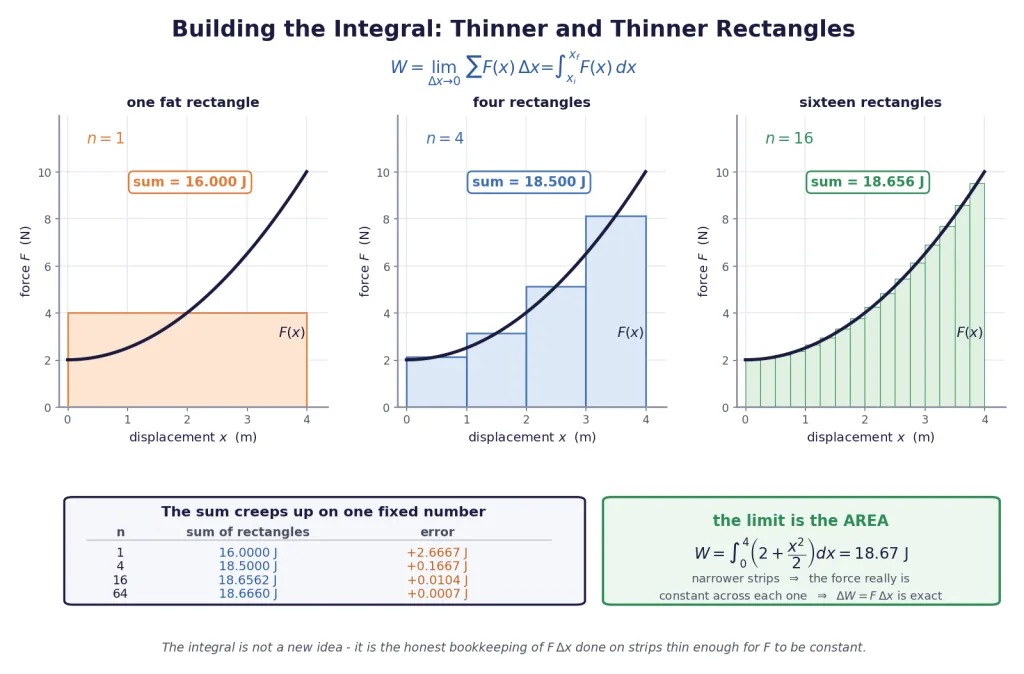
Watch the numbers converge
The figure above uses newtons over 0 to 4 m. Adding rectangles gives:
| Number of strips | Sum of | Error |
|---|---|---|
| 1 | 16.000 J | 2.667 J |
| 4 | 18.500 J | 0.167 J |
| 16 | 18.656 J | 0.010 J |
| 64 | 18.666 J | 0.001 J |
The sums are not wandering about. They are homing in on one number, J, and that number is what evaluates to. The integral is not some new physics bolted on — it is the honest version of "force times distance" when the force refuses to sit still.
The sanity checks
- Does it reduce to the old formula? If is a constant , then . Section 1's formula falls straight out, as it must.
- Is it still a scalar? Yes. Every is a number, and a sum of numbers is a number. Work remains a scalar measured in joules.
- Can it still be negative? Absolutely. Wherever is negative — a force opposing the motion — the contribution is negative and drags the total down.
[Board Important] "Derive the expression for work done by a variable force" is a standard 3-mark question. The three marks are: (i) chop into so small that is constant, (ii) write and sum, (iii) take to get the integral. Draw the rectangles-under-the-curve diagram and you will not lose a mark.
One thing we are not doing here: the spring. is the most famous variable force there is, and integrating it gives the elastic potential energy — but that is Section 5's territory, and it needs the potential-energy idea from Section 4 first. Everything in this section works with forces given to you directly.
Work Is the Area Under the Force-Displacement Graph
This is the single most useful sentence in the section, and it deserves its own heading, because a large fraction of every exam's variable-force questions are really just "find the area" in disguise.
Why is it true? Because that is exactly what an integral means. is the area of a thin rectangle of height and width standing on the -axis. Summing them tiles the region between the curve and the axis. In the limit, the tiles fill it exactly.
Key Point: On a graph of force against displacement, the work done is the area between the curve and the -axis, counted from to .
The word "signed" is not decoration
Here is where marks are won and lost.
- Where the graph lies above the axis, is positive — it pushes the way the body is going — and the area counts as positive work.
- Where the graph lies below the axis, is negative — it opposes the motion — and the area counts as negative work.
You add the pieces with their signs. You do not add up "how much ink is shaded".
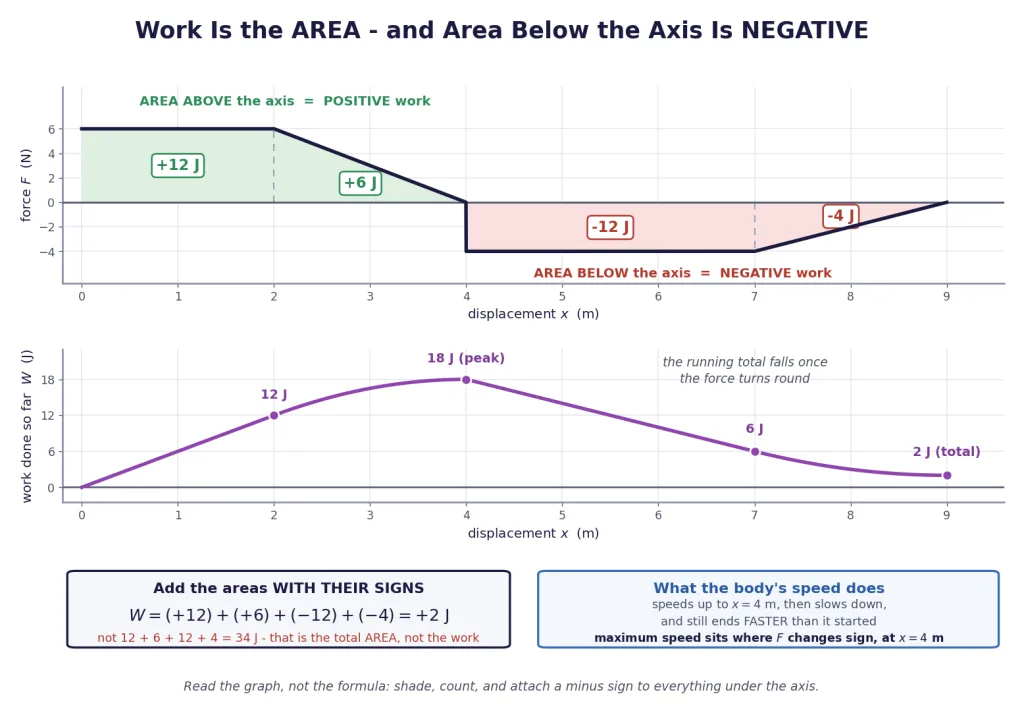
In the graph above the four pieces are J, J, J and J. The work done is not J. That 34 is the total area of the shaded regions; only J is the work.
The running total tells you the whole story
The lower panel of that figure plots the work done so far as the body advances. Read it like a bank balance:
- While the balance climbs — the body is gaining kinetic energy and speeding up.
- The balance peaks exactly where the force changes sign, at m. That is where the body is moving fastest.
- After that, and the balance falls — the body is being slowed.
- It ends at J, above where it started, so the body finishes faster than it began, though slower than it was at its peak.
[JEE Tip] "At what position is the speed maximum?" is a favourite. The answer is never "at the end". Kinetic energy stops rising the instant the work stops being added, so the speed peaks where crosses zero going from positive to negative — the point where the shaded area stops growing.
A caution about what the axes mean
The area rule works for a graph of against , force against displacement. Two graphs that look similar do completely different jobs:
| Graph | Area under it gives | Slope of it gives |
|---|---|---|
| against | work | the rate at which the force changes with position |
| against | impulse | the rate of change of force with time |
| against | displacement | acceleration |
[NEET Important] Area under - is work (joules). Area under - is impulse (newton seconds), which equals the change in momentum, not the change in energy. Mixing these two up is one of the most common single-mark losses in the paper.
Reading Work Off Any F-x Graph
The area rule is only useful if you can actually compute the area. In practice a Class 11 or JEE graph is built from three kinds of piece, and you handle each with school geometry.
The three standard shapes
| Shape of the graph | Area formula | When you see it |
|---|---|---|
| Rectangle: constant over a distance | a steady push, constant friction | |
| Triangle: rising or falling to zero | a spring, a force switched off smoothly | |
| Trapezium: changing linearly between two non-zero values | a force that fades but does not vanish |
The trapezium is worth a second look, because is just the average of the two end values. So for a force that changes linearly with position:
Key Point: The shortcut is valid only when varies linearly with . For a curved graph the average of the endpoints is not the average force, and this shortcut will give you a wrong answer. Students who apply it to lose the mark.
And when the graph curves
If the graph is a genuine curve, no triangle or trapezium fits it and you must integrate:
The standard results you will need are the ones you already know from Maths:
| (with ) | |
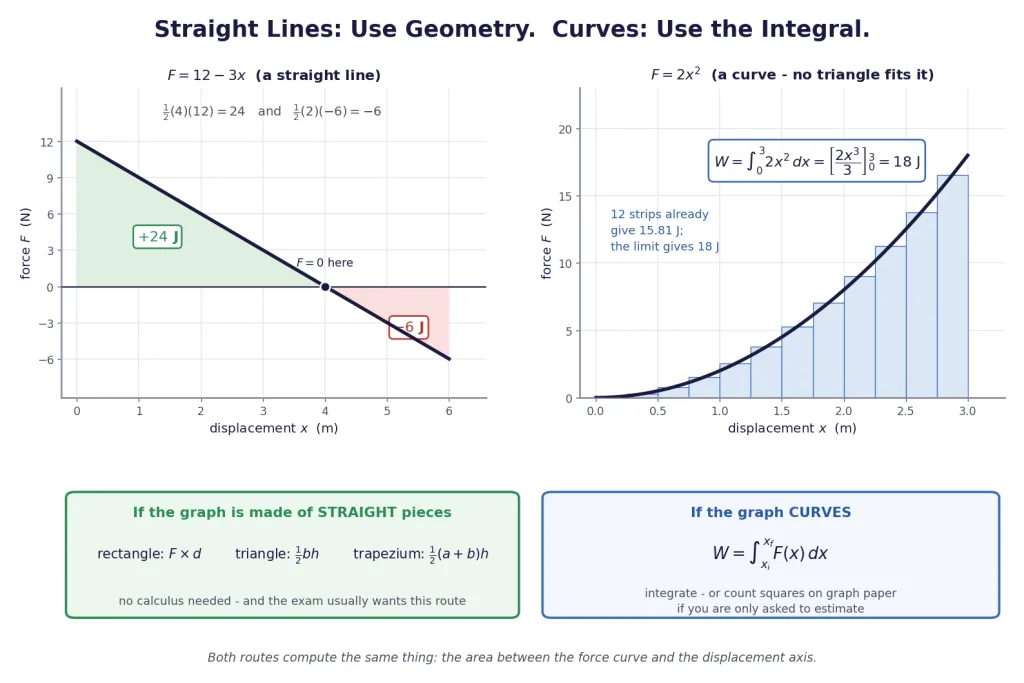
The recipe
- Sketch or read the - graph over the interval you are asked about — nothing else.
- Split it at every kink and every axis crossing. Each piece is then a single clean shape.
- Compute each piece separately and write down its sign as you go.
- Add the signed pieces.
- If a second force also acts (friction, usually), repeat the whole process for it and keep the two works separate until the very last line.
That last point matters. In the trunk problem worked below, the woman's push and the friction on the trunk are two different forces doing two different works, J and J. The question asks for both, so you report both; only if you were asked for the change in kinetic energy would you add them.
Estimating from a measured graph
Sometimes you are given experimental data rather than a formula — a table of readings, or a graph on squared paper. Two honest methods:
- Count squares. Work out what one small square is worth in joules (its width in metres times its height in newtons), then count squares, taking half-covered ones as half.
- Add trapezia. Between consecutive readings treat the graph as a straight line, so each strip contributes . This is the trapezoidal rule, and it is more than accurate enough for exam work.
[Board Important] If the question says "estimate", it is telling you that an approximate area is the expected answer. Do not go hunting for a formula that was never given.
The Work-Energy Theorem for a Variable Force
Section 2 proved using — a relation that only holds for constant acceleration, hence constant force. That proof is honest but limited. Here is the general one, and it is short.
The proof
Start with the kinetic energy of a body of mass and ask how fast it is changing with time:
Differentiate, using the chain rule on :
Now is the acceleration , and Newton's second law says . So and
Finally, , so
Cancel the on both sides — strictly, multiply through by — and you are left with a beautifully simple statement:
In words: every little bit of work done adds exactly that much to the kinetic energy.
Integrate from the initial position to the final one:
Key Point — the work-energy theorem, general form: This holds for ANY force — constant or variable, gentle or violent, in any direction. Nothing anywhere in the derivation assumed was constant.
Why this proof is better
Look back at what each step needed. Only two things went in: the definition and Newton's second law. No assumption about the force being constant, no kinematic equation with an "only if is constant" attached to it. That is why this version is the one that gets used for the rest of physics.
[JEE Tip] The line is worth memorising on its own. The right-hand side is the instantaneous power delivered by the force — Section 6's subject. So this proof quietly says: the rate at which kinetic energy grows is the power being supplied. Same statement, two languages.
The two things the theorem still will not do
Being general does not make it all-powerful, and it pays to be careful about this.
- It carries no time information. The theorem is an integral of the second law over an interval; the instant-by-instant detail is integrated away. It will tell you the speed after 5 m, never when the body got there. For timing, go back to forces and kinematics.
- It is a scalar statement. The second law is a vector equation and knows about directions; the theorem is one equation in scalars and has thrown that information away. It gives you the speed, not the velocity.
The mistake to avoid
The in the integral is the net force, exactly as in Section 2. If a variable applied force and a constant friction both act, then with the friction integral coming out negative. Computing and calling it is the standard error, and it is precisely what the trunk problem below is built to catch.
Three Dimensions, and Forces That Change With Time
The general three-dimensional form
Real motion is not confined to a line, and the extension is exactly what you would guess. Break the path into tiny displacement vectors . Over each one the force is effectively constant, so Section 1's dot product applies:
Add them along the path:
In Cartesian components, with , the dot product splits the integral into three ordinary ones:
That is all you need at this level. Notice that the dot product is still doing the job it did in Section 1: it automatically keeps only the part of the force that lies along the motion, so a sideways force still contributes nothing.
[JEE Tip] In a Board or JEE Main problem the components almost always separate cleanly — depends only on , only on — and you evaluate three independent single-variable integrals and add. That is the whole technique.
When the force depends on TIME, not position
Here is a trap. You are given — say newtons — and asked for the work done in the first 4 seconds. It is very tempting to write and call it work.
It is not. has units of newton seconds; it is the impulse, and it gives you the change in momentum, not the change in energy. Work is always , and is not .
There are two correct routes.
Route 1 — convert to position. Use the second law to find the motion, then substitute:
- Integrate for , integrate again for
- Since , rewrite the work as and integrate over time.
Route 2 — use the work-energy theorem. Find at the start and end from the motion, and write . For a body starting from rest this is usually the fastest line on the page.
Key Point: is impulse and changes momentum. is work and changes kinetic energy. If a force is given as a function of time, you must find or before you can compute any work.
The quantity appearing in Route 1 is the instantaneous power, so a third route is — the same integral wearing a different hat. Power is Section 6's subject, and that section develops this route properly along with and the constant-power problems. For now, just know the route exists.
Where this section sits
You now have the complete definition of work:
| Situation | Formula |
|---|---|
| Constant force, straight line | |
| Variable force, straight line | = area under the - graph |
| Any force, any path | |
| Any of the above, net force |
Next comes the observation that changes everything. For some forces — gravity, the spring force — the integral turns out not to care which path you took between two points. Those forces can be given a stored energy of their own, and that is potential energy, in Section 4.
Solved Examples
Where a problem needs , the problem states it; no problem here mixes two values of .
Example 1: The woman and the trunk — two forces, two areas
A woman pushes a trunk on a railway platform which has a rough surface. She applies a force of 100 N over a distance of 10 m. Thereafter she gets progressively tired and her applied force reduces linearly with distance to 50 N. The total distance through which the trunk has been moved is 20 m. Plot the force applied by the woman and the frictional force, which is 50 N, versus displacement. Calculate the work done by the two forces over 20 m.
Solution:
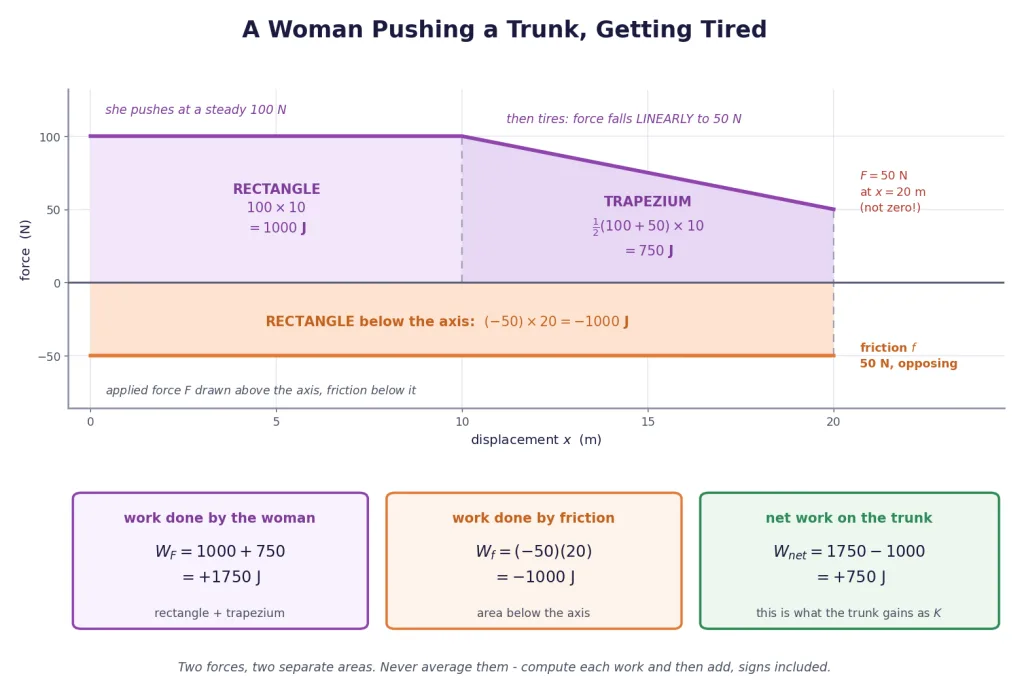
Read the applied force off the description. From to m it is a flat 100 N. From m to m it falls linearly from 100 N to 50 N. Note carefully that at m the force is 50 N, not zero — the graph ends on a step, not a point.
Where does friction go? Its magnitude is 50 N and it opposes the motion, so it points opposite to the displacement. On the graph it is drawn below the axis as a constant N line running the whole 20 m.
Work done by the woman = area under her graph, which splits at the kink at m:
- Rectangle from 0 to 10 m: J
- Trapezium from 10 to 20 m, with parallel sides 100 N and 50 N:
- Work done by friction = area of the rectangle below the axis: The area on the negative side of the force axis carries a negative sign.
Final Answer: J and J.
Takeaway: Two forces, two areas, two separate answers — never one averaged answer. Notice also that the second stretch used the trapezium rule and not : the force fades to 50 N, not to zero, so the shape is a trapezium. If you did want the trunk's gain in kinetic energy it would be J, but that is not what was asked.
Example 2: The block on the rough patch — an inverse- retarding force
A block of mass kg, moving on a horizontal surface with speed m/s, enters a rough patch ranging from m to m. The retarding force on the block in this range is inversely proportional to : where J. What are the final kinetic energy and speed of the block as it crosses this patch?
Solution:
Initial kinetic energy:
The force varies, so the work is an integral. Use the general theorem :
Evaluate the logarithm. Here is the natural logarithm to base , not :
So the final kinetic energy is
Recover the speed:
Final Answer: J and m/s.
Takeaway: This is the general work-energy theorem doing something the constant-force version simply cannot: the retarding force is enormous at m (5 N) and feeble at m (0.25 N), so there is no "average force" you could have guessed. Note the units of — since must be a force, is in newton metres, that is joules, which is why the question quotes J.
Example 3: A piecewise-constant force graph
A 2.5 kg body, initially at rest at , is acted on by a force along the -axis that is N from to 3 m, zero from 3 m to 5 m, and N from 5 m to 9 m. Find (a) the work done over the whole 9 m and (b) the final speed.
Solution:
Three rectangles, one for each stretch:
(a) Add them with their signs:
(b) Apply the work-energy theorem. The body starts from rest, so and J:
Final Answer: (a) J; (b) 4 m/s.
Takeaway: The body is not slowest at the end. Its kinetic energy is 60 J at m (a speed of 6.93 m/s), stays there through the force-free stretch, and is then eaten down to 20 J by the negative stretch. [JEE Tip] If the negative region had been even a little larger — say N over 6 m instead of 4 m — the running total would have hit zero and the body would have stopped before reaching 9 m, and the question would need re-reading. Always check that the running total stays positive.
Example 4: A triangular force graph
A force acting on a 4 kg body along its direction of motion increases linearly from 0 to 20 N as the body moves from to m, and then decreases linearly back to 0 at m. The body starts from rest. Find the total work done and the final speed.
Solution:
The graph is a triangle with base 8 m (from 0 to 8) and apex height 20 N at m. The whole area is one triangle:
Cross-check by halves. First half, a triangle of base 4 m and height 20 N: J. Second half, the mirror image: 40 J. Total 80 J. Agreed.
Final speed from the theorem:
Final Answer: J and m/s.
Takeaway: A tempting wrong route is to take the "average force" as or as 10 N over 8 m. The second of those happens to give J and is right by accident, because for a symmetric triangle the mean height really is half the peak. Do not rely on that; take the area.
Example 5: A force that goes as the square of the distance
A particle moves along the -axis under a force newtons, with in metres. Find the work done as it moves from to m. What fraction of that work is done in the second metre?
Solution:
The graph is a curve, so no triangle fits and we integrate:
The first metre alone:
The second metre alone:
Final Answer: J in total, of which J — seven eighths — is done in the second metre.
Takeaway: With a steeply rising force, almost all the work happens at the far end. Anyone who reached for the linear shortcut N would have got J, which is 50% too big. The average-of-the-endpoints trick is for straight lines only. As a reality check, four midpoint rectangles of width 0.5 m already give 7.875 J, comfortably closer to 8 than to 12.
Example 6: An inverse-square force
A charged bead is pushed along a groove by a repulsive force newtons, with measured in metres from a fixed point. Find the work done on the bead as it moves from m to m.
Solution:
Integrate, using :
Evaluate:
Sanity check on the shape. The force is 8 N at m and only 0.5 N at m. A crude constant-force estimate using the larger value would give J and using the smaller, J. The true answer, 6 J, sits between them — as it must.
Final Answer: J.
Takeaway: Most of this work is done early: from m to m alone the integral gives 4 J, two thirds of the total, over one third of the distance. [JEE/NEET] Inverse-square forces (gravitational, electrostatic) will return in Chapters 7 and 12, and this is exactly the integral you will do there.
Example 7: Variable force meets the work-energy theorem
A 6 kg block on a frictionless horizontal surface starts from rest at and is pushed by a force newtons. Find its speed at m, and at m.
Solution:
Work done from 0 to 4 m — the graph is a straight line through the origin, so this is a triangle of base 4 m and height N, and you can do it either way:
Theorem, starting from rest:
At m the work so far is J, so
Final Answer: 4 m/s at m, and 2 m/s at m.
Takeaway: Look at the pattern. Halving the distance quartered the work, because for the area is a triangle and goes as — so . That neat proportionality is special to this force law and is the reason a mass on a spring behaves the way it does. [JEE Tip] You could not have used here at any stage: the acceleration is newtons per kilogram and changes every instant.
Example 8: A force that reverses — where is the body fastest?
A 2 kg body moving in the direction passes with a speed of 3 m/s. From there on it experiences a force newtons. Find (a) the position at which its speed is greatest, (b) that greatest speed, and (c) its speed at m.
Solution:
(a) The speed peaks where the force changes sign, because up to that point work is being added and after it work is being removed:
(b) Work done from 0 to 2 m. The graph is a straight line from 4 N down to 0, a triangle: Initial kinetic energy is J, so
(c) From 2 m to 5 m the force is negative, running from 0 down to N. That is a triangle below the axis: Total work over the whole 5 m: J. (Integration agrees: J.)
Final kinetic energy and speed:
Final Answer: (a) m; (b) 3.61 m/s; (c) 2 m/s.
Takeaway: Three separate lessons in one problem. The maximum speed is at , not at the end. The net work came out negative even though the body started by speeding up. And the body is back to its original 9 J of kinetic energy at m — the positive triangle from 0 to 2 is exactly cancelled by the negative one from 2 to 4 — so it passes m at 3 m/s, the same speed it had at the start.
Example 9: A force that varies with TIME
A 2 kg body at rest on a frictionless surface is acted on from by a force newtons along its direction of motion. Find the work done in the first 4 seconds.
Solution:
Do not integrate . That would give N s, which is the impulse, not the work.
Find the motion first. From the second law, Integrating from rest, so at s, m/s.
Route 1 — the work integral rewritten in time. Since ,
Route 2 — the work-energy theorem, far quicker:
Final Answer: J.
Takeaway: Both routes agree, and Route 2 is three lines shorter. [JEE Tip] Whenever a force is given as a function of time, get the speed first and use ; only integrate if the question specifically wants the work over an interval in which you cannot find both end speeds easily. Note in passing that N s divided by kg does give m/s — the impulse-momentum theorem is a perfectly good cross-check, it just is not the work.
Example 10: Reading a mixed graph and tracking the energy
A 1 kg body enters a region at with a speed of 6 m/s. The force on it along the direction of motion is: N from 0 to 2 m; then falling linearly from N to 0 between 2 m and 4 m; then N from 4 m to 7 m; then rising linearly from N back to 0 between 7 m and 9 m. Find its kinetic energy at , 4, 7 and 9 m, and its greatest speed.
Solution:
Initial kinetic energy: J.
Take the four areas one at a time, each with its sign:
- Rectangle 0 to 2 m: J
- Triangle 2 to 4 m: J
- Rectangle 4 to 7 m: J
- Triangle 7 to 9 m: J
- Build the running total, adding each area to the kinetic energy:
| Position | Area added | (J) | Speed (m/s) |
|---|---|---|---|
| — | 18 | 6.00 | |
| m | 30 | 7.75 | |
| m | 36 | 8.49 | |
| m | 24 | 6.93 | |
| m | 20 | 6.32 |
The greatest speed is at m, where the force changes sign:
Total work over the 9 m: J, matching J.
Final Answer: , 36, 24 and 20 J at 2, 4, 7 and 9 m; maximum speed 8.49 m/s at m.
Takeaway: This is the whole section in one table. Areas above the axis push up, areas below pull it down, and the peak sits at the sign change. [JEE/NEET] Note that the total area of shading here is J. If you ever find yourself writing 34, you have forgotten the signs.
Example 11: Estimating work from measured data
In an experiment the force on a 2 kg trolley is measured at half-metre intervals along its 5 m track. The readings are:
| (m) | 0 | 1 | 2 | 3 | 4 | 5 |
|---|---|---|---|---|---|---|
| (N) | 0 | 4 | 8 | 10 | 10 | 6 |
Estimate the work done on the trolley over the 5 m, and its final speed if it started from rest.
Solution:
No formula was given, so use the trapezoidal rule: treat the graph as straight between consecutive readings and add the strips. Each strip is with m.
Strip by strip:
Add:
Final speed from the theorem:
Final Answer: J and m/s.
Takeaway: You do not need an algebraic to find work — you need an area, and an area can be estimated from a table or counted off squared paper. [Board Important] In a practical or data-based question, say explicitly that you used the trapezoidal rule (or counted squares) and quote the answer as an estimate. Note the middle strip, from 3 m to 4 m: the force was constant there, so that strip is an exact rectangle, not an approximation.
Example 12: Work in three dimensions
A particle is acted on by the force newtons, with in metres. It moves from the origin to the point m. Find the work done.
Solution:
Split the line integral into components. With ,
The -part, from to m:
The -part, from to m, with a constant 4 N:
Add:
Final Answer: J.
Takeaway: Because depends only on and only on , the two integrals are independent and the path taken between the two points does not matter — go straight, or go along the -axis first and then straight up, and you still get 20 J. That is not a coincidence and it is not universal either. Forces for which the work is path-independent are called conservative, and they are the whole subject of Section 4.