
Same Chapter, Half the Clock
Section 9 has just taken this chapter apart the JEE way — potential energy curves and equilibrium, the vertical circle by energy, pseudo forces in accelerating lifts, chains sliding off tables, constant-power calculus, oblique collisions. If you have read it, you already know far more than this section will ever ask of you.
So why a separate NEET Corner? Because NEET does not test the same skill.
JEE gives you a hard question and enough time to think. NEET gives you a manageable question and almost no time at all. Physics is 45 questions, and inside a 180-minute paper shared with Chemistry and Biology those 45 deserve roughly 45 minutes. One minute each — and Work, Energy and Power is one of the higher-weightage chapters in Class 11 mechanics, so you will meet three or four items from it. Every one of them has to be finished in well under a minute, correctly, so that the time is banked for the questions that genuinely need it.
What NEET does NOT ask from this chapter
This list matters as much as anything else in this section, because it tells you what to stop worrying about.
Key Point: NEET's Work, Energy and Power never leaves the core syllabus. No potential-energy-curve calculus. No tests for stable and unstable equilibrium. No pseudo-force work. No oblique or two-dimensional collisions beyond the one-line fact. No chains, ropes or movable wedges. No differentiation and no integration — the one exception being that you may have to read an area off an F-x graph, which is geometry, not calculus. Everything on the paper is a definition you recall, one formula you substitute into, a standard set-up you have drilled, or one of the two NEET-only formats.
Every single item in that list belongs to Section 9. If you find yourself differentiating a potential energy, or adding a pseudo force, or resolving a collision into components at an angle, you have wandered into the wrong section's version of the question.
The four types, and what each should cost you
| Type | What it looks like | Your budget | The right instinct |
|---|---|---|---|
| 1. Direct recall | "Work is a …" "The kilowatt-hour is a unit of …" "In which collision is momentum conserved?" | 15-20 s | You either know it or you do not. Never derive a definition. |
| 2. One-step plug-in | , , , , | 25-35 s | Spot the picture, pick the card, substitute once. |
| 3. Standard template | Body down an incline, block into a spring, bullet into a block, pump raising water, ball bouncing | 25-40 s | Recognise the set-up. You should already know the shape of the answer. |
| 4. Assertion-Reason / Column matching | Two NEET-only formats, both drilled below | 35-45 s | Judge each statement alone, then judge the link. |
[Important] A diagnostic worth internalising: if a question from this chapter needs a fourth line of working, you have misread it. NEET hands you two of the quantities and asks for a third. If your page is filling up, stop and reread the stem — you have almost certainly imported an assumption the question never made.
The / arithmetic
Four marks for a correct answer, minus one for a wrong one, zero for a blank. On a doubtful item the real question is not "can I get this?" but "can I get this in 40 seconds?" If two options survive elimination and 40 seconds have gone, take the better one and move on — a 50-50 guess is worth marks on average. What you must never do is spend three minutes rescuing one mark's worth of doubt in a chapter where the very next question might be a one-liner about the kilowatt-hour.
What this section does, and what it does not repeat
We will not re-derive the dot product (Section 1), re-derive the work-energy theorem (Section 2), rebuild the integral for a variable force (Section 3), re-derive the conservation of mechanical energy (Section 4), re-derive (Section 5), re-derive (Section 6), or re-derive the elastic-collision formulas (Section 7). What you get instead is the same material reorganised for recognition speed:
- The sentences NEET asks back almost verbatim.
- A force method or energy method chooser that runs in ten seconds.
- Plug-and-play formula cards, with the traps attached.
- The five standard templates with numbers clean enough to remember.
- Four ways to kill an option without solving anything.
- The two NEET-only formats, drilled properly.
Throughout, m/s^2 unless a problem says otherwise, and potential energy is written (the symbol used throughout this chapter; most coaching material writes , and they mean exactly the same thing).
The Sentences NEET Asks Back Almost Verbatim
This block is pure recall ammunition. Read it as flashcards, not as prose. Every item here has appeared as a complete question by itself, and the wording stays close to the standard phrasing because that is exactly how it gets asked.
Work: the four sentences
Key Point:
- Work is a SCALAR. It is the scalar product of two vectors, and a scalar product is a number. Work has magnitude and sign but no direction, and its SI unit is the joule, with .
- A force perpendicular to the displacement does ZERO work. . This is why the centripetal force does no work in circular motion, why the normal reaction does no work on a block sliding along a surface, and why the tension in the string of a simple pendulum does no work.
- Work can be negative. Whenever , is negative. Friction and air resistance therefore always do negative work on a moving body.
- Work needs a displacement. No displacement, no work — however hard you push and however tired you get.
Kinetic energy: the three sentences
Key Point:
- is the energy a body has by virtue of its motion. It is a scalar and it is NEVER negative, because and .
- goes as the square of the speed. Double the speed and is four times bigger; triple it and is nine times bigger. That is why stopping distance goes as .
- , so equal momenta means (the lighter body has more ), while equal kinetic energies means (the heavier body has more momentum).
And the theorem that ties work to kinetic energy:
Key Point — the work-energy theorem. . The is the work done by the NET force, which means the sum of the works done by every force acting, each with its own sign.
Potential energy: the three sentences
Key Point:
- Potential energy is the energy a body has by virtue of its position or configuration. Near the Earth's surface, ; for a spring, with measured from the natural length.
- Only CHANGES in potential energy are physically meaningful, so the zero level is yours to choose. Choose it, write it down, and never move it in the middle of a problem.
- Potential energy belongs to a conservative force. A force is conservative if the work it does is independent of the path, equivalently if the work it does around any closed loop is zero. Gravity and the spring force are conservative; friction and air resistance are not.
Conservation of mechanical energy
Key Point: When only conservative forces do work, constant. When a non-conservative force such as friction also acts, where is the friction force and the distance slid. Mechanical energy is not conserved then — but the total energy still is, because the missing mechanical energy has become heat.
Power
Key Point: and . Power is a SCALAR, measured in watts, with . Also W.
Key Point — the one everyone gets wrong: The kilowatt-hour is a unit of ENERGY, not of power. J. Your electricity bill charges you for energy, which is why it is measured in "units", each one a kilowatt-hour.
Collisions: the sentence the whole topic hangs on
Key Point: In EVERY collision — elastic, inelastic or perfectly inelastic — the total linear momentum is conserved, because the impulsive forces between the bodies are an internal third-law pair. Kinetic energy is conserved ONLY in an elastic collision. Never assume both.
| Collision | Momentum | Kinetic energy | |
|---|---|---|---|
| Elastic | conserved | conserved | |
| Inelastic | conserved | not conserved | |
| Perfectly inelastic (they stick) | conserved | maximum possible loss |
The always-true / never-true table
Speed comes from knowing which sentences are safe.
| Statement | Verdict |
|---|---|
| Work is a vector | Never — it is a scalar with a sign |
| A force perpendicular to the displacement does no work | Always |
| Kinetic energy can be negative | Never |
| Potential energy can be negative | True — it depends on where you put the zero |
| Mechanical energy is conserved when friction acts | False — total energy is, mechanical energy is not |
| The zero of potential energy can be chosen freely | True |
| Momentum is conserved in an inelastic collision | Always |
| Kinetic energy is conserved in every collision | Never — only in elastic ones |
| The kilowatt-hour is a unit of power | False — it is a unit of energy |
| Power is a vector because and are | False — a dot product is a scalar |
| A body moving at constant speed in a circle has work done on it | False — zero work, by any force that stays perpendicular |
| Work done by a spring over a closed path is zero | Always — the spring force is conservative |
| is the same in every frame of reference | False — is frame-dependent |
[Important] The three most reused distractors from this chapter are "the kilowatt-hour is a unit of power", "kinetic energy is conserved in all collisions" and "work is a vector". Each one appears somewhere almost every year, and each is worth four marks in under fifteen seconds.
Force Method or Energy Method? The 10-Second Chooser
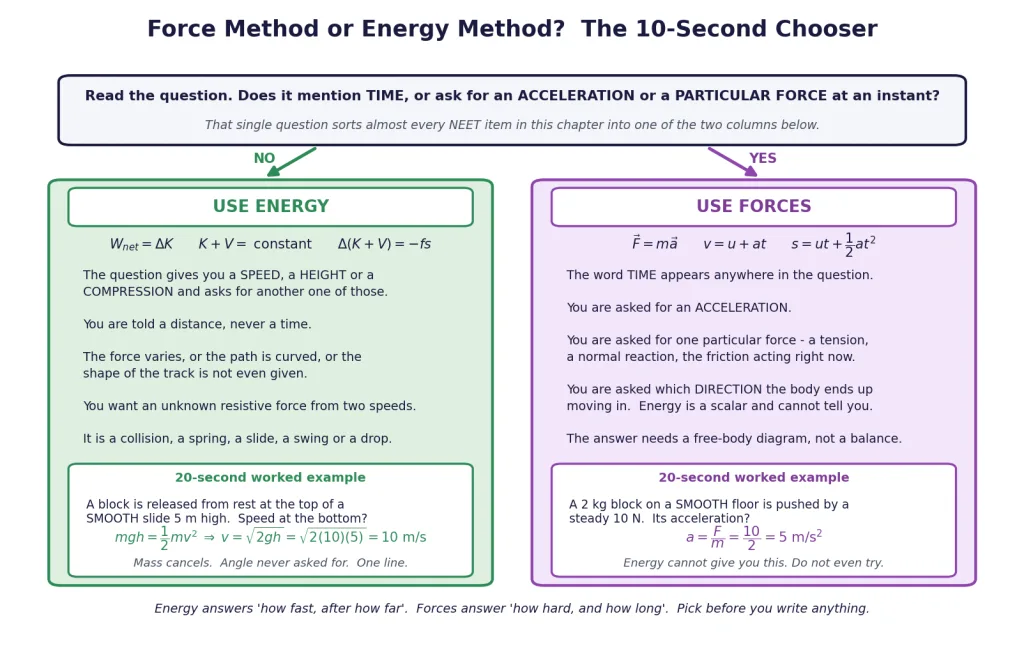
This is the single most useful decision aid in the chapter, and it is worth more marks than any formula on this page. Section 2 gave you a short version of it; here is the one you run against a clock.
The question you ask first
Key Point: Read the stem and ask: does it mention TIME, or ask for an ACCELERATION, or ask for one particular force at one particular instant?
No to all three use energy.
Yes to any one use forces.
That is it. Energy methods know nothing about time, nothing about the shape of the path, and nothing about direction — they only relate speeds, heights and compressions at two endpoints. Forces know everything about the instant but nothing about the whole journey unless you integrate.
The chooser table, with 20-second examples
| The question gives / asks for | Method | The 20-second worked version |
|---|---|---|
| Height, asks for speed | Energy | Released from rest 5 m up a smooth slide: m/s |
| Speed, asks for height | Energy | Thrown up at 20 m/s: m |
| Speed, asks for spring compression | Energy | 2 kg at 3 m/s into N/m: m |
| Two speeds, asks for a resistive force | Energy | 1500 kg at 20 m/s stopped in 50 m: N |
| Asks for stopping distance | Energy | , so tripling the speed makes it nine times longer |
| Asks for an acceleration | Forces | 2 kg pushed by 10 N on a smooth floor: m/s^2 |
| Asks how long it takes | Forces | Same block from rest: , from |
| Asks for a tension or a normal reaction | Forces | Free-body diagram, resolve, |
| Asks which DIRECTION it ends up going | Forces | Energy is a scalar and cannot answer this |
| Collision, asks for final velocities | Both, in order | Momentum first (always); kinetic energy second (only if elastic) |
Three things energy will never tell you
Section 2 flagged these and they are worth repeating, because a NEET candidate who reaches for energy on the wrong question loses a whole minute:
- Time. contains no anywhere. If the stem says "in 4 seconds", you need forces or kinematics.
- Direction. is a scalar. A body arriving at the bottom of a smooth slide with 10 m/s could be moving in any direction the track pointed it; only the geometry tells you which.
- The value of one particular force at one particular instant. Energy gives you the total work over a whole stretch. To get the normal reaction right now, draw a free-body diagram.
And the reverse: three things forces make painful
- A variable force. with a changing means a changing , so no kinematic equation applies. The area under the F-x graph gives you the work in one step.
- A curved or unknown path. A bead on a loop, a pendulum, a ski jump — gravity's work is whatever the shape, and is all you need.
- A collision. The force during impact is enormous, unknown and lasts for milliseconds. Momentum conservation sidesteps it completely.
[Important] When both methods would work, energy is almost always faster, because the mass usually cancels and the angle usually never appears. On a smooth slide, in a pendulum, on any incline of a given height, the answer does not care about the mass or the shape of the track. That is a whole family of NEET questions answered by one square root.
Plug-and-Play Formula Cards
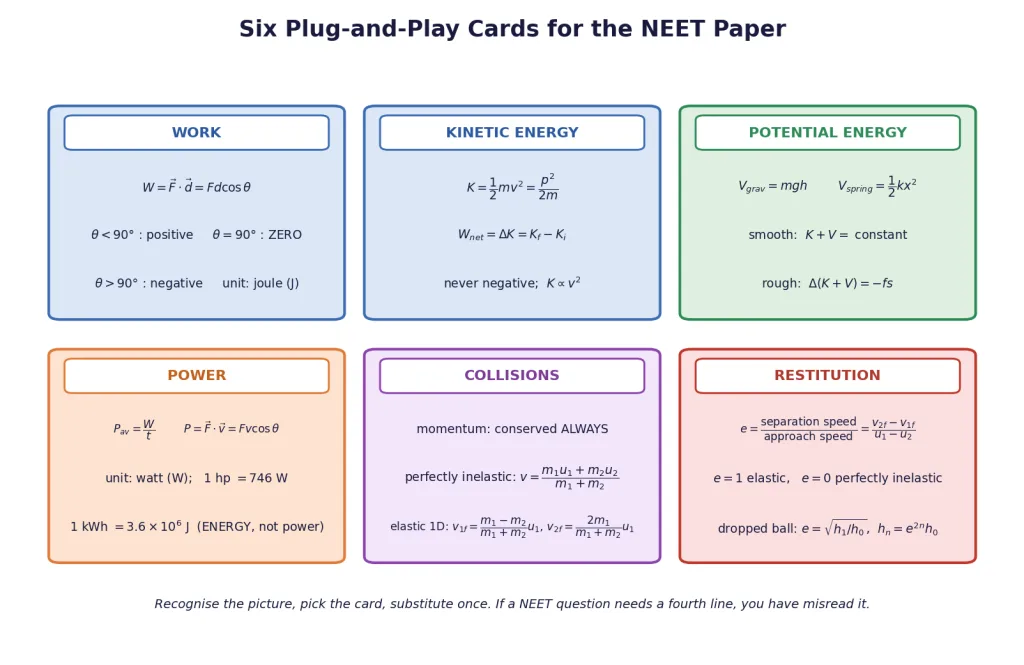
Six cards. The skill being tested is recognition, so learn each card with its picture and its trap attached.
Card 1 — Work
| Sign of | Standard example | |
|---|---|---|
| to just under | positive | you pull a trolley forward |
| exactly | zero | centripetal force, normal reaction, a coolie carrying a load on level ground |
| just over to | negative | friction, air drag, gravity on a body going up |
The trap. is only the special case . And if the force varies, no single exists to multiply — take the area under the F-x graph instead, counting area below the axis as negative.
Card 2 — Kinetic energy and the theorem
The trap. The is the work done by the net force. Adding up only the works you like — leaving out friction, say — gives a confident wrong answer. And is frame-dependent: a passenger walking in a train has one in the train's frame and a much larger one in the ground frame.
Card 3 — Potential energy and conservation
The trap. uses from the natural length, never from the floor or from some other position, and it is the same for a compression as for an extension of the same size. And the moment friction appears, stops being constant — write the term down before you do anything else.
Card 4 — Power
The trap. The kilowatt-hour is an energy. A "2 kW geyser" states a power; "40 units on the bill" states an energy. The bridge between them is always energy power time.
Card 5 — Collisions
Momentum is conserved in every collision. Write that line first, every single time.
The three special cases NEET reuses endlessly:
| Case | Read it as | ||
|---|---|---|---|
| velocities are exchanged | |||
| (ball off a wall) | it bounces straight back at the same speed | ||
| (truck hits a ball) | the light body leaves at twice the speed |
And the fraction of kinetic energy transferred in a head-on elastic collision is , which is maximum, and equal to 1, when the masses are equal — the whole reason a neutron moderator uses light nuclei.
Card 6 — Coefficient of restitution
is dimensionless, lies between 0 and 1, and depends on the materials. For a ball dropped from onto a fixed floor:
and the fraction of kinetic energy lost in one bounce is .
[Important] Every one of these cards has either a that is easy to lose, a mass that should cancel, or a sign that flips. Before you substitute, ask "should the mass survive?" On a smooth slide, on any incline of a given height, in a pendulum and in , it should not.
The Five Standard Templates, With Clean Numbers
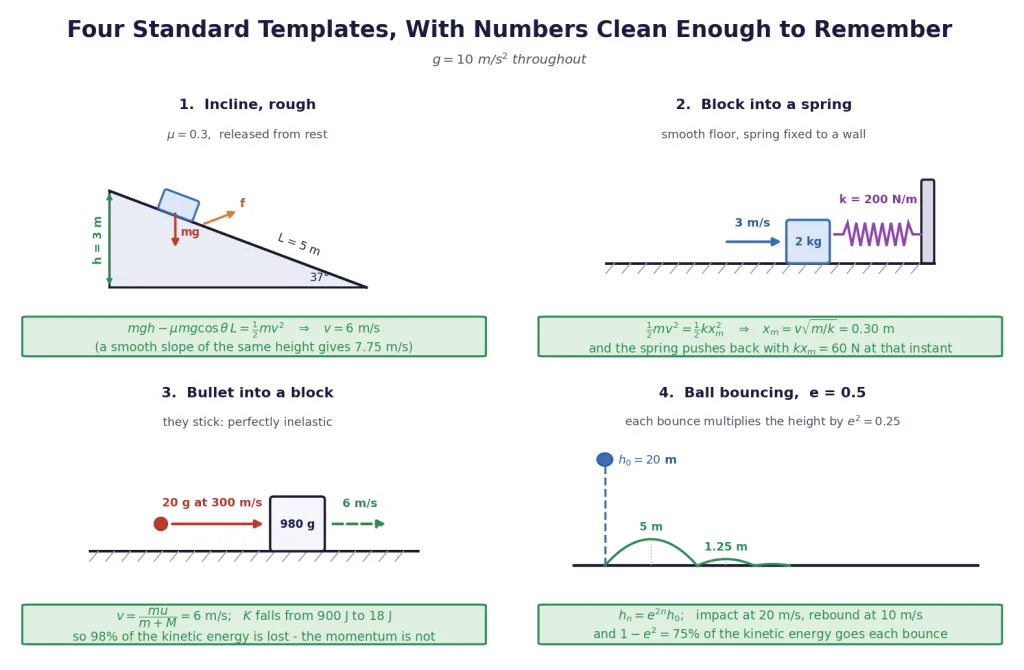
Learn these with the numbers attached, so the shape of the answer is familiar before you start. m/s^2 throughout.
Template 1 — a body sliding down an incline
Smooth. Released from rest at height , whatever the angle and whatever the mass:
For m this gives m/s. The mass cancels and the angle never appears. Three different smooth ramps of the same height deliver the same speed.
Rough. Now friction removes times the slope length :
Take (so , , ), and m, so m. For a 2 kg block: J, friction removes J, leaving J, so
The smooth answer for the same height would be 7.75 m/s, so friction has cost 24 J out of 60. Check the formula the lazy way: , so . Same answer, no free-body diagram.
Template 2 — a block running into a spring
A block of mass at speed on a smooth floor compresses a spring of constant :
For kg, m/s and N/m: m. Both sides are 9 J, and the spring pushes back with N at that instant.
Two follow-ups NEET likes. Where is the block fastest? At the natural length, , where all 9 J is kinetic. What is the speed at half the maximum compression? The spring holds J, leaving 6.75 J of kinetic energy, so m/s — note that halving the compression does not halve the speed, because the energy goes as .
(If the floor is rough you get a quadratic in ; that is Section 5's crash-test template, and NEET rarely goes there.)
Template 3 — a bullet embedding in a block (perfectly inelastic)
A 20 g bullet at 300 m/s embeds in a 980 g block at rest, so the total is exactly 1 kg.
So 882 J, or 98%, of the kinetic energy is gone — into heat, sound and deforming the wood — while the momentum has not changed at all. That contrast is the entire point of the template, and the fraction lost when the target starts at rest is simply
A light bullet hitting a heavy block loses almost all of its kinetic energy. That is why bulletproof vests work.
Template 4 — a pump raising water
The useful power is the rate at which gravitational potential energy is being created:
A pump raising 500 litres of water per minute through 12 m: the mass rate is kg/s, so W, a clean 1 kW. If the pump is only 50% efficient it must draw 2 kW from the mains, and running it for 5 hours a day for 30 days costs units, which is J.
The trap: "litres per minute" is a volume rate. Convert to a mass rate using 1 litre of water 1 kg, then divide by 60. Half the marks lost on pump questions are lost right there.
Template 5 — a ball bouncing
Dropped from m with :
Each bounce multiplies the height by and the speed by , and the fraction of kinetic energy lost each time is . Given any two of , and , you can produce the third in five seconds.
The one-line summary card
| Set-up | The one line |
|---|---|
| Smooth incline or slide, height | , mass and angle irrelevant |
| Rough incline, height | |
| Block into a spring | |
| Bullet into a block | , fraction of lost |
| Pump | , divided by the efficiency for the input |
| Bouncing ball | , fraction of lost per bounce |
[Important] Every template above assumes the words NEET always supplies: light string, smooth or frictionless surface, ideal spring, fixed floor. When one of those words is missing, that is deliberate, and it is usually the whole question.
Four Ways to Kill an Option Without Solving the Problem
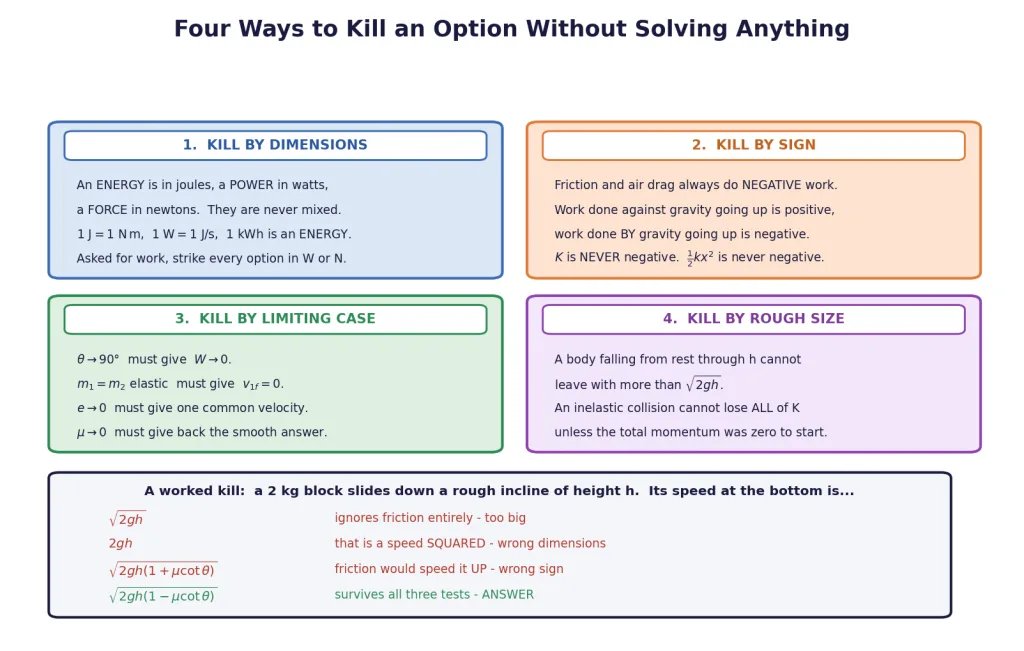
On a paper this fast, the quickest route to the answer is often not to compute it.
1. Kill by dimensions
Work and energy are in joules, power in watts, force in newtons. They are never interchangeable, and NEET routinely offers one where another is asked for.
| If the question asks for | The answer must be in | Kill anything in |
|---|---|---|
| Work, energy, heat, , | J (or kWh, or erg) | W, N, N/m |
| Power | W (or hp) | J, kWh |
| Spring constant | N/m | N, J |
| Coefficient of restitution | no unit at all | anything with a unit |
Two fast consequences. J is an energy, so it can never be an answer to "find the power". And is a pure number, so any option offering it in m/s is dead before you read the physics.
2. Kill by sign
- Friction and air drag always do negative work on a moving body. An option in which friction increases the kinetic energy is dead.
- Going up, gravity does negative work; coming down, positive. The work done against gravity is the other sign.
- is never negative. Nor is . Nor is a loss of kinetic energy in an inelastic collision.
- A spring being compressed does negative work on the block; a spring relaxing does positive work. Section 5 spends a whole block on this because the sign is the question.
3. Kill by limiting case
The most powerful of the four. Push each option to an extreme where you already know the answer.
| Limit | What the answer must become |
|---|---|
| in | |
| on a rough incline | the smooth result |
| in a head-on elastic collision | and |
| (ball off a wall) | |
| no kinetic energy lost | |
| the two bodies move off together | |
| in | |
| at fixed power | the work done grows without limit, the power does not change |
An option that misbehaves in any of these limits is gone, and the test costs about five seconds.
4. Kill by rough magnitude
Bounds you can apply without a calculator:
- A body released from rest through a height cannot arrive faster than . Friction can only make it slower.
- The kinetic energy after an inelastic collision cannot be zero unless the total momentum was zero to begin with. Two bodies that stick together and were moving must still be moving.
- The energy stored in a spring cannot exceed the kinetic energy that went into it on a smooth floor, and must be less than it on a rough one.
- A ball can never rebound higher than it was dropped from, so always.
- Work done by a single force can never exceed in magnitude, because .
Putting them together
A genuine NEET-style item: a 2 kg block slides from rest down a rough incline of angle and vertical height . Its speed at the bottom is…
- — that is the smooth answer, and friction must make it smaller. Dead by magnitude.
- — that is a speed squared. Dead by dimensions.
- — friction would be speeding the block up. Dead by sign.
- — reduces to when , is smaller than it otherwise, and has the dimensions of a speed. Answer.
Fifteen seconds, no algebra, and the mass never mattered.
Key Point: Ask "what can I rule out?" before you ask "what is the answer?" On a 45-question paper in 45 minutes, that habit is worth more than being fast at algebra.
Assertion-Reason and Column Matching: the Two NEET-Only Formats
These two are not harder physics. They are a different reading task, and both are entirely mechanical once you know the drill.
Assertion-Reason: the four codes
You are given an Assertion (A) and a Reason (R), and asked to choose:
| Code | Meaning |
|---|---|
| (a) | Both A and R are true, and R is the correct explanation of A |
| (b) | Both A and R are true, but R is not the correct explanation of A |
| (c) | A is true but R is false |
| (d) | A is false but R is true |
Some papers add "both false". Read the option list before you start — the order of these four is not fixed between papers, and picking "option (a)" from memory when the paper has shuffled them is a self-inflicted wound.
The attack: judge A, then R, then the link
Key Point: Three separate judgements, in this order, and never let one influence the next:
- Cover R. Is A true, on its own?
- Cover A. Is R true, on its own?
- Only if both are true: does R actually explain A, or is it merely another true fact about the same topic?
Step 3 is where the marks are, and it is the step people rush. "Both true" is not enough. Ask yourself: if R were false, would A stop being true? If yes, R explains A. If A would survive without R, the answer is (b).
The trap this format is built around is a true reason attached to a false assertion, which makes the assertion sound plausible. The defence is step 1: judge A with R covered.
Worked, four times
Item 1. A: The work done by the centripetal force on a body in uniform circular motion is zero. R: The centripetal force is always perpendicular to the velocity, and therefore to the displacement. A alone: true — the speed never changes, so , so . R alone: true. And R is exactly why A holds. So both true, R explains A.
Item 2. A: Kinetic energy is always positive. R: Kinetic energy is a scalar quantity. A alone: true, since has and . R alone: true. But does R explain A? No — being a scalar has nothing to do with being positive. Work is a scalar and it is routinely negative, and so is potential energy. So both true, R does NOT explain A. This is the single most instructive assertion-reason item in the chapter.
Item 3. A: In a perfectly inelastic collision the total kinetic energy is conserved. R: In every collision the total linear momentum is conserved. A alone: false — a perfectly inelastic collision loses the maximum possible kinetic energy. R alone: true. So A false, R true.
Item 4. A: The kilowatt-hour is a unit of power. R: Power is the rate of doing work. A alone: false — it is a unit of energy, equal to J. R alone: true, that is the definition of power. So A false, R true again — and note how a perfectly correct-sounding R makes the false A feel right. Cover R first.
Column matching: anchor and kill
You are given Column I (four situations, A to D) and Column II (four results, i to iv), and four codes that pair them up.
Key Point: Never work out all four pairings. Find the one you are surest of, use it to eliminate every code that contradicts it, then check whichever single pairing still separates the survivors. Two confident pairings almost always settle a four-option matching question.
The drill:
- Scan Column II for the odd one out — a zero, a negative number, the only quantity in watts, something that obviously belongs to one entry.
- Anchor on that pairing and strike out every code that disagrees.
- Count the survivors. If one remains, stop. If two remain, find the single letter where they differ and settle just that one.
- Never check a pairing that all the surviving codes agree on. It cannot change the answer.
A worked anchor. Take m/s^2.
| Column I | Column II |
|---|---|
| (A) Work done by gravity as a 2 kg body is raised 5 m | (i) 9 J |
| (B) Energy stored in a spring of N/m compressed 0.30 m | (ii) J |
| (C) Kinetic energy of a 4 kg body moving at 3 m/s | (iii) 1000 J |
| (D) Energy consumed by a 100 W bulb in 10 s | (iv) 18 J |
Anchor on (A): it is the only entry where the force opposes the displacement, and (ii) is the only negative value in Column II. So A-ii is certain, and every code without it dies. Then anchor on (D): power time J, and (iii) is the only entry of that size. D-iii. Two anchors, and the matching is settled: B-i ( J) and C-iv ( J) follow without any thought.
[Important] Column matching is answered by elimination between the codes, not by solving the physics four times. If you find yourself computing all four entries, you have already lost thirty seconds you did not have.
Where this goes next
- Section 12 (NEET Pattern Practice) drills all of this at exam pace with scoring.
- Section 9 (JEE Corner) is where the potential energy curves, pseudo forces, chains and oblique collisions live, if you are also sitting JEE.
- Section 13 compresses the whole chapter into revision cards for the last week.
Solved Examples
Twelve problems at NEET level and NEET pace. Give yourself 45 seconds on each before reading the solution. m/s^2 throughout.
Example 1: Eight one-liners, from the statements alone
Answer each in one sentence, with no calculation.
(a) Is work a scalar or a vector? (b) A body moves in a horizontal circle at constant speed. How much work does the centripetal force do in one revolution? (c) Can kinetic energy be negative? Can potential energy? (d) What is the SI unit of power, and what is 1 kWh a unit of? (e) In which kind of collision is momentum conserved? (f) In which kind of collision is kinetic energy conserved? (g) Does the zero level of gravitational potential energy affect any physical answer? (h) Which of these forces is non-conservative: gravity, the spring force, friction?
Solution:
(a) A scalar. It is the dot product of two vectors, and a dot product is a number. It has a sign but no direction.
(b) Zero. The centripetal force is always perpendicular to the velocity, so at every instant. Equivalently, the speed never changes, so , so .
(c) Kinetic energy: never negative, since has and . Potential energy: yes, it can be negative, because its zero level is a free choice — a body below your chosen zero has negative .
(d) The watt, with . The kilowatt-hour is a unit of ENERGY, equal to J.
(e) Every collision — elastic, inelastic and perfectly inelastic alike — because the impulsive forces between the bodies form an internal third-law pair.
(f) Only an elastic one. In any inelastic collision some kinetic energy becomes heat, sound and deformation.
(g) No. Only changes in potential energy are physical. Move the zero and every shifts by the same constant, which cancels in .
(h) Friction. The work it does depends on the path, and it is not zero around a closed loop — go there and come back and friction has taken energy both ways.
Final Answer: (a) scalar (b) zero (c) never, yes (d) watt; kWh is energy (e) all of them (f) elastic only (g) no (h) friction.
Takeaway: Eight questions, no arithmetic, well under a minute in total. These are the sentences NEET reuses year after year, and every second saved here is a second available for a numerical.
Example 2: Force method or energy method?
For each of these, say which method you would use and give the one-line answer.
(a) A block is released from rest at the top of a smooth slide 5 m high. Its speed at the bottom? (b) A 2 kg block on a smooth floor is pushed by a steady 10 N. Its acceleration? (c) A 1500 kg car moving at 20 m/s is brought to rest in 50 m. The average braking force? (d) A 0.5 kg ball is dropped from rest through 20 m. Its speed on landing? (e) The same ball. How long does it take to land?
Solution:
(a) ENERGY. Height in, speed out, no time mentioned. The mass cancels and the shape of the slide never appeared.
(b) FORCES. An acceleration is asked for, and energy contains no acceleration.
(c) ENERGY. Two speeds and a distance, no time.
(d) ENERGY. Height in, speed out.
(e) FORCES / kinematics. The word time appears, so energy is useless here.
Final Answer: (a) energy, 10 m/s (b) forces, 5 m/s^2 (c) energy, 6000 N (d) energy, 20 m/s (e) forces, 2 s.
Takeaway: Parts (d) and (e) are the same physical situation asked two ways, and they need two different methods. Read for the words time, acceleration and force at an instant before you write anything.
Example 3: The three signs of work, and the porter
A porter carries a 20 kg suitcase on his head. He walks 50 m along a level platform at constant speed, then climbs a staircase of vertical height 3 m.
(a) How much work does gravity do on the suitcase during the 50 m walk? (b) How much work does the porter do against gravity on the stairs? (c) How much work does gravity do on the suitcase on the stairs? (d) He then holds the suitcase still for two minutes and gets tired. How much work does he do in those two minutes?
Solution:
(a) Gravity is vertically down; the displacement is horizontal. The angle between them is , so Zero, however heavy the suitcase and however far he walks. This is the classic zero-work situation, and the reason is the perpendicularity, not the constant speed.
(b) Lifting at constant speed means the upward force equals N, and it acts through 3 m in the same direction as the displacement:
(c) Gravity points down while the suitcase moves up, so : The two are equal in magnitude and opposite in sign, which is exactly why the kinetic energy did not change: .
(d) Zero. There is no displacement, so there is no work, no matter how tired he gets. The fatigue is real — his muscle fibres are doing internal work — but on the suitcase, .
Final Answer: (a) 0 (b) 600 J (c) J (d) 0.
Takeaway: Three of the four parts are zero or a sign flip, and none needed a calculator. Learn to say "perpendicular, so zero" and "opposing, so negative" without pausing.
Solved Examples (continued)
Example 4: The work-energy theorem, twice
(a) A 5 kg body speeds up from 4 m/s to 10 m/s. What is the net work done on it? (b) A 1200 kg car travelling at 20 m/s is brought to rest in 20 m by its brakes. Find the braking force, and then the stopping distance if the same car were travelling at 60 m/s with the same braking force.
Solution:
(a) Straight substitution into : Note it is not . Kinetic energies subtract; speeds do not.
(b) The force. All the kinetic energy is removed over 20 m:
At 60 m/s, the same force must remove nine times as much kinetic energy, because and :
The shortcut worth memorising. With the same braking force, . Tripling the speed multiplies the stopping distance by nine. You never needed the mass or the force to say that.
Final Answer: (a) 210 J (b) 12000 N, and 180 m.
Takeaway: is the most reused proportionality in the chapter. Doubling the speed quadruples the stopping distance; tripling it makes it nine times longer.
Example 5: The incline template, smooth then rough
A 2 kg block is released from rest at the top of an incline of angle (, ) whose vertical height is 3 m.
(a) If the incline is smooth, find the speed at the bottom. (b) If instead , find the speed at the bottom. (c) How much energy went into heat? (d) Would either answer change for a 4 kg block?
Solution:
The geometry, once. The height is 3 m and , so the slope length is
(a) Smooth. Only gravity does work:
(b) Rough. Write the energy equation with the friction term. The normal force is N, so N.
(c) The heat is exactly the magnitude of the friction work: J. Check the books balance: . The total energy is conserved even though the mechanical energy is not.
(d) No. Divide the energy equation by and it becomes , with no mass anywhere: The speeds are unchanged; only the energies double, to 120 J of potential and 48 J of heat.
Final Answer: (a) 7.75 m/s (b) 6 m/s (c) 24 J (d) no, the speeds are mass-independent.
Takeaway: Two lines: , then . Everything else is arithmetic, and the mass always cancels out of the speed.
Example 6: The block and the spring, three questions
A 2 kg block slides along a smooth horizontal floor at 3 m/s and runs into a spring of constant 200 N/m fixed to a wall.
(a) Find the maximum compression. (b) Find the force the spring exerts on the block at that moment. (c) Find the speed of the block when the compression is half its maximum value. (d) Where is the block moving fastest?
Solution:
The energy statement, once. On a smooth floor the total is constant:
(a) At maximum compression the block is momentarily at rest, so all 9 J is in the spring: Or use the template directly: m.
(b) Hooke's law at that compression: Note this is the largest force in the whole interaction — the spring force starts at zero and grows.
(c) At m, the spring holds so the block still has J of kinetic energy: Halving the compression did not halve the speed, because the stored energy goes as : at half the compression the spring holds only a quarter of its maximum energy.
(d) At the natural length, , where all 9 J is kinetic and m/s. The block leaves the spring at exactly the speed it arrived with, in the opposite direction — the spring force is conservative and gives back everything it took.
Final Answer: (a) 0.30 m (b) 60 N (c) 2.60 m/s (d) at the natural length, at 3 m/s.
Takeaway: Write constant once, and all four parts fall out of it. The is what makes part (c) surprising.
Solved Examples (continued)
Example 7: The bullet and the block
A 20 g bullet travelling at 300 m/s embeds itself in a 980 g wooden block resting on a smooth horizontal surface.
(a) Find the common velocity just afterwards. (b) Verify that momentum is conserved. (c) Find the kinetic energy before and after, and the loss. (d) What percentage of the kinetic energy was lost, and where did it go?
Solution:
Identify the collision type. They stick together, so it is perfectly inelastic: momentum is conserved, kinetic energy is not, and the loss is the maximum possible.
(a) Momentum conservation, along the line of motion:
(b) The audit. Before: kg m/s along the bullet's direction, and zero perpendicular to it. After: kg m/s in the same direction, and still zero perpendicular. Both components match, which is what "momentum is conserved" actually means.
(c) Kinetic energies: Cross-check with the standard formula, which must agree:
(d) The percentage: which is exactly . It went into heat, sound and the permanent deformation of the wood — not into motion. Total energy is conserved; mechanical energy is not.
Final Answer: (a) 6 m/s (b) 6.0 kg m/s before and after (c) 900 J, 18 J, 882 J lost (d) 98%, into heat, sound and deformation.
Takeaway: A light body hitting a heavy one at rest loses almost all of its kinetic energy while the momentum passes through untouched. Momentum and kinetic energy are answering different questions, and only one of them survives a collision like this.
Example 8: The pump, the bill and the kilowatt-hour
A pump raises 500 litres of water per minute through a height of 12 m.
(a) Find the useful power output. (1 litre of water 1 kg.) (b) If the pump is 50% efficient, what power does it draw? (c) It runs 5 hours a day for 30 days. How many units of electricity does it use, and what is the bill at Rs 6 per unit? (d) Express that energy in joules.
Solution:
(a) Convert the volume rate to a mass rate first — this is where most of the marks are lost: The useful power is the rate at which potential energy is being created:
(b) Efficiency means output over input, so The other 1 kW goes into friction in the bearings, turbulence in the water and heat in the motor windings.
(c) Energy is what you pay for, and one "unit" is one kilowatt-hour:
(d) In joules:
Final Answer: (a) 1 kW (b) 2 kW (c) 300 units, Rs 1800 (d) J.
Takeaway: Two conversions decide this whole question: litres per minute to kilograms per second, and kilowatt-hours to joules. The physics is one line, .
Example 9: The bouncing ball
A ball is dropped from rest at a height of 20 m onto a hard horizontal floor with which its coefficient of restitution is 0.5.
(a) Find the speed with which it hits the floor. (b) Find the speed with which it leaves the floor. (c) Find the heights of the first and second rebounds. (d) What fraction of the kinetic energy is lost in each bounce?
Solution:
(a) Free fall through 20 m, using energy:
(b) The floor is fixed, so the relative speed of separation is just the ball's rebound speed and the relative speed of approach is just its impact speed:
(c) First rebound, from energy again: Or directly from m. Second rebound:
(d) Kinetic energy goes as the square of the speed, and each bounce multiplies the speed by :
The pattern to carry away: speeds multiply by , heights by , and kinetic energies by as well. Hence .
Final Answer: (a) 20 m/s (b) 10 m/s (c) 5 m and 1.25 m (d) 75%.
Takeaway: Three relations, all worth memorising with this example attached: , , and fraction of lost per bounce .
Solved Examples (continued)
Example 10: The elastic collision, and its three special cases
A 2 kg ball moving at 9 m/s collides head-on and elastically with a 4 kg ball at rest.
(a) Find both final velocities. (b) Verify momentum and kinetic energy. (c) What fraction of the kinetic energy was transferred? (d) State the three special cases of the same formula without recomputing anything.
Solution:
(a) Straight into the card, with : The minus sign is real: the lighter ball bounces back, which it always does when it strikes something heavier.
(b) The audit. Momentum before kg m/s; after kg m/s. Matches. Perpendicular components are zero on both sides. Kinetic energy before J; after J. Matches — which it must, because the collision was elastic. And the relative-velocity check: separation , approach , so exactly.
(c) The 4 kg ball ends with 72 J out of the original 81 J: which matches the standard result .
(d) The three cases, straight from the same formula:
- : and — the velocities are exchanged. The first ball stops dead. This is why a Newton's cradle works and why a moderator of hydrogen is best at slowing neutrons: only when the masses are equal.
- (a ball on a wall): , — it bounces back at the same speed and the wall does not move.
- (a truck hitting a football): , — the light body leaves at twice the heavy body's speed.
Final Answer: (a) m/s and m/s (b) 18 kg m/s and 81 J both before and after (c) (d) exchange, reversal, and the factor of two.
Takeaway: Two substitutions and two checks. If your momentum audit fails, you have a sign error; if your kinetic-energy audit fails on an "elastic" collision, you have used the inelastic formula.
Example 11: Four assertion-reason items
Use the standard codes: (a) both true, R explains A; (b) both true, R does not explain A; (c) A true, R false; (d) A false, R true.
Item 1. A: The work done by the normal reaction on a block sliding down a fixed incline is zero. R: The normal reaction is perpendicular to the displacement of the block. Item 2. A: Kinetic energy is always positive. R: Kinetic energy is a scalar quantity. Item 3. A: Kinetic energy is conserved in a perfectly inelastic collision. R: Linear momentum is conserved in every collision. Item 4. A: Mechanical energy is not conserved when a block slides down a rough incline. R: Friction is a non-conservative force and converts mechanical energy into heat.
Solution:
Item 1. Cover R: is A true? The block slides along the incline, and is perpendicular to it, so and . A is true. Cover A: is R true? Yes, that is what "normal" means. R is true. Does R explain A? Yes — perpendicularity is precisely why the work vanishes. Answer (a).
Item 2. A: true, since cannot be negative. R: true, kinetic energy is a scalar. But being a scalar does not make a quantity positive — work is a scalar and is routinely negative, and so is potential energy below the chosen zero. R is a true but irrelevant fact. Answer (b).
Item 3. Cover R first, as the drill demands. A: false — a perfectly inelastic collision loses the maximum possible kinetic energy; that is its definition. R: true — momentum is conserved in every collision. Answer (d). Notice how the true R makes the false A sound reasonable. That is the trap this format is built around.
Item 4. A: true — friction does negative work, so falls. R: true — friction is non-conservative and the missing energy appears as heat. And R is exactly why A holds. Answer (a).
Final Answer: Item 1 (a), Item 2 (b), Item 3 (d), Item 4 (a).
Takeaway: Item 2 is the one to remember: both statements true, and yet the answer is (b), because scalar-ness has nothing to do with positivity. Always ask "would A stop being true if R were false?"
Example 12: A column-matching item, done by anchor and kill
Match Column I with Column II. Take m/s^2.
| Column I | Column II |
|---|---|
| (A) Work done by gravity as a 2 kg body is raised 5 m | (i) 9 J |
| (B) Energy stored in a spring of N/m compressed 0.30 m | (ii) J |
| (C) Kinetic energy of a 4 kg body moving at 3 m/s | (iii) 1000 J |
| (D) Energy consumed by a 100 W bulb in 10 s | (iv) 18 J |
The codes offered are: (1) A-ii, B-i, C-iv, D-iii (2) A-iii, B-i, C-iv, D-ii (3) A-ii, B-iv, C-i, D-iii (4) A-i, B-ii, C-iii, D-iv
Solution:
Scan Column II for the odd one out. There is exactly one negative value, (ii), and exactly one entry in Column I where the force opposes the displacement — (A), because the body goes up while gravity pulls down. So J.
Anchor: A-ii. That kills code (2) (which has A-iii) and code (4) (which has A-i). Two codes survive: (1) and (3).
Find the single letter where they differ. Codes (1) and (3) agree on A and D but disagree on B and C. Settle just one of them: Code (1) has B-i; code (3) has B-iv. Code (3) is dead.
Stop. Only code (1) survives, so it is the answer. There was no need to compute (C) or (D) at all — but for completeness, J is (iv), and J is (iii), both consistent.
Final Answer: Code (1): A-ii, B-i, C-iv, D-iii.
Takeaway: Two calculations, not four. Anchor on the entry you are surest of — usually the only negative value, the only zero, or the only quantity of a different size — then settle the single pairing that separates the survivors.