
How to Use This Section
This is the last section of the chapter, and it is built for one job: to be read the night before the paper, and again in the queue outside the hall.
Nothing new is taught here. Every card below is a compression of something Sections 1 to 12 worked through properly, in the same notation and with the same results. So if a line here surprises you, that is not a line to memorise — it is a signal to go back and reread the section that owns it.
Seven formula cards, one mistake checklist, one 60-second panic list. Screenshot the three figures.
Potential energy is written throughout; most coaching material writes , and they are the same thing, so read both without blinking. And unless a card says otherwise, everything below uses m/s^2, because that is what makes the arithmetic land on clean numbers. Plenty of worked examples elsewhere use 9.8 m/s^2, and the difference is about 2% — enough to send you to the wrong option in a multiple-choice paper, which is why the last item on the mistake checklist is about exactly that.
Card 1 — Work
The definition
Key Point: where is the angle between the force and the displacement. Work is the scalar product of two vectors, so it is a SCALAR — it has magnitude and a sign, but no direction.
The dot product itself, from Section 1: . It is commutative and distributive, , and . When a question hands you and in component form, multiply the matching components and add — never bother with the angle.
The three signs
| The standard examples | |||
|---|---|---|---|
| positive | positive | you pulling a trolley; gravity on a falling body; a spring relaxing | |
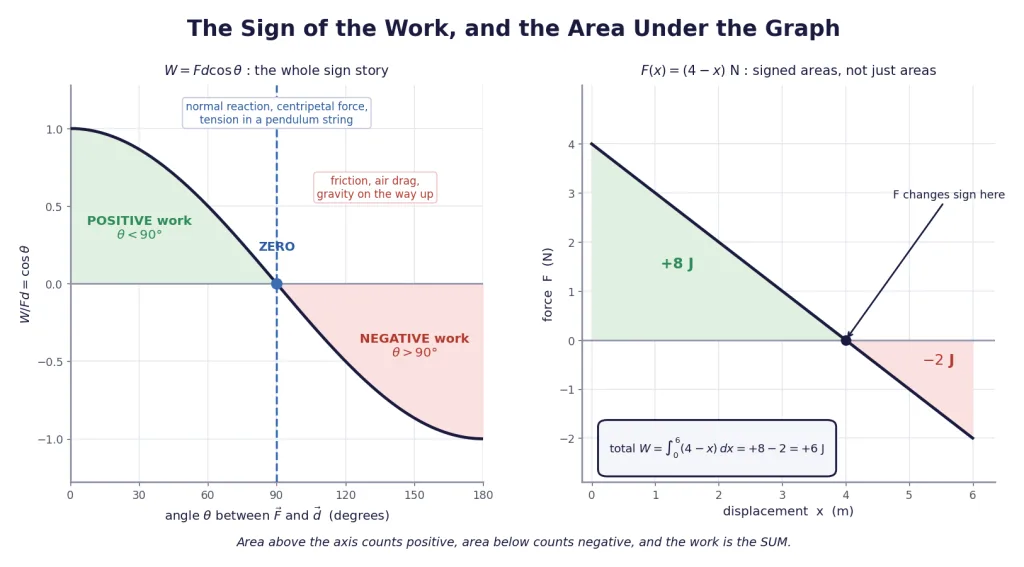
| zero | ZERO | the normal reaction on a sliding block; the centripetal force; the tension in a pendulum string; gravity on a load carried horizontally | |
| negative | negative | friction and air drag on any moving body; gravity on a body going up; a spring being compressed |
Positive work adds kinetic energy; negative work removes it. That is the whole meaning of the sign, and it is what makes the sign worth marks.
The three ways work can be zero
Key Point: if and only if one of these holds:
- The force is zero.
- The displacement is zero — a man pushing a rigid wall for two minutes does no work on it, however tired he gets.
- The force is perpendicular to the displacement, . This is the one that turns up most, and it is why the normal reaction and the centripetal force almost never appear in an energy equation.
The unit, and work by several forces
The SI unit is the joule: . One joule is the work done by 1 N acting through 1 m in its own direction. Also worth recognising: J, and J.
When several forces act, compute the work done by each one separately, with its own and its own sign, and add:
Both routes give the same number, and writing out every force — including the ones that contribute zero — is what stops you forgetting friction.
Finally, work is frame-dependent. The displacement depends on who is watching, so the work done by a given force does too. Pick a frame at the start and stay in it.
Card 2 — Kinetic Energy and the Work-Energy Theorem
Kinetic energy
Key Point: a scalar, measured in joules, and never negative, since and .
The form is what gets tested, and it has two standard readings:
| Held equal | Consequence | Which body wins |
|---|---|---|
| Same momentum | the lighter body has more kinetic energy | |
| Same kinetic energy | the heavier body has more momentum |
The scaling is the most reused proportionality in the chapter. Double the speed and is four times bigger; triple it and is nine times bigger. Since a fixed braking force must remove all of over the stopping distance, too — a car at 60 km/h needs four times the distance it needed at 30 km/h. Percentage versions turn up constantly: increase by 50% and rises by ; double and rises by 300%.
The theorem
Key Point: The is the work done by the NET force, that is, the sum of the works done by every force acting, each with its own sign.
What it does for you. It gives you a speed after a given distance, a stopping distance, or an unknown resistive force from two speeds — all without ever touching an acceleration.
What it will NOT do for you. It contains no time, so it can never give you how long something took. It is a scalar equation, so it can never give you a direction. And it gives totals over a stretch, not the value of one force at one instant. For any of those three, go back to .
And note is frame-dependent, because is. A 60 kg passenger walking at 2 m/s inside a train moving at 10 m/s has J in the train's frame and J in the ground frame. Both are correct; mixing them is not.
Card 3 — Work Done by a Variable Force
Key Point: and in three dimensions .
The idea behind it, in one line: chop the journey into strips so thin that is effectively constant across each one, use on every strip, and add. In the limit the sum becomes the integral, and the sum of the little rectangles becomes the area.
Signed areas
The word "signed" is not decoration. Area above the axis counts positive; area below the axis counts negative; and the work is the sum, not the total area.
The figure in Card 1 works a full example: for N from to m, the triangle above the axis is J and the triangle below is J, so the total work is J. The body speeds up until m, where the force changes sign, and slows down after that — so its kinetic energy is greatest at m, exactly where .
The three shapes you can read by eye
| Graph shape | Work |
|---|---|
| Horizontal line at height | base — the constant-force case |
| Triangle, rising from 0 to over a base | — this is where comes from |
| Trapezium, from to over a base |
The general work-energy theorem
Proved for a variable force in Section 3 using , which integrates to
Key Point: holds for any force — constant, variable, conservative or not — and for a path of any shape. The constant-force derivation from is only the easy special case.
One warning. If the force is given as a function of time, , you may not write and call it work — that is the impulse. Find first, then use , or use directly.
Card 4 — Potential Energy and the Conservation of Mechanical Energy
The two potential energies
Key Point:
Three things about that get asked directly: it is the area of the triangle under the line; it is the same for a compression as for an extension of the same size, because of the ; and it is never negative. Stretching from to therefore costs three times what the first stretch cost, not twice.
Only changes matter
Key Point: Only CHANGES in potential energy are physically meaningful, so the zero level is yours to choose. Move it and every shifts by the same constant, which cancels out of every . Choose your zero, write it at the top of your working, and never move it mid-problem. Potential energy is also a scalar, and it can be negative — for anything below your chosen zero.
Conservative forces: the three equivalent tests
Key Point: A force is conservative if any one of these holds, and then all three do:
- The work it does is independent of the path between two points.
- The work it does around any closed loop is zero.
- There exists a with
That third relation is the most useful direction to run it in: the force is minus the slope of the potential energy curve. Check it on a spring: , which is Hooke's law.
| Conservative | Non-conservative |
|---|---|
| gravity, the spring force, electrostatic force | friction, air drag, viscous force, a push by a person |
Friction fails all three tests. It always opposes the motion, so it takes energy on the way out and on the way back — the work round a closed loop is negative, never zero.
Conservation of mechanical energy
Key Point: When only conservative forces do work, A body speeds up by exactly as much as its potential energy falls.
Standard consequences worth having ready:
| Situation | Result |
|---|---|
| Dropped from rest through | |
| Down any smooth slope or curved track of height | — the shape and the mass are irrelevant |
| Thrown up at | rises ; at half the maximum height |
| Pendulum of length released from horizontal | at the lowest point |
| Block-spring on a smooth floor | , fastest at , at rest at |
And the friction correction
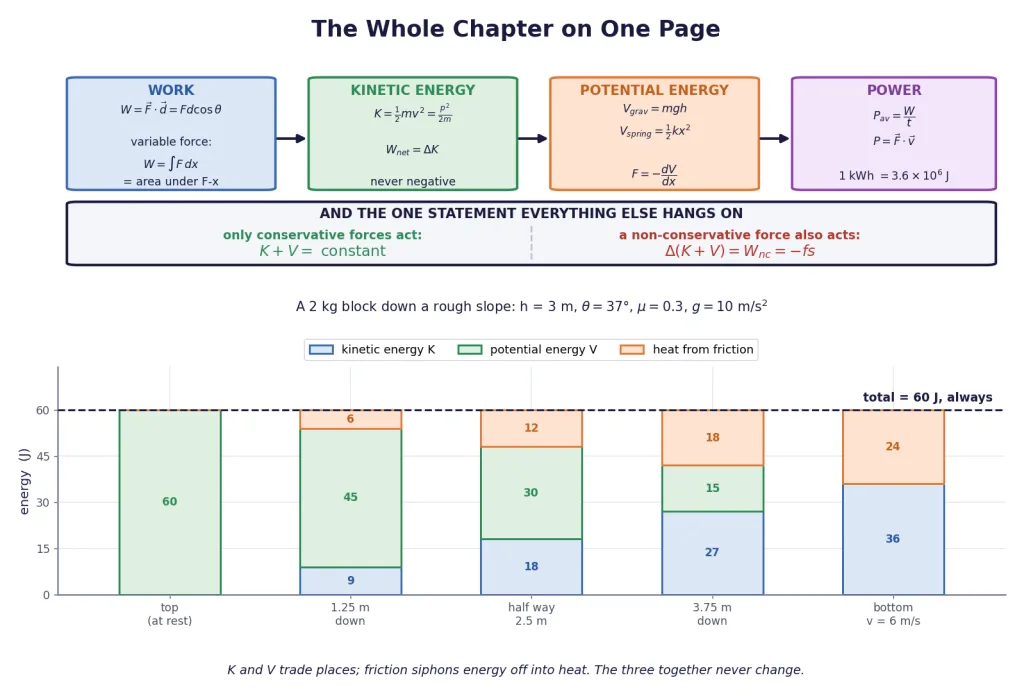
Key Point: When a non-conservative force also acts, where is the friction force and the distance actually slid. Mechanical energy is not conserved. The total energy still is: the missing mechanical energy has become heat.
The figure's bar chart is this equation drawn out. A 2 kg block released at the top of a slope 3 m high with starts with 60 J of potential energy; at the bottom it has 36 J of kinetic energy and 24 J has gone to heat. Every bar totals 60 J — and trade places while friction quietly siphons energy off, and the three together never change.
Two errors to avoid, both flagged in Sections 4 and 9. The friction distance is the path length actually slid, not the straight-line displacement. And the work done by friction on a body is not in general the same number as the heat generated — they agree only when one of the two surfaces is stationary.
Card 5 — Power
Key Point: Power is a SCALAR — a dot product of two vectors is a number — and it measures how fast work is done, not how much.
The units
| Unit | Value | Note |
|---|---|---|
| watt (W) | the SI unit | |
| horsepower | W | about three-quarters of a kilowatt |
| kilowatt-hour | J | a unit of ENERGY, not power |
Key Point — the trap that appears every year: the kilowatt-hour is a unit of ENERGY. It comes from power time: J. Your electricity bill charges you for energy, and one "unit" on the bill is exactly one kilowatt-hour. A 2 kW geyser run for 1.5 hours consumes 3 units, and what you pay for is those 3 units, not the 2 kW.
The three cases of
| Angle between and | Power | Example |
|---|---|---|
| , maximum | an engine driving a car forward | |
| the centripetal force; the normal reaction | ||
| , negative | friction and drag, which absorb energy |
The four standard set-ups
| Set-up | The one line |
|---|---|
| Vehicle at constant speed against a resistance | , since the engine force just balances the resistance |
| Raising a load at constant speed | |
| Pump raising water | ; divide by the efficiency for the input power |
| Climbing stairs | , using only the vertical height |
Efficiency is output over input, so . And the three-step routine for any bill question: convert the power to kilowatts, multiply by the hours to get units (kWh), multiply by the tariff.
[JEE only] Under constant power the force shrinks as the body speeds up, so no kinematic equation applies. Starting from rest, gives and . Against a constant resistance , the top speed is , reached when the engine force has fallen to exactly .
Card 6 — Collisions
The one line to write first
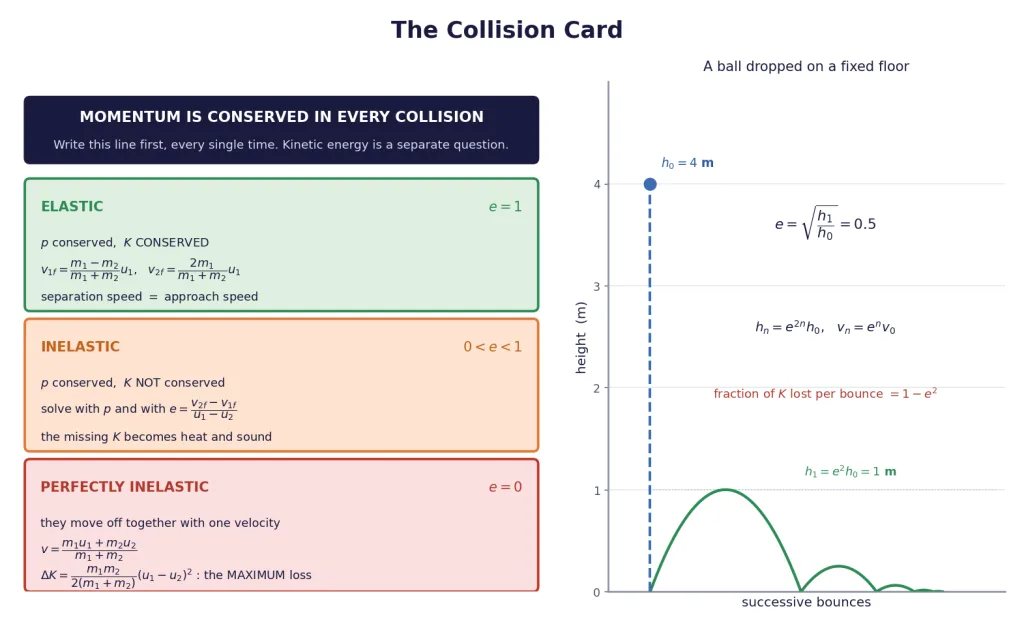
Key Point: The total linear momentum is conserved in EVERY collision — elastic, inelastic and perfectly inelastic alike — because the impulsive forces between the bodies are an internal action-reaction pair and cancel in the total. Kinetic energy is conserved ONLY in an elastic collision. Never assume both.
| Type | Momentum | Kinetic energy | |
|---|---|---|---|
| Elastic | conserved | conserved | |
| Inelastic | conserved | not conserved | |
| Perfectly inelastic (they stick) | conserved | maximum possible loss |
Perfectly inelastic
Key Point:
The loss is always positive (the bracket is squared), it is zero only if the two bodies were already moving together, and it is the largest loss any collision of those two bodies can have. When the target starts at rest the fraction lost simplifies beautifully to
so a light bullet embedding in a heavy block loses almost all of its kinetic energy while its momentum passes through untouched.
One-dimensional elastic
Key Point — the general results: and the shortcut that replaces the energy equation: the relative velocity of separation equals the relative velocity of approach.
With the target at rest () these collapse to and , and then the three special cases are:
| Case | Read it as | ||
|---|---|---|---|
| the velocities are exchanged | |||
| it bounces straight back; the wall does not move | |||
| the light body leaves at twice the speed |
The fraction of kinetic energy transferred is , which reaches its maximum value of 1 when the masses are equal — the reason a neutron moderator uses light nuclei.
Coefficient of restitution
Key Point: is dimensionless, lies between 0 and 1, and depends on the materials. is elastic, is perfectly inelastic.
For a ball dropped from onto a fixed floor:
and the fraction of kinetic energy lost in one bounce is . Dropped from 4 m with , the ball rises to 1 m, then to 0.25 m, losing 75% of its kinetic energy each time.
Two dimensions
Momentum is conserved component by component, giving two equations. An elastic 2D collision has four unknowns and only three equations, so one more fact must always be supplied — usually one scattering angle. The one result worth memorising: when equal masses collide elastically and obliquely, one initially at rest, the two velocities afterwards are at to each other.
Card 7 — The JEE Extension
Everything up to Card 6 is Board and NEET material in full. NEET candidates can skip this card without losing a single mark — none of it is on the NEET syllabus for this chapter, and Section 11 says so explicitly. It is Section 9 compressed to one page, for JEE candidates only.
Potential energy curves
Everything comes from : the force is minus the slope.
and the second derivative sorts the equilibria out:
| Shape of | Type | A small displacement | |
|---|---|---|---|
| a minimum, a valley | STABLE | the force pushes it back | |
| a maximum, a hilltop | UNSTABLE | the force pushes it further away | |
| over a range | flat | NEUTRAL | no force either way |
Turning points and forbidden regions. Draw the total-energy line across the curve. Since and :
- : allowed, and the vertical gap is the kinetic energy.
- : a turning point — the body stops momentarily and reverses. It is not an equilibrium; the force there is generally not zero.
- : the classically forbidden region, where the body simply cannot be.
Energy in a vertical circle
On a string (which can pull but not push): , , and at any speed, not only the critical one. On a rod or inside a tube, which can push as well, the requirements drop to and .
Non-inertial frames
In a frame accelerating at , add a pseudo force to every body and then do energy bookkeeping as usual. The pseudo force does real work in that frame. Pick a frame at the start and stay in it — the kinetic energies differ between frames, but every physical answer agrees.
Constant-power motion
and against a constant resistance , the top speed is .
Oblique elastic collisions, and successive bounces
Equal masses, one at rest, elastic and oblique: the two velocities afterwards are at exactly . It falls straight out of momentum plus energy — and together force .
A ball bouncing forever, in a finite time. With , the geometric series sum to
Infinitely many bounces, both totals finite. For m and with m/s^2, that is 45.6 m travelled in 12.73 s, after which the ball is simply lying still.
Chains, wedges and the centre of mass
For a chain or rope, replace the messy integral by — track the centre of mass and the problem collapses to one line. On a movable wedge, remember that both bodies have kinetic energy and that horizontal momentum is conserved as well as energy.
Card 8 — The Twelve Mistakes That Cost the Most Marks
Every one of these was flagged somewhere in Sections 1 to 12. They are ordered roughly by how often they actually turn up in answer scripts.
1. Forgetting that a perpendicular force does no work. , so the normal reaction on a sliding block, the centripetal force on anything moving in a circle, the tension in a pendulum string and gravity on a load carried horizontally all do exactly zero work. Write ", perpendicular" on the line for each of them and move on — but do write the line, so you can see you checked.
2. Treating work as a vector. Work is the scalar product of two vectors, and a scalar product is a number. It has a sign, not a direction. "Both inputs are vectors" does not make the output one. The same goes for kinetic energy, potential energy and power — all scalars.
3. Forgetting that friction's work is negative. Friction opposes the relative sliding, so and , always, on a body that is moving. Dropping the minus sign turns a body that should be slowing down into one that speeds up, and the arithmetic will not warn you.
4. Using when the force is variable. needs a constant . If the force changes with position, there is no single to multiply by, and you must take — the area under the F-x graph. This is exactly why a spring stores and not : the force grows from zero, so you take the triangle, not the rectangle.
5. Assuming mechanical energy is conserved when friction acts. is constant only when the non-conservative forces do no work. The moment friction, drag or a rough patch enters, write before anything else. Total energy is still conserved — the missing mechanical energy is heat — but the mechanical energy alone is not.
6. Forgetting that only CHANGES in potential energy matter, so the zero level is a free choice. Pick your zero, write it at the top of the page, and never move it mid-problem. Two different students choosing two different zeros get two different values of and the same answer for everything physical. Moving the zero halfway through, however, produces an answer that agrees with nothing.
7. Confusing the work done BY a spring with the work done ON it. They are equal and opposite. Compressing or stretching a spring from to , the spring does , and you do the negative of that. Going out from the natural length the spring does negative work; coming back it does positive work; and around a closed path it does exactly zero, which is what makes it conservative. Read the question for the words "by" and "on" before you write a sign.
8. Assuming kinetic energy is conserved in every collision. Momentum is conserved in every collision. Kinetic energy only in an elastic one. In a perfectly inelastic collision the loss is the maximum possible — 98% of it when a 20 g bullet embeds in a 980 g block. Writing down both conservation laws for a collision that is not elastic is the single most expensive error in the collisions topic.
9. Treating the kilowatt-hour as a unit of power. It is a unit of ENERGY: J. Power time energy, and one "unit" on an electricity bill is one kilowatt-hour. The mirror error is quoting an energy in watts. Check the units of your answer against the units the question asked for, every time.
10. Forgetting that is frame-dependent. Kinetic energy depends on , and depends on who is watching. A passenger walking in a train has one in the train's frame and a much larger one in the ground frame. Both are right. Pick one frame and stay in it — and note that the energy lost in a collision, unlike itself, comes out the same in every inertial frame.
11. Confusing the work done by friction with the heat generated. They agree only when one of the two rubbing surfaces is stationary. When a block slides on a plank that is itself sliding on the floor, the heat generated is (relative sliding distance), which is neither of the two individual works. Section 9 gives this its own trap box, and it separates the top scorers on this chapter.
12. Mixing and within one problem. Pick one value at the very start, write it at the top of your working, and use it everywhere. Some sources use 9.8 and others use 10, and the two differ by about 2% — enough to move you between two adjacent options in a multiple-choice paper. Mixing them inside a single question produces answers that do not even agree with each other.
Key Point: Three more that cost single marks each: forgetting that the friction distance is the path length actually slid, not the straight-line displacement; measuring a spring's from the floor or from some other position instead of from the natural length; and forgetting that the in means the work of the net force, so every force must appear.
The 60-Second Revision
You are in the queue outside the hall. This is the irreducible minimum.
Work. , a scalar with a sign. Positive below , zero at , negative above. Zero work also if or . Unit the joule. Variable force: the signed area under the F-x graph.
Kinetic energy. , never negative, , so stopping distance . Same means the lighter body has more ; same means the heavier body has more . — no time, no direction, net force.
Potential energy. , from the natural length. Conservative path-independent zero round a closed loop . Only changes matter; the zero is yours.
Conservation. Smooth: constant, so down any shape of smooth track, mass irrelevant. Rough: , and the lost energy is heat.
Power. , , a scalar in watts. W. J and it is an ENERGY. Vehicle ; pump ; efficiency output/input.
Collisions. Momentum always; kinetic energy only if elastic. Perfectly inelastic: , loss , maximum possible. Elastic 1D with the target at rest: , ; equal masses exchange; light off heavy reverses; heavy on light gives . Restitution , , , fraction of lost per bounce .
JEE only. ; stable, unstable; turning points where . Vertical circle , , . Constant power , . Oblique elastic, equal masses: . Bouncing totals and .
Habits. Decide energy or forces before you write anything — energy for "how fast after how far", forces for "how hard and how long". List every force and its sign. Check whether anything non-conservative acts. Pick one value of and keep it.
That is the whole chapter. Go and get the marks.