
Depolarisation at Site 'A' - the Action Potential is Born
The resting fibre is polarised - outer surface positive, inner surface negative - and it is nearly impermeable to . Now apply a stimulus at one spot on that membrane. Call the spot site 'A'. Here is exactly what happens, in order:
- A stimulus is applied at site 'A' on the polarised membrane.
- The membrane at site 'A' becomes freely permeable to . The one thing that was nearly shut out at rest is now let straight through.
- This leads to a rapid influx of - sodium rushes in, both because it is far more concentrated outside and because the inside is negative.
- The influx is followed by the reversal of the polarity at that site: the outer surface of the membrane becomes negatively charged and the inner side becomes positively charged.
- The polarity of the membrane at site 'A' is thus reversed, and the site is hence depolarised.
- The electrical potential difference across the plasma membrane at site 'A' is called the action potential, which is in fact termed as a nerve impulse.
Step 6 is the sentence to memorise whole. The action potential is not a movement and it is not a chemical - it is a potential difference across the membrane, at the site that has just reversed. And the chapter says plainly that this action potential is what we call a nerve impulse. The two words name the same thing.
Depolarised is worth pinning down too. It does not mean the charge has vanished. It means the polarity has been reversed - the side that was positive is now negative and the side that was negative is now positive.
[NEET Important] Three marked facts. The stimulus makes the membrane freely permeable to , which causes a rapid influx of - not an efflux, and not a movement of . At the depolarised site the outer surface is negative and the inner surface is positive, which is the exact opposite of the resting state. And the action potential is the electrical potential difference across the plasma membrane at that site, and is in fact termed a nerve impulse.
From Site 'A' to Site 'B' - How the Impulse is Conducted
An action potential at one spot is not yet a message travelling down an axon. What makes it travel is the fact that the membrane just ahead of the excited spot is still in the resting state. Follow the sequence in order - the chapter walks it point by point and so must your answer:
- At site 'A' the polarity has been reversed: outer surface negative, inner surface positive.
- At sites immediately ahead - take site 'B' - the axon membrane still has a positive charge on the outer surface and a negative charge on its inner surface. Site 'B' has not been touched yet.
- Because the two sites now carry opposite arrangements of charge, current flows between them. On the inner surface, a current flows from site 'A' to site 'B'.
- On the outer surface, current flows from site 'B' to site 'A', which completes the circuit of current flow.
- Hence the polarity at site 'B' is reversed, and an action potential is generated at site 'B'.
- Thus the impulse - the action potential - generated at site 'A' arrives at site 'B'.
- The sequence is repeated along the length of the axon, and consequently the impulse is conducted.
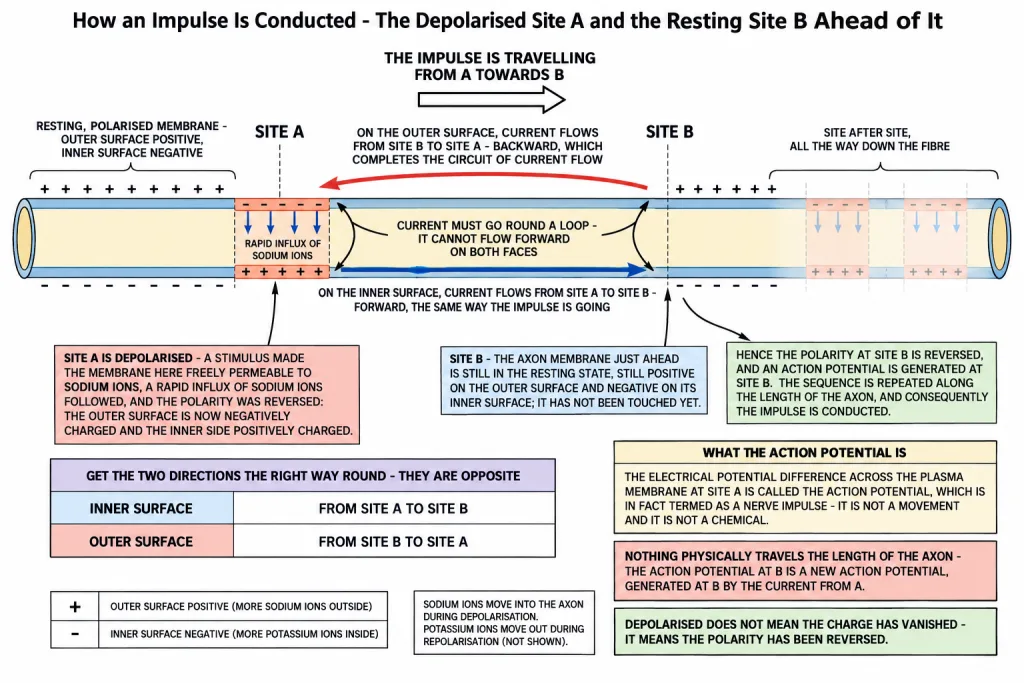
Get the two current directions the right way round, because they are opposite and they are routinely swapped in the exam hall:
| Surface of the membrane | Direction of current flow |
|---|---|
| Inner surface | From site 'A' to site 'B' - that is, forward, in the direction the impulse is going |
| Outer surface | From site 'B' to site 'A' - that is, backward, which completes the circuit |
The way to hold it: the impulse is travelling from 'A' towards 'B', and the inner current runs the same way as the impulse. The outer current has to run the other way for the circuit to be complete. Current must go round a loop - it cannot flow forward on both faces.
Note also what is not happening. Nothing physically travels the length of the axon. The action potential at 'B' is a new action potential, generated at 'B' by the current from 'A'. The impulse is conducted because the sequence is repeated at site after site all the way down the fibre.
[NEET Important] The direction pair is the marked item: current flows from 'A' to 'B' on the INNER surface, and from 'B' to 'A' on the OUTER surface. An option that gives both currents the same direction is wrong, and so is one that reverses the pair. The other marked line is the ending: the sequence is repeated along the length of the axon and consequently the impulse is conducted.
Repolarisation - Getting the Fibre Ready Again
If the sodium gates simply stayed open, the fibre would depolarise once and never work again. They do not. The recovery is quick and it is worked by the other ion:
- The rise in the stimulus-induced permeability to is extremely short-lived. The sodium doors open, and then they shut again almost at once.
- It is quickly followed by a rise in permeability to . The membrane now lets potassium through.
- Within a fraction of a second, diffuses outside the membrane. Potassium is high inside and low outside, so once the channels open it leaves down its gradient, carrying positive charge out with it.
- This restores the resting potential of the membrane at the site of excitation - the outer surface is positive again and the inner surface negative again. This return to the resting state is called repolarisation.
- The fibre becomes once more responsive to further stimulation.
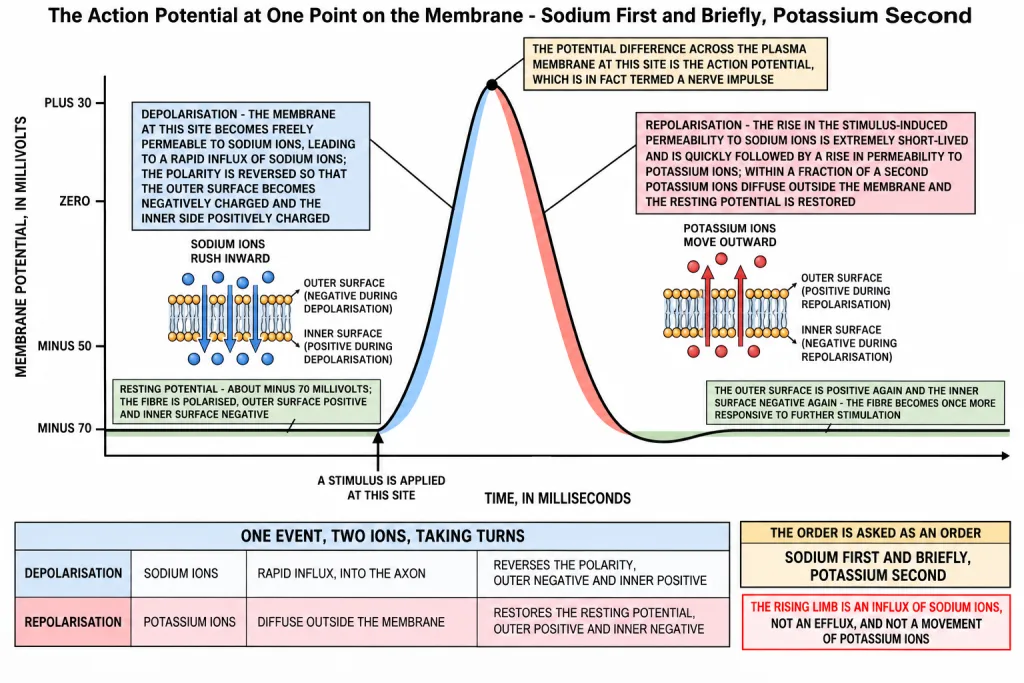
So the whole event at one point on the membrane is a two-ion story with the ions taking turns:
| Phase | Which ion moves | Which way | What it does to the membrane |
|---|---|---|---|
| Depolarisation | Rapid influx - into the axon | Reverses the polarity: outer negative, inner positive | |
| Repolarisation | Diffuses outside the membrane | Restores the resting potential: outer positive, inner negative |
The order matters and is asked as an order: sodium first and briefly, potassium second. The sodium permeability is extremely short-lived; the potassium permeability rises quickly after it. And the whole thing is over within a fraction of a second, which is why a single fibre can carry impulse after impulse.
[NEET Important] The marked sequence is short-lived rise in permeability, then a rise in permeability, then diffuses outside and the resting potential is restored. A distractor that has moving inwards during repolarisation is wrong - it diffuses outside. And the consequence gets marked too: the fibre becomes once more responsive to further stimulation.
Quick Recap
- A stimulus applied at site 'A' on the polarised membrane makes the membrane there freely permeable to .
- This leads to a rapid influx of , followed by the reversal of the polarity at that site - the outer surface becomes negatively charged and the inner side becomes positively charged.
- The polarity at site 'A' is thus reversed and the site is hence depolarised.
- The electrical potential difference across the plasma membrane at site 'A' is called the action potential, which is in fact termed as a nerve impulse.
- At sites immediately ahead, for example site 'B', the membrane still has a positive charge on the outer surface and a negative charge on its inner surface.
- As a result, a current flows on the inner surface from site 'A' to site 'B', and on the outer surface current flows from site 'B' to site 'A', to complete the circuit of current flow.
- Hence the polarity at site 'B' is reversed and an action potential is generated at site 'B', so the impulse generated at 'A' arrives at 'B'.
- The sequence is repeated along the length of the axon and consequently the impulse is conducted.
- The rise in the stimulus-induced permeability to is extremely short-lived, and is quickly followed by a rise in permeability to .
- Within a fraction of a second diffuses outside the membrane and restores the resting potential at the site of excitation - this is repolarisation.
- The fibre becomes once more responsive to further stimulation.
Solved Examples
Question 1
Q. Compare resting potential and action potential. This is one of the chapter-end exercises.
Answer.
| Feature | Resting potential | Action potential |
|---|---|---|
| When it exists | When the neuron is not conducting any impulse, that is, resting | When a stimulus has been applied and the site has been depolarised |
| Definition | The electrical potential difference across the resting plasma membrane | The electrical potential difference across the plasma membrane at the stimulated site |
| Charge on the outer surface | Positive | Negative |
| Charge on the inner surface | Negative | Positive |
| State of the membrane | Polarised | Depolarised - the polarity is reversed |
| Permeability to | Nearly impermeable | Freely permeable, giving a rapid influx of |
| Ion movement responsible | Gradients maintained by the sodium-potassium pump, which moves 3 out for 2 in | Rapid influx of into the axon |
| Other name | - | It is in fact termed a nerve impulse |
| Typical value | About -70 millivolts | The value swings to a positive figure at the excited site |
The one line that gets the mark: the resting potential is the potential difference across a polarised membrane, outer surface positive and inner surface negative; the action potential is the potential difference across the same membrane after the polarity has been reversed by a rapid influx of , so that the outer surface is negative and the inner surface positive - and the action potential is the nerve impulse.
Question 2
Q. Explain the depolarisation of the membrane of a nerve fibre. This is one of the chapter-end exercises.
Answer. Depolarisation is the reversal of the polarity of the axonal membrane at the site where a stimulus acts. It happens like this.
- The membrane starts polarised: outer surface positive, inner surface negative, and nearly impermeable to .
- A stimulus is applied at a site on the polarised membrane - take it as site 'A'.
- The membrane at site 'A' now becomes freely permeable to .
- This leads to a rapid influx of into the axon, because sodium is at a high concentration outside and the inside is negative.
- The influx is followed by the reversal of the polarity at that site: the outer surface of the membrane becomes negatively charged and the inner side becomes positively charged.
- The polarity at site 'A' is thus reversed, and the membrane there is said to be depolarised.
- The electrical potential difference across the plasma membrane at site 'A' is called the action potential, which is in fact termed as a nerve impulse.
Depolarisation therefore does not mean the charge has disappeared - it means the two surfaces have swapped their charges.
Question 3
Q. Explain the role of sodium ions in the generation of the action potential. This is one of the chapter-end exercises.
Answer. is the ion that generates the action potential. Its role runs through the whole event.
- In the resting state, sodium sets up the gradient it will later use. The resting membrane is nearly impermeable to , and the sodium-potassium pump transports 3 outwards for 2 into the cell. So the fluid outside the axon holds a high concentration of while the axoplasm holds a low concentration - a steep concentration gradient, pointing inwards.
- The stimulus acts by changing the membrane's permeability to sodium. When a stimulus is applied at a site on the polarised membrane, that membrane becomes freely permeable to .
- Sodium then rushes in. There is a rapid influx of , driven by the concentration gradient built up in step 1 and helped by the negative charge inside.
- The influx of positive charge reverses the polarity. The outer surface of the membrane becomes negatively charged and the inner side becomes positively charged - the site is depolarised.
- That reversal is the action potential. The electrical potential difference across the plasma membrane at that site is the action potential, which is in fact termed a nerve impulse.
- The sodium change is deliberately brief. The rise in the stimulus-induced permeability to is extremely short-lived, and is quickly followed by a rise in permeability to , so that can diffuse out and restore the resting potential.
In one line: the rapid influx of through a membrane made freely permeable to by the stimulus is what reverses the polarity and generates the action potential.
Question 4
Q. What happens to the permeability of the membrane at the site where a stimulus is applied?
Answer. The membrane at that site becomes freely permeable to . At rest it had been nearly impermeable to that ion.
Question 5
Q. Define action potential.
Answer. The electrical potential difference across the plasma membrane at the stimulated site, after the polarity there has been reversed. It is in fact termed a nerve impulse.
Question 6
Q. What are the charges on the two surfaces of the membrane at a depolarised site?
Answer. The outer surface becomes negatively charged and the inner side becomes positively charged - exactly the reverse of the resting state.
Question 7
Q. State the direction of current flow on the inner and on the outer surface of the axon between site 'A' and site 'B'.
Answer. On the inner surface a current flows from site 'A' to site 'B'. On the outer surface current flows from site 'B' to site 'A', which completes the circuit of current flow. The two directions are opposite, and that is what makes it a circuit.
Question 8
Q. Why is the membrane at site 'B' able to be excited by the events at site 'A'?
Answer. Because site 'B' has not yet been stimulated, so its membrane still has a positive charge on the outer surface and a negative charge on its inner surface. Site 'A' now carries the opposite arrangement. That difference between the two sites drives a current between them, which reverses the polarity at site 'B' and generates an action potential at site 'B'.
Question 9
Q. How does an impulse generated at one point travel the whole length of the axon?
Answer. The impulse generated at site 'A' arrives at site 'B' because the current between the two sites reverses the polarity at 'B' and an action potential is generated at site 'B'. Site 'B' then does to the site ahead of it what 'A' did to 'B'. The sequence is repeated along the length of the axon, and consequently the impulse is conducted. Nothing physically runs down the fibre - a new action potential is generated at each successive point.
Question 10
Q. How long does the stimulus-induced rise in permeability to last, and what follows it?
Answer. It is extremely short-lived. It is quickly followed by a rise in permeability to .
Question 11
Q. Which ion restores the resting potential after an impulse, and how?
Answer. . Within a fraction of a second the membrane's permeability to rises, and diffuses outside the membrane. Potassium is at a high concentration inside, so once the channels open it leaves down its gradient and carries positive charge out with it. That restores the resting potential of the membrane at the site of excitation.
Question 12
Q. What is repolarisation, and why does it matter to the neuron?
Answer. Repolarisation is the return of the membrane to its resting condition after an action potential - diffuses outside the membrane and restores the resting potential at the site of excitation, so the outer surface is positive and the inner surface negative once more. It matters because only then does the fibre become once more responsive to further stimulation. Without it the fibre could carry one impulse and no more.
Question 13
Q. A student writes that during repolarisation potassium ions move into the axon. Correct the statement.
Answer. That is the wrong direction. During repolarisation diffuses OUTSIDE the membrane. Potassium is at a high concentration inside the axon, so when the permeability to rises it moves out, taking positive charge with it and restoring the resting potential.
Question 14
Q. Put these events in the correct order: rise in permeability to ; rapid influx of ; stimulus applied; resting potential restored; reversal of polarity.
Answer.
- Stimulus applied at the site, making the membrane freely permeable to .
- Rapid influx of .
- Reversal of polarity - the site is depolarised and an action potential appears.
- Rise in permeability to , the sodium permeability being extremely short-lived.
- Resting potential restored, as diffuses outside the membrane.
Question 15
Q. After the resting potential has been restored at the site of excitation, what can the fibre now do?
Answer. It becomes once more responsive to further stimulation - it can carry the next impulse.