
The Forebrain, and the Shape of the Cerebrum
The forebrain consists of the cerebrum, the thalamus and the hypothalamus. Name all three whenever the forebrain is asked about. This section takes up the first of them; the thalamus and the hypothalamus are dealt with in the section that follows.
The cerebrum forms the major part of the human brain. It is the part you see when you look at a brain from outside - the large, folded mass covering everything else.
Its shape comes from one deep split and one thick bridge:
- A deep cleft divides the cerebrum longitudinally into two halves, which are termed the left and right cerebral hemispheres. The cleft runs front to back down the middle.
- The two hemispheres are not independent. The hemispheres are connected by a tract of nerve fibres called the corpus callosum.
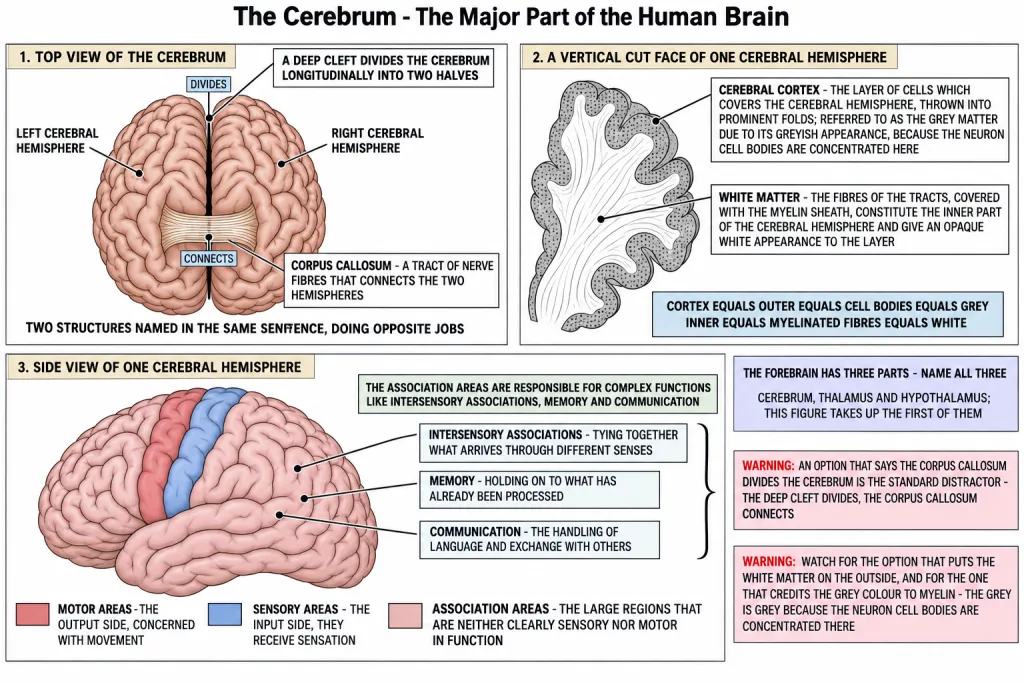
So the cerebrum is one organ split into two halves that stay in constant communication. The deep cleft separates them; the corpus callosum joins them. Those two structures do opposite jobs and both are named in the same sentence of the chapter, which is exactly why they get swapped in exam options.
[NEET Important] Three names in one line: the deep cleft divides the cerebrum longitudinally into the left and right cerebral hemispheres, and the corpus callosum connects them. An option that says the corpus callosum divides the cerebrum is the standard distractor. And remember to name all three forebrain parts - cerebrum, thalamus and hypothalamus - not the cerebrum alone.
Grey Matter and White Matter - the Central Comparison
The cerebral hemisphere is built in two layers, and they look different because they are made of different parts of the neuron.
The outer layer. The layer of cells which covers the cerebral hemisphere is called the cerebral cortex, and it is thrown into prominent folds. The cerebral cortex is referred to as the grey matter due to its greyish appearance. The colour has a cause: the neuron cell bodies are concentrated here, giving the colour.
The inner layer. Fibres of the tracts are covered with the myelin sheath, and these constitute the inner part of the cerebral hemisphere. They give an opaque white appearance to the layer and hence it is called the white matter.
| Feature | Grey matter | White matter |
|---|---|---|
| Where it lies | The outer layer - it covers the cerebral hemisphere | The inner part of the cerebral hemisphere |
| Its proper name | The cerebral cortex | The white matter of the hemisphere |
| What it is made of | Neuron cell bodies, concentrated here | Fibres of the tracts covered with the myelin sheath |
| Appearance | Greyish | Opaque white |
| Surface | Thrown into prominent folds | Lies beneath, not folded on the surface |
Say the pairing out loud, because it is the one thing this block exists to fix:
cortex = outer = cell bodies = grey. inner = myelinated fibres = white.
The inversion of that pairing - putting the white matter on the outside, or saying the cortex is white because of myelin - is the standard distractor in this part of the chapter. Fix the chain in the order position, then content, then colour, and it cannot invert on you.
[NEET Important] Both halves of the pairing are asked. The cerebral cortex is the outer layer, it is grey matter, and it is grey because the neuron cell bodies are concentrated there. The inner part is white matter, and it is white because the fibres of the tracts are covered with the myelin sheath. Watch for the option that reverses the two positions, and for the one that credits the grey colour to myelin.
What the Cerebral Cortex Contains - Motor, Sensory and Association Areas
The cortex is not one uniform sheet. The cerebral cortex contains motor areas, sensory areas and large regions that are neither clearly sensory nor motor in function.
| Kind of area | What it deals with |
|---|---|
| Motor areas | The output side - they are concerned with movement |
| Sensory areas | The input side - they receive sensation |
| Association areas | The large regions that are neither clearly sensory nor motor in function |
The third row is the one the chapter spends its words on. These regions, called the association areas, are responsible for complex functions like intersensory associations, memory and communication.
Take the three functions one at a time:
- Intersensory associations - tying together what arrives through different senses, so that a sight and a sound are understood as one event.
- Memory - holding on to what has already been processed.
- Communication - the handling of language and exchange with others.
The association areas are why the cerebrum does more than sense and move. They are the regions that make the cerebrum the seat of the complex functions the chapter credits to the brain, and they are the reason the cerebrum counts as the most developed part of the human brain.
[NEET Important] The definition is asked in the chapter's own words: the association areas are the regions neither clearly sensory nor motor in function, and they handle intersensory associations, memory and communication. That three-item list is asked as a set - an option that swaps in "thermoregulation" or "balance of the body" is wrong, because those belong to other parts of the brain.
Quick Recap
- The forebrain consists of the cerebrum, the thalamus and the hypothalamus.
- The cerebrum forms the major part of the human brain, and it is the most developed part of the human brain.
- A deep cleft divides the cerebrum longitudinally into two halves, termed the left and right cerebral hemispheres.
- The hemispheres are connected by a tract of nerve fibres called the corpus callosum.
- The layer of cells which covers the cerebral hemisphere is called the cerebral cortex, and it is thrown into prominent folds.
- The cerebral cortex is referred to as the grey matter due to its greyish appearance, which is because the neuron cell bodies are concentrated here.
- Fibres of the tracts are covered with the myelin sheath and constitute the inner part of the cerebral hemisphere; they give an opaque white appearance to that layer, which is therefore called the white matter.
- Hold the pairing: cortex = outer = cell bodies = grey; inner = myelinated fibres = white.
- The cerebral cortex contains motor areas, sensory areas and large regions that are neither clearly sensory nor motor in function.
- Those regions are the association areas, responsible for complex functions like intersensory associations, memory and communication.
Solved Examples
Question 1
Q. Write a short note on the forebrain. This is one of the chapter-end exercises.
Answer. The forebrain consists of the cerebrum, the thalamus and the hypothalamus.
Cerebrum. It forms the major part of the human brain. A deep cleft divides the cerebrum longitudinally into two halves, termed the left and right cerebral hemispheres, and the two hemispheres are connected by a tract of nerve fibres called the corpus callosum. The layer of cells which covers the cerebral hemisphere is the cerebral cortex, thrown into prominent folds and called the grey matter because the neuron cell bodies are concentrated there. The inner part of the hemisphere is made of fibres of the tracts covered with the myelin sheath, which give it an opaque white appearance - the white matter. The cortex holds motor areas, sensory areas and association areas, the last being responsible for intersensory associations, memory and communication.
Thalamus. The cerebrum wraps around the thalamus, which is a major coordinating centre for sensory and motor signalling.
Hypothalamus. It lies at the base of the thalamus and contains a number of centres which control body temperature and the urge for eating and drinking. It also contains several groups of neurosecretory cells which secrete hypothalamic hormones.
The inner parts of the cerebral hemispheres, together with associated deep structures such as the amygdala and hippocampus, form the limbic lobe or limbic system, which along with the hypothalamus is involved in the regulation of sexual behaviour, the expression of emotional reactions and motivation.
Question 2
Q. Which part of the human brain is the most developed? This is one of the chapter-end exercises.
Answer. The cerebrum.
The reasons are the ones the chapter gives. The cerebrum forms the major part of the human brain - it is by far the largest division, wrapping over the thalamus and the rest of the brain. It carries the cerebral cortex, a layer of cells thrown into prominent folds so that a very large sheet of neuron cell bodies is packed into the skull. And within that cortex, besides the motor areas and sensory areas, lie the association areas - the large regions neither clearly sensory nor motor in function, which are responsible for complex functions like intersensory associations, memory and communication. No other part of the brain carries anything of that kind, which is why the cerebrum is counted as the most developed part.
Question 3
Q. Name the three parts of the forebrain.
Answer. The cerebrum, the thalamus and the hypothalamus.
Question 4
Q. What divides the cerebrum into two halves, and what are the halves called?
Answer. A deep cleft divides the cerebrum longitudinally into two halves, and those halves are termed the left and right cerebral hemispheres.
Question 5
Q. What is the corpus callosum?
Answer. It is the tract of nerve fibres that connects the two cerebral hemispheres. The deep cleft divides the cerebrum; the corpus callosum is what still joins the two halves together.
Question 6
Q. What is the cerebral cortex, and why is it called the grey matter?
Answer. The cerebral cortex is the layer of cells which covers the cerebral hemisphere, and it is thrown into prominent folds. It is referred to as the grey matter due to its greyish appearance, and the appearance comes from the fact that the neuron cell bodies are concentrated here.
Question 7
Q. Why is the inner part of the cerebral hemisphere called the white matter?
Answer. Because the fibres of the tracts that constitute the inner part of the cerebral hemisphere are covered with the myelin sheath. The myelin gives them an opaque white appearance, and the layer is therefore called the white matter.
Question 8
Q. Distinguish between the grey matter and the white matter of the cerebral hemisphere.
Answer.
| Feature | Grey matter | White matter |
|---|---|---|
| Position | The outer layer, covering the cerebral hemisphere | The inner part of the cerebral hemisphere |
| Name given to it | The cerebral cortex | The white matter |
| Composition | Neuron cell bodies concentrated here | Fibres of the tracts covered with the myelin sheath |
| Appearance | Greyish | Opaque white |
| Surface | Thrown into prominent folds | Lies underneath, not folded at the surface |
The one line that gets the mark: cortex = outer = cell bodies = grey, and inner = myelinated fibres = white.
Question 9
Q. A student writes that the cerebral cortex is white because it is full of myelinated fibres. Correct both mistakes.
Answer. Two things are wrong. First, the cerebral cortex is the grey matter, not the white matter. Second, its greyish appearance comes from the neuron cell bodies concentrated there, not from myelin. It is the inner part of the cerebral hemisphere, made of fibres of the tracts covered with the myelin sheath, that has the opaque white appearance and is called the white matter.
Question 10
Q. What is the surface of the cerebral cortex like?
Answer. It is thrown into prominent folds. The cortex does not lie as a smooth sheet over the hemisphere; it is folded, and those folds are what make the surface of the cerebrum look wrinkled.
Question 11
Q. Name the three kinds of areas found in the cerebral cortex.
Answer. Motor areas, sensory areas, and the large regions that are neither clearly sensory nor motor in function, which are called the association areas.
Question 12
Q. What are the association areas and what are they responsible for?
Answer. The association areas are the large regions of the cerebral cortex that are neither clearly sensory nor motor in function. They are responsible for complex functions like intersensory associations, memory and communication.
Question 13
Q. Fill in the blanks: the layer of cells covering the cerebral hemisphere is the , referred to as the matter; the inner part, made of fibres covered with the , is the matter.
Answer. The layer of cells covering the cerebral hemisphere is the cerebral cortex, referred to as the grey matter; the inner part, made of fibres covered with the myelin sheath, is the white matter.