
The Brain as the Command and Control System
The brain is the central information processing organ of our body, and it acts as the 'command and control system'. Everything the neural system senses is brought to it, and every deliberate instruction the body issues starts from it.
The chapter lists what the brain controls, and it is asked as a set, so learn it as a list and not as a sentence:
- voluntary movements
- balance of the body
- functioning of the vital involuntary organs such as the lungs, heart and kidneys
- thermoregulation
- hunger and thirst
- circadian (24-hour) rhythms of the body
- the activities of several endocrine glands
- human behaviour
On top of all that control work, the brain is also the place where experience is turned into thought. It is the site for the processing of vision, hearing, speech, memory, intelligence, emotions and thoughts.
Two things are worth noticing in that list. The brain runs both the voluntary side of the body, such as movement, and the involuntary side, such as the heart and kidneys - it is not restricted to what you choose to do. And it reaches beyond the neural system itself, because it controls the activities of several endocrine glands as well.
[NEET Important] The phrase 'command and control system' and the description central information processing organ are both asked directly. The controlled set is asked as a spot-the-odd-one item, so keep circadian (24-hour) rhythms and the activities of several endocrine glands in the list - those two are the ones students forget. Note that thermoregulation and hunger and thirst are on the brain's list, not the list of any other organ.
How the Brain Is Protected - the Cranial Meninges
The brain is soft tissue and it is protected in two layers of defence, one hard and one membranous.
First, bone. The human brain is well protected by the skull.
Second, membranes. Inside the skull, the brain is covered by cranial meninges. The cranial meninges consist of three layers, and the exam asks for them in order from the outside inwards:
| Position | Layer | Where it lies |
|---|---|---|
| Outer | Dura mater | The outermost of the three, lying just inside the skull |
| Middle | Arachnoid | A very thin middle layer |
| Inner | Pia mater | The innermost layer, in contact with the brain tissue |
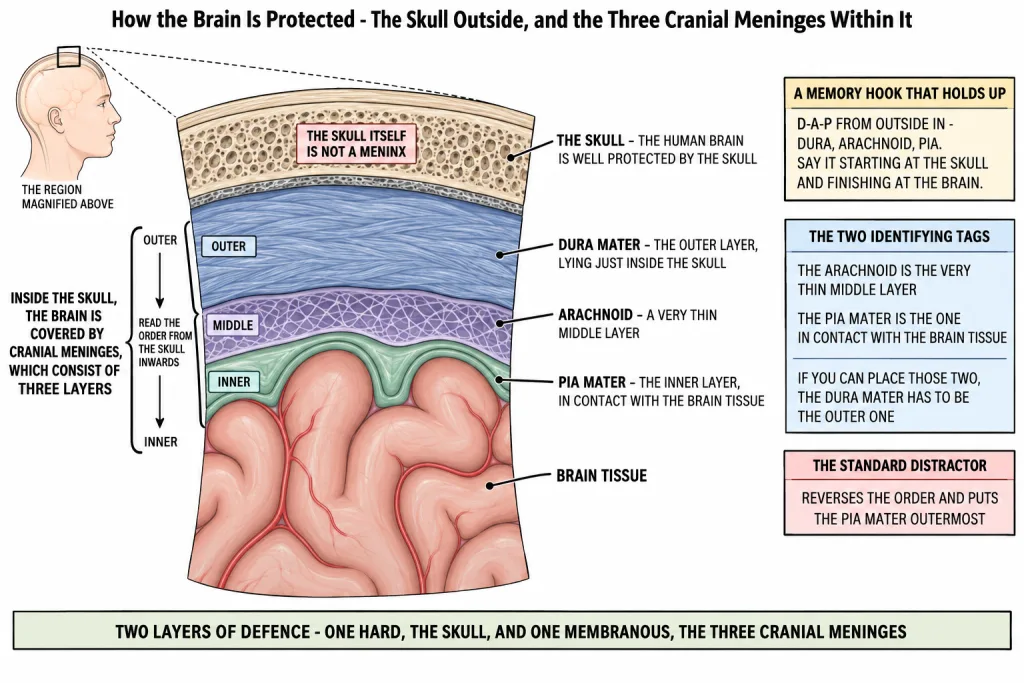
The order is what gets asked. From the skull inwards it runs dura mater, then arachnoid, then pia mater, and the two identifying tags are attached to particular layers: the arachnoid is the very thin middle layer, and the pia mater is the one in contact with the brain tissue. If you can place those two, the dura mater has to be the outer one.
A memory hook that holds up: D-A-P from outside in - Dura, Arachnoid, Pia. Say it starting at the skull and finishing at the brain.
[NEET Important] The whole of this block reduces to one ordered triple: dura mater (outer), arachnoid (very thin, middle), pia mater (inner, in contact with the brain tissue). The standard distractor reverses the order and puts the pia mater outermost. Also remember that the meninges are inside the skull - the skull itself is not a meninx.
The Three Major Divisions of the Brain
The brain can be divided into three major parts:
- the forebrain
- the midbrain
- the hindbrain
Each of these gets a section of its own later, so here is only the map of what sits in each:
| Major part | What it contains | The one-line idea |
|---|---|---|
| Forebrain | The cerebrum, the thalamus and the hypothalamus | The largest part, and the one that handles thought, sensation and the body's internal drives |
| Midbrain | The cerebral aqueduct running through it, and the corpora quadrigemina on its dorsal side | A short connecting region that also handles visual, tactile and auditory input |
| Hindbrain | The pons, the cerebellum and the medulla | Balance and coordination, plus the centres that keep breathing and the heart going |
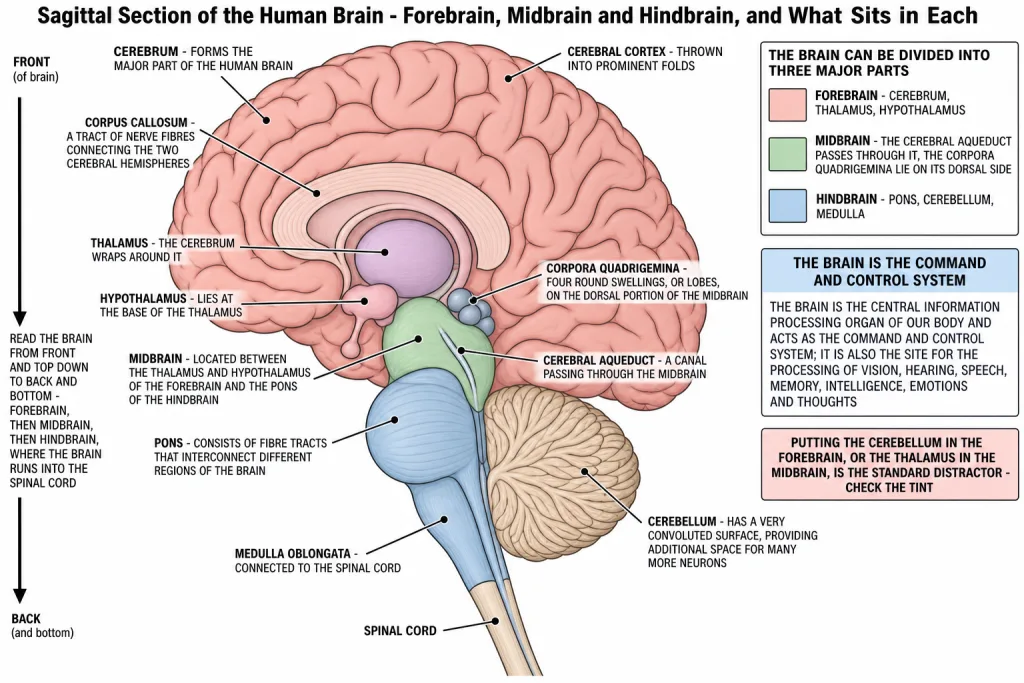
Read the table downwards and you are reading the brain from front to back. The forebrain is the front and top of the brain, the midbrain is the short stretch behind and below it, and the hindbrain is the back and bottom, where the brain runs into the spinal cord.
[NEET Important] Three major parts - forebrain, midbrain and hindbrain. The count is asked, and so is the membership: cerebrum, thalamus and hypothalamus are forebrain; pons, cerebellum and medulla are hindbrain. Putting the cerebellum in the forebrain, or the thalamus in the midbrain, is the standard distractor.
Quick Recap
- The brain is the central information processing organ of our body and acts as the 'command and control system'.
- It controls voluntary movements, balance of the body, the functioning of the vital involuntary organs such as the lungs, heart and kidneys, thermoregulation, hunger and thirst, circadian (24-hour) rhythms of the body, the activities of several endocrine glands and human behaviour.
- It is also the site for the processing of vision, hearing, speech, memory, intelligence, emotions and thoughts.
- The human brain is well protected by the skull.
- Inside the skull the brain is covered by cranial meninges, which consist of three layers.
- The layers from outside inwards are the dura mater (outer), the arachnoid (a very thin middle layer) and the pia mater (inner, in contact with the brain tissue).
- The brain can be divided into three major parts - forebrain, midbrain and hindbrain.
- The forebrain consists of the cerebrum, thalamus and hypothalamus.
- The midbrain is the region through which the cerebral aqueduct passes and which carries the corpora quadrigemina on its dorsal side.
- The hindbrain consists of the pons, cerebellum and medulla.
Solved Examples
Question 1
Q. Briefly describe the structure of the brain. This is one of the chapter-end exercises.
Answer. The brain is the central information processing organ of our body, and it acts as the 'command and control system'.
How it is protected. The human brain is well protected by the skull. Inside the skull, the brain is covered by cranial meninges, which consist of three layers:
| Position | Layer |
|---|---|
| Outer | Dura mater |
| Middle | Arachnoid, a very thin layer |
| Inner | Pia mater, which is in contact with the brain tissue |
How it is divided. The brain can be divided into three major parts - the forebrain, the midbrain and the hindbrain.
- The forebrain consists of the cerebrum, the thalamus and the hypothalamus. The cerebrum forms the major part of the human brain; a deep cleft divides it into the left and right cerebral hemispheres, joined by the corpus callosum. The thalamus is a major coordinating centre for sensory and motor signalling, and the hypothalamus, at the base of the thalamus, controls body temperature and the urge for eating and drinking.
- The midbrain lies between the thalamus and hypothalamus of the forebrain and the pons of the hindbrain. A canal called the cerebral aqueduct passes through it, and its dorsal portion carries the corpora quadrigemina.
- The hindbrain consists of the pons, the cerebellum and the medulla. The medulla is connected to the spinal cord.
The brain stem - the midbrain, pons and medulla oblongata together - forms the connections between the brain and the spinal cord.
Question 2
Q. Draw a labelled diagram of the brain. This is one of the chapter-end exercises.
Answer. The diagram wanted is a sagittal section - the brain cut down the middle from front to back, so that you are looking at one half from the inside. Draw it like this and then label it.
How to lay it out.
- Draw a large domed outline filling the top and front of the picture. That is the cerebrum. Give its surface a wavy, deeply wrinkled edge all the way round, because the cerebral cortex is thrown into prominent folds. The cerebrum takes up most of the space, since it forms the major part of the human brain.
- Just under the middle of that dome, draw a thick curved band running from front to back like an arch. That is the corpus callosum, the tract of nerve fibres connecting the two cerebral hemispheres.
- Below the arch of the corpus callosum, in the centre of the brain, draw an oval. That is the thalamus. The cerebrum wraps around it.
- Immediately below the thalamus, draw a smaller swelling. That is the hypothalamus - it lies at the base of the thalamus. Their positions relative to each other are what gets marked: thalamus above, hypothalamus below it.
- Behind and below the thalamus and hypothalamus, draw a short narrow stretch running backwards and downwards. That is the midbrain. Draw a fine canal running lengthwise through it and label it the cerebral aqueduct. On its upper (dorsal) surface show four small round swellings and label them the corpora quadrigemina.
- Continuing down from the midbrain, draw a bulge on the front side of the stem. That is the pons.
- Behind the pons, at the back and bottom of the brain, draw a rounded mass with a finely ridged, tree-like inner pattern. That is the cerebellum, whose surface is very convoluted.
- Below the pons, draw the stem narrowing downwards. That is the medulla oblongata, and it continues straight into the spinal cord at the bottom of the diagram.
Labels to put on the diagram: cerebrum, cerebral cortex, corpus callosum, thalamus, hypothalamus, midbrain, cerebral aqueduct, corpora quadrigemina, pons, cerebellum, medulla oblongata, spinal cord. If the question asks for the coverings as well, add the three cranial meninges outside the cerebrum in the order dura mater, arachnoid, pia mater, with the skull outside them all.
Question 3
Q. Why is the brain described as the 'command and control system' of the body?
Answer. Because it is the central information processing organ of our body. All the information gathered by the neural system is processed there, and the instructions that regulate the body go out from there. It controls voluntary movements, balance of the body, the functioning of the vital involuntary organs, thermoregulation, hunger and thirst, circadian rhythms, the activities of several endocrine glands and human behaviour.
Question 4
Q. List the functions of the body controlled by the brain.
Answer. The brain controls:
- voluntary movements
- balance of the body
- functioning of the vital involuntary organs such as the lungs, heart and kidneys
- thermoregulation
- hunger and thirst
- circadian (24-hour) rhythms of the body
- the activities of several endocrine glands
- human behaviour
Question 5
Q. Besides controlling the body, what is the brain the site of?
Answer. It is the site for the processing of vision, hearing, speech, memory, intelligence, emotions and thoughts.
Question 6
Q. What are circadian rhythms, and which organ controls them?
Answer. Circadian rhythms are the body's 24-hour rhythms - the daily cycle its activities follow. They are among the things controlled by the brain.
Question 7
Q. How is the human brain protected?
Answer. In two ways. On the outside the brain is well protected by the skull. Inside the skull it is covered by cranial meninges, three membranous layers - the dura mater on the outside, the very thin arachnoid in the middle and the pia mater on the inside, in contact with the brain tissue.
Question 8
Q. Name the cranial meninges in order from the outside inwards, with the identifying feature of each.
Answer.
| Order | Layer | Identifying feature |
|---|---|---|
| 1 (outermost) | Dura mater | The outer layer, lying just inside the skull |
| 2 (middle) | Arachnoid | A very thin middle layer |
| 3 (innermost) | Pia mater | In contact with the brain tissue |
The one line that gets the mark: from the skull inwards, dura mater, arachnoid, pia mater.
Question 9
Q. A student writes that the pia mater is the outermost of the cranial meninges. Correct the statement.
Answer. That is wrong. The pia mater is the inner layer and is the one in contact with the brain tissue. The outer layer is the dura mater, and the arachnoid is the very thin layer between them.
Question 10
Q. Which layer of the cranial meninges is described as very thin, and which one touches the brain tissue?
Answer. The arachnoid is the very thin middle layer. The pia mater is the layer in contact with the brain tissue.
Question 11
Q. Into how many major parts can the brain be divided, and what are they?
Answer. Into three major parts - the forebrain, the midbrain and the hindbrain.
Question 12
Q. Name the structures contained in each of the three major parts of the brain.
Answer.
| Major part | Structures it contains |
|---|---|
| Forebrain | Cerebrum, thalamus and hypothalamus |
| Midbrain | The cerebral aqueduct passing through it and the corpora quadrigemina on its dorsal portion |
| Hindbrain | Pons, cerebellum and medulla |
Question 13
Q. Fill in the blanks: the brain is the central _ processing organ of the body; it is protected by the , and inside that it is covered by the , which have _ layers.
Answer. The brain is the central information processing organ of the body; it is protected by the skull, and inside that it is covered by the cranial meninges, which have three layers.