
Same Syllabus. A Different Exam.
The Important Questions and Answers section worked this chapter the way a written paper does - describe the neuron, explain the polarisation, compare the thalamus and the hypothalamus. NEET does not ask you to explain anything here. It names one ion, one brain part or one number, gives four options, and you have about half a minute.
The marking is +4 for a correct answer and -1 for a wrong one. In a written answer, "the pump moves sodium out and potassium in" earns most of the mark even without the numbers. Here, choosing 2 sodium out for 3 potassium in instead of 3 sodium out for 2 potassium in is worth -1, which puts you five marks behind someone who left it blank.
This chapter is two different exams stitched together. The first half is a MECHANISM - the resting potential, the action potential, the impulse crossing the synapse - and it is asked as order: what happens first, what happens next, which ion moves when. The second half is an ADDRESS GRID - the brain and its parts - and it is asked as location: which part controls what, and which division that part belongs to. They need different revision. The mechanism you rehearse as a sequence until you can say it in order without stopping. The grid you rehearse as a table until you can go either way, part to function and function to part.
The one thing both halves share: the wrong options are drawn from the chapter itself. The distractor against the medulla is the pons, not an invented structure. The distractor against sodium is potassium. Nothing in the option list is unfamiliar, which is exactly why a half-memory is dangerous here.
The Four Shapes This Chapter Is Asked In
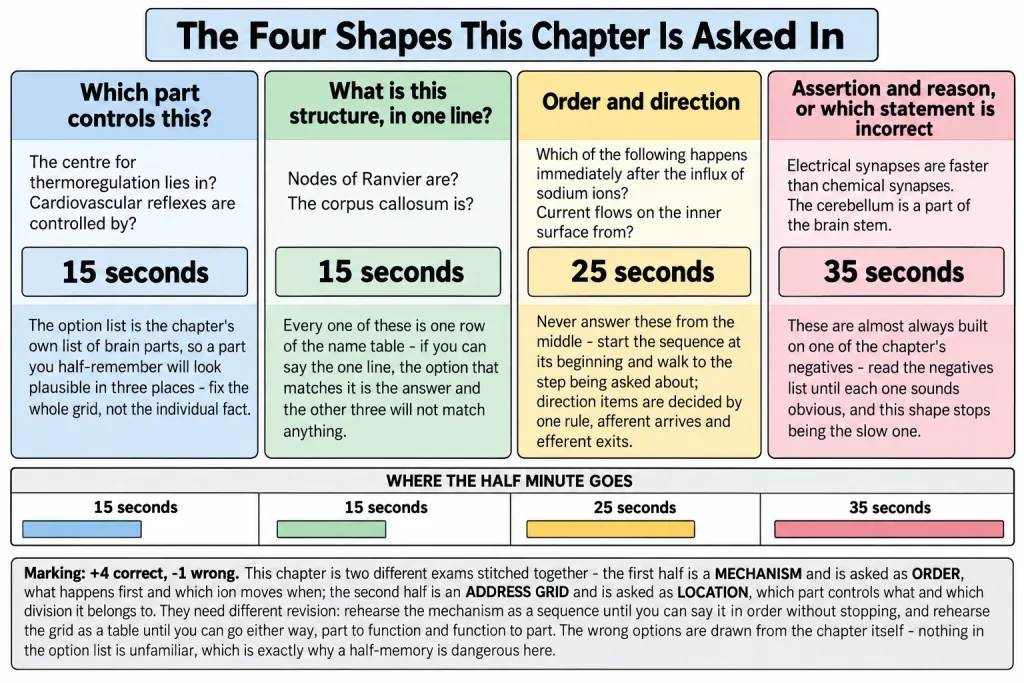
Shape 1 - Which part controls this? "The centre for thermoregulation lies in?" "Cardiovascular reflexes are controlled by?" Budget 15 seconds. The shortcut: the option list is the chapter's own list of brain parts, so a part you half-remember will look plausible in three places. Fix the grid, not the individual fact.
Shape 2 - What is this structure, in one line? "Nodes of Ranvier are?" "The corpus callosum is?" Budget 15 seconds. The shortcut: every one of these is one row of the name table below. If you can say the one line, the option that matches it is the answer and the other three will not match anything.
Shape 3 - Order and direction. "Which of the following happens immediately after the influx of sodium ions?" "In the resting membrane, current flows on the inner surface from?" Budget 25 seconds. The shortcut: never answer these from the middle. Start the sequence from its beginning and walk to the step being asked about. Direction items are decided by one rule - afferent arrives, efferent exits - and the inner-surface current runs from the depolarised site to the site ahead.
Shape 4 - Assertion and reason, or "which statement is incorrect". "Electrical synapses are faster than chemical synapses." "The cerebellum is a part of the brain stem." Budget 35 seconds. The shortcut: these are almost always built on one of the negatives listed below. Read the negatives list until each one sounds obvious, and this shape stops being the slow one.
Every Number in the Chapter
Learn these as a block, because the wrong options are drawn from this same block.
| Number | What it counts |
|---|---|
| 2 | Parts of the human neural system - CNS and PNS |
| 2 | Types of PNS nerve fibres - afferent and efferent |
| 2 | Divisions of the PNS - somatic and autonomic |
| 2 | Divisions of the autonomic system - sympathetic and parasympathetic |
| 3 | Major parts of a neuron - cell body, dendrites, axon |
| 3 | Types of neuron by axons and dendrites - multipolar, bipolar, unipolar |
| 2 | Types of axon - myelinated and non-myelinated |
| 3 out, 2 in | The sodium-potassium pump - 3 outwards for 2 into the cell |
| about -70 millivolts | The resting potential |
| 2 | Types of synapse - electrical and chemical |
| 3 | Cranial meninges - dura mater, arachnoid, pia mater, outer to inner |
| 3 | Major parts of the brain - forebrain, midbrain, hindbrain |
| 3 | Parts of the forebrain - cerebrum, thalamus, hypothalamus |
| 3 | Parts of the hindbrain - pons, cerebellum, medulla |
| 3 | Regions of the brain stem - midbrain, pons, medulla oblongata |
| 4 | Corpora quadrigemina - four round swellings on the dorsal midbrain |
| 24 hours | The circadian rhythm the brain runs |
| 12 pairs | Cranial nerves, from the brain |
| 31 pairs | Spinal nerves, from the spinal cord |
The two that get swapped most often: 3 out and 2 in for the pump, and 12 against 31 for the nerves. Both swaps look right at a glance and both cost -1.
One Name, One Line
Every Shape 2 question is one row of this table.
| Name | Its one line |
|---|---|
| Neuron | the highly specialised cell that detects, receives and transmits stimuli |
| Nissl's granules | the granular bodies in the cell body and the dendrites - not in the axon |
| Dendrite | short branching fibre that carries impulses TOWARDS the cell body |
| Axon | long fibre that carries impulses AWAY from the cell body |
| Synaptic knob | the bulb-like ending of an axon branch, holding synaptic vesicles |
| Schwann cell | present on both axon types - it forms a myelin sheath only in the myelinated one |
| Node of Ranvier | the gap between two adjacent myelin sheaths |
| Multipolar neuron | one axon and two or more dendrites; found in the cerebral cortex |
| Bipolar neuron | one axon and one dendrite; found in the retina of the eye |
| Unipolar neuron | cell body with one axon only; found usually in the embryonic stage |
| Resting potential | the potential difference across the resting plasma membrane - outside positive, inside negative |
| Action potential | the potential difference at the depolarised site - and it IS the nerve impulse |
| Synapse | the junction formed by a pre-synaptic and a post-synaptic membrane |
| Synaptic cleft | the fluid-filled space between them at a chemical synapse |
| Neurotransmitter | the chemical released from the vesicles into the cleft |
| Meninges | the three coverings of the brain inside the skull |
| Corpus callosum | the tract of nerve fibres connecting the two cerebral hemispheres |
| Cerebral cortex | the outer layer of cells of the hemisphere - the grey matter |
| Grey matter | grey because neuron cell bodies are concentrated there |
| White matter | white because the fibres of the tracts are covered with myelin sheath |
| Association areas | cortical regions neither clearly sensory nor motor - intersensory associations, memory, communication |
| Thalamus | the major coordinating centre for sensory and motor signalling |
| Hypothalamus | at the base of the thalamus; body temperature, eating and drinking, hypothalamic hormones |
| Limbic system | inner hemispheres plus amygdala and hippocampus; emotion, sexual behaviour, motivation, olfaction |
| Cerebral aqueduct | the canal passing through the midbrain |
| Corpora quadrigemina | the four round swellings on the dorsal midbrain |
| Pons | fibre tracts interconnecting different regions of the brain |
| Cerebellum | convoluted surface giving space for many more neurons; balance |
| Medulla | respiration, cardiovascular reflexes, gastric secretions |
| Brain stem | midbrain + pons + medulla, connecting the brain to the spinal cord |
The Negatives, and the Pairs That Get Swapped
The negatives
- The spinal cord is NOT part of the PNS. It is CNS. The spinal nerves are PNS.
- The resting membrane is NOT impermeable to potassium. It is comparatively MORE permeable to and nearly impermeable to .
- The sodium-potassium pump is NOT diffusion. It is active transport, and it costs energy.
- The rise in sodium permeability is NOT sustained. It is extremely short-lived, and is followed by a rise in potassium permeability.
- The action potential is not something separate from the nerve impulse. The chapter says the action potential is in fact termed as a nerve impulse.
- A chemical synapse is NOT faster than an electrical one. Electrical synapses are ALWAYS faster - and they are rare in our system, which is the second half of the same fact.
- A synapse does NOT always have a cleft. The definition says the two membranes may or may not be separated by a gap; the cleft belongs to the chemical synapse.
- The new potential in the post-synaptic neuron is NOT always excitatory. It may be either excitatory or inhibitory.
- Nissl's granules are NOT in the axon. They are in the cell body and the dendrites.
- The cerebellum is NOT part of the brain stem. The brain stem is midbrain, pons and medulla.
- The brain stem is NOT a fourth division of the brain. The divisions are three - forebrain, midbrain, hindbrain - and the brain stem cuts across two of them.
- The corpora quadrigemina are NOT in the hindbrain. They are on the dorsal midbrain.
- The medulla does NOT control balance. That is the cerebellum. The medulla controls respiration, cardiovascular reflexes and gastric secretions.
- The unmyelinated fibre is NOT without a Schwann cell. It is enclosed by a Schwann cell - that cell simply does not form a myelin sheath.
The pairs that get swapped
| This | Not this |
|---|---|
| Afferent: tissues to CNS | Efferent: CNS to tissues |
| Somatic: to skeletal muscle | Autonomic: to involuntary organs and smooth muscle |
| Dendrite: towards the cell body | Axon: away from the cell body |
| Bipolar: retina of the eye | Multipolar: cerebral cortex |
| Pump: 3 out | 2 in |
| Depolarisation: influx | Repolarisation: outflow |
| Inner surface: current from 'A' to 'B' | Outer surface: current from 'B' to 'A' |
| Grey matter: cell bodies, outer cortex | White matter: myelinated fibres, inner |
| Thalamus: sensory and motor coordination | Hypothalamus: temperature, hunger, thirst, hormones |
| Cerebellum: balance | Medulla: respiration and cardiovascular reflexes |
| 12 pairs: cranial nerves | 31 pairs: spinal nerves |
Solved Examples at NEET Pace
Each item names the shortcut it uses, because the shortcut is the thing worth carrying into the exam hall.
Question 1
Q. The sodium-potassium pump transports how many ions in each direction?
Answer. 3 outwards for 2 into the cell. Shortcut: sodium is the bigger number and it goes out. Sodium is high outside, so the pump has to keep pushing it out - the direction and the bigger number travel together.
Question 2
Q. In a resting neuron, the axonal membrane is comparatively more permeable to which ion?
Answer. . Shortcut: potassium is the inside ion, and the resting membrane lets its ion move. Sodium is the outside ion and the resting membrane is nearly impermeable to it.
Question 3
Q. Which structure carries impulses towards the cell body?
Answer. The dendrite. Shortcut: D for dendrite, D for the direction that ends at the cell body. The axon does the opposite.
Question 4
Q. Nodes of Ranvier are found between which two structures?
Answer. Between two adjacent myelin sheaths. Shortcut: a node is a gap, and a gap needs two things on either side of it. An option that puts the node between two Schwann cells or between two axons is testing whether you know what the gap is a gap in.
Question 5
Q. Bipolar neurons are found in which part of the body?
Answer. The retina of the eye. Shortcut: two poles, two eyes. Multipolar goes with the cerebral cortex, unipolar with the embryonic stage - the three locations are asked as a set.
Question 6
Q. Which of these is the correct order of the cranial meninges, from outside inward?
Answer. Dura mater, arachnoid, pia mater. Shortcut: DAP. Dura is the tough outer one, pia is the one in contact with the brain tissue, and arachnoid is the very thin one in between.
Question 7
Q. During the generation of an action potential, the outer surface of the membrane at the stimulated site becomes what?
Answer. Negatively charged, while the inner side becomes positively charged. Shortcut: the action potential is the reversal. Whatever the resting state was, the action potential is its mirror.
Question 8
Q. What immediately follows the extremely short-lived rise in permeability to sodium ions?
Answer. A rise in permeability to , so that potassium diffuses outside and the resting potential is restored. Shortcut: sodium in, then potassium out. The ions take turns, and sodium always goes first.
Question 9
Q. Transmission across which type of synapse is always faster?
Answer. The electrical synapse. Shortcut: no chemical step, no delay. Remember the second half too - electrical synapses are rare in our system - because the same fact gets asked from the other side.
Question 10
Q. The binding of a neurotransmitter to its receptor on the post-synaptic membrane does what?
Answer. It opens ion channels, and the entry of ions generates a new potential in the post-synaptic neuron, which may be excitatory or inhibitory. Shortcut: binding opens a channel; it does not by itself carry a charge across.
Question 11
Q. Which part of the brain is the major coordinating centre for sensory and motor signalling?
Answer. The thalamus. Shortcut: the thalamus is the switchboard, the hypothalamus is the housekeeper. Temperature, hunger and thirst belong to the hypothalamus; routing signals belongs to the thalamus.
Question 12
Q. The corpora quadrigemina are found on which part of which division of the brain?
Answer. On the dorsal portion of the midbrain. Shortcut: quadri means four, and four swellings sit on the roof of the midbrain. The cerebral aqueduct runs through the same division.
Question 13
Q. Centres controlling respiration, cardiovascular reflexes and gastric secretions lie in which part?
Answer. The medulla. Shortcut: the medulla runs the things you would die without. Breathing and the heart are its business; balance is the cerebellum's.
Question 14
Q. Which of the following is NOT a part of the brain stem?
Answer. The cerebellum. Shortcut: the brain stem is a stem, and the cerebellum hangs off the back of it. The stem is midbrain, pons and medulla oblongata.
Question 15
Q. The grey matter of the cerebrum owes its colour to what?
Answer. The concentration of neuron cell bodies in the cerebral cortex. Shortcut: cells are grey, cables are white. The white matter is white because its fibres are covered with the myelin sheath.
Question 16
Q. How many pairs of spinal nerves and how many pairs of cranial nerves are there?
Answer. 31 pairs of spinal nerves and 12 pairs of cranial nerves. Shortcut: the spinal cord is longer, so it gets the bigger number. Swapping the two is the single commonest arithmetic slip in this chapter.
A Drill Before You Move On
Decide each one before you read the verdict. Aim for 15 to 20 seconds per question.
- The spinal cord is part of the peripheral neural system. - False. The spinal cord is CNS; the spinal nerves are PNS.
- Afferent fibres carry regulatory impulses from the CNS to the organs. - False. That is efferent. Afferent carries impulses from the tissues and organs TO the CNS.
- The resting membrane is nearly impermeable to sodium ions. - True. And it is comparatively more permeable to potassium ions.
- The sodium-potassium pump moves 2 sodium ions out for 3 potassium ions in. - False. It is 3 sodium out for 2 potassium in.
- The action potential is another name for the nerve impulse. - True. The chapter says it is in fact termed as a nerve impulse.
- During depolarisation the outer surface becomes positively charged. - False. The polarity reverses - the outer surface becomes negative and the inner becomes positive.
- Repolarisation is brought about by potassium diffusing outside the membrane. - True.
- Every synapse has a synaptic cleft. - False. The two membranes may or may not be separated by a gap; the cleft belongs to the chemical synapse.
- Chemical synapses are faster than electrical synapses. - False. Electrical synapses are always faster, and they are rare in our system.
- Nissl's granules occur in the cell body, the dendrites and the axon. - False. In the cell body and the dendrites only.
- An unmyelinated axon has no Schwann cell. - False. It is enclosed by a Schwann cell; that cell simply does not form a myelin sheath.
- Multipolar neurons are found in the retina of the eye. - False. Those are bipolar. Multipolar neurons are found in the cerebral cortex.
- The arachnoid is the innermost of the cranial meninges. - False. It is the very thin middle layer; the innermost is the pia mater.
- The cerebrum is divided into two hemispheres by a deep cleft, and the two are connected by the corpus callosum. - True.
- The white matter of the cerebrum lies outside the grey matter. - False. The grey matter is the outer cortex; the white matter constitutes the inner part.
- The hypothalamus lies at the base of the thalamus. - True.
- The cerebral aqueduct passes through the hindbrain. - False. It passes through the midbrain.
- The cerebellum is a part of the brain stem. - False. The brain stem is midbrain, pons and medulla oblongata.
- The medulla contains centres controlling respiration and cardiovascular reflexes. - True. Gastric secretions belong to the same list.
- There are 12 pairs of spinal nerves. - False. 12 pairs are cranial; there are 31 pairs of spinal nerves.