
The Two Divisions of the Human Neural System
The human neural system is divided into two parts:
- the central neural system (CNS)
- the peripheral neural system (PNS)
| Division | What it is made of | What it does |
|---|---|---|
| Central neural system (CNS) | The brain and the spinal cord | It is the site of information processing and control |
| Peripheral neural system (PNS) | All the nerves of the body associated with the CNS - that is, with the brain and the spinal cord | It carries information to and from the CNS |
The split is easy to state and easy to lose marks on. The CNS is not "the brain"; it is the brain plus the spinal cord. The PNS is not "the nerves of the limbs"; it is all the nerves of the body that are associated with the CNS.
The phrase to memorise for the CNS is site of information processing and control. The CNS is where the decision is taken. The PNS is the wiring that brings the information in and carries the decision out.
[NEET Important] The commonest error is to put the spinal cord in the PNS. The spinal cord is CNS. What comes out of the spinal cord - the spinal nerves - is PNS. Keep the cord and the nerves apart.
Afferent and Efferent - Which Way the Impulse Travels
The nerve fibres of the PNS are of two types:
| Type of fibre | Direction of travel | What it carries |
|---|---|---|
| Afferent nerve fibres | From the tissues and organs TO the CNS | Impulses coming in - what the body is sensing |
| Efferent nerve fibres | From the CNS TO the concerned peripheral tissues and organs | Regulatory impulses going out - the instruction |
The word the chapter attaches to the efferent fibres is regulatory. An efferent impulse is not just travelling outward; it is going out to regulate the tissue or organ it reaches.
A trick that survives the exam hall: Afferent = Arriving at the CNS. Efferent = Exiting the CNS. Say it that way and the direction never inverts.
[NEET Important] Direction is the marked thing. Afferent carries impulses from tissues and organs to the CNS; efferent carries regulatory impulses from the CNS to the peripheral tissues and organs. A stem that describes a fibre carrying an impulse from the skin to the spinal cord wants afferent; one that describes a fibre running from the spinal cord to a muscle wants efferent.
Somatic, Autonomic and the Nerves Themselves
The PNS is divided into two divisions, and one of them divides again:
| Division of the PNS | Where it sends impulses |
|---|---|
| Somatic neural system | Relays impulses from the CNS to the skeletal muscles |
| Autonomic neural system | Transmits impulses from the CNS to the involuntary organs and the smooth muscles of the body |
The autonomic neural system is further classified into the sympathetic neural system and the parasympathetic neural system. Those two are taken up in the next section.
The nerves themselves. The nerves of the PNS come out of the two parts of the CNS, and they are counted:
| Kind of nerve | Where it arises from | How many |
|---|---|---|
| Cranial nerves | The brain | 12 pairs |
| Spinal nerves | The spinal cord | 31 pairs |
Both kinds are PNS, even though both arise from CNS structures - what makes a nerve peripheral is that it runs out into the body, not where it starts.
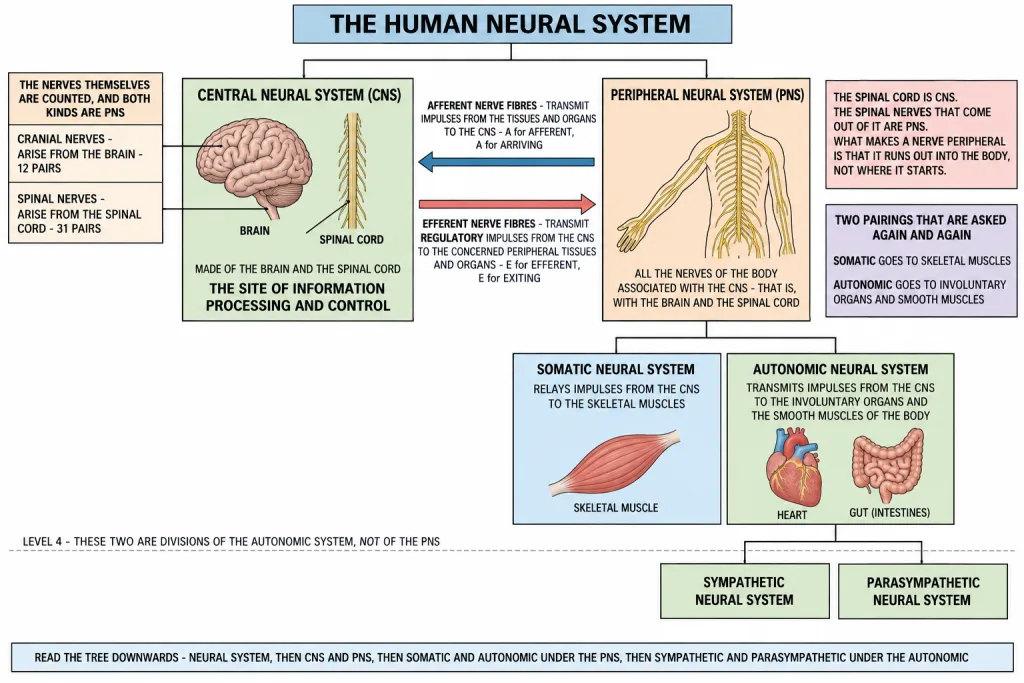
[NEET Important] Two pairings are asked again and again. Somatic goes to skeletal muscles; autonomic goes to involuntary organs and smooth muscles. And the counts: 12 pairs of cranial nerves, 31 pairs of spinal nerves - swapping those two numbers is the standard distractor.
Quick Recap
- The human neural system is divided into the central neural system (CNS) and the peripheral neural system (PNS).
- The CNS includes the brain and the spinal cord and is the site of information processing and control.
- The PNS comprises all the nerves of the body associated with the CNS (brain and spinal cord).
- PNS nerve fibres are of two types: afferent and efferent.
- Afferent nerve fibres transmit impulses from tissues and organs to the CNS.
- Efferent fibres transmit regulatory impulses from the CNS to the concerned peripheral tissues and organs.
- The PNS is divided into the somatic neural system and the autonomic neural system.
- The somatic neural system relays impulses from the CNS to skeletal muscles.
- The autonomic neural system transmits impulses from the CNS to the involuntary organs and smooth muscles of the body.
- The autonomic neural system is further classified into sympathetic and parasympathetic.
- 12 pairs of cranial nerves arise from the brain; 31 pairs of spinal nerves arise from the spinal cord. Both are part of the PNS.
Solved Examples
Question 1
Q. Compare the central neural system (CNS) and the peripheral neural system (PNS). This is one of the chapter-end exercises.
Answer.
| Feature | Central neural system (CNS) | Peripheral neural system (PNS) |
|---|---|---|
| What it is made of | The brain and the spinal cord | All the nerves of the body associated with the CNS |
| Position | Lies along the central axis of the body, protected by the skull and the vertebral column | Spreads out into the body, reaching every tissue and organ |
| Main role | The site of information processing and control - the decision is taken here | Carries information to the CNS and instructions away from it |
| Fibre types | Not classified this way | Afferent and efferent fibres |
| Divisions | Brain and spinal cord | Somatic and autonomic, and the autonomic further into sympathetic and parasympathetic |
The one line that gets the mark: the CNS processes and controls, the PNS connects. The spinal cord belongs to the CNS; the spinal nerves belong to the PNS.
Question 2
Q. Distinguish between afferent neurons and efferent neurons. This is one of the chapter-end exercises.
Answer.
| Feature | Afferent neurons | Efferent neurons |
|---|---|---|
| Direction of the impulse | From the tissues and organs TO the CNS | From the CNS TO the concerned peripheral tissues and organs |
| Nature of the impulse carried | Incoming information about what the body is sensing | Regulatory impulses - the instruction to act |
| Where the message ends | In the brain or the spinal cord | In a muscle, gland or other effector organ |
| Easy name for them | Sensory, because they bring the sensation in | Motor, because they carry the order out |
The one line that gets the mark: afferent fibres carry impulses towards the CNS, efferent fibres carry regulatory impulses away from it.
Question 3
Q. Distinguish between cranial nerves and spinal nerves. This is one of the chapter-end exercises.
Answer.
| Feature | Cranial nerves | Spinal nerves |
|---|---|---|
| Where they arise | From the brain | From the spinal cord |
| Number | 12 pairs | 31 pairs |
| Where they supply | Mainly the structures of the head and neck, and some reach further | The trunk and the limbs |
| Which system they belong to | The peripheral neural system | The peripheral neural system |
| Fibre type of the axons | Myelinated nerve fibres are found in cranial nerves | Myelinated nerve fibres are found in spinal nerves |
The one line that gets the mark: cranial nerves come off the brain and there are 12 pairs; spinal nerves come off the spinal cord and there are 31 pairs. Both are PNS.
Question 4
Q. The human neural system is divided into how many parts, and what are they?
Answer. Into two parts - the central neural system (CNS) and the peripheral neural system (PNS).
Question 5
Q. What does the CNS include, and what is it the site of?
Answer. The CNS includes the brain and the spinal cord, and it is the site of information processing and control.
Question 6
Q. A student writes that the PNS includes the spinal cord because the spinal nerves come out of it. Where is the mistake?
Answer. The spinal cord itself is part of the CNS. Only the nerves that come out of it - the spinal nerves - belong to the PNS. The PNS comprises all the nerves of the body associated with the CNS, and "associated with" means the nerves that run to and from the brain and spinal cord, not the brain and spinal cord themselves.
Question 7
Q. Name the two divisions of the PNS and state what each supplies.
Answer. The somatic neural system, which relays impulses from the CNS to the skeletal muscles, and the autonomic neural system, which transmits impulses from the CNS to the involuntary organs and the smooth muscles of the body.
Question 8
Q. Into what is the autonomic neural system further classified?
Answer. Into the sympathetic neural system and the parasympathetic neural system.
Question 9
Q. An impulse travels from a stretch receptor in a leg muscle up to the spinal cord. Name the type of fibre that carries it, and give its defining property.
Answer. An afferent nerve fibre. Afferent fibres transmit impulses from the tissues and organs to the CNS.
Question 10
Q. An impulse travels from the spinal cord to the muscle of the thigh, telling it to contract. Name the type of fibre and the exact word the chapter uses for the impulse it carries.
Answer. An efferent nerve fibre, and the impulse is called a regulatory impulse - efferent fibres transmit regulatory impulses from the CNS to the concerned peripheral tissues and organs.
Question 11
Q. Which division of the PNS would be involved when you deliberately lift your arm, and which when your intestine moves food along? Give a reason for each.
Answer. Lifting the arm uses the somatic neural system, because it relays impulses from the CNS to the skeletal muscles, and the muscle of the arm is a skeletal muscle under voluntary control. Moving food along the intestine uses the autonomic neural system, because it transmits impulses from the CNS to the involuntary organs and the smooth muscles of the body, and the intestinal wall is smooth muscle that is not under voluntary control.
Question 12
Q. Fill in the blanks: the CNS is the site of _ and , while the PNS comprises all the _ of the body associated with the CNS.
Answer. The CNS is the site of information processing and control, while the PNS comprises all the nerves of the body associated with the CNS.
Question 13
Q. Give the number of pairs of cranial nerves and of spinal nerves, and say where each arises.
Answer. 12 pairs of cranial nerves, arising from the brain. 31 pairs of spinal nerves, arising from the spinal cord.