
The Synapse - Where One Neuron Hands Over to the Next
An impulse that has travelled the length of an axon reaches the end of that neuron and has to get onto the next one. It does not simply carry on, because the two neurons are separate cells. A nerve impulse is transmitted from one neuron to another through junctions called synapses.
The chapter defines the junction precisely, and the wording is what gets marked:
A synapse is formed by the membranes of a pre-synaptic neuron and a post-synaptic neuron, which may or may not be separated by a gap called the synaptic cleft.
Read the two halves of that sentence separately.
- Which membranes. The synapse is built out of two membranes - the membrane of the neuron the impulse is arriving from, the pre-synaptic neuron, and the membrane of the neuron it is going to, the post-synaptic neuron. Direction is built into the names.
- May or may not. The two membranes are sometimes separated by a gap and sometimes not. That cautious phrase is doing real work - it is exactly what splits the synapses into two kinds.
There are two types of synapses - electrical synapses and chemical synapses. The one with no real gap is the electrical synapse; the one with a fluid-filled gap is the chemical synapse.
[NEET Important] The definition is asked as a fill-in. The junction is between a pre-synaptic and a post-synaptic neuron, the gap is the synaptic cleft, and the phrase may or may not be separated is the one students drop. An option that says every synapse has a cleft is wrong - the electrical synapse does not.
The Electrical Synapse - and How It Compares with the Chemical Synapse
At an electrical synapse, the membranes of the pre- and post-synaptic neurons are in very close proximity. There is no real fluid gap to cross, so there is nothing to ferry the signal across with.
- Because the membranes are so close, electrical current can flow directly from one neuron into the other across these synapses.
- That means transmission of an impulse across an electrical synapse is very similar to impulse conduction along a single axon. The impulse behaves as though it never left one fibre.
- Impulse transmission across an electrical synapse is always faster than that across a chemical synapse. The word is always, not usually.
- Electrical synapses are rare in our system. Fast, but uncommon.
| Feature | Electrical synapse | Chemical synapse |
|---|---|---|
| The two membranes | In very close proximity | Separated by a fluid-filled space called the synaptic cleft |
| What crosses | Electrical current flows directly from one neuron into the other | Neurotransmitters, released into the cleft |
| Resemblance | Very similar to impulse conduction along a single axon | Involves release, diffusion and binding to receptors |
| Speed | Always faster than a chemical synapse | Slower, because a chemical has to be released, cross the cleft and bind |
| How common in our system | Rare | The usual kind |
Put the two marked facts side by side and keep them there: the electrical synapse is always faster and it is rare. Speed and rarity go together in the same row, and an item that gives you one of them is usually testing whether you know the other.
[NEET Important] This pair is the most-asked fact in this part of the chapter. Electrical synapses are ALWAYS FASTER than chemical synapses, and they are RARE in our system. The two standard distractors invert exactly these - an option calling the chemical synapse the faster one, and an option calling electrical synapses the common type. Also remember the resemblance: electrical transmission is very similar to impulse conduction along a single axon.
The Chemical Synapse - What It Is Made Of
At a chemical synapse, the membranes of the pre- and post-synaptic neurons are separated by a fluid-filled space called the synaptic cleft. The impulse now has a real gap in front of it, and an electrical current cannot simply jump across a fluid-filled space. Something has to be carried over.
Chemicals called neurotransmitters are involved in the transmission of impulses at these synapses.
The pre-synaptic side is built for exactly this job:
- The axon terminals contain vesicles filled with these neurotransmitters. They are stocked and waiting before the impulse ever arrives.
- The post-synaptic membrane carries the specific receptors that those neurotransmitters fit into.
- Between the two lies the synaptic cleft, filled with fluid.
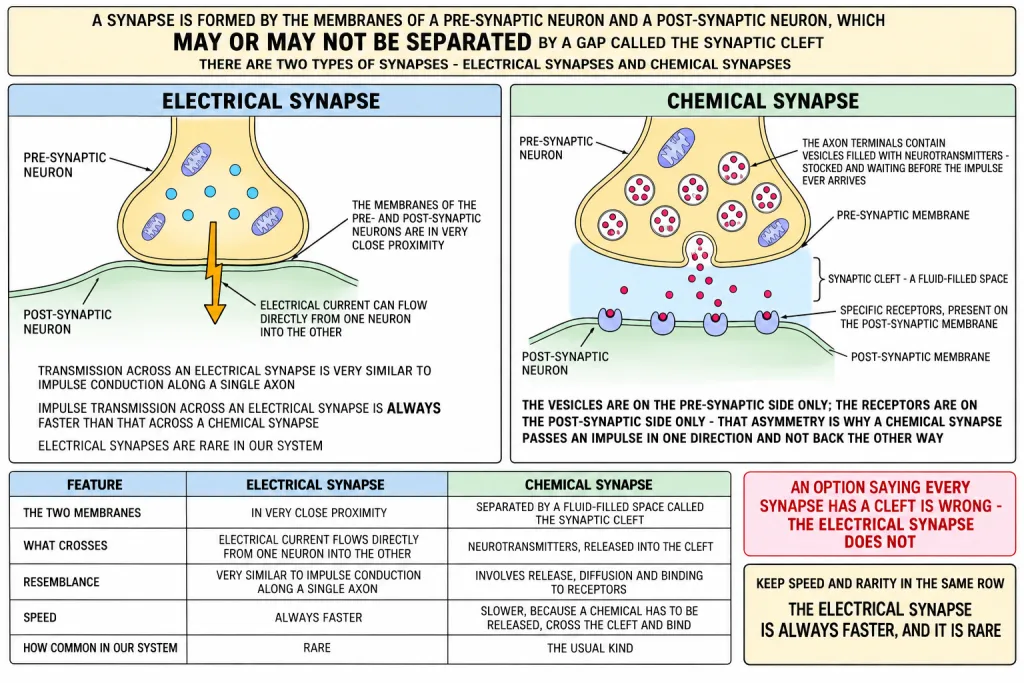
Notice how one-sided the structure is. The vesicles are on the pre-synaptic side only; the receptors are on the post-synaptic side only. That asymmetry is why a chemical synapse passes an impulse in one direction and not back the other way.
[NEET Important] Two locations are asked directly. The vesicles filled with neurotransmitters are in the axon terminals of the pre-synaptic neuron, and the specific receptors are on the post-synaptic membrane. Putting the receptors on the pre-synaptic membrane, or the vesicles on the post-synaptic side, is the standard trap.
How an Impulse Crosses a Chemical Synapse - Step by Step
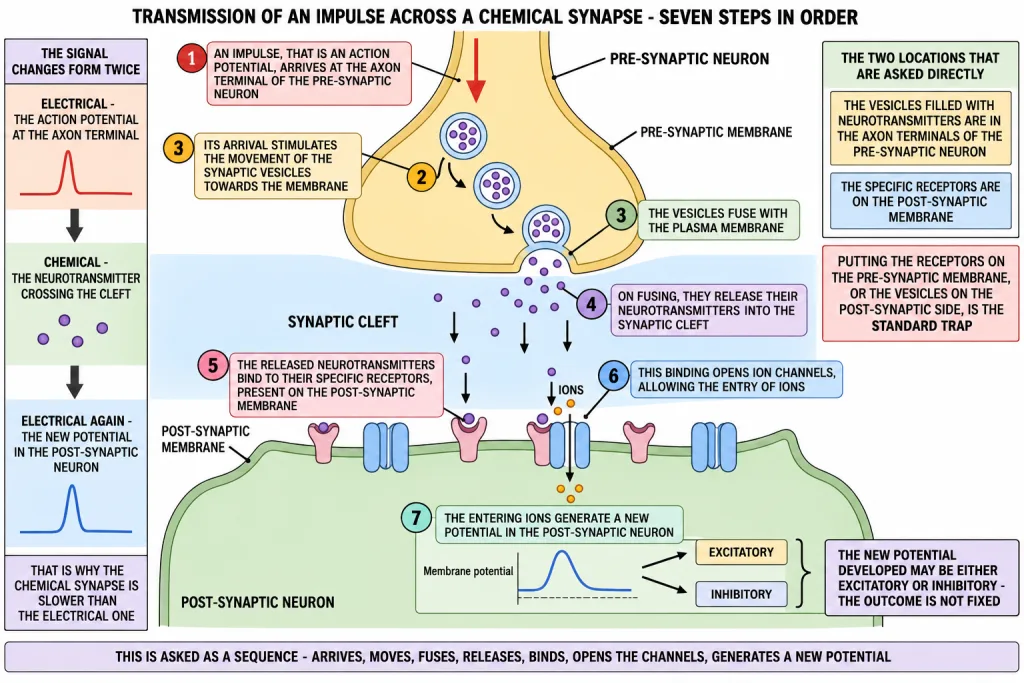
This is a sequence, and it is asked as a sequence. Learn it in order:
- An impulse (action potential) arrives at the axon terminal of the pre-synaptic neuron.
- Its arrival stimulates the movement of the synaptic vesicles towards the membrane.
- The vesicles fuse with the plasma membrane.
- On fusing, they release their neurotransmitters into the synaptic cleft.
- The released neurotransmitters bind to their specific receptors, present on the post-synaptic membrane.
- This binding opens ion channels, allowing the entry of ions.
- The entering ions generate a new potential in the post-synaptic neuron. The new potential developed may be either excitatory or inhibitory.
Two things are worth pulling out of that list.
The arriving signal changes form twice. It comes in as an electrical event - the action potential at the axon terminal. It crosses the cleft as a chemical - the neurotransmitter. It becomes electrical again on the far side - the new potential in the post-synaptic neuron. That is why the chemical synapse is slower than the electrical one.
The outcome is not fixed. Step 7 does not say the next neuron always fires. The new potential may be either excitatory or inhibitory - an excitatory one pushes the post-synaptic neuron towards generating its own impulse, an inhibitory one holds it back. The chapter is careful about this and so should you be.
[NEET Important] Sequence items are common here: arrival at the axon terminal, movement of vesicles, fusion with the plasma membrane, release into the cleft, binding to receptors on the post-synaptic membrane, opening of ion channels, entry of ions, new potential. Two marked details: the neurotransmitters bind to specific receptors on the post-synaptic membrane (not anywhere on it), and the new potential is either excitatory or inhibitory - an option that says it is always excitatory is wrong.
Quick Recap
- A nerve impulse is transmitted from one neuron to another through junctions called synapses.
- A synapse is formed by the membranes of a pre-synaptic neuron and a post-synaptic neuron, which may or may not be separated by a gap called the synaptic cleft.
- There are two types of synapses - electrical synapses and chemical synapses.
- At an electrical synapse the membranes of the pre- and post-synaptic neurons are in very close proximity, and electrical current can flow directly from one neuron into the other.
- Transmission across an electrical synapse is very similar to impulse conduction along a single axon.
- Impulse transmission across an electrical synapse is always faster than that across a chemical synapse, and electrical synapses are rare in our system.
- At a chemical synapse the membranes are separated by a fluid-filled space called the synaptic cleft, and chemicals called neurotransmitters carry the impulse across.
- The axon terminals contain vesicles filled with these neurotransmitters.
- The steps in order: the impulse arrives at the axon terminal; it stimulates the movement of the synaptic vesicles towards the membrane; the vesicles fuse with the plasma membrane; they release their neurotransmitters into the synaptic cleft; the neurotransmitters bind to their specific receptors on the post-synaptic membrane; the binding opens ion channels allowing the entry of ions; the ions generate a new potential in the post-synaptic neuron.
- The new potential developed may be either excitatory or inhibitory.
Solved Examples
Question 1
Q. Explain the transmission of a nerve impulse across a chemical synapse. This is one of the chapter-end exercises.
Answer. At a chemical synapse the membranes of the pre-synaptic neuron and the post-synaptic neuron are separated by a fluid-filled space called the synaptic cleft. An electrical current cannot simply cross that fluid gap, so the message is carried over by chemicals called neurotransmitters. The axon terminals contain vesicles filled with these neurotransmitters, ready before the impulse arrives.
The transmission happens in this order:
- An impulse (action potential) arrives at the axon terminal.
- It stimulates the movement of the synaptic vesicles towards the membrane.
- The vesicles fuse with the plasma membrane.
- They release their neurotransmitters into the synaptic cleft.
- The released neurotransmitters bind to their specific receptors, present on the post-synaptic membrane.
- This binding opens ion channels, allowing the entry of ions.
- The entering ions generate a new potential in the post-synaptic neuron.
The new potential developed may be either excitatory or inhibitory. An excitatory potential pushes the post-synaptic neuron towards firing its own impulse; an inhibitory one holds it back. So the signal changes form twice on the way across - electrical at the axon terminal, chemical in the cleft, and electrical again in the post-synaptic neuron.
Question 2
Q. Write a short note on the synapse. This is one of the chapter-end exercises.
Answer. A synapse is a junction between neurons. A nerve impulse is transmitted from one neuron to another through junctions called synapses, and a synapse is formed by the membranes of a pre-synaptic neuron and a post-synaptic neuron, which may or may not be separated by a gap called the synaptic cleft.
There are two types of synapses - electrical synapses and chemical synapses.
At an electrical synapse the membranes of the pre- and post-synaptic neurons are in very close proximity, so electrical current can flow directly from one neuron into the other. Transmission there is very similar to impulse conduction along a single axon, it is always faster than transmission across a chemical synapse, and electrical synapses are rare in our system.
At a chemical synapse the two membranes are separated by a fluid-filled space called the synaptic cleft, and neurotransmitters carry the impulse across. The axon terminals contain vesicles filled with these neurotransmitters. The arriving impulse makes the vesicles move to the membrane, fuse with it and release the neurotransmitters into the cleft; the neurotransmitters bind to specific receptors on the post-synaptic membrane, the binding opens ion channels, and the entry of ions generates a new potential in the post-synaptic neuron, which may be either excitatory or inhibitory.
Question 3
Q. Define a synapse in the exact terms the chapter uses.
Answer. A synapse is formed by the membranes of a pre-synaptic neuron and a post-synaptic neuron, which may or may not be separated by a gap called the synaptic cleft. The phrase may or may not is the part that must not be dropped - the electrical synapse has no such gap.
Question 4
Q. Name the two types of synapses and give the one structural difference between them.
Answer. Electrical synapses and chemical synapses. The structural difference is the gap: at an electrical synapse the two membranes are in very close proximity, while at a chemical synapse they are separated by a fluid-filled space called the synaptic cleft.
Question 5
Q. Compare an electrical synapse with a chemical synapse.
Answer.
| Feature | Electrical synapse | Chemical synapse |
|---|---|---|
| The two membranes | In very close proximity | Separated by a fluid-filled synaptic cleft |
| What crosses the junction | Electrical current flows directly from one neuron into the other | Neurotransmitters released into the cleft |
| What it resembles | Impulse conduction along a single axon | Release of a chemical, its diffusion and its binding to receptors |
| Speed | Always faster | Slower |
| Occurrence in our system | Rare | The usual kind of synapse |
The one line that gets the mark: the electrical synapse is always faster but rare; the chemical synapse is slower but is the one the body mostly uses.
Question 6
Q. Which type of synapse conducts an impulse faster, and why?
Answer. The electrical synapse. Its two membranes are in very close proximity, so electrical current can flow directly from one neuron into the other - nothing has to be released, diffused across a gap and bound to a receptor first. That is why impulse transmission across an electrical synapse is always faster than that across a chemical synapse.
Question 7
Q. Why is transmission across an electrical synapse described as being very similar to impulse conduction along a single axon?
Answer. Because at an electrical synapse there is no fluid gap and no chemical messenger. The membranes are in very close proximity and the electrical current simply flows on from one neuron into the other, in the same way that local current flow carries the impulse from one point of an axon to the next. The impulse behaves as though it had never left a single fibre.
Question 8
Q. Electrical synapses are the faster kind. Why then is most transmission in our body chemical?
Answer. Because electrical synapses are rare in our system. Speed is not the only thing that matters - a chemical synapse can produce a potential in the post-synaptic neuron that is either excitatory or inhibitory, so it can stop a signal as well as pass it on. An electrical synapse simply carries the current through.
Question 9
Q. What are neurotransmitters and where are they stored before they are used?
Answer. Neurotransmitters are the chemicals involved in the transmission of impulses at chemical synapses. They are stored in vesicles, and those vesicles are contained in the axon terminals of the pre-synaptic neuron.
Question 10
Q. What happens to the synaptic vesicles when an impulse arrives at the axon terminal?
Answer. The arriving impulse (action potential) stimulates the movement of the synaptic vesicles towards the membrane, where they fuse with the plasma membrane and release their neurotransmitters into the synaptic cleft.
Question 11
Q. Where exactly do the released neurotransmitters go, and what does their arrival there do?
Answer. They bind to their specific receptors, present on the post-synaptic membrane. That binding opens ion channels, which allows the entry of ions, and the entering ions generate a new potential in the post-synaptic neuron.
Question 12
Q. The new potential generated in the post-synaptic neuron - is it always one that makes the neuron fire? Give the chapter's exact position.
Answer. No. The new potential developed may be either excitatory or inhibitory. An excitatory potential moves the post-synaptic neuron towards generating its own impulse; an inhibitory one moves it away from doing so. Saying the post-synaptic neuron always fires is wrong.
Question 13
Q. These steps of chemical synaptic transmission are jumbled. Put them in order: binding to receptors; fusion of vesicles with the plasma membrane; entry of ions; arrival of the impulse at the axon terminal; opening of ion channels; release of neurotransmitters into the cleft; movement of vesicles towards the membrane.
Answer. In order:
- Arrival of the impulse (action potential) at the axon terminal.
- Movement of the synaptic vesicles towards the membrane.
- Fusion of the vesicles with the plasma membrane.
- Release of the neurotransmitters into the synaptic cleft.
- Binding of the neurotransmitters to their specific receptors on the post-synaptic membrane.
- Opening of ion channels.
- Entry of ions, generating a new potential in the post-synaptic neuron.
Question 14
Q. A chemical synapse passes an impulse in one direction only. Which two structural facts from the chapter explain that?
Answer. First, the vesicles filled with neurotransmitters are in the axon terminals - that is, on the pre-synaptic side only. Second, the specific receptors are present on the post-synaptic membrane - on the far side only. The chemical can only be released from one side and can only be received on the other, so the message can only travel one way across the synaptic cleft.