
The Thalamus - the Structure the Cerebrum Wraps Around
The forebrain has three parts - cerebrum, thalamus and hypothalamus. The cerebrum has already been dealt with. The other two are small, they sit deep inside the brain, and between them they run a surprising amount of the body.
Start with position, because position is half the answer in this part of the chapter:
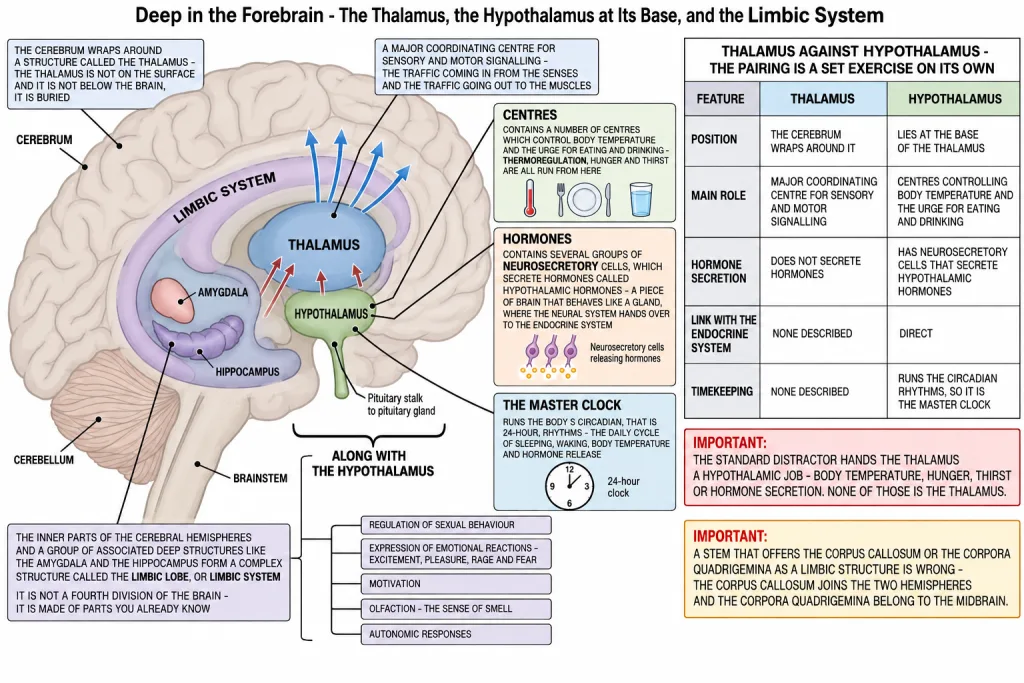
- The cerebrum wraps around a structure called the thalamus. The thalamus is not on the surface and it is not below the brain - it is buried, with the cerebral hemispheres folded around it.
And the job:
- The thalamus is a major coordinating centre for sensory and motor signalling.
Read that phrase carefully, because it is the whole of the thalamus in the exam. It is a coordinating centre, and what it coordinates is sensory and motor signalling - the traffic coming in from the senses and the traffic going out to the muscles. Almost everything the cerebral cortex is going to process passes through the thalamus first, and almost every instruction the cortex issues passes back out through it. That is why a structure this small is called major.
[NEET Important] Two facts, both one-liners. The cerebrum wraps around the thalamus, and the thalamus is a major coordinating centre for sensory and motor signalling. The standard distractor hands the thalamus a hypothalamic job - body temperature, hunger, thirst or hormone secretion. None of those is the thalamus.
The Hypothalamus - the Control Panel, and the Master Clock
Another very important part of the brain called the hypothalamus lies at the base of the thalamus. Learn the relation in that direction: hypo- means below, and the hypothalamus is the part below, that is, at the base of the thalamus. The two names look alike and the exam relies on students mixing them up.
The hypothalamus does three separate things:
- It contains a number of centres which control body temperature and the urge for eating and drinking. Thermoregulation, hunger and thirst are all run from here.
- It contains several groups of neurosecretory cells, which secrete hormones called hypothalamic hormones. This is a piece of brain that behaves like a gland - it is the point where the neural system hands over to the endocrine system.
- It is the part of the central neural system that runs the body's circadian (24-hour) rhythms - the daily cycle of sleeping, waking, body temperature and hormone release. That makes it the master clock of the central neural system.
Now put the two neighbours side by side, because this pairing is a set exercise on its own:
| Feature | Thalamus | Hypothalamus |
|---|---|---|
| Position | The cerebrum wraps around it | Lies at the base of the thalamus |
| Main role | Major coordinating centre for sensory and motor signalling | Contains centres controlling body temperature and the urge for eating and drinking |
| Hormone secretion | Does not secrete hormones | Has neurosecretory cells that secrete hypothalamic hormones |
| Link with the endocrine system | None described | Direct - its hormones control endocrine activity |
| Timekeeping | None described | Runs the circadian (24-hour) rhythms, so it is the master clock |
[NEET Important] The word neurosecretory carries a mark on its own - the hypothalamus contains groups of neurosecretory cells and what they release are hypothalamic hormones, not neurotransmitters. And for the master-clock item the answer is the hypothalamus, because it is the part running the circadian (24-hour) rhythms; "cerebrum" is the tempting wrong answer because the cerebrum is the biggest part, but size is not the point here.
The Limbic System - Where Emotion Lives
The inner parts of the cerebral hemispheres and a group of associated deep structures like the amygdala and the hippocampus form a complex structure called the limbic lobe or limbic system.
Notice what that definition is doing. The limbic system is not a fourth division of the brain sitting somewhere new - it is made of the inner parts of the cerebral hemispheres you already know, plus some deep structures that get their own names. Two of those deep structures are named in the chapter and both are askable: the amygdala and the hippocampus.
Along with the hypothalamus, the limbic system is involved in:
- the regulation of sexual behaviour
- the expression of emotional reactions - the chapter gives four examples: excitement, pleasure, rage and fear
- motivation
- olfaction - the sense of smell
- autonomic responses
The phrase along with the hypothalamus matters. The limbic system does not do this work alone; the chapter always names the two together. That is also why the hypothalamus turns up twice in this section - once for its own centres and hormones, and again as the limbic system's partner.
[NEET Important] The four named emotions - excitement, pleasure, rage and fear - are asked as a set, and so is the pairing limbic system along with the hypothalamus. The two deep structures to memorise are the amygdala and the hippocampus; a stem that offers the corpus callosum or the corpora quadrigemina as a limbic structure is wrong - the corpus callosum joins the two hemispheres and the corpora quadrigemina belong to the midbrain.
Quick Recap
- The forebrain consists of the cerebrum, the thalamus and the hypothalamus.
- The cerebrum wraps around a structure called the thalamus.
- The thalamus is a major coordinating centre for sensory and motor signalling.
- The hypothalamus lies at the base of the thalamus.
- The hypothalamus contains a number of centres which control body temperature and the urge for eating and drinking.
- The hypothalamus also contains several groups of neurosecretory cells, which secrete hormones called hypothalamic hormones.
- The hypothalamus runs the body's circadian (24-hour) rhythms, which makes it the master clock of the central neural system.
- The inner parts of the cerebral hemispheres and a group of associated deep structures like the amygdala and the hippocampus form the limbic lobe or limbic system.
- Along with the hypothalamus, the limbic system is involved in the regulation of sexual behaviour, the expression of emotional reactions such as excitement, pleasure, rage and fear, and motivation, as well as olfaction and autonomic responses.
Solved Examples
Question 1
Q. Differentiate between the thalamus and the hypothalamus. This is one of the chapter-end exercises.
Answer.
| Feature | Thalamus | Hypothalamus |
|---|---|---|
| Position | The cerebrum wraps around it | Lies at the base of the thalamus |
| Division of the brain | Forebrain | Forebrain |
| Main function | A major coordinating centre for sensory and motor signalling | Contains a number of centres which control body temperature and the urge for eating and drinking |
| Secretion | Does not secrete hormones | Contains several groups of neurosecretory cells which secrete hypothalamic hormones |
| Control of body rhythms | Not described as doing this | Runs the circadian (24-hour) rhythms, so it acts as the master clock |
| Relation to the limbic system | Not a partner of it | Works along with the limbic system in sexual behaviour, emotions and motivation |
The one line that gets the mark: the thalamus is the relay and coordinating centre for sensory and motor signalling, while the hypothalamus is the control centre for body temperature, hunger, thirst and hormone secretion and lies below the thalamus.
Question 2
Q. Which part of our central neural system acts as a master clock? This is one of the chapter-end exercises.
Answer. The hypothalamus.
A clock is the part that keeps time, and the body does keep time - it runs on circadian (24-hour) rhythms. Sleep and waking, body temperature, hunger and the release of several hormones all rise and fall on a roughly 24-hour cycle. The part of the brain that houses the centres running those rhythms is the hypothalamus, which is why it is called the master clock of the central neural system.
It is the natural place for the job. The hypothalamus already controls body temperature and the urge for eating and drinking, and its neurosecretory cells secrete hypothalamic hormones that set the activity of the endocrine glands. All three of those things follow a daily rhythm, so the structure that controls them is the structure that keeps the time.
Question 3
Q. Which structure does the cerebrum wrap around, and what is that structure's function?
Answer. The cerebrum wraps around the thalamus. The thalamus is a major coordinating centre for sensory and motor signalling - it coordinates the sensory traffic coming in and the motor traffic going out.
Question 4
Q. Where exactly does the hypothalamus lie, and which two kinds of centres does it contain?
Answer. The hypothalamus lies at the base of the thalamus. It contains a number of centres which control body temperature and the urge for eating and drinking, and it also contains several groups of neurosecretory cells, which secrete hormones called hypothalamic hormones.
Question 5
Q. What are hypothalamic hormones, and which cells secrete them?
Answer. Hypothalamic hormones are the hormones secreted by the hypothalamus. They are released by several groups of neurosecretory cells present in the hypothalamus. The word to keep is neurosecretory - these are nerve cells that behave like gland cells, and they are the bridge between the neural system and the endocrine system.
Question 6
Q. Which structures together form the limbic lobe, and what is another name for it?
Answer. The inner parts of the cerebral hemispheres together with a group of associated deep structures like the amygdala and the hippocampus form the limbic lobe, which is also called the limbic system.
Question 7
Q. List the functions in which the limbic system, along with the hypothalamus, is involved.
Answer. Working along with the hypothalamus, the limbic system is involved in:
- the regulation of sexual behaviour;
- the expression of emotional reactions such as excitement, pleasure, rage and fear;
- motivation;
- olfaction;
- autonomic responses.
Question 8
Q. Name the two deep structures the chapter gives as examples of parts of the limbic system.
Answer. The amygdala and the hippocampus.
Question 9
Q. A patient can see, hear and move normally, but cannot regulate body temperature and feels thirsty all the time. Which part of the brain is most likely affected, and why?
Answer. The hypothalamus. It contains a number of centres which control body temperature and the urge for eating and drinking, so damage there disturbs thermoregulation and thirst while leaving vision, hearing and movement - which belong to the cerebrum and other parts - untouched.
Question 10
Q. A student writes that the thalamus lies at the base of the hypothalamus. Correct the statement.
Answer. It is the other way round. The hypothalamus lies at the base of the thalamus. The prefix hypo- means below, so the hypothalamus is the part below the thalamus.
Question 11
Q. What is meant by a circadian rhythm, and which part of the brain runs it?
Answer. A circadian rhythm is a body rhythm that repeats on a 24-hour cycle - the daily pattern of sleep and waking, of body temperature, of hunger and of several hormone releases. The part of the central neural system that runs these circadian (24-hour) rhythms is the hypothalamus, which is why it is called the master clock.
Question 12
Q. Why does the chapter always say the limbic system acts "along with the hypothalamus" instead of on its own?
Answer. Because the two work as a pair. The limbic system supplies the emotional and motivational side - sexual behaviour, the expression of emotional reactions, motivation, olfaction and autonomic responses - while the hypothalamus supplies the bodily side, through its centres for body temperature, eating and drinking and its hypothalamic hormones. An emotion such as fear is not only a feeling; it changes heart rate, breathing and hormone release as well. That second half of the response needs the hypothalamus, so the chapter names the two together.
Question 13
Q. Fill in the blanks: the cerebrum wraps around the , which is a major coordinating centre for and _ signalling; the lies at the base of it and secretes _ hormones.
Answer. The cerebrum wraps around the thalamus, which is a major coordinating centre for sensory and motor signalling; the hypothalamus lies at the base of it and secretes hypothalamic hormones.