
Coordination - What the Word Actually Means
The functions of the organs and organ systems in our body have to be coordinated if the body is to maintain homeostasis. The chapter gives the word a precise meaning, and that exact wording is what gets marked:
Coordination is the process through which two or more organs interact and complement the functions
of one another.
The word that carries the mark is complement. Coordination is not one organ ordering another about; it is two or more organs working so that each one's activity fits what the others are doing.
The worked example the chapter opens with - physical exercise. Follow the chain, because every link in it is a separate organ being pulled into line:
- You start exercising, so the energy demand goes up to maintain the increased muscular activity.
- The supply of oxygen is increased to meet that demand.
- That increased oxygen supply needs an increase in the rate of respiration, in the heart beat, and in the blood flow through the blood vessels.
- When the physical exercise is stopped, the activities of the nerves, lungs, heart and kidney gradually return to their normal conditions.
So during a single bout of exercise the muscles, lungs, heart, blood vessels, kidney and other organs are all coordinated. Not one of them acted alone, and not one of them was left behind when the exercise stopped.
[NEET Important] The definition is asked word for word. Two or more organs interact and
COMPLEMENT the functions of one another - the common distractor replaces complement with control
or with replace, and both are wrong. Also note the return leg: after exercise the organs
gradually return to normal, they do not stop and they do not stay elevated.
Two Systems Do the Coordinating
In our body the neural system and the endocrine system jointly coordinate and integrate all the activities of the organs, so that they function in a synchronised fashion. They are not alternatives to each other - both are running all the time, and the chapter is careful to say jointly.
They do the job in two completely different ways:
| Feature | Neural system | Endocrine system |
|---|---|---|
| What it provides | An organised network of point-to-point connections | Chemical integration |
| The messenger | The nerve impulse, carried along neurons | Hormones |
| The route | Along a fixed wired path from one definite point to another definite point | Carried in the blood, reaching the cells that have the right receptor |
| Speed | Built for quick coordination | Slower to arrive, because the message has to travel in the blood |
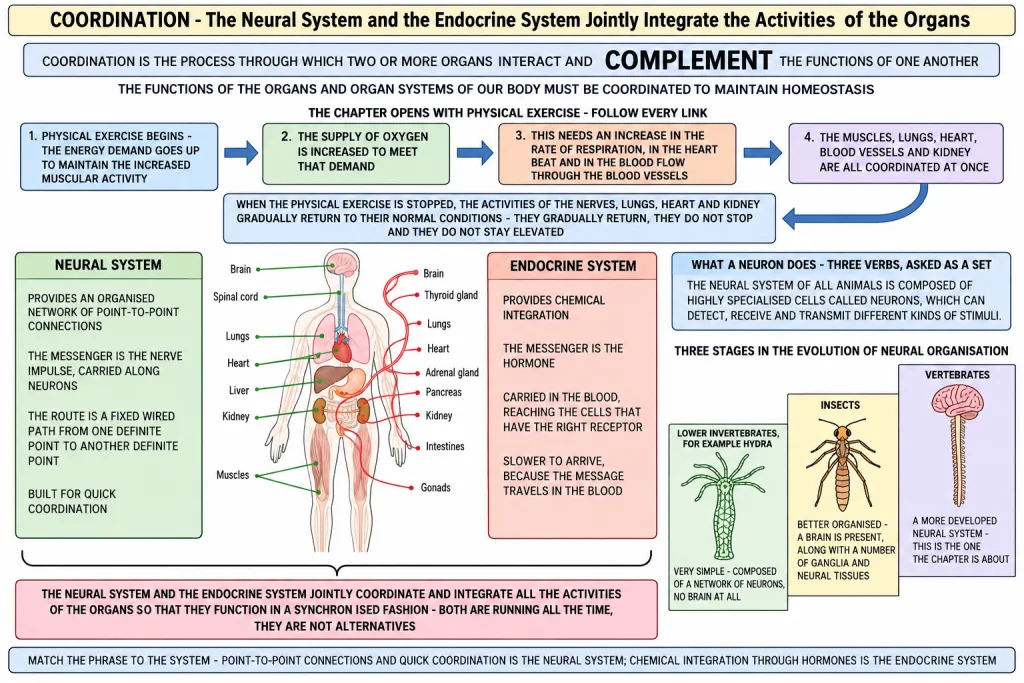
The phrase point-to-point is the whole idea of the neural system. A nerve impulse does not spread out over the body hoping to find its target - it runs down a definite fibre and arrives at one definite place. That is why the neural route is the fast route.
[NEET Important] Match the phrase to the system: point-to-point connections and quick
coordination = neural system, chemical integration through hormones = endocrine system. An item
that offers "chemical integration" as a property of the neural system is wrong, and so is one that
makes the two systems alternatives instead of partners - the chapter's word is jointly.
Neurons, and the Neural System Across Animals
The neural system of all animals is composed of highly specialised cells called neurons, which can detect, receive and transmit different kinds of stimuli. That is a set of three verbs and it is asked as a set.
How those neurons are organised, however, changes enormously as you go up the animal groups:
| Group | How the neural system is organised |
|---|---|
| Lower invertebrates, for example Hydra | Very simple - composed of a network of neurons |
| Insects | Better organised - a brain is present, along with a number of ganglia and neural tissues |
| Vertebrates | A more developed neural system |
Read that as a ladder with three rungs. Hydra has no brain at all, only a net. The insect has a brain but its work is shared with ganglia scattered along the body. The vertebrate has the developed system that the rest of this chapter is about.
What this chapter goes on to cover: the neural system of the human, and the mechanisms of neural coordination - the transmission of the nerve impulse and impulse conduction across a synapse.
[NEET Important] The Hydra rung is the one that gets asked, and the marked words are network of
neurons - not "nerve cord", not "brain". For insects the marked pairing is brain plus ganglia;
an option that gives insects a brain only, with no ganglia, is the standard distractor.
Quick Recap
- Coordination is the process through which two or more organs interact and complement the functions of one another, and it is what keeps homeostasis.
- In the exercise example, increased energy demand raises oxygen supply, which raises the rate of respiration, the heart beat and the blood flow; when exercise stops, the nerves, lungs, heart and kidney gradually return to normal.
- The neural system and the endocrine system jointly coordinate and integrate all the activities of the organs so that they function in a synchronised fashion.
- The neural system provides an organised network of point-to-point connections for quick coordination.
- The endocrine system provides chemical integration through hormones.
- The neural system of all animals is composed of neurons, highly specialised cells that detect, receive and transmit different kinds of stimuli.
- Lower invertebrates such as Hydra: a network of neurons. Insects: a brain plus a number of ganglia and neural tissues. Vertebrates: a more developed neural system.
Solved Examples
Question 1
Q. Write a short note on neural coordination. This is one of the chapter-end exercises.
Answer. Neural coordination is the coordination the body carries out through its neural system. The organs of the body cannot work in isolation - their functions have to be matched to one another so that homeostasis is maintained, and coordination is the process through which two or more organs interact and complement the functions of one another.
The neural system does this by providing an organised network of point-to-point connections. The message is a nerve impulse, it travels along neurons, and it goes from one definite place to another definite place instead of spreading through the body. That is what makes neural coordination quick, and it is why the neural system is the one the body uses when a response is needed at once.
The other half of the job belongs to the endocrine system, which provides chemical integration through hormones. The two systems act jointly, so that all the organs of the body function in a synchronised fashion. A good example is physical exercise: the increased energy demand of the muscles raises the oxygen supply, and with it the rate of respiration, the heart beat and the blood flow, and when the exercise stops the activities of the nerves, lungs, heart and kidney gradually return to their normal conditions.
Question 2
Q. Why is the neural system described as providing point-to-point connections, and what does the body gain from that arrangement?
Answer. Because a nerve impulse travels along a definite fibre from one definite point to another definite point. It is not released into the blood and it does not go looking for a target. The gain is speed - the chapter calls it quick coordination. A hormone has to be carried in the blood to reach its target, which takes time; an impulse is already wired to where it is going.
Question 3
Q. During physical exercise the demand for energy increases. List, in order, the changes that follow from that in the body.
Answer. In order:
- The energy demand increases for maintaining the increased muscular activity.
- The supply of oxygen is increased.
- That increased oxygen supply needs an increase in the rate of respiration, an increase in the heart beat, and an increased blood flow via the blood vessels.
- When the physical exercise is stopped, the activities of the nerves, lungs, heart and kidney gradually return to their normal conditions.
The point of the example is that the muscles, lungs, heart, blood vessels and kidney were all coordinated during a single activity.
Question 4
Q. Name the two systems that jointly coordinate and integrate the activities of the organs, and state in one line what each contributes.
Answer. The neural system and the endocrine system. The neural system provides an organised network of point-to-point connections for quick coordination. The endocrine system provides chemical integration through hormones.
Question 5
Q. What are neurons, and what three things can they do?
Answer. Neurons are the highly specialised cells that the neural system of all animals is composed of. They can detect, receive and transmit different kinds of stimuli.
Question 6
Q. Compare the organisation of the neural system in Hydra, in insects and in vertebrates.
Answer.
| Animal group | Organisation of the neural system |
|---|---|
| Hydra, a lower invertebrate | Very simple - a network of neurons, with no brain |
| Insects | Better organised - a brain is present along with a number of ganglia and neural tissues |
| Vertebrates | A more developed neural system |
The single line worth remembering: Hydra has a net, the insect has a brain plus ganglia, and the vertebrate has the developed system.
Question 7
Q. A student writes that coordination means "one organ controlling the functions of another". Correct the statement.
Answer. That is wrong. Coordination is the process through which two or more organs interact and complement the functions of one another. The organs complement each other - each one's activity fits what the others are doing. It is not a one-way chain of command.
Question 8
Q. What is homeostasis, and how is coordination related to it?
Answer. Homeostasis is the maintenance of a steady internal state in the body. The functions of the organs and organ systems must be coordinated to maintain homeostasis - if the organs worked independently, their activities would pull the internal state in different directions. Coordination is the process that keeps them matched.
Question 9
Q. After exercise stops, do the heart and lungs shut down at once? What does the chapter say happens?
Answer. No. When physical exercise is stopped, the activities of the nerves, lungs, heart and kidney gradually return to their normal conditions. The word that gets marked is gradually - the return is a slow settling back to normal, not a sudden switch-off.
Question 10
Q. Which two mechanisms of neural coordination does this chapter set out to explain?
Answer. The transmission of the nerve impulse along the neuron, and impulse conduction across a synapse - the junction between one neuron and the next.
Question 11
Q. Why can the neural system respond faster than the endocrine system?
Answer. The neural system's message travels as an impulse along a fixed, wired, point-to-point path, so it arrives at its target directly. The endocrine system's message is a hormone that has to be carried in the blood before it reaches the cells it acts on. A wired route beats a carried route, which is why the neural system is the one built for quick coordination.
Question 12
Q. Fill in the blank: the neural system provides an organised network of _ connections, while the endocrine system provides _ integration.
Answer. The neural system provides an organised network of point-to-point connections, while the endocrine system provides chemical integration.