
The Voluntary Half and the Involuntary Half
The peripheral neural system (PNS) is divided into two divisions, and the line between them is the line between what you decide to do and what your body does without asking you:
| Division of the PNS | Where it sends impulses | Under your control? |
|---|---|---|
| Somatic neural system | Relays impulses from the CNS to the skeletal muscles | Voluntary - you decide to lift your arm and it lifts |
| Autonomic neural system | Transmits impulses from the CNS to the involuntary organs and the smooth muscles of the body | Involuntary - your heart beats and your gut moves food along whether you attend to it or not |
Both divisions are efferent routes out of the CNS. The difference is the target tissue. The somatic system ends on skeletal muscle. The autonomic system ends on the heart, the glands, and the smooth muscle in the walls of the gut, the blood vessels, the bronchi, the iris and the urinary bladder.
The autonomic neural system is further classified into the sympathetic neural system and the parasympathetic neural system. Those two are what the rest of this section is about.
[NEET Important] Keep the two targets apart: somatic goes to skeletal muscles, autonomic goes to the involuntary organs and smooth muscles. The standard distractor swaps the targets, or offers "sympathetic and parasympathetic" as the two divisions of the PNS - they are not. They are the two divisions of the autonomic system, one level further down.
The Visceral Nervous System
The chapter gives a separate, formal definition for the wiring that serves the internal organs, and it is worth learning in its own words:
Visceral nervous system is the part of the peripheral nervous system that comprises the whole complex of nerves, fibres, ganglia, and plexuses by which impulses travel from the central nervous system to the viscera and from the viscera to the central nervous system.
Two things in that sentence are examinable, and both are lists.
First, what it is made of - four items:
- nerves
- fibres
- ganglia
- plexuses
Notice that it is not just nerves. Ganglia are collections of nerve cell bodies sitting outside the CNS, and a plexus is a network where nerves interweave and redistribute before reaching the organ. The definition deliberately gathers the whole complex, not one kind of structure.
Second, the traffic runs both ways:
| Direction | From | To |
|---|---|---|
| Outgoing | The central nervous system | The viscera - the internal organs |
| Incoming | The viscera | The central nervous system |
So the visceral nervous system is not a one-way outgoing route. It carries instructions down to the internal organs and it carries information back up from them. That two-way description is exactly why it is called a part of the peripheral nervous system rather than a branch of the autonomic system alone.
[NEET Important] The four-item list and the two-way traffic are both marked. Write nerves, fibres, ganglia and plexuses in full, and write from the CNS to the viscera AND from the viscera to the CNS. An option that gives only one direction, or that drops ganglia and plexuses and leaves only "nerves and fibres", is the distractor.
Sympathetic and Parasympathetic - Two Divisions That Pull Opposite Ways
The autonomic system reaches most internal organs by two separate sets of fibres, and the two sets do opposite things to the same organ. That is the single idea the whole comparison rests on: the sympathetic and parasympathetic divisions act antagonistically on the organs they share.
- The sympathetic neural system prepares the body for emergency. It is the fight or flight system - the body being tuned up for sudden hard effort.
- The parasympathetic neural system brings the body back down and keeps it running quietly. It is the rest and digest system - the body being tuned for conserving and rebuilding.
Read the table across, one organ at a time, and note how every pair is an exact mirror:
| Organ or activity | Sympathetic - fight or flight | Parasympathetic - rest and digest |
|---|---|---|
| Heart rate | Increases the heart rate | Decreases the heart rate |
| Force of the heart beat | Increases the force of contraction | Decreases the force of contraction |
| Pupil of the eye | Dilates the pupil | Constricts the pupil |
| Bronchi | Dilates the bronchi, so more air moves | Constricts the bronchi |
| Blood flow to skeletal muscle | Increases the blood flow to the skeletal muscles | Blood flow to the skeletal muscles falls back to normal |
| Digestion | Inhibits digestion | Stimulates digestion |
| Salivation | Inhibits salivation, so the mouth goes dry | Stimulates salivation |
| Urinary bladder | Relaxes the wall of the urinary bladder, holding urine in | Contracts the wall of the urinary bladder, emptying it |
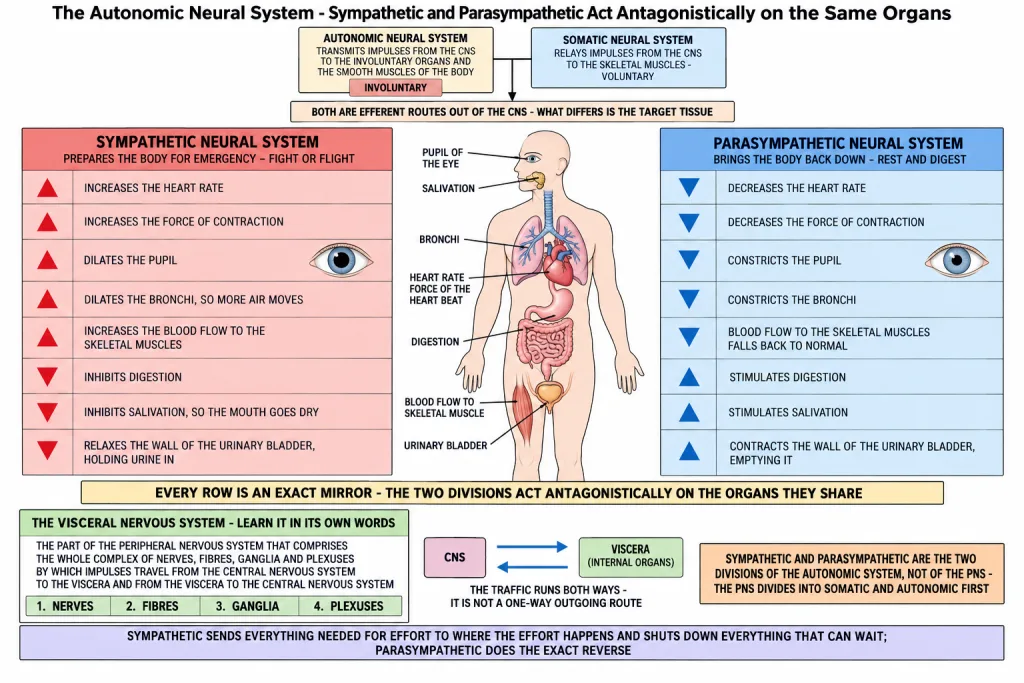
Why the pattern makes sense. Sympathetic activity sends everything the body needs for effort to where the effort happens: more blood, faster and harder heart beats, wider airways, more light into the eye. At the same moment it shuts down everything that can wait - digestion, salivation, emptying the bladder. Parasympathetic activity does the exact reverse, because a resting body has time for the jobs that were put off.
Antagonistic does not mean one is switched off. Both sets of fibres reach the organ all the time, and what the organ actually does is set by which of the two is currently dominant. That is why a single organ such as the heart can be sped up and slowed down again through the same autonomic route.
[NEET Important] Items are almost always set as a single organ and a single effect. Fix the two anchors - sympathetic increases heart rate and dilates the pupil, parasympathetic decreases heart rate and constricts the pupil - and every other row follows from the mirror. The classic trap is the urinary bladder, where the pattern feels inverted: sympathetic relaxes the bladder wall, parasympathetic contracts it. The other trap is an option saying the two divisions act synergistically on the same organ; they act antagonistically.
Quick Recap
- The PNS is divided into the somatic neural system and the autonomic neural system.
- The somatic neural system relays impulses from the CNS to skeletal muscles and is the voluntary route.
- The autonomic neural system transmits impulses from the CNS to the involuntary organs and smooth muscles of the body and is the involuntary route.
- The autonomic neural system is further classified into the sympathetic neural system and the parasympathetic neural system.
- The visceral nervous system is the part of the peripheral nervous system that comprises the whole complex of nerves, fibres, ganglia, and plexuses.
- In the visceral nervous system, impulses travel from the central nervous system to the viscera and from the viscera to the central nervous system - the traffic runs both ways.
- The sympathetic system prepares the body for emergency, the fight or flight response.
- The parasympathetic system restores the body to rest, the rest and digest state.
- Sympathetic effects: heart rate increased, force of the beat increased, pupil dilated, bronchi dilated, blood flow to skeletal muscle increased, digestion inhibited, salivation inhibited, wall of the urinary bladder relaxed.
- Parasympathetic effects: heart rate decreased, force of the beat decreased, pupil constricted, bronchi constricted, digestion stimulated, salivation stimulated, wall of the urinary bladder contracted.
- The two divisions generally act antagonistically on the same organ - what the organ does depends on which division is dominant at that moment.
Solved Examples
Question 1
Q. Name the two divisions of the peripheral neural system and state what each one supplies.
Answer. The somatic neural system, which relays impulses from the CNS to the skeletal muscles, and the autonomic neural system, which transmits impulses from the CNS to the involuntary organs and the smooth muscles of the body. In everyday terms the somatic route is the voluntary one and the autonomic route is the involuntary one.
Question 2
Q. Define the visceral nervous system.
Answer. The visceral nervous system is the part of the peripheral nervous system that comprises the whole complex of nerves, fibres, ganglia, and plexuses by which impulses travel from the central nervous system to the viscera and from the viscera to the central nervous system.
Two parts of that definition carry the marks - the four structures it is built from, and the fact that the impulses travel in both directions.
Question 3
Q. List the four kinds of structure that make up the visceral nervous system.
Answer. Nerves, fibres, ganglia and plexuses. The definition calls them the whole complex, so all four must be named - writing only "nerves and fibres" loses the mark.
Question 4
Q. In which directions do impulses travel in the visceral nervous system?
Answer. In both directions. Impulses travel from the central nervous system to the viscera, and also from the viscera to the central nervous system. It is not a one-way outgoing pathway.
Question 5
Q. Into what is the autonomic neural system further classified?
Answer. Into the sympathetic neural system and the parasympathetic neural system.
Question 6
Q. Compare the sympathetic and the parasympathetic neural systems.
Answer.
| Feature | Sympathetic neural system | Parasympathetic neural system |
|---|---|---|
| Overall role | Prepares the body for emergency - the fight or flight response | Restores the body to rest - the rest and digest state |
| Heart rate | Increased | Decreased |
| Force of the heart beat | Increased | Decreased |
| Pupil | Dilated | Constricted |
| Bronchi | Dilated | Constricted |
| Blood flow to skeletal muscle | Increased | Returns to normal |
| Digestion and salivation | Inhibited | Stimulated |
| Wall of the urinary bladder | Relaxed | Contracted |
The one line that gets the mark: the sympathetic system prepares the body for emergency, the parasympathetic system brings it back to rest, and the two act antagonistically on the same organ.
Question 7
Q. What happens to the heart under sympathetic and under parasympathetic influence?
Answer. Under sympathetic influence the heart rate increases and the force of contraction increases, so more blood is pushed out per minute. Under parasympathetic influence the heart rate decreases and the force of contraction decreases, bringing the heart back to its resting output.
Question 8
Q. A person walks out of a dark room into bright sunlight and the pupil narrows. Which division of the autonomic system is dominant, and what would the other division have done?
Answer. The parasympathetic division is dominant, because it constricts the pupil. The sympathetic division does the opposite - it dilates the pupil, which is what happens when a person is frightened or is in a dark place.
Question 9
Q. Which division stimulates digestion and salivation, and which inhibits them? Give the reason behind the pattern.
Answer. The parasympathetic division stimulates digestion and salivation; the sympathetic division inhibits both. The reason is what each state is for. In an emergency the body diverts everything to effort - blood goes to the skeletal muscles and digestion is put on hold, which is why the mouth goes dry when a person is frightened. At rest there is time for digestion, so the parasympathetic system turns it back on.
Question 10
Q. What does it mean to say that the sympathetic and parasympathetic systems act antagonistically?
Answer. It means the two divisions produce opposite effects on the same organ. Sympathetic fibres speed the heart up, parasympathetic fibres slow it down; sympathetic fibres dilate the pupil, parasympathetic fibres constrict it. Both sets reach the organ, and what the organ actually does at any moment depends on which division is dominant. Antagonistic does not mean one of them is switched off.
Question 11
Q. A student is startled by a loud noise. List the changes the sympathetic system produces.
Answer. The sympathetic system prepares the body for emergency, the fight or flight response. It increases the heart rate and the force of the heart beat, dilates the pupil, dilates the bronchi so that more air moves, and increases the blood flow to the skeletal muscles. At the same time it inhibits digestion and salivation and relaxes the wall of the urinary bladder.
Question 12
Q. Why is the somatic neural system called voluntary and the autonomic neural system involuntary?
Answer. Because of the tissue each one ends on. The somatic system relays impulses from the CNS to the skeletal muscles, and skeletal muscles are the ones you contract deliberately - you decide to lift your arm and it lifts. The autonomic system transmits impulses from the CNS to the involuntary organs and the smooth muscles of the body, and those organs work without any decision from you - the heart keeps beating and the gut keeps moving food along whether you attend to them or not.
Question 13
Q. What happens to the wall of the urinary bladder under each division of the autonomic system?
Answer. The sympathetic division relaxes the wall of the urinary bladder, so urine is held in. The parasympathetic division contracts the wall of the urinary bladder, so it is emptied. This is the row students most often invert, because it feels backwards next to "sympathetic increases everything" - in an emergency the body holds urine in rather than emptying it.
Question 14
Q. Fill in the blanks: the autonomic neural system is classified into the _ and the neural systems, and the two generally act _ on the same organ.
Answer. Into the sympathetic and the parasympathetic neural systems, and the two generally act antagonistically on the same organ.