
Three Types of Neurons - Counted by Axons and Dendrites
Every neuron has the same three parts - a cell body, dendrites and an axon - but the neurons of the body do not all carry the same number of these fibres. Based on the number of axons and dendrites, neurons are divided into three types. The count is the whole basis of the classification, and each type has a place in the body where it is the one you find.
| Type of neuron | Number of axons and dendrites | Where it is found |
|---|---|---|
| Multipolar | One axon and two or more dendrites | The cerebral cortex |
| Bipolar | One axon and one dendrite | The retina of the eye |
| Unipolar | Cell body with one axon only - no dendrite | Usually in the embryonic stage |
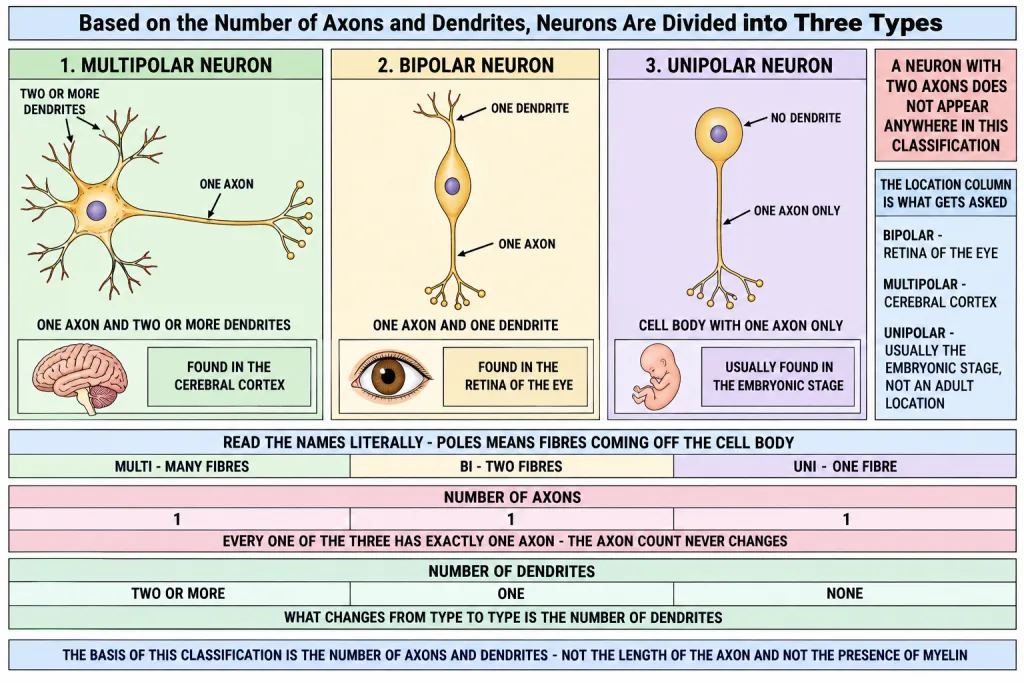
Read the names literally and the table writes itself. Poles here means fibres coming off the cell body. Multipolar has many - one axon plus two or more dendrites. Bipolar has two - one axon plus one dendrite. Unipolar has one - the axon alone.
Notice that every one of the three has exactly one axon. What changes from type to type is the number of dendrites: two or more, then one, then none. A neuron with two axons does not appear anywhere in this classification.
The locations are as heavily marked as the structures. The cerebral cortex is packed with multipolar neurons, the retina of the eye carries bipolar neurons, and the unipolar neuron is the one usually found in the embryonic stage rather than in the adult body.
[NEET Important] The location column is what gets asked - "bipolar neurons are found in " wants the retina of the eye, and "multipolar neurons are found in " wants the cerebral cortex. The standard distractor swaps those two locations, or gives the unipolar neuron an adult location instead of the embryonic stage. Remember also that the basis of the classification is the number of axons and dendrites, not the length of the axon and not the presence of myelin.
Two Types of Axons - Myelinated and Non-Myelinated
The second classification does not count fibres at all. It looks at the covering on the axon, and on that basis there are two types of axons, namely, myelinated and non-myelinated.
| Feature | Myelinated nerve fibre | Non-myelinated (unmyelinated) nerve fibre |
|---|---|---|
| Schwann cell | Present - the fibre is enveloped with Schwann cells | Present - the fibre is enclosed by a Schwann cell |
| Myelin sheath | The Schwann cells form a myelin sheath around the axon | The Schwann cell does not form a myelin sheath around the axon |
| Nodes of Ranvier | Present - the gaps between two adjacent myelin sheaths are called nodes of Ranvier | Absent, because there are no myelin sheaths to leave gaps between |
| Where it is found | Spinal and cranial nerves | Autonomous and the somatic neural systems |
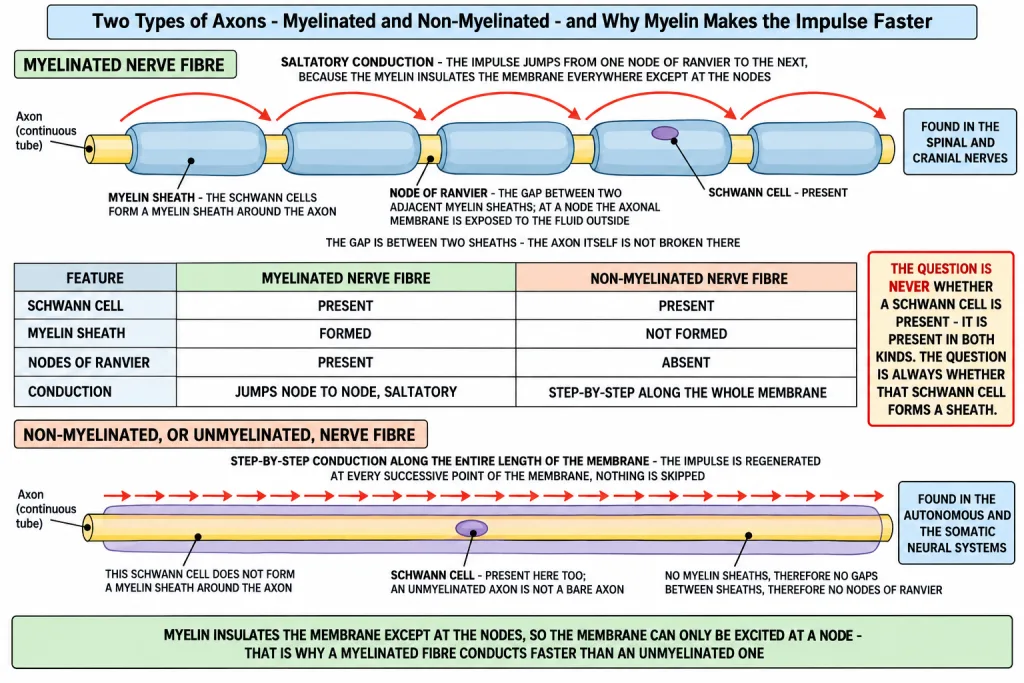
The subtle point, and the one that separates a good answer from an average one: a Schwann cell is present in BOTH kinds of fibre. An unmyelinated axon is not a bare axon. It is enclosed by a Schwann cell just as the myelinated one is - the difference is only that this Schwann cell does not form a myelin sheath around the axon. So the question is never "is there a Schwann cell", it is always "does the Schwann cell form a sheath".
The nodes of Ranvier follow from the sheath. The myelin does not run in one unbroken tube down the axon; it comes in stretches, and the gaps between two adjacent myelin sheaths are the nodes of Ranvier. At a node the axonal membrane is exposed to the fluid outside. Between the nodes it is wrapped in myelin, which insulates it. Since an unmyelinated fibre has no sheaths, it has no gaps between sheaths, and so it has no nodes of Ranvier.
[NEET Important] Two facts carry the marks here. First, a Schwann cell is present in both types - an option saying the unmyelinated fibre has no Schwann cell is the classic wrong answer. Second, the locations: myelinated fibres are found in spinal and cranial nerves, unmyelinated fibres are commonly found in autonomous and the somatic neural systems. And nodes of Ranvier = gaps between two adjacent myelin sheaths, never gaps between two Schwann cells' nuclei and never gaps in the axon itself.
Saltatory Conduction - Why Myelin Makes the Impulse Faster
The myelin sheath is not just a wrapper. It changes the way the impulse travels down the fibre, and that is why the two kinds of axon conduct at such different speeds.
In an unmyelinated fibre. The membrane is exposed along its whole length, so the impulse has to be regenerated at every successive point of the membrane. Conduction is step-by-step along the entire length of the membrane - each patch depolarises, then the patch next to it depolarises, and so on with nothing skipped.
In a myelinated fibre. The myelin insulates the membrane everywhere except at the nodes of Ranvier, so the membrane can only be excited at a node. The impulse therefore jumps from one node of Ranvier to the next. This is called saltatory conduction.
| Feature | Myelinated nerve fibre | Unmyelinated nerve fibre |
|---|---|---|
| How the impulse travels | It jumps from one node of Ranvier to the next - saltatory conduction | Step-by-step along the whole length of the membrane |
| Where the membrane is excited | Only at the nodes of Ranvier | At every point along the membrane |
| Speed of conduction | Much faster | Slower |
| Energy cost | Less - fewer patches of membrane have to be restored afterwards | More, because the whole membrane has to be depolarised and then repolarised |
The energy point is worth holding on to. Every stretch of membrane that depolarises must afterwards be pumped back to its resting state, and that pumping costs ATP. A myelinated fibre depolarises only the small patches at the nodes, so it has far less to restore. That is why saltatory conduction is both much faster and less costly in energy.
[NEET Important] The pairing that gets marked is jumps from node to node = myelinated = faster and cheaper, against step-by-step along the whole membrane = unmyelinated = slower and costlier. The word saltatory belongs to the myelinated fibre only. A distractor that says the impulse in a myelinated fibre travels through the myelin sheath itself is wrong - the myelin insulates, and the impulse is regenerated at the nodes.
Quick Recap
- Based on the number of axons and dendrites, neurons are divided into three types: multipolar, bipolar and unipolar.
- Multipolar neuron: one axon and two or more dendrites; found in the cerebral cortex.
- Bipolar neuron: one axon and one dendrite; found in the retina of the eye.
- Unipolar neuron: cell body with one axon only; found usually in the embryonic stage.
- All three types have exactly one axon - only the number of dendrites changes.
- There are two types of axons: myelinated and non-myelinated.
- Myelinated nerve fibres are enveloped with Schwann cells, which form a myelin sheath around the axon.
- The gaps between two adjacent myelin sheaths are called nodes of Ranvier.
- Myelinated nerve fibres are found in spinal and cranial nerves.
- An unmyelinated nerve fibre is enclosed by a Schwann cell that does not form a myelin sheath around the axon, and is commonly found in autonomous and the somatic neural systems.
- A Schwann cell is present in both types of fibre - the difference is whether it forms a sheath.
- In a myelinated fibre the impulse jumps from one node of Ranvier to the next - saltatory conduction - which is much faster and less costly in energy.
- In an unmyelinated fibre conduction is step-by-step along the whole length of the membrane, and is therefore slower and uses more energy.
Solved Examples
Question 1
Q. Differentiate between myelinated and non-myelinated axons. This is one of the chapter-end exercises.
Answer.
| Feature | Myelinated axon | Non-myelinated axon |
|---|---|---|
| Schwann cell | Present - the axon is enveloped with Schwann cells | Present - the axon is enclosed by a Schwann cell |
| Myelin sheath | The Schwann cells form a myelin sheath around the axon | The Schwann cell does not form a myelin sheath around the axon |
| Nodes of Ranvier | Present - they are the gaps between two adjacent myelin sheaths | Absent |
| Appearance | Looks white, because of the fatty myelin | Looks grey, as there is no myelin |
| Conduction of the impulse | Saltatory - the impulse jumps from one node of Ranvier to the next, so conduction is fast | Step-by-step along the whole membrane, so conduction is slow |
| Where it is found | Spinal and cranial nerves | Autonomous and the somatic neural systems |
The one line that gets the mark: in a myelinated axon the Schwann cells form a myelin sheath around the axon and leave nodes of Ranvier between the sheaths; in a non-myelinated axon the Schwann cell is still there but it does not form a myelin sheath.
Question 2
Q. Distinguish between impulse conduction in a myelinated nerve fibre and in an unmyelinated nerve fibre. This is one of the chapter-end exercises.
Answer.
| Feature | Myelinated nerve fibre | Unmyelinated nerve fibre |
|---|---|---|
| Path taken by the impulse | The impulse jumps from one node of Ranvier to the next | The impulse travels step-by-step along the whole length of the membrane |
| Name of the conduction | Saltatory conduction | Ordinary or continuous conduction |
| Where the membrane is excited | Only at the nodes of Ranvier; the rest is insulated by the myelin sheath | At every successive point of the membrane |
| Speed | Much faster | Slower |
| Energy used | Less, because only the small patches at the nodes have to be restored afterwards | More, because the entire membrane has to be depolarised and then repolarised |
The one line that gets the mark: in a myelinated fibre the impulse is conducted by saltatory conduction, jumping from node of Ranvier to node of Ranvier, which makes it much faster and less energy-consuming than the step-by-step conduction along the whole membrane of an unmyelinated fibre.
Question 3
Q. On what basis are neurons divided into multipolar, bipolar and unipolar types?
Answer. On the basis of the number of axons and dendrites the neuron carries. It is a count of fibres coming off the cell body, nothing else - not the length of the axon and not the presence of a myelin sheath.
Question 4
Q. Give the structure and the location of a multipolar neuron.
Answer. A multipolar neuron has one axon and two or more dendrites. It is found in the cerebral cortex.
Question 5
Q. Which type of neuron is found in the retina of the eye, and how many axons and dendrites does it have?
Answer. The bipolar neuron, which has one axon and one dendrite.
Question 6
Q. Describe the unipolar neuron and say where it is usually found.
Answer. A unipolar neuron is a cell body with one axon only - it has no dendrite. It is usually found in the embryonic stage.
Question 7
Q. A student says that a unipolar neuron is one with a single dendrite and no axon. Correct the statement.
Answer. That is the wrong way round. A unipolar neuron is a cell body with one axon only, and it is the dendrite that is missing. In fact all three types - multipolar, bipolar and unipolar - have exactly one axon; what changes between them is the number of dendrites: two or more, then one, then none.
Question 8
Q. What forms the myelin sheath around an axon?
Answer. Schwann cells. In a myelinated nerve fibre the axon is enveloped with Schwann cells, which form a myelin sheath around the axon.
Question 9
Q. What are nodes of Ranvier, and in which type of nerve fibre do they occur?
Answer. The nodes of Ranvier are the gaps between two adjacent myelin sheaths. They occur only in myelinated nerve fibres. An unmyelinated fibre has no myelin sheaths, so it has no gaps between sheaths and therefore no nodes of Ranvier.
Question 10
Q. Where in the body are myelinated nerve fibres found, and where are unmyelinated fibres found?
Answer. Myelinated nerve fibres are found in the spinal and cranial nerves. Unmyelinated nerve fibres are commonly found in the autonomous and the somatic neural systems.
Question 11
Q. Is a Schwann cell present in an unmyelinated nerve fibre? Explain.
Answer. Yes. An unmyelinated nerve fibre is enclosed by a Schwann cell, exactly as a myelinated one is enveloped by Schwann cells. The difference is that in the unmyelinated fibre the Schwann cell does not form a myelin sheath around the axon. So the presence of the Schwann cell is not what separates the two types - whether that Schwann cell forms a sheath is.
Question 12
Q. What is saltatory conduction?
Answer. Saltatory conduction is the way an impulse travels along a myelinated nerve fibre. The myelin sheath insulates the membrane between the nodes, so the membrane can be excited only at the nodes of Ranvier, and the impulse therefore jumps from one node of Ranvier to the next instead of moving through every point of the membrane. This makes conduction much faster and less costly in energy.
Question 13
Q. Why does a myelinated fibre spend less energy on conducting an impulse than an unmyelinated one?
Answer. Because far less membrane is disturbed. In an unmyelinated fibre every point of the membrane along the whole length depolarises and must afterwards be restored to the resting state, and that restoring costs ATP. In a myelinated fibre only the small patches of membrane at the nodes of Ranvier depolarise, since the rest is insulated by the myelin sheath, so there is much less to restore.
Question 14
Q. Name the two types of axons and state the single structural difference between them.
Answer. The two types are myelinated and non-myelinated axons. The single structural difference is the myelin sheath: in a myelinated axon the Schwann cells form a myelin sheath around the axon, while in a non-myelinated axon the Schwann cell does not form a myelin sheath.
Question 15
Q. Fill in the blanks: multipolar neurons occur in the , bipolar neurons in the , and unipolar neurons usually in the __.
Answer. Multipolar neurons occur in the cerebral cortex, bipolar neurons in the retina of the eye, and unipolar neurons usually in the embryonic stage.