
The Midbrain
The midbrain is the middle of the three major parts of the brain, and it is the smallest. Three facts describe it, and all three are asked.
Where it is. The midbrain is located between the thalamus/hypothalamus of the forebrain and the pons of the hindbrain. Say that in full - it is not merely "in the middle of the brain", it is between two named neighbours, one belonging to the forebrain and one to the hindbrain.
What runs through it. A canal called the cerebral aqueduct passes through the midbrain. It is a narrow channel, and the name is the marked word.
What it looks like from behind. The dorsal portion of the midbrain consists mainly of four round swellings (lobes) called corpora quadrigemina. The count is four, the shape is round swellings or lobes, the side is dorsal, and the name is corpora quadrigemina.
What it does. The chapter summary adds the function: the midbrain receives and integrates visual, tactile and auditory inputs. Three senses - sight, touch and hearing - are brought together here.
[NEET Important] All four midbrain facts are single-line answers, so they make easy one-mark items. The two that get confused are the cerebral aqueduct, which is a canal of the midbrain, and the corpus callosum, which is the tract joining the two cerebral hemispheres. Also keep the count right - four round swellings, and the word is the plural corpora quadrigemina.
The Hindbrain - Pons, Cerebellum and Medulla
The hindbrain comprises pons, cerebellum and medulla (also called the medulla oblongata). Three parts, three distinct jobs:
| Part of the hindbrain | Structure | What it does |
|---|---|---|
| Pons | Consists of fibre tracts | Those fibre tracts interconnect different regions of the brain |
| Cerebellum | Has a very convoluted surface, in order to provide the additional space for many more neurons | Integrates information received from the semicircular canals of the ear and the auditory system; this is the part behind the balance of the body |
| Medulla (medulla oblongata) | Is connected to the spinal cord | Contains centres which control respiration, cardiovascular reflexes and gastric secretions |
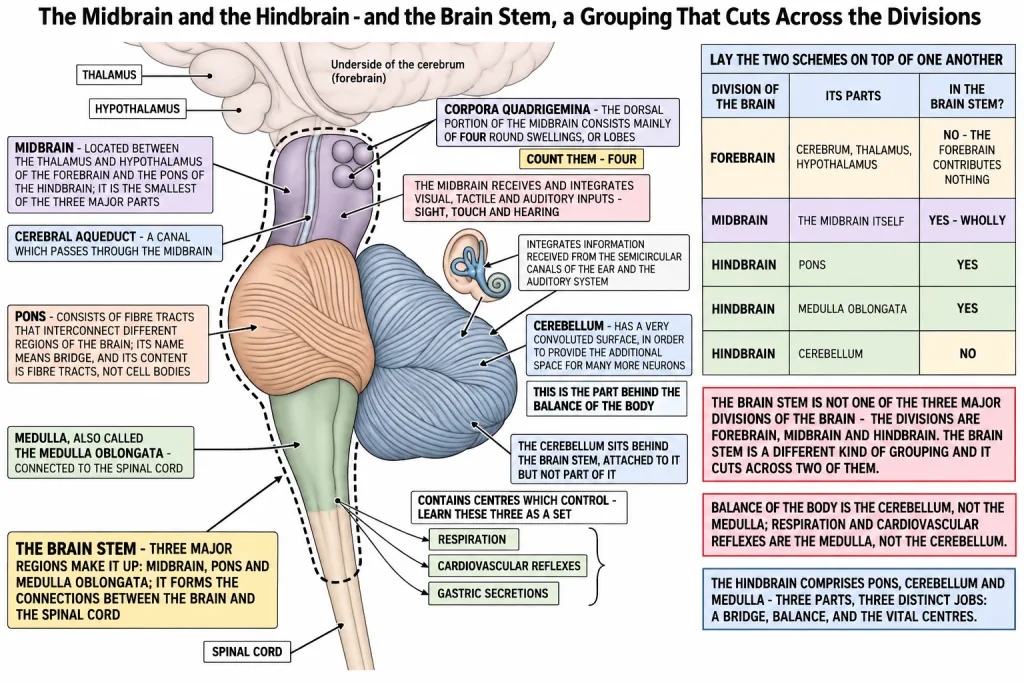
Three points in that table repay a second look.
The pons is a bridge. Its name means bridge and its content is fibre tracts, not cell bodies. Whatever needs to get from one region of the brain to another can travel through it.
The cerebellum is convoluted for a reason the chapter states. The surface is folded in order to provide the additional space for many more neurons. More surface means more neurons packed into the same skull. And the information it works on comes from the semicircular canals of the ear and the auditory system - which is exactly why the cerebellum, and not some other part, is the one associated with the balance of the body.
The medulla's three centres are learnt as a set of three: respiration, cardiovascular reflexes and gastric secretions. Breathing, the heart and blood vessels, and the secretions of the stomach. The medulla is also the part connected to the spinal cord, so it is the last piece of brain a descending impulse passes through.
[NEET Important] The medulla's trio - respiration, cardiovascular reflexes and gastric secretions - is asked as a complete set, and an option that swaps in "balance of the body" is wrong, because balance belongs to the cerebellum. Equally, the reason for the cerebellum's folding is space for many more neurons, not extra blood supply.
The Brain Stem - a Grouping That Cuts Across the Divisions
Now a name that trips up more students than any other in this chapter.
Three major regions make up the brain stem - midbrain, pons and medulla oblongata - and the brain stem forms the connections between the brain and the spinal cord.
The brain stem is NOT one of the three major divisions of the brain. The three divisions are the forebrain, the midbrain and the hindbrain. The brain stem is a different kind of grouping altogether: it collects the parts that lie along the stalk connecting the brain to the spinal cord, and in doing so it cuts across two of the three divisions.
Lay the two schemes on top of one another and the overlap becomes obvious:
| Division of the brain | Its parts | In the brain stem? |
|---|---|---|
| Forebrain | Cerebrum, thalamus, hypothalamus | No - the forebrain contributes nothing to the brain stem |
| Midbrain | The midbrain itself | Yes - the midbrain is wholly part of the brain stem |
| Hindbrain | Pons | Yes |
| Hindbrain | Medulla oblongata | Yes |
| Hindbrain | Cerebellum | No - the cerebellum is part of the hindbrain but NOT part of the brain stem |
So of the six parts named in the last two sections, exactly three make the brain stem: midbrain, pons and medulla oblongata. The cerebellum sits behind the brain stem, attached to it but not part of it, and that single exclusion is the standard trap.
[NEET Important] Learn the exclusion, not just the list. The brain stem is midbrain + pons + medulla oblongata; the cerebellum belongs to the hindbrain but not to the brain stem, and no part of the forebrain is in the brain stem at all. The other half of the fact is the function: the brain stem forms the connections between the brain and the spinal cord.
Quick Recap
- The midbrain is located between the thalamus/hypothalamus of the forebrain and the pons of the hindbrain.
- A canal called the cerebral aqueduct passes through the midbrain.
- The dorsal portion of the midbrain consists mainly of four round swellings (lobes) called corpora quadrigemina.
- The midbrain receives and integrates visual, tactile and auditory inputs.
- The hindbrain comprises pons, cerebellum and medulla (also called the medulla oblongata).
- Pons consists of fibre tracts that interconnect different regions of the brain.
- The cerebellum has a very convoluted surface in order to provide the additional space for many more neurons, and it integrates information received from the semicircular canals of the ear and the auditory system - it looks after the balance of the body.
- The medulla is connected to the spinal cord and contains centres which control respiration, cardiovascular reflexes and gastric secretions.
- Three major regions make up the brain stem - midbrain, pons and medulla oblongata, and the brain stem forms the connections between the brain and the spinal cord.
- The brain stem is not one of the three major divisions of the brain, and the cerebellum is part of the hindbrain but not part of the brain stem.
Solved Examples
Question 1
Q. Write a short note on the midbrain. This is one of the chapter-end exercises.
Answer. The midbrain is the middle of the three major parts of the brain - forebrain, midbrain and hindbrain. It is located between the thalamus/hypothalamus of the forebrain and the pons of the hindbrain, so it lies on the stalk that runs down from the cerebrum towards the spinal cord.
A canal called the cerebral aqueduct passes through the midbrain. On the back of it, the dorsal portion of the midbrain consists mainly of four round swellings (lobes) called corpora quadrigemina - four in number, rounded, and lying on the dorsal side.
In function, the midbrain receives and integrates visual, tactile and auditory inputs. Sight, touch and hearing are brought together here before the information goes further. The midbrain is also one of the three regions that make up the brain stem, along with the pons and the medulla oblongata, and the brain stem forms the connections between the brain and the spinal cord.
Question 2
Q. Write a short note on the hindbrain. This is one of the chapter-end exercises.
Answer. The hindbrain is the hindmost of the three major parts of the brain, and it comprises pons, cerebellum and medulla (also called the medulla oblongata).
The pons consists of fibre tracts that interconnect different regions of the brain - it works as a bridge carrying traffic from one region to another.
The cerebellum has a very convoluted surface in order to provide the additional space for many more neurons, so its folded surface packs in far more cells than a smooth one could. It integrates information received from the semicircular canals of the ear and the auditory system, and it is therefore the part associated with the balance of the body.
The medulla is connected to the spinal cord and contains centres which control respiration, cardiovascular reflexes and gastric secretions - breathing, the heart and blood vessels, and the secretions of the stomach.
Two of the three hindbrain parts, the pons and the medulla oblongata, are also regions of the brain stem, which forms the connections between the brain and the spinal cord. The cerebellum is not part of the brain stem.
Question 3
Q. Name the canal that passes through the midbrain.
Answer. The cerebral aqueduct.
Question 4
Q. What are the corpora quadrigemina - how many are there and where do they lie?
Answer. They are four round swellings (lobes) that make up most of the dorsal portion of the midbrain.
Question 5
Q. Which sensory inputs does the midbrain receive and integrate?
Answer. Visual, tactile and auditory inputs - that is, inputs of sight, touch and hearing.
Question 6
Q. Name the three parts of the hindbrain.
Answer. The pons, the cerebellum and the medulla, which is also called the medulla oblongata.
Question 7
Q. What does the pons consist of, and what is its function?
Answer. The pons consists of fibre tracts, and those fibre tracts interconnect different regions of the brain.
Question 8
Q. Why does the cerebellum have a very convoluted surface?
Answer. In order to provide the additional space for many more neurons. Folding the surface increases its area, so far more neurons can be accommodated in the same volume.
Question 9
Q. From which structures does the cerebellum integrate information, and which body function does this support?
Answer. It integrates information received from the semicircular canals of the ear and the auditory system. That is what allows the cerebellum to look after the balance of the body.
Question 10
Q. Which centres are contained in the medulla, and to which part of the CNS is the medulla connected?
Answer. The medulla contains centres which control respiration, cardiovascular reflexes and gastric secretions. The medulla is connected to the spinal cord.
Question 11
Q. Which three regions make up the brain stem, and what does the brain stem do?
Answer. The midbrain, the pons and the medulla oblongata - three major regions make up the brain stem. The brain stem forms the connections between the brain and the spinal cord.
Question 12
Q. Is the cerebellum a part of the brain stem? Explain your answer.
Answer. No. The cerebellum is a part of the hindbrain, but the brain stem is made up of only three regions - the midbrain, the pons and the medulla oblongata. So the cerebellum belongs to the hindbrain while standing outside the brain stem. It sits behind the brain stem, attached to it, but it is not counted as one of its regions.
Question 13
Q. A student writes that the brain is divided into four major parts - forebrain, midbrain, hindbrain and brain stem. What is wrong with that?
Answer. The brain is divided into three major parts: forebrain, midbrain and hindbrain. The brain stem is not a fourth division. It is a grouping of parts that already belong to the other divisions - the midbrain, the pons and the medulla oblongata - assembled because together they form the connections between the brain and the spinal cord. The grouping cuts across two divisions and leaves the cerebellum and the whole forebrain out.
Question 14
Q. A person suffers damage to the medulla. Which three body functions are put at immediate risk, and why?
Answer. Respiration, cardiovascular reflexes and gastric secretions, because the medulla contains the centres which control all three. Breathing and the control of the heart and blood vessels are vital functions, which is why damage to this small part of the hindbrain is so serious.