
A Neuron Has Three Major Parts
A neuron is a microscopic structure - it cannot be seen without a microscope, however long its fibres run - and it is composed of three major parts:
- the cell body
- the dendrites
- the axon
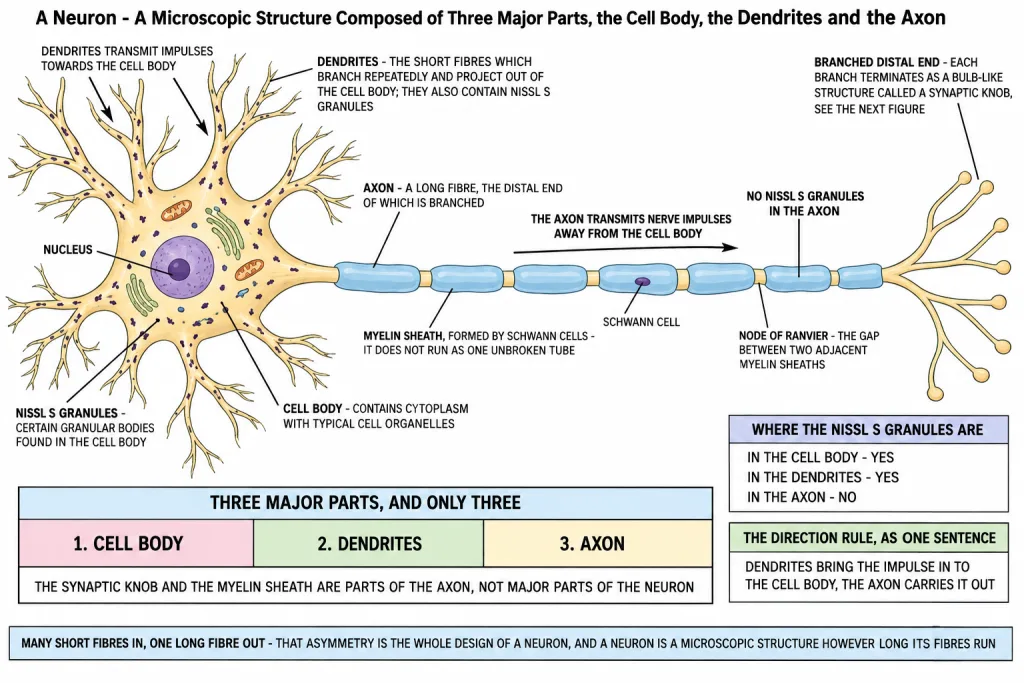
Hold the shape in your head before the detail. The cell body is the swollen centre that carries the nucleus and the cell machinery. Out of it come many short, repeatedly branching fibres - the dendrites. Out of it also comes one long fibre - the axon - which runs away from the cell body and only branches right at its far end.
That asymmetry is the whole design of a neuron. Many short fibres in, one long fibre out. Everything else in this section is a detail hung on that frame.
[NEET Important] The count and the names are asked together: three major parts - cell body, dendrites and axon. A stem that adds the synaptic knob or the myelin sheath to that list of three is wrong - those are parts of the axon, not major parts of the neuron. And the neuron is described as a microscopic structure.
The Cell Body and the Dendrites
The cell body. The cell body contains cytoplasm with typical cell organelles, exactly as any other cell does, and in addition it contains certain granular bodies called Nissl's granules. Those granules are the feature that identifies a neuron cell body under the microscope, and the name is one of the most commonly asked single words in this chapter.
The dendrites. The chapter defines them in one careful sentence: they are the short fibres which branch repeatedly and project out of the cell body. Three things are packed into that:
| Feature of a dendrite | What the chapter says |
|---|---|
| Length | Short fibres |
| Branching | They branch repeatedly |
| Origin | They project out of the cell body |
| Contents | They also contain Nissl's granules |
| Direction of the impulse | They transmit impulses towards the cell body |
The word also in "also contain Nissl's granules" is doing real work. Nissl's granules are found in two places - the cell body and the dendrites. They are not found in the axon. That single fact is enough to answer a whole family of questions.
[NEET Important] Two facts get set again and again. Nissl's granules occur in the cell body AND in the dendrites, but not in the axon. And dendrites transmit impulses towards the cell body - an option that has dendrites carrying impulses away from the cell body is the standard trap, because that is the axon's job.
The Axon, the Synaptic Knob, and the Direction Rule
The axon is a long fibre, and the distal end of which is branched - that is, it runs a long way undivided and then splits into branches only at the far end, the end away from the cell body.
Each branch terminates as a bulb-like structure called a synaptic knob. Each synaptic knob possesses synaptic vesicles containing chemicals called neurotransmitters. Follow that chain of containers, because the exam sets it as a chain:
axon -> branched distal end -> synaptic knob (bulb-like) -> synaptic vesicles -> neurotransmitters
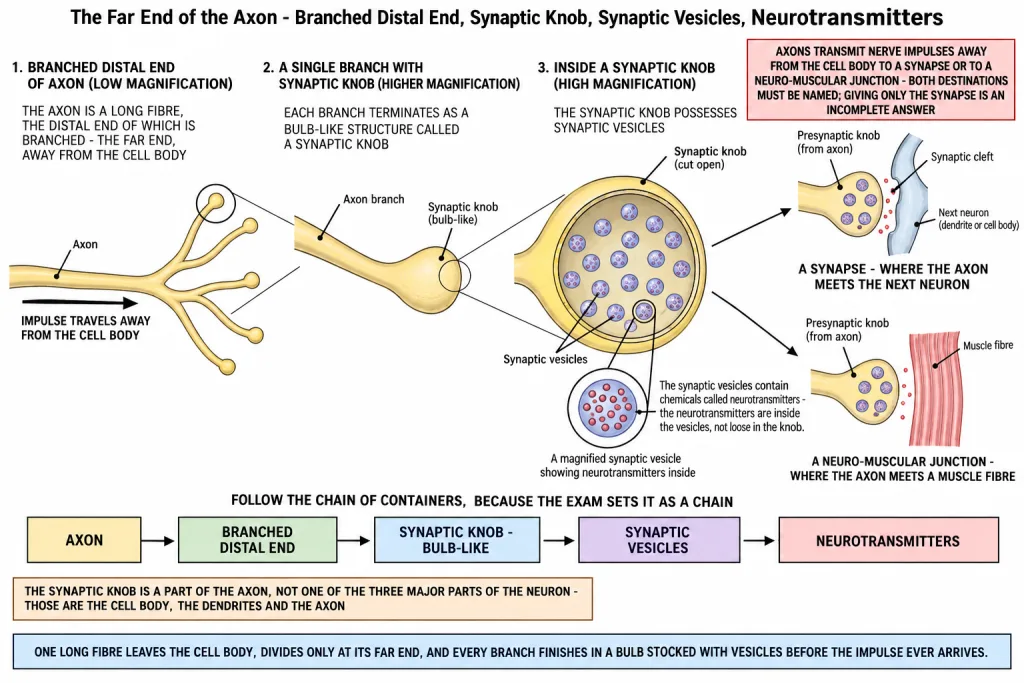
Where the axon delivers. The axons transmit nerve impulses away from the cell body to a synapse or to a neuro-muscular junction. So an axon ends in one of two places - at a synapse, where it meets the next neuron, or at a neuro-muscular junction, where it meets a muscle fibre. Both destinations must be named; giving only the synapse is an incomplete answer.
The direction rule. This is the spine of the whole section, and it is a pairing, not two separate facts:
| Fibre | Direction the impulse travels |
|---|---|
| Dendrite | TOWARDS the cell body |
| Axon | AWAY from the cell body |
Say it as one sentence: dendrites bring the impulse in to the cell body, the axon carries it out. Once the pairing is fixed, the rest of the neuron's structure follows - the dendrites are short and many because they are collecting from many sources, and the axon is long and single because it is delivering to one destination.
[NEET Important] The direction pairing is the single most-asked thing here, and it is asked as an inversion: a stem describing "the fibre that carries the impulse away from the cell body to a neuro-muscular junction" wants axon, and one describing "short repeatedly branching fibres carrying impulses towards the cell body" wants dendrite. Also fix the container chain - synaptic vesicles are inside the synaptic knob, and the neurotransmitters are inside the vesicles, not loose in the knob.
Quick Recap
- A neuron is a microscopic structure composed of three major parts - the cell body, the dendrites and the axon.
- The cell body contains cytoplasm with typical cell organelles and certain granular bodies called Nissl's granules.
- Dendrites are the short fibres which branch repeatedly and project out of the cell body.
- Dendrites also contain Nissl's granules, so the granules occur in both the cell body and the dendrites - never in the axon.
- Dendrites transmit impulses TOWARDS the cell body.
- The axon is a long fibre, the distal end of which is branched.
- Each branch of the axon terminates as a bulb-like structure called a synaptic knob.
- The synaptic knob possesses synaptic vesicles containing chemicals called neurotransmitters.
- Axons transmit nerve impulses AWAY from the cell body to a synapse or to a neuro-muscular junction.
- The pairing to memorise: dendrite - towards the cell body; axon - away from the cell body.
Solved Examples
Question 1
Q. Draw a labelled diagram of a neuron. This is one of the chapter-end exercises.
Answer. A diagram cannot be drawn here, so here is the picture in words, laid out exactly as you should put it on paper, followed by the labels.
How to lay the drawing out:
- Start with the cell body. Draw it on the left of the page as a rounded, slightly star-shaped blob about the size of a large coin. Put a circle inside it for the nucleus, and stipple the cytoplasm around the nucleus with small dots and short dashes - those dots are the Nissl's granules.
- Add the dendrites. From the upper, lower and left edges of the cell body draw five or six short fibres that split into two, and split again, so they end as fine twigs. Keep them short and keep them close to the cell body - that is what tells the examiner they are dendrites and not axons.
- Add the single axon. From the right side of the cell body draw one fibre, much longer than any dendrite, running straight across the page. Draw it as two parallel lines so it has thickness. Where it leaves the cell body, mark the small cone-shaped start.
- Add the myelin sheath. Along the axon draw a row of long sausage-shaped segments wrapped around it, one after another. Leave a narrow gap between each pair of segments where the axon is bare - those constrictions are the nodes of Ranvier. Put a small nucleus in one of the sheath segments to show the Schwann cell that made it.
- Branch the far end. At the distal end of the axon - the end away from the cell body - split the fibre into three or four branches.
- Finish with the knobs. End every branch in a small filled bulb. These are the synaptic knobs. Draw a few tiny circles inside one enlarged knob to show the synaptic vesicles, and label the chemicals they hold.
- Add an arrow running from the dendrites, through the cell body, along the axon, to the knobs. That arrow shows the direction the impulse travels and earns a mark on its own.
The labels, and what each part does:
| Label | What it is and what it does |
|---|---|
| Cell body | Contains cytoplasm with typical cell organelles and Nissl's granules; the metabolic centre of the neuron |
| Nucleus | Lies in the cell body and controls the cell |
| Nissl's granules | Granular bodies in the cell body and in the dendrites |
| Dendrites | Short fibres which branch repeatedly and project out of the cell body; they transmit impulses towards the cell body |
| Axon | The long fibre leaving the cell body; transmits nerve impulses away from the cell body |
| Schwann cell and myelin sheath | The covering wrapped around a myelinated axon |
| Node of Ranvier | The gap between two adjacent myelin sheaths |
| Branched distal end of the axon | The far end of the axon, which is branched |
| Synaptic knob | The bulb-like structure at the end of each branch |
| Synaptic vesicles | Held inside the synaptic knob; they contain chemicals called neurotransmitters |
The finished drawing should read left to right as many short branching fibres, then one blob, then one long fibre, then a spray of knobs.
Question 2
Q. Differentiate between dendrites and axons. This is one of the chapter-end exercises.
Answer.
| Feature | Dendrites | Axon |
|---|---|---|
| Direction of the impulse | Transmit impulses TOWARDS the cell body | Transmit nerve impulses AWAY from the cell body |
| Length | Short fibres | A long fibre |
| Number per neuron | Many project out of the cell body | Usually one |
| Branching | Branch repeatedly along their whole length, close to the cell body | Undivided for most of its length; only the distal end is branched |
| Nissl's granules | Present - dendrites also contain Nissl's granules | Absent |
| How it ends | In fine twigs near the cell body | In synaptic knobs, which possess synaptic vesicles containing neurotransmitters |
| Where the impulse goes | Into the cell body | To a synapse or to a neuro-muscular junction |
The one line that gets the mark: dendrites carry the impulse towards the cell body, the axon carries it away from the cell body.
Question 3
Q. Name the three major parts of a neuron.
Answer. The cell body, the dendrites and the axon. The chapter calls a neuron a microscopic structure composed of three major parts.
Question 4
Q. What are Nissl's granules and where are they found?
Answer. Nissl's granules are the granular bodies present in a neuron. They are found in the cell body, in the cytoplasm alongside the typical cell organelles, and also in the dendrites. They are not present in the axon.
Question 5
Q. Describe the cell body of a neuron.
Answer. The cell body contains cytoplasm with typical cell organelles - the same organelles any cell has - and in addition certain granular bodies called Nissl's granules. The dendrites and the axon both project out of it.
Question 6
Q. What are dendrites? Give the chapter's description in full.
Answer. Dendrites are the short fibres which branch repeatedly and project out of the cell body. They also contain Nissl's granules, and they transmit impulses towards the cell body.
Question 7
Q. Describe the axon of a neuron.
Answer. The axon is a long fibre, the distal end of which is branched. Each branch terminates as a bulb-like structure called a synaptic knob, and each knob possesses synaptic vesicles containing chemicals called neurotransmitters. Axons transmit nerve impulses away from the cell body to a synapse or to a neuro-muscular junction.
Question 8
Q. What is a synaptic knob, and what does it contain?
Answer. A synaptic knob is the bulb-like structure in which each branch of the distal end of the axon terminates. It possesses synaptic vesicles, and those vesicles contain chemicals called neurotransmitters.
Question 9
Q. Where in a neuron are neurotransmitters stored?
Answer. Inside the synaptic vesicles, which lie inside the synaptic knobs at the ends of the branches of the axon. The order of the containers matters: the knob holds the vesicles, and the vesicles hold the neurotransmitters.
Question 10
Q. An axon carries an impulse away from the cell body. To what two kinds of destination can it deliver that impulse?
Answer. To a synapse, where the axon meets the next neuron, or to a neuro-muscular junction, where the axon meets a muscle. Both must be named - the chapter says axons transmit nerve impulses to a synapse or to a neuro-muscular junction.
Question 11
Q. A student writes that dendrites carry impulses away from the cell body and the axon carries them towards it. Correct the statement.
Answer. The student has the pairing inverted. Dendrites transmit impulses TOWARDS the cell body, and axons transmit nerve impulses AWAY from the cell body, to a synapse or a neuro-muscular junction. An easy check is the shape of the neuron: the dendrites are short and many because they are collecting information in, and the axon is long and single because it is delivering the impulse out.
Question 12
Q. Which end of the axon is branched, and what is found at the tip of each branch?
Answer. The distal end - the end away from the cell body - is branched. Each branch terminates as a bulb-like structure called a synaptic knob.
Question 13
Q. Fill in the blanks: a neuron is a _ structure composed of three major parts, namely the , the and the _.
Answer. A neuron is a microscopic structure composed of three major parts, namely the cell body, the dendrites and the axon.