
Why a Neuron Can Be Excited At All
Neurons are excitable cells, and the chapter gives the reason in one line: because their membranes are in a polarised state. "Polarised" means the two faces of the membrane do not carry the same charge - one side is positive and the other is negative. A membrane held like that is a membrane ready to be disturbed, and disturbing it is exactly what a stimulus does.
So before you can understand a nerve impulse you have to understand why the resting membrane is polarised in the first place. The answer is built out of three things:
- Different types of ion channels are present on the neural membrane, and these ion channels are selectively permeable to different ions - a channel lets one kind of ion through and not another.
- Because of which channels are open, the resting membrane has different permeabilities to different ions, so the ions end up unequally distributed on the two sides.
- That unequal distribution is held in place by a pump that works continuously, using energy.
A neuron that is not conducting any impulse is said to be resting. Everything in this section describes that resting state - the state the fibre sits in before a stimulus arrives, and the state it returns to afterwards.
[NEET Important] The exact reason asked for is: neurons are excitable cells because their membranes are in a polarised state. And the property of the ion channels that gets marked is that they are selectively permeable to different ions - not freely permeable, and not permeable to all ions alike.
What the Resting Membrane Lets Through, and What Follows
Take a neuron that is not conducting any impulse, that is, resting, and ask what its axonal membrane allows across. Three statements, and every one of them is marked:
- The axonal membrane is comparatively more permeable to potassium ions, .
- It is nearly impermeable to sodium ions, .
- It is impermeable to the negatively charged proteins present in the axoplasm - these are large molecules that simply cannot leave.
Consequently the ions end up sorted, and the chapter states the result as a contrast between the two sides of the membrane:
| Side of the membrane | What it contains |
|---|---|
| Inside - the axoplasm | A high concentration of , a high concentration of negatively charged proteins, and a low concentration of |
| Outside - the fluid outside the axon | A low concentration of and a high concentration of |
A difference in concentration across a membrane like this forms a concentration gradient. There is a gradient - high inside, low outside - and a gradient running the other way - high outside, low inside.
Notice how the two gradients are opposite in direction. That is worth fixing in memory as a picture: potassium is the inside ion, sodium is the outside ion. The negatively charged proteins sit only on the inside, because the membrane will not let them out at all.
[NEET Important] The permeability pair is the marked fact: at rest the membrane is more permeable to and nearly impermeable to . The commonest distractor reverses that. The second marked fact is the concentration pattern - high and high negatively charged proteins inside, high outside - and the third is that the membrane is impermeable to the negatively charged proteins of the axoplasm, which is why they never leave.
The Sodium-Potassium Pump, and the Resting Potential
Ions leak. If nothing worked against the gradients they would slowly even out and the polarisation would disappear. It does not disappear, and the chapter says why: these ionic gradients across the resting membrane are maintained by the active transport of ions by the sodium-potassium pump.
The pump moves 3 outwards for 2 into the cell. Read the two halves carefully, because both direction and number are asked:
- 3 out - sodium is pushed to the outside, which is where sodium is already abundant.
- 2 in - potassium is pulled into the axoplasm, which is where potassium is already abundant.
Both movements are against the concentration gradient - from where the ion is scarce to where it is plentiful. Nothing moves that way on its own. That is why the chapter calls it active transport, and active transport costs energy in the form of ATP. The pump is not a hole in the membrane; it is a machine that is burning ATP the whole time the neuron is alive.
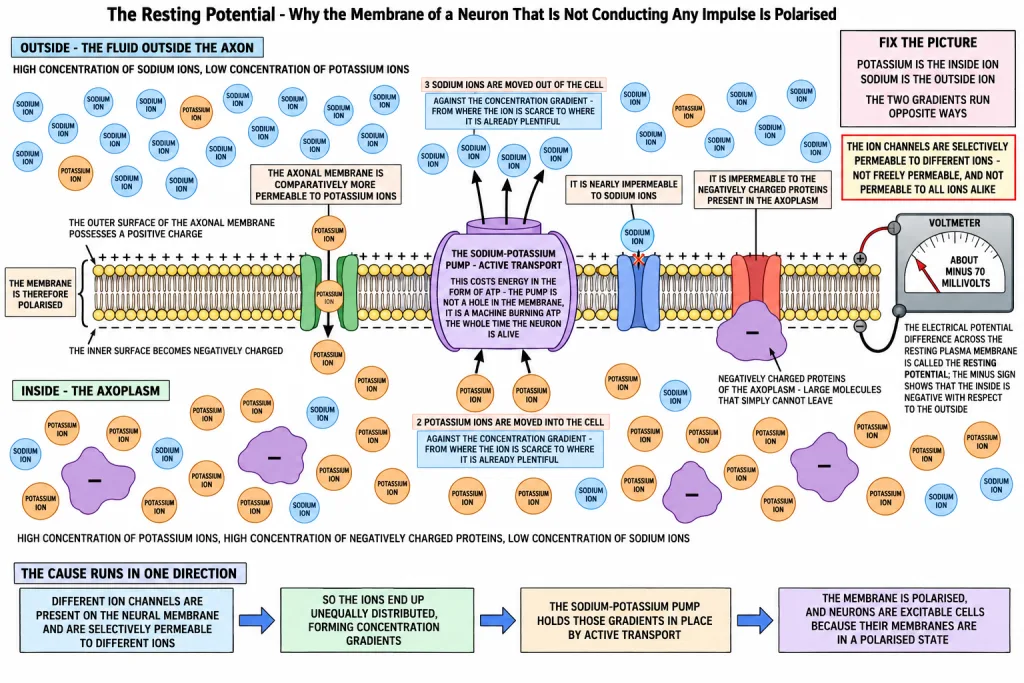
The result of all this. Since 3 positive charges leave for every 2 that come in, the outside gains positive charge and the inside loses it, while the trapped negatively charged proteins keep the inside negative:
- The outer surface of the axonal membrane possesses a positive charge.
- The inner surface becomes negatively charged.
- The membrane is therefore polarised.
- The electrical potential difference across the resting plasma membrane is called the resting potential. In a typical neuron its value is about -70 millivolts, the minus sign showing that the inside is negative with respect to the outside.
That is the state the fibre waits in. A stimulus arriving at such a membrane will reverse it, and that reversal is the nerve impulse.
[NEET Important] Three things get asked from this block. The pump ratio - 3 out for 2 in - and an option that reverses it, or that makes it 2 out for 3 in, is the standard trap. That the pump works by active transport and therefore uses ATP - "simple diffusion" and "facilitated diffusion" are the distractors. And the definition: the resting potential is the electrical potential difference across the resting plasma membrane, with the outer surface positive and the inner surface negative, about -70 millivolts.
Quick Recap
- Neurons are excitable cells because their membranes are in a polarised state.
- Different types of ion channels are present on the neural membrane, and they are selectively permeable to different ions.
- When a neuron is not conducting any impulse, that is, resting, the axonal membrane is comparatively more permeable to and nearly impermeable to .
- The membrane is also impermeable to the negatively charged proteins present in the axoplasm.
- Inside the axon (axoplasm): high , high negatively charged proteins, low .
- Outside the axon: low , high . The two sides thus form a concentration gradient.
- These ionic gradients are maintained by the active transport of ions by the sodium-potassium pump.
- The pump transports 3 outwards for 2 into the cell, both against the gradient, so it uses ATP.
- As a result the outer surface of the axonal membrane possesses a positive charge while its inner surface becomes negatively charged, and the membrane is therefore polarised.
- The electrical potential difference across the resting plasma membrane is called the resting potential, and it is about -70 millivolts.
Solved Examples
Question 1
Q. Explain the polarisation of the membrane of a nerve fibre. This is one of the chapter-end exercises.
Answer. Polarisation means that the two surfaces of the axonal membrane carry opposite charges - the outer surface is positive and the inner surface is negative. It comes about in the following steps.
- Different types of ion channels are present on the neural membrane, and they are selectively permeable to different ions.
- When the neuron is not conducting any impulse, that is, resting, the axonal membrane is comparatively more permeable to and nearly impermeable to . It is also impermeable to the negatively charged proteins present in the axoplasm, so those proteins are trapped inside.
- Consequently the axoplasm contains a high concentration of and negatively charged proteins and a low concentration of , while the fluid outside the axon contains a low concentration of and a high concentration of . The two sides thus form a concentration gradient.
- These ionic gradients are maintained by the active transport of ions by the sodium-potassium pump, which transports 3 outwards for 2 into the cell. Because both ions are moved against their gradients, this is active transport and it uses ATP.
- Since three positive charges are sent out for every two brought in, and the negatively charged proteins stay inside, the outer surface of the axonal membrane possesses a positive charge while its inner surface becomes negatively charged. The membrane is now polarised.
- The electrical potential difference across this resting plasma membrane is called the resting potential, and its value is about -70 millivolts, the minus sign showing that the inside is negative with respect to the outside.
Because the membrane is held in this polarised state, the neuron is an excitable cell - a stimulus can reverse the polarity and start an impulse.
Question 2
Q. Why are neurons described as excitable cells?
Answer. Because their membranes are in a polarised state. The outer surface is positive and the inner surface is negative, so the membrane is ready to be reversed by a stimulus.
Question 3
Q. What is the property of the ion channels present on the neural membrane?
Answer. Different types of ion channels are present on the neural membrane, and they are selectively permeable to different ions - each channel allows particular ions through and not others.
Question 4
Q. State the permeability of the resting axonal membrane to , to and to the proteins of the axoplasm.
Answer. At rest the axonal membrane is comparatively more permeable to , nearly impermeable to , and impermeable to the negatively charged proteins present in the axoplasm.
Question 5
Q. Give the concentrations of the two ions inside and outside a resting axon.
Answer.
| Side | Negatively charged proteins | ||
|---|---|---|---|
| Inside (axoplasm) | High | Low | High - they cannot cross the membrane |
| Outside the axon | Low | High | Not present in the same way |
The difference on the two sides forms a concentration gradient for each ion, and the two gradients run in opposite directions.
Question 6
Q. How are the ionic gradients across the resting membrane maintained?
Answer. By the active transport of ions by the sodium-potassium pump. The pump keeps working against the leakage, so the gradients do not run down.
Question 7
Q. How many sodium ions and how many potassium ions does the sodium-potassium pump move, and in which directions?
Answer. It transports 3 outwards for 2 into the cell - three sodium ions out, two potassium ions in.
Question 8
Q. The sodium-potassium pump is said to work by active transport. What does that mean for the cell, and what does the pump consume?
Answer. It means the pump moves both ions against their concentration gradients - sodium out to where sodium is already high, potassium in to where potassium is already high. Nothing moves that way on its own, so the pump has to spend energy, and it consumes ATP. This is why the pump is not simple diffusion and not facilitated diffusion.
Question 9
Q. What is the resting potential?
Answer. The electrical potential difference across the resting plasma membrane of a neuron. It exists because the outer surface of the axonal membrane is positively charged and the inner surface is negatively charged, and its value is about -70 millivolts.
Question 10
Q. Why is the inner surface of the resting axonal membrane negative?
Answer. For two reasons. The negatively charged proteins of the axoplasm are trapped inside, because the membrane is impermeable to them. And the sodium-potassium pump sends out 3 for every 2 it brings in, so more positive charge leaves the cell than enters it. Together these leave the inside negative and the outside positive.
Question 11
Q. What does it mean to say a neuron is "resting"?
Answer. That the neuron is not conducting any impulse. Its membrane is polarised and it is waiting for a stimulus.
Question 12
Q. If a drug stopped the sodium-potassium pump from working, what would happen to the resting potential?
Answer. The pump is what maintains the ionic gradients across the resting membrane. Without it, and would gradually leak down their concentration gradients until the difference between the two sides was lost. The outer surface would no longer be positive relative to the inner surface, the membrane would stop being polarised, and the resting potential would disappear. The neuron would then no longer be an excitable cell.
Question 13
Q. Which ion is at a high concentration inside the axon, and which is at a high concentration outside?
Answer. is high inside the axon, in the axoplasm. is high outside, in the fluid surrounding the axon.
Question 14
Q. Fill in the blanks: in a resting neuron the outer surface of the axonal membrane possesses a _ charge while its inner surface is charged, and the membrane is therefore said to be _.
Answer. The outer surface possesses a positive charge, the inner surface is negatively charged, and the membrane is therefore said to be polarised.