
What a Growth Rate Is, and Arithmetic Growth
The increased growth per unit time is termed the growth rate. Growth is not only a question of how much, but of how much in how long - and once you put time into it, the rate of growth can be expressed mathematically.
An organism, or a part of an organism, can produce more cells in a variety of ways. That single sentence is why one formula will not do for every case. The growth rate shows an increase that may be arithmetic or geometrical.
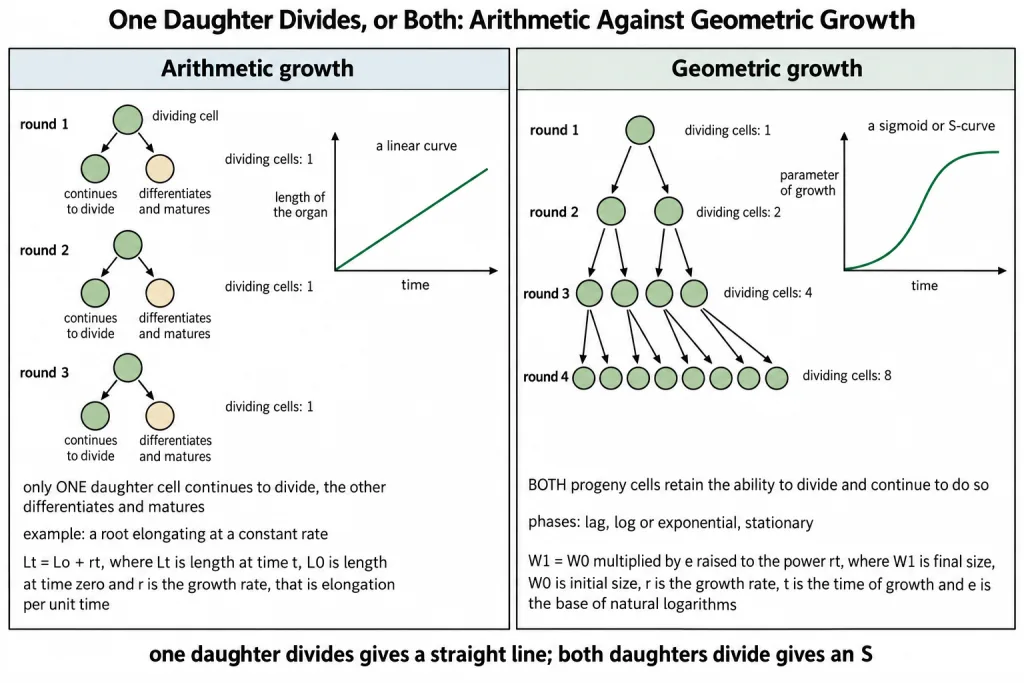
In arithmetic growth, following mitotic cell division, only one daughter cell continues to divide while the other differentiates and matures. Count what that does to the population of dividing cells: it stays the same. One divider goes in, one divider comes out, and the extra cell leaves the pool. So the organ gains cells at a steady, unchanging rate.
The simplest expression of arithmetic growth is exemplified by a root elongating at a constant rate. On plotting the length of the organ against time, a linear curve is obtained - a straight line, because equal times give equal increases.
Mathematically it is expressed as
- = length at time t
- = length at time zero
- = growth rate, that is elongation per unit time
Read the equation as a sentence: you start with a length, and you add the same amount for every unit of time that passes.
[NEET Important] The examinable half of arithmetic growth is the cell behaviour, not the equation. Only ONE daughter cell continues to divide; the other differentiates and matures. The standard wrong option says both daughter cells keep dividing - that is geometric growth. The second giveaway is the shape: arithmetic growth plots as a LINEAR curve, never a sigmoid one.
Geometric Growth, the Sigmoid Curve and the Efficiency Index
Now let us see what happens in geometrical growth.
In most systems, the initial growth is slow - the lag phase - and it increases rapidly thereafter, at an exponential rate - the log or exponential phase.
The reason sits in the cells. Here, both the progeny cells following mitotic cell division retain the ability to divide and continue to do so. Two dividers become four, four become eight; the pool of dividing cells doubles instead of staying constant, and that is what makes the climb steep.
However, with limited nutrient supply, the growth slows down, leading to a stationary phase. Nothing grows without end in a closed world.
If we plot the parameter of growth against time, we get a typical sigmoid or S-curve.
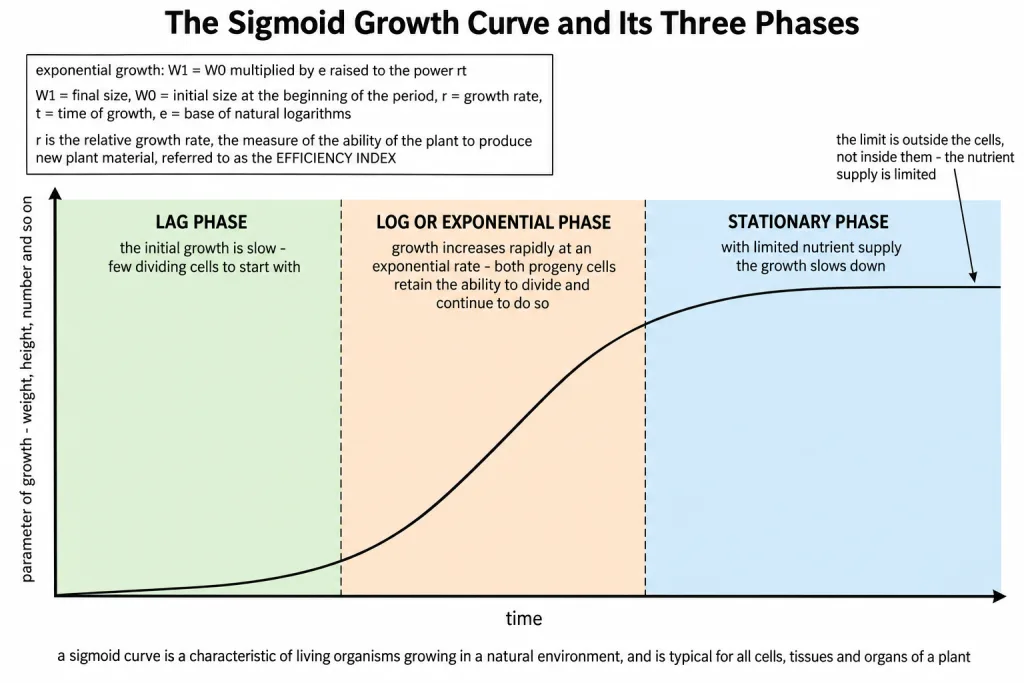
The curve is read from the bottom left upwards, and it has three phases in this order:
| Phase | What the curve does | What the cells are doing |
|---|---|---|
| Lag phase | rises very slowly | few dividing cells to start with |
| Log or exponential phase | rises rapidly | both progeny cells keep dividing |
| Stationary phase | flattens off | nutrient supply is limited |
A sigmoid curve is a characteristic of living organisms growing in a natural environment. It is typical for all cells, tissues and organs of a plant.
The exponential growth can be expressed as
- = final size (weight, height, number and so on)
- = initial size at the beginning of the period
- = growth rate
- = time of growth
- = base of natural logarithms
Here is the relative growth rate and is also the measure of the ability of the plant to produce new plant material, referred to as EFFICIENCY INDEX.
Hence the final size depends on the initial size . Two plants with the same growing for the same will not end up the same size if they did not start the same size - the bigger starter stays ahead, and the gap widens.
[NEET Important] Learn the efficiency-index line word for word - it is asked directly. In , is the relative growth rate, and it is the measure of the ability of the plant to produce new plant material, called the efficiency index. Distractors offer as the absolute growth rate, as the time, or as itself. The second favourite item asks what depends on - the answer is the initial size .
Arithmetic Versus Geometric - The Contrast That Carries the Marks
Put the two side by side and almost every question in this area answers itself.
| Arithmetic growth | Geometric growth | |
|---|---|---|
| Daughter cells after mitosis | only ONE continues to divide; the other differentiates and matures | BOTH progeny cells retain the ability to divide and continue to do so |
| Pool of dividing cells | stays constant | doubles each round |
| Shape of the curve | linear | sigmoid or S-curve |
| Phases | none - one steady slope | lag, log (exponential), stationary |
| Standard example | a root elongating at a constant rate | cells in culture, and organs of a plant in a natural environment |
| Expression |
One daughter divides gives you a straight line. Both daughters divide give you an S. If you remember nothing else from this section, remember that pair.
The stationary phase is not a failure of the cells - it is a shortage in the surroundings. The chapter is explicit: the growth slows down because the nutrient supply is limited.
[NEET Important] Do not confuse the three phases of the sigmoid curve with the three phases of growth from the previous section. They are different lists, and the examiner deliberately mixes them.
- Sigmoid growth curve: lag, log (exponential), stationary - these are phases of a growth curve in time, describing how fast a population or an organ is gaining size.
- Phases of growth in a root tip: meristematic, elongation, maturation - these are zones along an axis, describing what the cells in each region are doing. A question asking for "the three phases of the sigmoid growth curve" that offers meristematic, elongation and maturation among the options is testing exactly this confusion. Lag, log, stationary belongs to the curve; meristematic, elongation, maturation belongs to the root tip.
Quick Recap
- The increased growth per unit time is termed the growth rate, and the rate of growth can be expressed mathematically.
- An organism, or a part of it, can produce more cells in a variety of ways, so the growth rate shows an increase that may be arithmetic or geometrical.
- Arithmetic growth: following mitotic cell division, only ONE daughter cell continues to divide while the other differentiates and matures.
- The simplest expression of arithmetic growth is a root elongating at a constant rate, and plotting length against time gives a linear curve.
- Arithmetic growth: with = length at time t, = length at time zero, = growth rate or elongation per unit time.
- Geometric growth: the initial growth is slow - the lag phase - and increases rapidly thereafter at an exponential rate - the log or exponential phase.
- In geometric growth BOTH progeny cells following mitotic cell division retain the ability to divide and continue to do so.
- With limited nutrient supply the growth slows down, leading to a stationary phase.
- Plotting the parameter of growth against time gives a typical sigmoid or S-curve.
- A sigmoid curve is a characteristic of living organisms growing in a natural environment; it is typical for all cells, tissues and organs of a plant.
- Exponential growth: with = final size (weight, height, number etc.), = initial size at the beginning of the period, = growth rate, = time of growth, = base of natural logarithms.
- Here is the relative growth rate and is also the measure of the ability of the plant to produce new plant material, referred to as efficiency index.
- Hence the final size depends on the initial size .
- The three phases of the sigmoid curve are lag, log (exponential) and stationary - not the meristematic, elongation and maturation phases of the root tip.
Solved Examples
Question 1
Q. What is meant by growth rate?
Answer. The increased growth per unit time is termed the growth rate. Because time is part of it, the rate of growth can be expressed mathematically.
Question 2
Q. Describe briefly: Arithmetic growth. This is one of the chapter-end exercises.
Answer. In arithmetic growth, following mitotic cell division, only one daughter cell continues to divide while the other differentiates and matures. Because only one cell of each pair stays in the dividing pool, the number of dividing cells never changes and the organ gains size at a constant rate.
The simplest expression of arithmetic growth is a root elongating at a constant rate. On plotting the length of the organ against time, a linear curve is obtained.
It is expressed mathematically as
where = length at time t, = length at time zero and = growth rate, that is elongation per unit time.
Question 3
Q. Describe briefly: Geometric growth. This is one of the chapter-end exercises.
Answer. In geometric growth, both the progeny cells following mitotic cell division retain the ability to divide and continue to do so. The pool of dividing cells therefore doubles each round instead of staying constant.
In most systems the initial growth is slow - the lag phase - and it increases rapidly thereafter, at an exponential rate, called the log or exponential phase. However, with limited nutrient supply the growth slows down, leading to a stationary phase.
The exponential growth can be expressed as
where = final size (weight, height, number etc.), = initial size at the beginning of the period, = growth rate, = time of growth and = base of natural logarithms. Here is the relative growth rate and is also the measure of the ability of the plant to produce new plant material, referred to as efficiency index, and the final size therefore depends on the initial size .
Question 4
Q. Describe briefly: Sigmoid growth curve. This is one of the chapter-end exercises.
Answer. If the parameter of growth is plotted against time in a geometrically growing system, we get a typical sigmoid or S-curve. It has three phases:
- Lag phase - the initial growth is slow.
- Log or exponential phase - growth increases rapidly, at an exponential rate, because both progeny cells of every mitotic division keep dividing.
- Stationary phase - with limited nutrient supply the growth slows down and the curve flattens.
A sigmoid curve is a characteristic of living organisms growing in a natural environment. It is typical for all cells, tissues and organs of a plant.
Question 5
Q. After mitosis in an arithmetically growing tissue, what becomes of the two daughter cells?
Answer. Only one daughter cell continues to divide. The other differentiates and matures, leaving the dividing pool for good.
Question 6
Q. Give the mathematical expression for arithmetic growth and say what each symbol stands for.
Answer. is the length at time t, is the length at time zero and is the growth rate, that is the elongation per unit time.
Question 7
Q. What shape of curve do you get on plotting the length of a root elongating at a constant rate against time, and why?
Answer. A linear curve - a straight line. The root adds the same length in every equal interval of time, because the number of dividing cells stays constant in arithmetic growth.
Question 8
Q. Why does an exponentially growing system eventually enter a stationary phase?
Answer. Because the nutrient supply is limited. With limited nutrient supply the growth slows down, leading to a stationary phase. The cells have not lost the ability to divide; the surroundings can no longer support the rate.
Question 9
Q. Write the expression for exponential growth and define every term in it.
Answer. = final size (weight, height, number etc.), = initial size at the beginning of the period, = growth rate, = time of growth, = base of natural logarithms.
Question 10
Q. What is the efficiency index?
Answer. In the exponential expression, is the relative growth rate, and it is also the measure of the ability of the plant to produce new plant material. That measure is referred to as the efficiency index. A plant with a high efficiency index turns what it already has into new plant material quickly.
Question 11
Q. On what does the final size depend?
Answer. On the initial size . Two plants with the same growth rate , grown for the same time , will still differ in final size if they started at different sizes - the larger starter stays larger, and the gap widens with time.
Question 12
Q. Name the three phases of a sigmoid growth curve in order, and say why a sigmoid curve is important.
Answer. Lag phase, then log or exponential phase, then stationary phase. It matters because a sigmoid curve is a characteristic of living organisms growing in a natural environment and is typical for all cells, tissues and organs of a plant.
Question 13
Q. A student writes that the three phases of the sigmoid growth curve are meristematic, elongation and maturation. Correct the mistake.
Answer. Those are the three phases of growth seen along a root tip, not the phases of the sigmoid curve. The sigmoid growth curve has the lag, log (exponential) and stationary phases - they describe how fast the system is gaining size as time passes. Meristematic, elongation and maturation are zones along the axis and describe what the cells in each region are doing. Keep the two lists apart.
Question 14
Q. In a tissue where both daughter cells of every mitotic division keep dividing, what type of growth is shown and what curve results?
Answer. Geometric growth, and the plot of the growth parameter against time is a sigmoid or S-curve. Contrast this with arithmetic growth, where only one daughter cell continues to divide and the curve is linear.