
What Development Means
Growth is one word, differentiation is another, and the word that holds them both is development.
Development is a term that includes all changes an organism goes through during its life cycle, from germination of the seed to senescence.
That is the full definition, and the two end points are part of it. Development does not start at flowering and it does not stop at maturity - it runs from the germination of the seed right through to senescence.
The chapter draws the sequence of processes that make up the development of a cell of a higher plant like this:
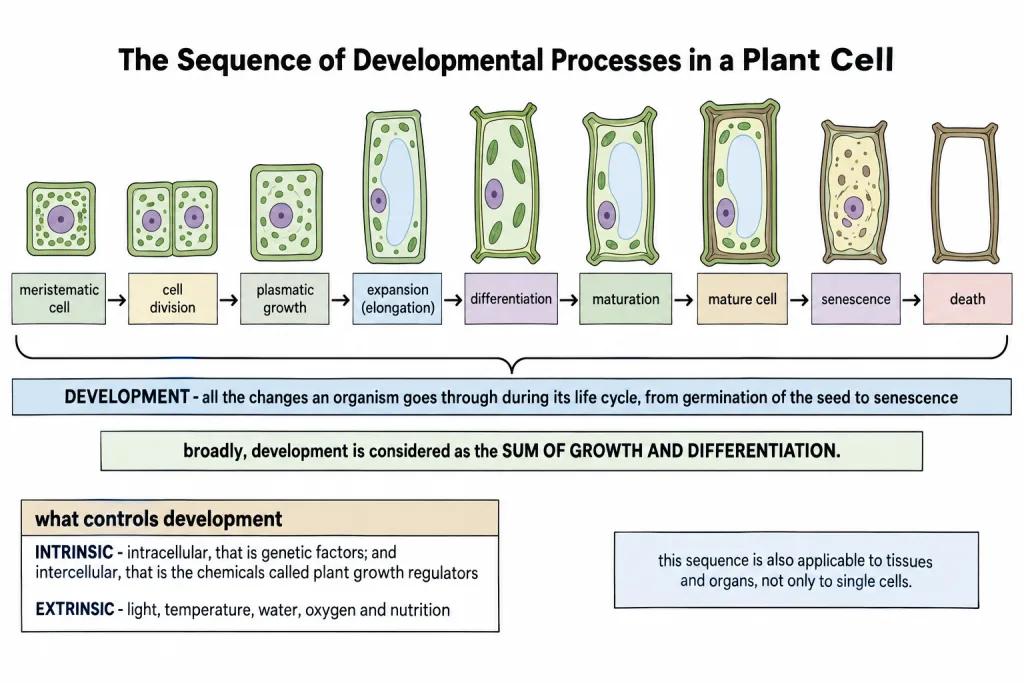
meristematic cell -> cell division -> plasmatic growth -> expansion (elongation) -> differentiation -> maturation -> mature cell -> senescence -> death
Walk along it once:
- A meristematic cell divides - cell division.
- The new cell builds up its living contents - plasmatic growth.
- It takes in water and gets longer - expansion, that is, elongation.
- It begins to take on the features of its job - differentiation.
- It finishes the job - maturation - and is now a mature cell.
- With time it ages - senescence - and finally death.
And this sequence is not only about cells. It is also applicable to tissues and organs. A leaf goes through the same story that one of its cells does.
Broadly, development is considered as the sum of growth and differentiation.
That one-line equation is asked directly, so keep it in exactly those words: development = growth + differentiation.
[NEET Important] Three separate one-liners come out of this block, and papers ask all three. Development includes all the changes from germination of the seed to senescence. Development is the sum of growth and differentiation. The developmental sequence applies to tissues and organs as well as to cells. In the sequence itself the order that gets scrambled is the middle: plasmatic growth comes before expansion, and differentiation comes after expansion and before maturation.
Plasticity and Heterophylly
A plant cannot walk away from a bad spot, so it changes what it builds instead.
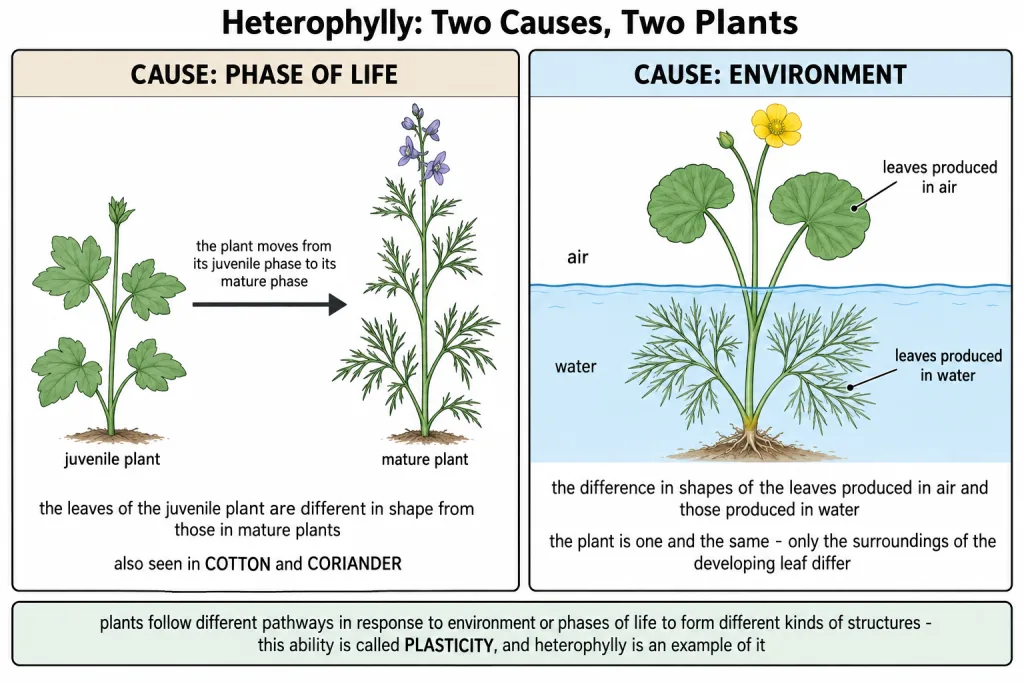
Plants follow different pathways in response to environment or phases of life to form different kinds of structures. This ability is called plasticity.
The chapter's illustration of plasticity is heterophylly - literally different leaves on one plant - and it gives two examples with two different causes. Which example belongs to which cause is exactly what gets asked.
| Cause | Example plants | What is seen |
|---|---|---|
| Phase of life | cotton, coriander and larkspur | the leaves of the juvenile plant are different in shape from those in mature plants |
| Environment | buttercup | leaves produced in air differ in shape from those produced in water |
Take the two apart.
Heterophylly due to the phase of life. In cotton, coriander and larkspur, the leaves of the juvenile plant are different in shape from those in mature plants. Nothing outside the plant has changed. The plant itself has moved from its juvenile phase to its mature phase, and the leaf shape moved with it.
Heterophylly due to the environment. In buttercup, the difference in shapes of the leaves produced in air and those produced in water represents heterophyllous development due to environment. Here the plant is one and the same; the surroundings of the developing leaf are different, and the leaf answers accordingly - the submerged leaves being finely divided and the aerial ones broader.
This phenomenon of heterophylly is an example of plasticity.
Thus, growth, differentiation and development are very closely related events in the life of a plant. They are not three separate topics but three views of the same story: growth adds the material, differentiation shapes it, and development is the whole life history that results.
[NEET Important] The examiner does not ask what heterophylly is; the examiner asks which cause goes with which plant. Cotton, coriander and larkspur - phase of life (juvenile leaves differ from mature leaves). Buttercup - environment (leaves in air differ from leaves in water). The standard wrong option swaps them, or offers heterophylly as an example of dedifferentiation instead of plasticity.
What Controls Development: Intrinsic and Extrinsic Factors
Development in plants - that is, both growth and differentiation - is under the control of intrinsic and extrinsic factors.
This classification is the bridge into the second half of the chapter, because the plant growth regulators you are about to meet sit in one particular box of it.
| Factor | Type | What it covers |
|---|---|---|
| Intrinsic | intracellular factors | genetic factors |
| Intrinsic | intercellular factors | chemicals, namely the plant growth regulators |
| Extrinsic | from outside the plant | light, temperature, water, oxygen and nutrition |
Say it as one sentence: intrinsic factors are the intracellular genetic factors and the intercellular chemicals called plant growth regulators, while extrinsic factors are light, temperature, water, oxygen and nutrition.
Two things about this table get marks.
- Plant growth regulators are intrinsic, not extrinsic. They are made inside the plant and act between its cells, so they are intercellular intrinsic factors. Light and temperature are the extrinsic ones.
- Genetic factors are intrinsic and intracellular - inside the cell itself.
[NEET Important] NEET asks this as a straight classification item: put the factor in the right box. Intrinsic - intracellular (genetic) and intercellular (plant growth regulators). Extrinsic - light, temperature, water, oxygen, nutrition. The commonest wrong answer files plant growth regulators under extrinsic factors, because they can also be sprayed on from outside; in this chapter's classification the regulators the plant makes are intrinsic.
Quick Recap
- Development is a term that includes all changes an organism goes through during its life cycle, from germination of the seed to senescence.
- The developmental sequence of a plant cell: meristematic cell -> cell division -> plasmatic growth -> expansion (elongation) -> differentiation -> maturation -> mature cell -> senescence -> death.
- The sequence is also applicable to tissues and organs, not only to single cells.
- Broadly, development is considered as the sum of growth and differentiation.
- Plasticity - plants follow different pathways in response to environment or phases of life to form different kinds of structures.
- Heterophylly due to the phase of life: cotton, coriander and larkspur - the leaves of the juvenile plant are different in shape from those in mature plants.
- Heterophylly due to the environment: buttercup - the leaves produced in air differ in shape from those produced in water.
- This phenomenon of heterophylly is an example of plasticity.
- Growth, differentiation and development are very closely related events in the life of a plant.
- Development, that is both growth and differentiation, is under the control of intrinsic and extrinsic factors.
- Intrinsic factors - intracellular (genetic) factors and intercellular factors, the chemicals called plant growth regulators.
- Extrinsic factors - light, temperature, water, oxygen and nutrition.
Solved Examples
Question 1
Q. Define development.
Answer. Development is a term that includes all the changes an organism goes through during its life cycle, from germination of the seed to senescence. Both end points belong in the definition.
Question 2
Q. Give the sequence of processes that constitute the development of a cell of a higher plant.
Answer. Meristematic cell -> cell division -> plasmatic growth -> expansion (elongation) -> differentiation -> maturation -> mature cell -> senescence -> death.
Question 3
Q. Is this developmental sequence true only of single cells?
Answer. No. It is also applicable to tissues and organs. A whole leaf passes through the same story - it is formed, it grows and expands, it differentiates and matures, it ages, and finally it dies.
Question 4
Q. Broadly, development is considered as the sum of what?
Answer. Development is broadly considered as the sum of growth and differentiation. Growth supplies the increase in size and number; differentiation gives those cells their specific structure and function.
Question 5
Q. What is plasticity in plants?
Answer. Plants follow different pathways in response to environment or phases of life to form different kinds of structures. This ability is called plasticity.
Question 6
Q. What is heterophylly, and in which plants does it occur because of the phase of life?
Answer. Heterophylly is the production of leaves of different shapes on the same plant. It occurs because of the phase of life in cotton, coriander and larkspur, where the leaves of the juvenile plant are different in shape from those in mature plants.
Question 7
Q. Why do the leaves of a buttercup differ in shape, and what does this show?
Answer. Because of the environment. The leaves produced in air differ in shape from those produced in water - the submerged leaves and the aerial leaves develop differently even though the plant is one and the same. This is heterophyllous development due to environment.
Question 8
Q. Heterophylly has two causes in this chapter. Name them and give the example plant for each.
Answer. Phase of life - cotton, coriander and larkspur, where juvenile leaves differ in shape from mature leaves. Environment - buttercup, where leaves produced in air differ in shape from those produced in water. Keep the pairs the right way round; that is what is asked.
Question 9
Q. Heterophylly is an example of which phenomenon?
Answer. Plasticity. The phenomenon of heterophylly is an example of plasticity, because the plant is following different pathways to form different kinds of structures in response to its phase of life or its environment.
Question 10
Q. Development in plants is under the control of which two sets of factors?
Answer. Intrinsic and extrinsic factors, and this control covers both growth and differentiation.
Question 11
Q. What do the intrinsic factors include?
Answer. Intracellular factors, which are the genetic factors, and intercellular factors, which are chemicals - the plant growth regulators. Plant growth regulators are intrinsic factors, not extrinsic ones.
Question 12
Q. List the extrinsic factors that control development.
Answer. Light, temperature, water, oxygen and nutrition.
Question 13
Q. How are growth, differentiation and development related to one another?
Answer. They are very closely related events in the life of a plant. Growth is the irreversible increase in size, differentiation is the maturation of cells to perform specific functions, and development is broadly the sum of the two - the whole set of changes from germination of the seed to senescence.