
What the Gibberellins Are
Gibberellins are another kind of PROMOTORY PGR - they belong with the auxins and cytokinins in the growth promoting group, not with the inhibitors.
There are more than 100 gibberellins reported from widely different organisms such as fungi and higher plants. That is worth pausing on: the same family of regulators is made by a fungus and by a flowering plant, which is exactly how the first one was found, in the fungus that causes the foolish seedling disease of rice.
They are denoted as , , and so on - numbered in the order they were characterised, not by how important they are.
However, gibberellic acid was one of the FIRST gibberellins to be discovered and remains the MOST INTENSIVELY STUDIED form. When a question simply says "gibberellin" and gives a practical use, it usually means .
All GAs are ACIDIC. One word, one mark. They produce a wide range of physiological responses in plants.
[NEET Important] Four recall facts sit in this paragraph and all four get asked: more than 100 gibberellins; from organisms as different as fungi and higher plants; is one of the first discovered and the most intensively studied; all GAs are acidic. The distractors offer "all GAs are basic" and "more than 10" or "more than 1000" gibberellins.
What Gibberellins Do
The whole list turns on one central ability - gibberellins cause an increase in the length of the axis - plus two effects that are not about length at all.
- INCREASE THE LENGTH OF THE AXIS. This ability is used to increase the length of grape stalks, so the bunch is looser and the berries larger.
- ELONGATE AND IMPROVE THE SHAPE OF FRUIT. Gibberellins cause fruits like apple to elongate and improve its shape.
- DELAY SENESCENCE. Thus the fruits can be left on the tree longer, so as to extend the market period. Ageing is postponed, so the grower is not forced to pick everything at once.
- SPEED UP THE MALTING PROCESS. is used to speed up the malting process in the brewing industry.
- INCREASE SUGARCANE YIELD. Sugarcane stores carbohydrate as sugar in its stems. Spraying the sugarcane crop with gibberellins increases the length of the stem, thus increasing the yield by as much as 20 TONNES PER ACRE. The reasoning is the point: a longer stem is simply a bigger store, because the sugar is kept in the stem.
- HASTEN MATURITY IN CONIFERS. Spraying juvenile conifers with GAs hastens the maturity period, thus leading to early seed production.
- PROMOTE BOLTING in rosette plants - dealt with in the next block.
Note which way the senescence effect runs. Gibberellin DELAYS senescence. In this chapter the regulators that promote senescence are others; do not let an option persuade you that a promotory PGR hurries ageing along.
[NEET Important] The application-to-crop matches are the examinable grid here: grape stalks - length; apple - elongation and shape; brewing industry - malting; sugarcane - 20 tonnes per acre; juvenile conifers - early seed production; beet and cabbage - bolting. The single most-swapped pair is grape and sugarcane. The number 20 tonnes per acre is asked as a number, so learn it exactly.
Bolting and the Rosette Habit
Two words have to be clear before the exercise on this makes any sense.
A rosette habit means the plant grows its leaves in a tight circular cluster close to the ground, because its internodes stay extremely short. The leaves are stacked almost on top of one another - beet and cabbage are the standard examples. There is a stem, but it has hardly any length.
Bolting is internode elongation just prior to flowering. The short internodes suddenly stretch, the flat rosette shoots up into a tall flowering stalk, and the plant flowers.
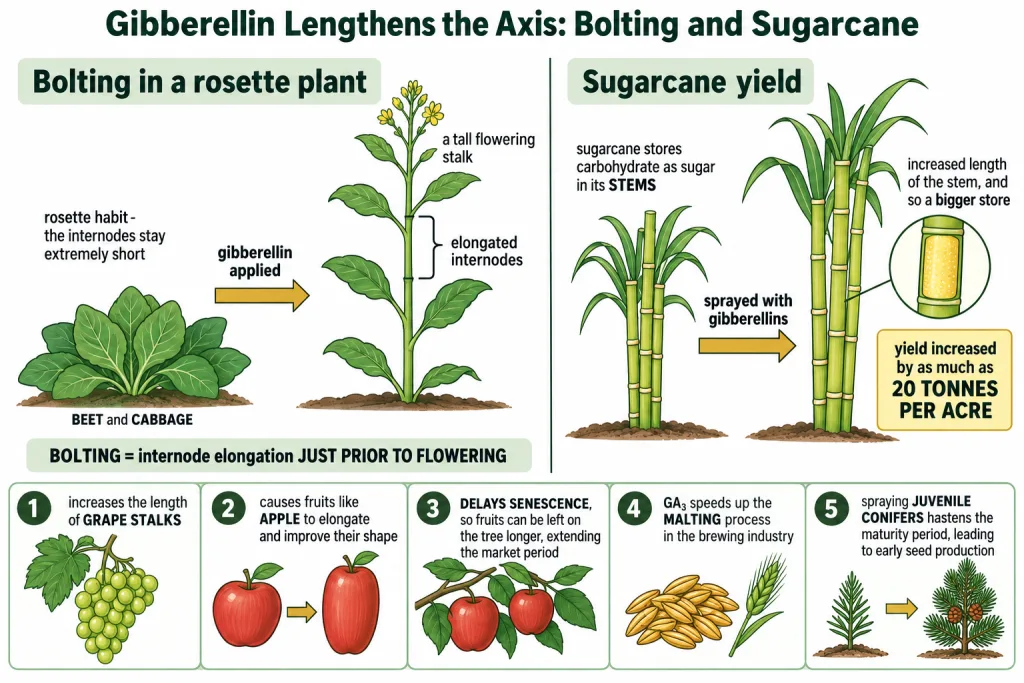
Gibberellins also promote bolting - internode elongation just prior to flowering - in beet, cabbages and many plants with a rosette habit.
So gibberellin is the regulator you apply if you want a rosette plant to bolt, and it works because the one thing gibberellin does best is lengthen the axis. A rosette plant is a plant whose axis has not lengthened; give it gibberellin and it does.
[NEET Important] Define bolting in the chapter's own words - internode elongation just prior to flowering - and be ready to name beet and cabbages as the examples. A question that asks which regulator would you use to bolt a rosette plant wants gibberellin, and the distractors will be auxin, cytokinin, abscisic acid or ethylene.
Quick Recap
- Gibberellins are another kind of PROMOTORY PGR.
- More than 100 gibberellins have been reported from widely different organisms such as fungi and higher plants.
- They are denoted as , , and so on.
- Gibberellic acid was one of the FIRST gibberellins to be discovered and remains the MOST INTENSIVELY STUDIED form.
- All GAs are ACIDIC, and they produce a wide range of physiological responses.
- They increase the length of the axis - used to increase the length of GRAPE STALKS.
- They cause fruits like APPLE to ELONGATE and IMPROVE ITS SHAPE.
- They DELAY SENESCENCE, so fruits can be left on the tree longer, extending the market period.
- is used to SPEED UP THE MALTING PROCESS in the brewing industry.
- Sugarcane stores carbohydrate as sugar in its stems; spraying sugarcane with gibberellins increases stem length and so the yield by as much as 20 TONNES PER ACRE.
- Spraying JUVENILE CONIFERS with GAs HASTENS THE MATURITY PERIOD, leading to EARLY SEED PRODUCTION.
- Gibberellins promote BOLTING - internode elongation just prior to flowering - in BEET, CABBAGES and many plants with a ROSETTE HABIT.
- Rosette habit = leaves in a tight cluster near the ground because the internodes stay very short.
Solved Examples
Question 1
Q. To which functional group of PGRs do the gibberellins belong?
Answer. They are promotory PGRs - growth promoters, along with the auxins and cytokinins.
Question 2
Q. How many gibberellins are known, and from what kinds of organisms?
Answer. More than 100 gibberellins have been reported, from widely different organisms such as fungi and higher plants.
Question 3
Q. How are gibberellins named, and what is special about ?
Answer. They are denoted as , , and so on. Gibberellic acid was one of the first gibberellins to be discovered and remains the most intensively studied form.
Question 4
Q. What is the chemical character of all gibberellins?
Answer. All GAs are acidic.
Question 5
Q. How are gibberellins used on grapes?
Answer. Their ability to cause an increase in the length of the axis is used to increase the length of grape stalks.
Question 6
Q. What do gibberellins do to a fruit like the apple?
Answer. They cause fruits like apple to elongate and improve its shape.
Question 7
Q. How does the effect of gibberellin on senescence help a fruit grower?
Answer. Gibberellins delay senescence. Thus the fruits can be left on the tree longer, so as to extend the market period - the grower is not forced to harvest and sell everything at once.
Question 8
Q. Name the industrial use of given in this chapter.
Answer. is used to speed up the malting process in the brewing industry.
Question 9
Q. Why does spraying sugarcane with gibberellin raise the yield so much, and by how much?
Answer. Sugarcane stores carbohydrate as sugar in its stems. Gibberellin increases the length of the stem, and a longer stem is simply a bigger store for that sugar. The yield goes up by as much as 20 tonnes per acre.
Question 10
Q. What is the effect of spraying juvenile conifers with gibberellins?
Answer. It hastens the maturity period, thus leading to early seed production.
Question 11
Q. What is meant by rosette habit and by bolting?
Answer. A plant with the rosette habit carries its leaves in a tight cluster close to the ground because its internodes remain extremely short - beet and cabbage are the usual examples. Bolting is internode elongation just prior to flowering: the short internodes stretch out, the flat rosette shoots up into a tall flowering stalk, and the plant flowers.
Question 12
Q. Which growth regulator would you use to "bolt" a rosette plant? This is one of the chapter-end exercises.
Answer. Gibberellin. Gibberellins promote bolting - internode elongation just prior to flowering - in beet, cabbages and many plants with a rosette habit. It works because the outstanding ability of gibberellin is to increase the length of the axis, and a rosette plant is one whose axis has not elongated.
Question 13
Q. What would be expected to happen if is applied to rice seedlings? This is one of the chapter-end exercises.
Answer. The seedlings would grow abnormally tall and spindly. This is the "foolish seedling" or bakanae phenotype, the very condition from which gibberellin was first discovered, and it happens because causes a marked elongation of the internodes. Such over-elongated seedlings are weak, they tend to lodge - fall over - and they give a poor yield.