
What a Plant Growth Regulator Is
The plant growth regulators (PGRs) are small, simple molecules of diverse chemical composition.
Three words in that sentence carry the marks. Small and simple - a PGR is not a big protein like an enzyme. Diverse - there is no one chemical family that all PGRs belong to, and that is exactly why the examiner can ask you to match a regulator to its chemical nature.
There are five chemical classes, and the chemical-nature match is asked directly, so learn this as a table.
| Chemical class | Example | Common name or symbol |
|---|---|---|
| Indole compounds | indole-3-acetic acid | IAA |
| Adenine derivatives | -furfurylamino purine | kinetin |
| Derivatives of carotenoids | abscisic acid | ABA |
| Terpenes | gibberellic acid | |
| Gases | ethylene |
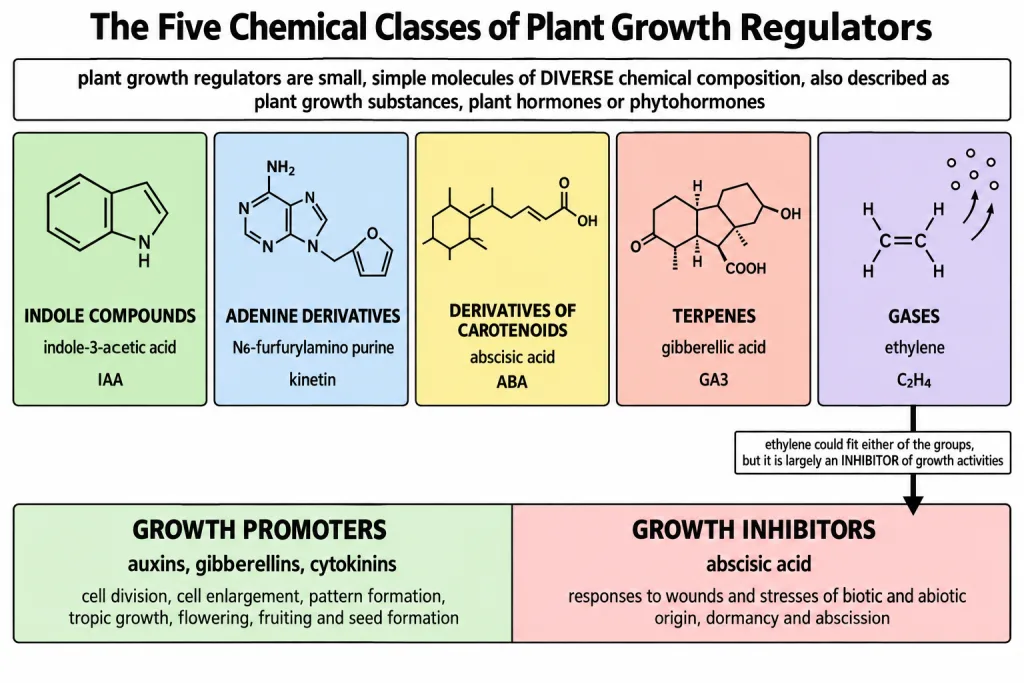
Plant growth regulators are variously described as plant growth substances, plant hormones or phytohormones in the literature. All four names mean the same set of molecules - if a question offers you "phytohormone" and "plant growth regulator" as different things, they are not different.
[NEET Important] Learn the chemical class of each regulator by heart. IAA is an indole compound. Kinetin is an adenine derivative. ABA is a derivative of carotenoids. Gibberellic acid is a terpene. Ethylene is a gas. The favourite trick is to swap ABA and gibberellic acid between carotenoid derivative and terpene, or to call kinetin an indole compound because IAA is one. Ethylene is the only gaseous PGR.
Two Functional Groups - Promoters and Inhibitors
The PGRs can be broadly divided into two groups based on their functions in a living plant body.
- Growth PROMOTERS - auxins, gibberellins and cytokinins. One group of PGRs is involved in growth promoting activities, such as cell division, cell enlargement, pattern formation, tropic growth, flowering, fruiting and seed formation. These three are also called plant growth promoters.
2. Growth INHIBITORS. The PGRs of the other group play an important role in plant responses to wounds and stresses of biotic and abiotic origin. They are also involved in various growth inhibiting activities such as dormancy and abscission. The PGR abscisic acid belongs to this group.
Ethylene could fit either of the groups, but it is largely an INHIBITOR of growth activities.
Read that last line again and memorise it in those words. Ethylene sits on the fence chemically and functionally, and the chapter settles the matter for you: largely an inhibitor.
- Promoters (3): auxins, gibberellins, cytokinins
- Inhibitor (clear-cut): abscisic acid
- Inhibitor (with a foot in both camps): ethylene
[NEET Important] "Ethylene is largely an inhibitor of growth activities" is a favourite single-mark question, and the distractor is always "growth promoter". The other reliable item is the promoter trio - auxins, gibberellins and cytokinins - with ABA slipped in to see if you will take it. Wounds and stresses of biotic and abiotic origin, dormancy and abscission are the inhibitor group's key words.
The Discovery of the Five Groups
Interestingly, the discovery of each of the five major groups of PGRs has been accidental. Nobody set out to find a plant hormone. Each one turned up while somebody was looking at something else - a bending seedling, a diseased rice crop, a tissue culture that would not grow, a crate of oranges.
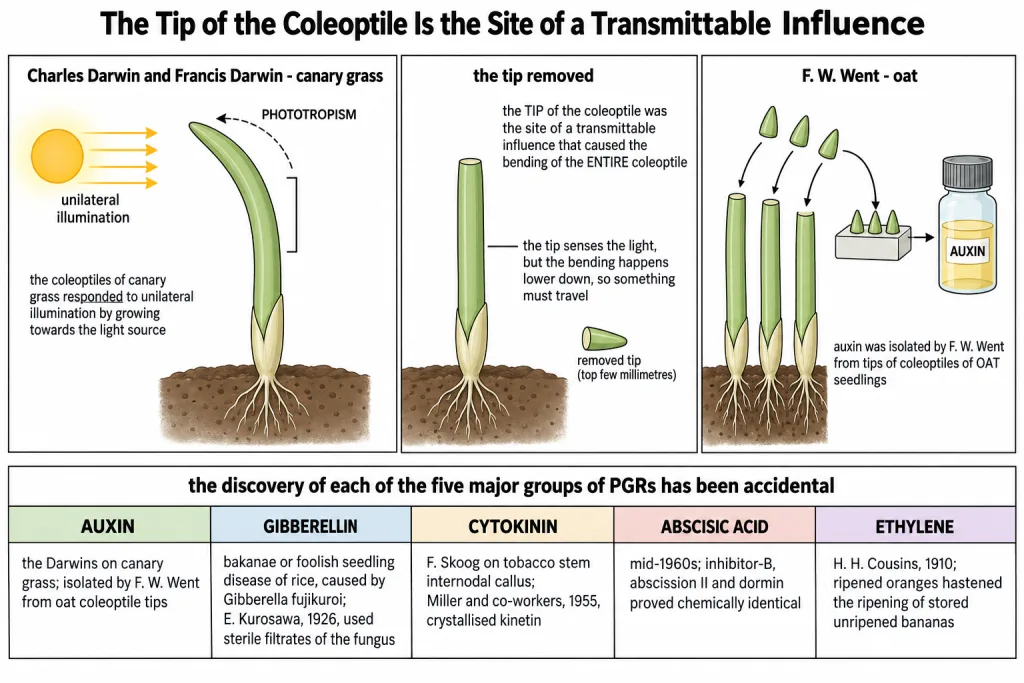
Auxin - the Darwins and Went. Charles Darwin and his son Francis Darwin observed that the coleoptiles of canary grass responded to unilateral illumination by growing towards the light source (phototropism). After a series of experiments it was concluded that the TIP of the coleoptile was the site of a transmittable influence that caused the bending of the entire coleoptile. Note the logic: the tip senses the light, but the bending happens lower down, so something must travel. Auxin was isolated by F. W. Went from tips of coleoptiles of oat seedlings.
Gibberellin - Kurosawa and a sick rice crop. The "bakanae" or foolish seedling disease of rice seedlings was caused by the fungal pathogen Gibberella fujikuroi. E. Kurosawa (1926) reported the appearance of the symptoms of the disease in rice seedlings when they were treated with sterile filtrates of the fungus. Sterile filtrate is the key word - no living fungus was needed, so the effect came from a chemical the fungus made. The active substances were later identified as gibberellic acid.
Cytokinin - Skoog, Miller and a callus that would not divide. F. Skoog and his co-workers observed that from the internodal segments of tobacco stems, the callus - a mass of undifferentiated cells - proliferated only if, in addition to auxins, the nutrient medium was supplemented with one of the following: extracts of vascular tissues, yeast extract, coconut milk or DNA. Miller et al. (1955) later identified and crystallised the cytokinesis promoting active substance, which they termed kinetin.
Abscisic acid - three names for one molecule. During the mid-1960s, three independent researchers reported the purification and chemical characterisation of three different kinds of inhibitors: inhibitor-B, abscission II and dormin. Later all the three were proved to be chemically identical. It was named abscisic acid (ABA).
Ethylene - Cousins and the oranges. H. H. Cousins (1910) confirmed the release of a volatile substance from ripened oranges that hastened the ripening of stored unripened bananas. Later this volatile substance was identified as ethylene, a gaseous PGR.
[NEET Important] Names, organisms and years are all fair game here. The set that gets asked over and over: canary grass for the Darwins, oat for Went, rice and Gibberella fujikuroi for the bakanae disease, tobacco stem internodes for Skoog's callus, oranges and bananas for Cousins. The years worth carrying are Kurosawa 1926, Miller et al. 1955, mid-1960s for ABA and Cousins 1910. The commonest swap is canary grass and oat between the Darwins and Went - the Darwins watched canary grass; Went isolated auxin from oat.
Quick Recap
- PGRs are small, simple molecules of diverse chemical composition.
- Indole compounds - indole-3-acetic acid, IAA.
- Adenine derivatives - -furfurylamino purine, kinetin.
- Derivatives of carotenoids - abscisic acid, ABA.
- Terpenes - gibberellic acid, .
- Gases - ethylene, .
- PGRs are variously described as plant growth substances, plant hormones or phytohormones.
- Growth promoters - auxins, gibberellins, cytokinins - do cell division, cell enlargement, pattern formation, tropic growth, flowering, fruiting and seed formation.
- The other group handles responses to wounds and stresses of biotic and abiotic origin and growth inhibiting activities such as dormancy and abscission; ABA belongs to this group.
- Ethylene could fit either group but is largely an INHIBITOR of growth activities.
- The discovery of each of the five major groups of PGRs has been accidental.
- Auxin: the Darwins saw canary grass coleoptiles bend towards unilateral light (phototropism); the tip was the site of a transmittable influence; F. W. Went isolated auxin from tips of coleoptiles of oat seedlings.
- Gibberellin: bakanae or foolish seedling disease of rice, caused by Gibberella fujikuroi; E. Kurosawa (1926) used sterile filtrates of the fungus; the active substances were gibberellic acid.
- Cytokinin: F. Skoog and co-workers - tobacco stem internodal callus grew only with auxin plus extracts of vascular tissues, yeast extract, coconut milk or DNA; Miller et al. (1955) crystallised it and named it kinetin.
- ABA: mid-1960s, inhibitor-B, abscission II and dormin proved chemically identical, named abscisic acid.
- Ethylene: H. H. Cousins (1910) - a volatile substance from ripened oranges hastened ripening of stored unripened bananas.
Solved Examples
Question 1
Q. What kind of molecules are plant growth regulators?
Answer. They are small, simple molecules of diverse chemical composition. They are not large molecules like enzymes, and they do not all belong to one chemical family.
Question 2
Q. Name the five chemical classes of PGRs with one example of each.
Answer. Indole compounds - indole-3-acetic acid (IAA). Adenine derivatives - -furfurylamino purine (kinetin). Derivatives of carotenoids - abscisic acid (ABA). Terpenes - gibberellic acid . Gases - ethylene .
Question 3
Q. By what other names are plant growth regulators described?
Answer. Plant growth substances, plant hormones or phytohormones. All of these refer to the same group of molecules.
Question 4
Q. On what basis are PGRs divided into two groups, and which regulators fall in each?
Answer. On the basis of their functions in a living plant body. One group does growth promoting work - auxins, gibberellins and cytokinins, the plant growth promoters. The other group is involved in plant responses to wounds and stresses of biotic and abiotic origin and in growth inhibiting activities such as dormancy and abscission - abscisic acid belongs here, and ethylene is largely an inhibitor too.
Question 5
Q. List the growth promoting activities the first group of PGRs is involved in.
Answer. Cell division, cell enlargement, pattern formation, tropic growth, flowering, fruiting and seed formation.
Question 6
Q. To which functional group does ethylene belong?
Answer. Ethylene could fit either of the two groups, but it is largely an INHIBITOR of growth activities. That is the answer the chapter wants - inhibitor, not promoter.
Question 7
Q. List the five main groups of natural plant growth regulators. Write a note on the discovery, physiological functions and agricultural or horticultural applications of any one of them. This is one of the chapter-end exercises.
Answer. The five main groups of natural plant growth regulators are auxins, gibberellins, cytokinins, abscisic acid and ethylene.
A note on auxins.
Discovery. The story began with Charles Darwin and his son Francis Darwin, who observed that the coleoptiles of canary grass responded to unilateral illumination by growing towards the light source (phototropism). After a series of experiments it was concluded that the tip of the coleoptile was the site of a transmittable influence that caused the bending of the entire coleoptile. Auxin was later isolated by F. W. Went from the tips of coleoptiles of oat seedlings. Auxins were first isolated from human urine, and the name comes from the Greek "auxein", meaning to grow.
Physiological functions. Auxins are produced by the growing apices of the stems and roots, from where they migrate to the regions of their action. They initiate rooting in stem cuttings, promote flowering, prevent fruit and leaf drop at early stages but promote the abscission of older mature leaves and fruits, cause apical dominance - the growing apical bud inhibits the growth of the lateral (axillary) buds - induce parthenocarpy, control xylem differentiation and help in cell division.
Agricultural and horticultural applications.
- Rooting in stem cuttings, an application widely used for plant propagation.
- Promoting flowering, for example in pineapples.
- Decapitation - removing the shoot tips - to release the lateral buds, which is why tea plantations are pruned and hedges are trimmed, giving dense bushy growth.
- Inducing parthenocarpy, for example in tomatoes, so that seedless fruit is set.
- As herbicides - 2,4-D kills dicotyledonous weeds but does not affect mature monocotyledonous plants, and is used by gardeners to prepare weed-free lawns.
Question 8
Q. What is common to the discovery of all five major groups of PGRs?
Answer. Each discovery was accidental. In every case the regulator turned up while someone was investigating something else - a bending seedling, a diseased rice crop, a tissue culture, a crate of fruit.
Question 9
Q. What did the Darwins observe, and what did they conclude?
Answer. They observed that the coleoptiles of canary grass responded to unilateral illumination by growing towards the light source, which is phototropism. After a series of experiments it was concluded that the tip of the coleoptile was the site of a transmittable influence that caused the bending of the entire coleoptile.
Question 10
Q. Who isolated auxin, and from what material?
Answer. F. W. Went, from the tips of coleoptiles of oat seedlings.
Question 11
Q. Describe the discovery of gibberellins.
Answer. The "bakanae" or foolish seedling disease of rice seedlings was caused by the fungal pathogen Gibberella fujikuroi. E. Kurosawa (1926) reported the appearance of the symptoms of the disease in rice seedlings when they were treated with sterile filtrates of the fungus. Because only the filtrate was needed and not the living fungus, the cause had to be a chemical. The active substances were later identified as gibberellic acid.
Question 12
Q. What did F. Skoog and his co-workers find about tobacco callus?
Answer. They observed that from the internodal segments of tobacco stems the callus - a mass of undifferentiated cells - proliferated only if, in addition to auxins, the nutrient medium was supplemented with one of the following: extracts of vascular tissues, yeast extract, coconut milk or DNA. So auxin alone was not enough; a second factor was needed for cell division.
Question 13
Q. Who named kinetin, and in what year?
Answer. Miller et al. (1955). They identified and crystallised the cytokinesis promoting active substance and termed it kinetin.
Question 14
Q. How did abscisic acid get its name?
Answer. During the mid-1960s three independent researchers reported the purification and chemical characterisation of three different kinds of inhibitors: inhibitor-B, abscission II and dormin. Later all the three were proved to be chemically identical, and the single substance was named abscisic acid (ABA).
Question 15
Q. What did H. H. Cousins report in 1910, and what was the substance?
Answer. He confirmed the release of a volatile substance from ripened oranges that hastened the ripening of stored unripened bananas. This volatile substance was later identified as ethylene, a gaseous PGR.