
Absolute Growth Rate and Relative Growth Rate
Quantitative comparisons between the growth of living systems can also be made in two ways.
(i) Measurement and the comparison of TOTAL growth per unit time is called the ABSOLUTE growth rate.
(ii) The growth of the given system per unit time expressed on a common basis, for example per unit initial parameter, is called the RELATIVE growth rate.
The difference is simply whether you divide by what was there to begin with. Absolute growth rate asks how much was added. Relative growth rate asks how much was added for every unit the system already had.
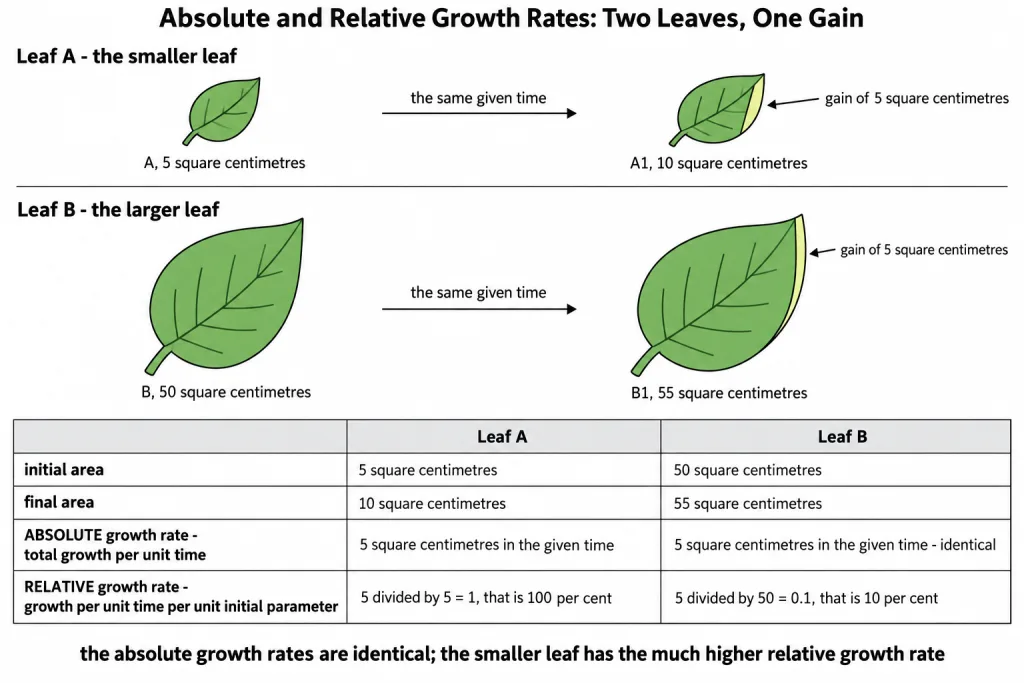
The chapter proves the point with two leaves. Two leaves, A and B, are of different sizes, but both increase their area by 5 square centimetres in the same given time, producing the leaves A1 and B1.
Their ABSOLUTE growth rates are therefore identical - each leaf added exactly 5 square centimetres in that time. But one of them shows a much higher relative growth rate. Which one, and why?
It is the SMALLER leaf, and here is the arithmetic. Say leaf A began at 5 square centimetres and leaf B began at 50 square centimetres.
| Leaf A (small) | Leaf B (large) | |
|---|---|---|
| Initial area | 5 square centimetres | 50 square centimetres |
| Final area | 10 square centimetres | 55 square centimetres |
| Absolute growth rate | 5 square centimetres in the given time | 5 square centimetres in the given time - identical |
| Relative growth rate | 5 divided by 5 = 1, that is 100 per cent | 5 divided by 50 = 0.1, that is 10 per cent |
Leaf A has doubled. Leaf B has gained a tenth. The same 5 square centimetres is a far larger fraction of a small initial area than of a large one, so the smaller leaf has a relative growth rate ten times that of the larger leaf even though the two absolute growth rates cannot be told apart.
[NEET Important] The wording of the two definitions is what gets asked. Absolute = total growth per unit time. Relative = growth per unit time expressed on a common basis, for example per unit initial parameter. In the two-leaf item the answer is always the same pair of statements: the absolute growth rates are equal, and the smaller leaf has the higher relative growth rate. Note also the link back to the exponential expression - the in is the relative growth rate, called the efficiency index.
Conditions for Growth - Water, Oxygen and Nutrients
Ask what a plant must be given before it can grow at all, and the list comes to three. Water, oxygen and nutrients are very essential elements for growth.
1. Water. The plant cells grow in size by cell enlargement, which in turn requires water. Turgidity of cells helps in extension growth. A limp cell cannot push its wall outwards; a turgid one can. Thus plant growth and further development is intimately linked to the water status of the plant.
Water also provides the medium for the enzymatic activities needed for growth. So water is doing two separate jobs - it is the physical driver of cell enlargement through turgor, and it is the medium in which the enzymes of growth work. Both count.
2. Oxygen. Oxygen helps in releasing metabolic energy essential for growth activities. Growth is spending, and the spending is paid for by respiration.
3. Nutrients. Nutrients - macro and micro essential elements - are required by plants for the synthesis of protoplasm and act as a source of energy. Recall from the previous sections that growth at the cellular level is principally an increase in the amount of protoplasm; the raw material for that protoplasm has to come from somewhere, and it comes from the essential elements.
| Condition | What it does for growth |
|---|---|
| Water | cell enlargement needs it; turgidity helps in extension growth; provides the medium for enzymatic activities |
| Oxygen | helps in releasing metabolic energy essential for growth activities |
| Nutrients (macro and micro essential elements) | required for the synthesis of protoplasm and act as a source of energy |
[NEET Important] Match the condition to its exact job - the distractors swap the three jobs between the three inputs. Water is for cell enlargement, turgidity and the enzymatic medium. Oxygen is for releasing metabolic energy. Nutrients are for the synthesis of protoplasm and as a source of energy. An option that offers oxygen as the medium for enzyme activity, or water as the source of metabolic energy, is the standard trap.
Temperature and the Environmental Signals
Water, oxygen and nutrients get the plant to the starting line. Two more conditions decide how well it does.
Every plant organism has an optimum temperature range best suited for its growth. Not a single best temperature - a range. And the warning that follows is the examinable half: any deviation from this range could be detrimental to its survival. Notice how strong the word is. The chapter does not say growth merely slows; it says survival can be at stake.
Environmental signals such as light and gravity also affect certain phases or stages of growth. They do not feed the plant; they tell it what to do and which way to do it. Light and gravity are signals, not nutrients - that distinction is worth holding on to, because it is exactly where a question can catch you.
So the complete answer to "what are the necessary conditions for growth?" runs:
- Water - cell enlargement, turgidity for extension growth, and the medium for enzymatic activity
- Oxygen - releases the metabolic energy essential for growth activities
- Nutrients (macro and micro essential elements) - synthesis of protoplasm and a source of energy
- An optimum temperature range, with deviation detrimental to survival
- Environmental signals - light and gravity - affecting certain phases or stages of growth
[NEET Important] Read the temperature statement carefully. It is an optimum temperature RANGE, it is specific to each plant organism, and deviation could be detrimental to survival, not merely to growth rate. For the last line, the two signals named by the chapter are light and gravity - and they affect certain phases or stages of growth, which is not the same as supplying the plant with anything.
Quick Recap
- Quantitative comparisons between the growth of living systems can be made in two ways.
- (i) Measurement and comparison of total growth per unit time is called the ABSOLUTE growth rate.
- (ii) The growth of the given system per unit time expressed on a common basis, for example per unit initial parameter, is called the RELATIVE growth rate.
- Two leaves A and B of different sizes both increase their area by 5 square centimetres in the same time, giving A1 and B1; their absolute growth rates are identical.
- The smaller leaf has the much higher relative growth rate, because the same 5 square centimetres is a far larger fraction of a small initial area than of a large one - 5 to 10 square centimetres is a doubling; 50 to 55 square centimetres is a gain of one tenth.
- Water, oxygen and nutrients are very essential elements for growth.
- Plant cells grow in size by cell enlargement, which in turn requires water; turgidity of cells helps in extension growth.
- Plant growth and further development is intimately linked to the water status of the plant.
- Water also provides the medium for the enzymatic activities needed for growth.
- Oxygen helps in releasing metabolic energy essential for growth activities.
- Nutrients (macro and micro essential elements) are required for the synthesis of protoplasm and act as a source of energy.
- Every plant organism has an optimum temperature range best suited for its growth, and any deviation from this range could be detrimental to its survival.
- Environmental signals such as light and gravity also affect certain phases or stages of growth.
Solved Examples
Question 1
Q. Describe briefly: Absolute and relative growth rates. This is one of the chapter-end exercises.
Answer. Quantitative comparisons between the growth of living systems can be made in two ways.
Absolute growth rate is the measurement and comparison of total growth per unit time. It simply asks how much was added in the time given.
Relative growth rate is the growth of the given system per unit time expressed on a common basis, for example per unit initial parameter. It asks how much was added for every unit the system already had:
The chapter shows the difference with two leaves. Two leaves A and B, of different sizes, both increase their area by 5 square centimetres in a given time, to give the leaves A1 and B1. Their absolute growth rates are therefore identical. But the smaller leaf shows a much higher relative growth rate.
Take leaf A as 5 square centimetres growing to 10, and leaf B as 50 square centimetres growing to 55. Both added 5 square centimetres, so the absolute growth rates are the same. But leaf A's relative growth rate is 5 divided by 5 = 1, a doubling or 100 per cent, while leaf B's is 5 divided by 50 = 0.1, only 10 per cent. The same increase is a far larger fraction of a small initial area than of a large one, so the smaller leaf grows ten times faster in relative terms.
Question 2
Q. Define the absolute growth rate.
Answer. The measurement and the comparison of total growth per unit time. It counts only the amount added, and takes no account of how big the system was to begin with.
Question 3
Q. Define the relative growth rate.
Answer. The growth of a given system per unit time expressed on a common basis, for example per unit initial parameter. In practice you divide the growth in that time by the initial size.
Question 4
Q. Two leaves of different sizes each increase their area by 5 square centimetres in the same time. Compare their absolute and relative growth rates.
Answer. Their absolute growth rates are identical - each added 5 square centimetres in the given time. Their relative growth rates are not. The smaller leaf has the much higher relative growth rate, because the 5 square centimetres it gained is a much larger fraction of its small initial area.
Question 5
Q. A leaf grows from 5 to 10 square centimetres while another grows from 50 to 55 square centimetres in the same time. Work out both relative growth rates.
Answer. First leaf: growth = 5 square centimetres, initial area = 5, so relative growth rate = 5 divided by 5 = 1, that is 100 per cent, a doubling. Second leaf: growth = 5 square centimetres, initial area = 50, so relative growth rate = 5 divided by 50 = 0.1, that is 10 per cent. The smaller leaf's relative growth rate is ten times the larger leaf's, although their absolute growth rates are equal.
Question 6
Q. List the conditions necessary for growth.
Answer. Water, oxygen and nutrients are very essential elements for growth. In addition, every plant organism has an optimum temperature range best suited for its growth, and environmental signals such as light and gravity also affect certain phases or stages of growth.
Question 7
Q. Why is water essential for growth? Give both of its roles.
Answer. First, plant cells grow in size by cell enlargement, which in turn requires water, and turgidity of cells helps in extension growth - so plant growth and further development is intimately linked to the water status of the plant. Second, water provides the medium for the enzymatic activities needed for growth.
Question 8
Q. How does turgidity contribute to growth?
Answer. Turgidity of cells helps in extension growth. A turgid cell presses outwards on its wall, and that pressure is what lets the cell enlarge; a cell short of water cannot extend.
Question 9
Q. What is the role of oxygen in plant growth?
Answer. Oxygen helps in releasing metabolic energy essential for growth activities. Growth costs energy, and that energy is released by respiration, which needs oxygen.
Question 10
Q. Why does a growing plant need nutrients?
Answer. Nutrients - the macro and micro essential elements - are required by plants for the synthesis of protoplasm and act as a source of energy. Since growth at the cellular level is principally an increase in the amount of protoplasm, the plant cannot grow without the raw materials to build it.
Question 11
Q. What does the chapter say about temperature and growth?
Answer. Every plant organism has an optimum temperature range best suited for its growth. It is a range, not a single value, and it is specific to the plant. Any deviation from this range could be detrimental to its survival - not merely to its rate of growth.
Question 12
Q. Name two environmental signals that affect growth, and say how they differ from water, oxygen and nutrients.
Answer. Light and gravity. They affect certain phases or stages of growth. The difference is that water, oxygen and nutrients are supplied to the plant and are used up in growth, while light and gravity act as signals that influence when and in which direction growth happens.
Question 13
Q. A seedling and a full-grown tree both add the same dry weight in one week. Which has the higher relative growth rate, and why?
Answer. The seedling. Their absolute growth rates are equal, because total growth per unit time is the same for both. But relative growth rate is the growth per unit initial parameter, and the seedling's initial dry weight is tiny compared with the tree's, so the same addition is a far larger fraction of what the seedling already had.