
What an Auxin Is and Where It Comes From
Auxins - from the Greek "auxein", meaning to grow - were first isolated from HUMAN URINE.
That is not a joke and it is asked. The very first auxin preparation came from human urine, long before anyone could get a usable amount out of a plant.
The term "auxin" is applied to indole-3-acetic acid (IAA), and to other natural and synthetic compounds having certain growth regulating properties. So auxin is a job description, not a single molecule - anything with those growth regulating properties counts.
They are generally produced by the growing apices of the stems and roots, from where they MIGRATE to the regions of their action.
Made at the tip, used lower down. That single sentence explains apical dominance, and it is the reason the Darwins' coleoptile bent below the point where the light was sensed.
Natural auxins are isolated from plants; synthetic auxins are made in the laboratory. The split is a standard one-mark item.
| Natural auxins - isolated from plants | Synthetic auxins |
|---|---|
| IAA - indole-3-acetic acid | NAA - naphthalene acetic acid |
| IBA - indole butyric acid | 2,4-D - 2,4-dichlorophenoxyacetic acid |
All these auxins have been used extensively in agricultural and horticultural practices.
[NEET Important] Sort the four names without hesitating: IAA and IBA are natural, NAA and 2,4-D are synthetic. The trap is IBA, whose name looks synthetic but which has been isolated from plants. Also remember the odd fact that auxins were first isolated from human urine - it appears as a straight recall question.
What Auxins Do
Every effect below is worth learning as a verb plus its example, because that is the form the question takes.
- INITIATE ROOTING IN STEM CUTTINGS. This application is widely used for plant propagation - dip the cut end of a twig in auxin and roots form.
- PROMOTE FLOWERING, for example in pineapples.
- PREVENT fruit and leaf drop at early stages, but PROMOTE the abscission of older, mature leaves and fruits.
- CAUSE APICAL DOMINANCE (the next block deals with this in full).
- INDUCE PARTHENOCARPY, for example in tomatoes - fruit develops without fertilisation, so the fruit is seedless.
- ACT AS HERBICIDES. 2,4-D is widely used to kill DICOTYLEDONOUS weeds. It does not affect mature MONOCOTYLEDONOUS plants. It is used by gardeners to prepare weed-free lawns - a lawn is grass, that is, a monocot, so the 2,4-D wipes out the broad-leaved weeds and leaves the grass standing.
- CONTROL XYLEM DIFFERENTIATION and HELP IN CELL DIVISION.
The abscission effect runs in two directions and that is the classic trap. Auxin PREVENTS the drop of young fruits and leaves. Auxin PROMOTES the drop of older, mature leaves and fruits. So an option that simply says "auxin prevents abscission" is incomplete, and an option that says "auxin promotes abscission" is also incomplete. The age of the organ decides the direction.
[NEET Important] Two items from this list appear almost every year. First, 2,4-D kills dicot weeds but not mature monocots - which is why it makes weed-free lawns. Second, the two-directional abscission effect; read the option to the end and check whether it says early or older mature. Also keep parthenocarpy in tomato and flowering in pineapple apart from each other - swapping the two examples is the usual distractor.
Apical Dominance and Decapitation
In most higher plants, the growing apical bud inhibits the growth of the lateral (axillary) buds. This phenomenon is called apical dominance.
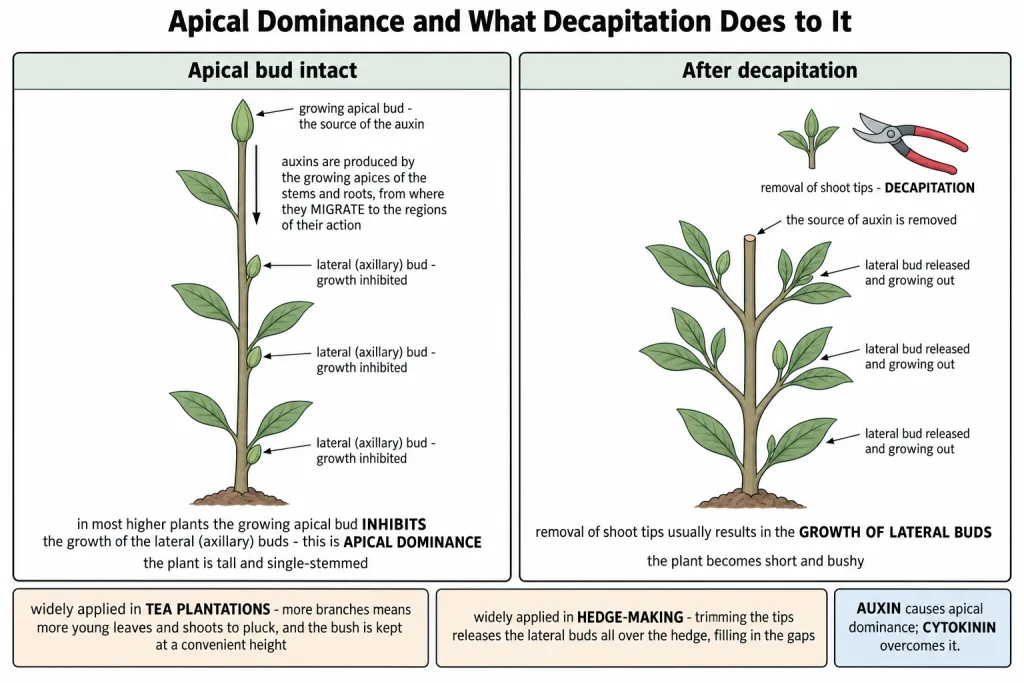
Removal of shoot tips - decapitation - usually results in the growth of lateral buds. Take the apex off and the buds that were being held back start growing into branches. The plant stops being tall and single-stemmed and becomes short and bushy.
It is widely applied in tea plantations and hedge-making. Can you explain why? Yes:
- The apical bud is the source of the auxin, and that auxin moves down and keeps the lateral buds suppressed.
- Decapitation removes the source. With the auxin supply cut off, the axillary buds are released and grow out into branches.
- In a tea plantation the crop is the young leaves and shoots, so more branches means more shoots to pluck; plucking and pruning the tips is a way of forcing the bush to keep producing them, and it keeps the bush at a convenient height for the pickers.
- In hedge-making the aim is a dense, even wall of foliage. Trimming the tips releases the lateral buds all over the hedge, filling in the gaps instead of letting a few shoots run away upwards.
Auxin causes apical dominance; cytokinin works against it and helps the lateral buds grow. Keep those two on opposite sides.
[NEET Important] Apical dominance is defined by what the apical bud does to the lateral buds - it inhibits their growth. Learn decapitation = removal of shoot tips = growth of lateral buds, and be ready to give tea plantations and hedge-making as the applications. A question may run the logic backwards: a plant made bushy by pruning has had its auxin source removed.
Quick Recap
- Auxin comes from the Greek "auxein", to grow, and auxins were first isolated from HUMAN URINE.
- The term auxin applies to indole-3-acetic acid (IAA) and to other natural and synthetic compounds having certain growth regulating properties.
- Auxins are generally produced by the growing apices of the stems and roots, from where they MIGRATE to the regions of their action.
- Natural auxins isolated from plants: IAA and indole butyric acid (IBA).
- Synthetic auxins: NAA (naphthalene acetic acid) and 2,4-D (2,4-dichlorophenoxyacetic acid).
- All these auxins have been used extensively in agricultural and horticultural practices.
- Auxins help to INITIATE ROOTING IN STEM CUTTINGS - widely used for plant propagation.
- Auxins PROMOTE FLOWERING, e.g. in pineapples.
- Auxins PREVENT fruit and leaf drop at early stages but PROMOTE the abscission of older mature leaves and fruits.
- APICAL DOMINANCE - the growing apical bud inhibits the growth of the lateral (axillary) buds.
- Removal of shoot tips (decapitation) usually results in the growth of lateral buds; this is widely applied in tea plantations and hedge-making.
- Auxins INDUCE PARTHENOCARPY, e.g. in tomatoes.
- Auxins are widely used as HERBICIDES; 2,4-D kills DICOTYLEDONOUS weeds, does not affect mature MONOCOTYLEDONOUS plants, and is used to prepare weed-free lawns.
- Auxin CONTROLS XYLEM DIFFERENTIATION and HELPS IN CELL DIVISION.
Solved Examples
Question 1
Q. Where does the word auxin come from, and from what material was auxin first isolated?
Answer. From the Greek word "auxein", meaning to grow. Auxins were first isolated from human urine.
Question 2
Q. To what does the term auxin apply?
Answer. To indole-3-acetic acid (IAA) and to other natural and synthetic compounds having certain growth regulating properties. Auxin is therefore a functional term, not the name of one molecule.
Question 3
Q. Where are auxins produced, and how do they reach the tissues they act on?
Answer. They are generally produced by the growing apices of the stems and roots, and from there they migrate to the regions of their action.
Question 4
Q. Which auxins are natural and which are synthetic?
Answer. Natural, isolated from plants: IAA (indole-3-acetic acid) and IBA (indole butyric acid). Synthetic: NAA (naphthalene acetic acid) and 2,4-D (2,4-dichlorophenoxyacetic acid). All of them are used extensively in agricultural and horticultural practices.
Question 5
Q. Which growth regulator would you use to induce rooting in a twig? This is one of the chapter-end exercises.
Answer. An auxin - IAA or IBA. Auxins help to initiate rooting in stem cuttings, and this application is widely used for plant propagation. In practice the cut end of the twig is treated with the auxin, and roots form at that end.
Question 6
Q. Name a plant in which auxins are used to promote flowering.
Answer. Pineapple. Auxins promote flowering, for example in pineapples.
Question 7
Q. State the effect of auxin on abscission carefully.
Answer. Auxins help to PREVENT fruit and leaf drop at early stages, but they PROMOTE the abscission of older, mature leaves and fruits. The age of the organ decides which way the effect runs, so neither half of the statement is complete on its own.
Question 8
Q. Define apical dominance.
Answer. In most higher plants the growing apical bud inhibits the growth of the lateral (axillary) buds. That phenomenon is apical dominance.
Question 9
Q. What happens when the shoot tip of such a plant is removed?
Answer. Removal of shoot tips - decapitation - usually results in the growth of the lateral buds. The plant becomes shorter and bushier, because the suppressed axillary buds grow out into branches.
Question 10
Q. Tea plantations and hedges are pruned at the tips. Explain why.
Answer. The apical bud is the source of auxin, and that auxin travels down and keeps the lateral buds from growing. Pruning removes that source, so the lateral buds are released and grow out into branches. In tea, the crop is the young shoots and leaves, so more branches means more shoots to pluck, and the bush is kept at a height convenient for picking. In a hedge, releasing the lateral buds all over the plant gives the dense, even wall of foliage that is wanted.
Question 11
Q. What is parthenocarpy, and which regulator induces it?
Answer. Parthenocarpy is the development of fruit without fertilisation, so the fruit is seedless. Auxins induce parthenocarpy, for example in tomatoes.
Question 12
Q. Why does 2,4-D make a good weedkiller for a lawn?
Answer. 2,4-D is widely used to kill dicotyledonous weeds, and it does not affect mature monocotyledonous plants. A lawn is made of grasses, which are monocots, and the weeds in it are broad-leaved dicots. So the spray removes the weeds and leaves the grass unharmed - it is used to prepare weed-free lawns.
Question 13
Q. Apart from the effects above, name two other roles of auxin.
Answer. Auxin controls xylem differentiation and helps in cell division.