
How the Cytokinins Were Found
The name tells you the job. Cytokinins have specific effects on CYTOKINESIS - on the division of the cell itself. Where auxin stretches a cell and gibberellin lengthens an axis, cytokinin makes one cell into two.
Cytokinins were discovered as KINETIN, a modified form of ADENINE, a PURINE, obtained from AUTOCLAVED HERRING SPERM DNA. Read that sentence in three pieces, because all three get asked separately.
- What it is: kinetin, chemically -furfurylamino purine.
- What it is made of: a modified form of adenine, which is a purine - not a pyrimidine, and not an amino acid.
- Where it came from: autoclaved herring sperm DNA - a laboratory preparation, heated in an autoclave.
And here is the fact the examiner is really after: KINETIN DOES NOT OCCUR NATURALLY IN PLANTS. It is a discovery product, not a plant hormone you can extract from a root. Every year a question offers "kinetin" as the natural cytokinin of plants and a large number of students take it.
So the search moved on. The search for natural substances with cytokinin-like activity led to the isolation of ZEATIN from CORN-KERNELS and COCONUT MILK. Zeatin is the natural one; kinetin is not.
Since the discovery of zeatin, several naturally occurring cytokinins, and some synthetic compounds with cell-division-promoting activity, have been identified. The family is therefore part natural and part synthetic, exactly like the auxins.
[NEET Important] Kinetin - autoclaved herring sperm DNA - modified adenine - a purine - NOT natural in plants. Zeatin - corn-kernels and coconut milk - natural. The two standard traps are "kinetin is the naturally occurring cytokinin of plants" and "kinetin is a modified pyrimidine". Both are wrong. A third distractor swaps the sources, offering zeatin from herring sperm DNA.
Where Cytokinins Are Made, and What They Do
Natural cytokinins are synthesised in regions where rapid cell division occurs. The chapter names three:
- root apices
- developing shoot buds
- young fruits
Notice that the list is a definition in disguise. A cytokinin is made wherever cells are dividing fast, so if a question gives you an unfamiliar tissue and tells you it is dividing rapidly, cytokinin is being made there.
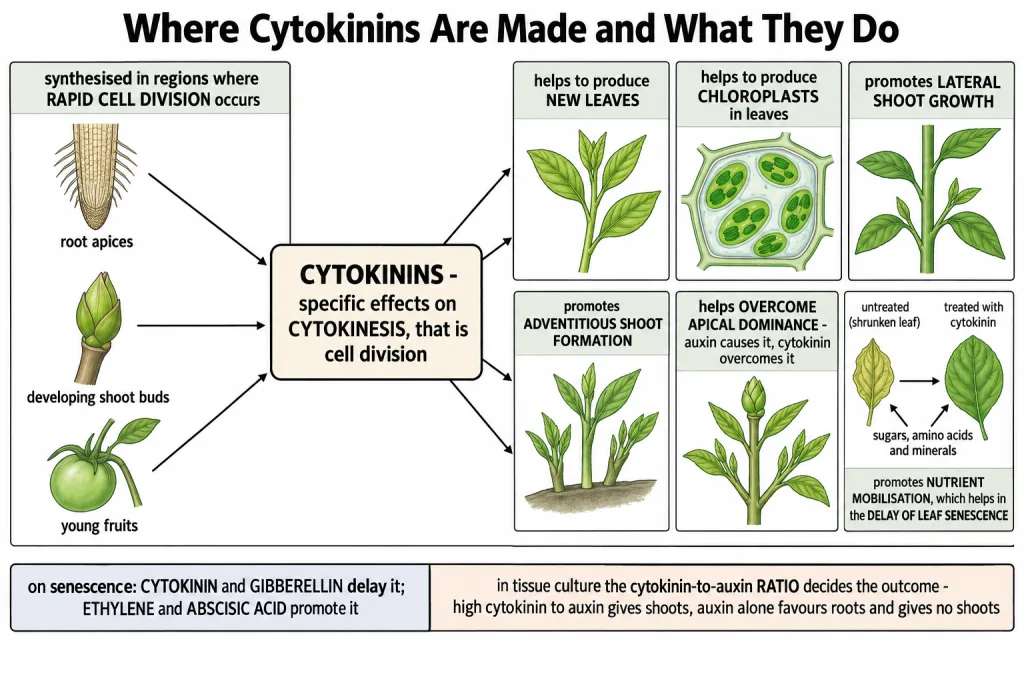
Now the effects, each one worth learning as a verb phrase:
- HELPS TO PRODUCE NEW LEAVES.
- HELPS TO PRODUCE CHLOROPLASTS IN LEAVES. The leaf is not only made, it is made green.
- PROMOTES LATERAL SHOOT GROWTH. The buds down the side of the stem are released and grow out.
- PROMOTES ADVENTITIOUS SHOOT FORMATION. Shoots appear where shoots do not normally arise.
- HELPS OVERCOME APICAL DOMINANCE. This is the same fact as lateral shoot growth, stated as the chapter states it.
- PROMOTES NUTRIENT MOBILISATION, WHICH HELPS IN THE DELAY OF LEAF SENESCENCE. Cytokinin pulls sugars, amino acids and minerals towards the treated leaf, and a leaf that keeps being fed does not age - it stays green and alive longer.
The mechanism behind the last one is worth holding on to, because it is the reason, not just the fact. Senescence is delayed BECAUSE nutrients are mobilised towards the tissue. The delay of leaf senescence by cytokinin is sometimes called the Richmond-Lang effect in older books; the chapter simply calls it the delay of leaf senescence.
[NEET Important] Root apices, developing shoot buds and young fruits is the exact site list, and "regions where rapid cell division occurs" is the exact reason. On the effects, the two highest-value ones are overcoming apical dominance and delaying leaf senescence through nutrient mobilisation - and the delay question wants cytokinin, with ethylene and abscisic acid offered as tempting wrong answers because those two promote senescence.
Cytokinin Against Auxin
This chapter is examined as a grid: one effect, more than one regulator, often pulling in opposite directions. Cytokinin gives you the cleanest opposite pair in the whole chapter, so state it in full and never half of it.
AUXIN CAUSES APICAL DOMINANCE. CYTOKININ OVERCOMES IT.
Recall what apical dominance is. The growing apical bud makes auxin, that auxin travels down the stem, and it stops the axillary buds below from growing - so the plant grows tall and unbranched. Remove the apex and the buds are released. Cytokinin does the same thing chemically: apply it to an axillary bud and the bud grows out even though the apex is still there. That is why cytokinin promotes lateral shoot growth, and it is the whole answer to "which regulator would you use to induce growth in axillary buds".
The same opposition runs through plant tissue culture, and this is where the exercise on the culture medium comes from.
| What is in the medium | What the tissue does |
|---|---|
| Auxin alone, no cytokinin | root formation is favoured; shoots do not form |
| Cytokinin alone, or a high cytokinin-to-auxin ratio | shoot formation is favoured |
| Both, in balance | the callus divides normally and a complete plantlet, shoot plus root, is regenerated |
So it is the RATIO of cytokinin to auxin, not the amount of either one, that decides whether a callus becomes a shoot or a root. Leave the cytokinin out and the callus will not show normal cell division and will not form shoots - no complete plantlet is regenerated.
One more pairing to carry forward: on senescence, cytokinin and gibberellin DELAY it, while ethylene and abscisic acid PROMOTE it. Cytokinin sits on the delaying side.
[NEET Important] "Auxin causes apical dominance, cytokinin overcomes it" is the single most-asked sentence about cytokinin, and it is asked in both directions - which one causes, which one relieves. In tissue culture questions, remember the rule as high cytokinin-to-auxin means shoots, high auxin-to-cytokinin means roots; the distractor reverses it.
Quick Recap
- Cytokinins have specific effects on CYTOKINESIS - on cell division.
- They were discovered as KINETIN, a modified form of ADENINE, a PURINE, from AUTOCLAVED HERRING SPERM DNA.
- KINETIN DOES NOT OCCUR NATURALLY IN PLANTS.
- The search for natural substances with cytokinin-like activity led to the isolation of ZEATIN from CORN-KERNELS and COCONUT MILK.
- Since the discovery of zeatin, several naturally occurring cytokinins and some synthetic compounds with cell-division-promoting activity have been identified.
- Natural cytokinins are synthesised in regions where rapid cell division occurs - root apices, developing shoot buds, young fruits.
- Cytokinin helps to produce NEW LEAVES, CHLOROPLASTS in leaves, LATERAL SHOOT GROWTH and ADVENTITIOUS SHOOT FORMATION.
- Cytokinins help OVERCOME APICAL DOMINANCE.
- They promote NUTRIENT MOBILISATION, which helps in the DELAY OF LEAF SENESCENCE.
- The opposite pair: AUXIN CAUSES apical dominance, CYTOKININ OVERCOMES it.
- On senescence: cytokinin and gibberellin DELAY it; ethylene and abscisic acid PROMOTE it.
- In tissue culture, shoot versus root depends on the cytokinin-to-auxin ratio; auxin alone favours roots and gives no shoots.
Solved Examples
Question 1
Q. What does the name cytokinin refer to?
Answer. Cytokinins have specific effects on cytokinesis, that is, on the division of the cell. The name is taken straight from the process they act on.
Question 2
Q. How were cytokinins discovered?
Answer. They were discovered as kinetin, a modified form of adenine, a purine, obtained from autoclaved herring sperm DNA.
Question 3
Q. Kinetin is a modified form of which base, and what class of base is that?
Answer. Adenine, which is a purine. It is not a pyrimidine.
Question 4
Q. Does kinetin occur naturally in plants?
Answer. No. Kinetin does not occur naturally in plants. It came out of autoclaved herring sperm DNA in the laboratory. The naturally occurring cytokinin named in this chapter is zeatin, not kinetin.
Question 5
Q. From where was zeatin isolated, and why was it looked for?
Answer. Zeatin was isolated from corn-kernels and coconut milk. It was found because the search was on for natural substances with cytokinin-like activity - kinetin worked, but it was not a plant substance.
Question 6
Q. What has been found since zeatin was discovered?
Answer. Several naturally occurring cytokinins, and some synthetic compounds with cell-division-promoting activity, have been identified.
Question 7
Q. Where are natural cytokinins synthesised in a plant?
Answer. In regions where rapid cell division occurs - for example root apices, developing shoot buds and young fruits.
Question 8
Q. List the effects of cytokinins on a plant.
Answer. Cytokinin helps to produce new leaves, chloroplasts in leaves, lateral shoot growth and adventitious shoot formation. Cytokinins help overcome apical dominance. They also promote nutrient mobilisation, which helps in the delay of leaf senescence.
Question 9
Q. Which growth regulator would you use to delay leaf senescence? This is one of the chapter-end exercises.
Answer. Cytokinin. Cytokinins promote nutrient mobilisation, that is, they pull sugars, amino acids and minerals towards the treated leaf. A leaf that is being supplied in this way stays green and functional for longer, so senescence is delayed. Watch the direction of the effect: cytokinin and gibberellin delay senescence, while ethylene and abscisic acid promote it.
Question 10
Q. Which growth regulator would you use to induce growth in axillary buds? This is one of the chapter-end exercises.
Answer. Cytokinin, because cytokinins help overcome apical dominance. Apical dominance is caused by auxin coming down from the growing apical bud, which keeps the axillary buds below it from growing. Cytokinin applied to an axillary bud releases that bud and it grows out, even with the apex still in place - which is the same thing as saying cytokinin promotes lateral shoot growth.
Question 11
Q. State the opposition between auxin and cytokinin in one sentence.
Answer. Auxin causes apical dominance; cytokinin overcomes it.
Question 12
Q. What would be expected to happen if you forget to add cytokinin to the culture medium? This is one of the chapter-end exercises.
Answer. The callus would not show normal cell division, and it would fail to form shoots. Cytokinin is the regulator that drives cytokinesis and shoot formation, so without it the tissue simply does not organise into a shoot.
With auxin alone in the medium, root formation is favoured and shoot formation does not occur, so the culture would at best produce roots on an unorganised callus and no complete plantlet would be regenerated.
The general rule behind this is worth stating: the shoot-to-root balance in tissue culture depends on the cytokinin-to-auxin ratio. A high cytokinin-to-auxin ratio gives shoots; a high auxin-to-cytokinin ratio gives roots; a balance of the two gives a whole plantlet.
Question 13
Q. A gardener wants a bushy plant rather than a tall unbranched one, and does not want to cut off the apex. What can be done, and why does it work?
Answer. Apply a cytokinin to the axillary buds. The plant is tall and unbranched because auxin from the apical bud is imposing apical dominance. Cytokinin overcomes apical dominance, so the axillary buds grow out into lateral shoots and the plant becomes bushy - the same result as removing the apex, but achieved chemically.