
Growth Is Measurable
At a cellular level, growth is principally a consequence of increase in the amount of protoplasm.
That is the honest answer to "what actually increases?" - more protoplasm. The trouble is practical: increase in protoplasm is difficult to measure directly.
So one generally measures some quantity which is more or less proportional to it. Growth is therefore measured by a variety of parameters, and the chapter lists six:
- increase in fresh weight
- increase in dry weight
- increase in length
- increase in area
- increase in volume
- increase in cell number
[NEET Important] The exact phrasing is examinable. Growth at the cellular level is an increase in the amount of protoplasm, and the six parameters are only proxies used because protoplasm cannot be measured directly. A question that asks "growth is principally a consequence of increase in…" wants protoplasm, not fresh weight.
Which Parameter for Which Organ
The parameter you choose depends on the organ in front of you, and the chapter proves it with four cases that get quoted constantly.
| System | What is measured | The figure the chapter gives |
|---|---|---|
| Maize root apical meristem | cell number | more than 17,500 new cells per hour |
| Watermelon cells | cell size | cells may increase in size by up to 3,50,000 times |
| Pollen tube | length | growth is measured in terms of its length |
| Dorsiventral leaf | surface area | an increase in surface area denotes its growth |
Read the first two rows together, because that is how they are asked. In the maize root apical meristem, growth is expressed as an increase in cell number. In the watermelon, growth is expressed as an increase in the size of the cell. Same word, two different measurements, and the examiner swaps the two organs to see whether you noticed.
This is also the answer to a chapter-end exercise: why no one parameter is good enough to demonstrate growth throughout the life of a flowering plant. A single plant grows in different ways at different times and in different organs. A meristem grows by making more cells, so cell number works there but the cells stay small. An elongating internode or a ripening watermelon grows by cell enlargement, where cell number hardly changes at all. Dry weight rises while a seedling builds tissue but falls in a germinating seed that is spending its stored food, even though the seedling is plainly growing. Fresh weight rises and falls with the water status of the plant during a single day. A pollen tube gets longer without getting wider; a leaf gets wider without getting much longer. No single number tracks all of that, so the parameter has to be chosen to suit the organ and the stage.
[NEET Important] Fresh weight is the least reliable parameter because it moves with water content. Dry weight is more reliable but can fall during germination, when reserves are being respired away. Keep both facts - they are the standard reasoning marks.
The Three Phases of Growth
The period of growth is generally divided into three phases: meristematic, elongation and maturation.
Look at a root tip and you can see all three, one behind the other.
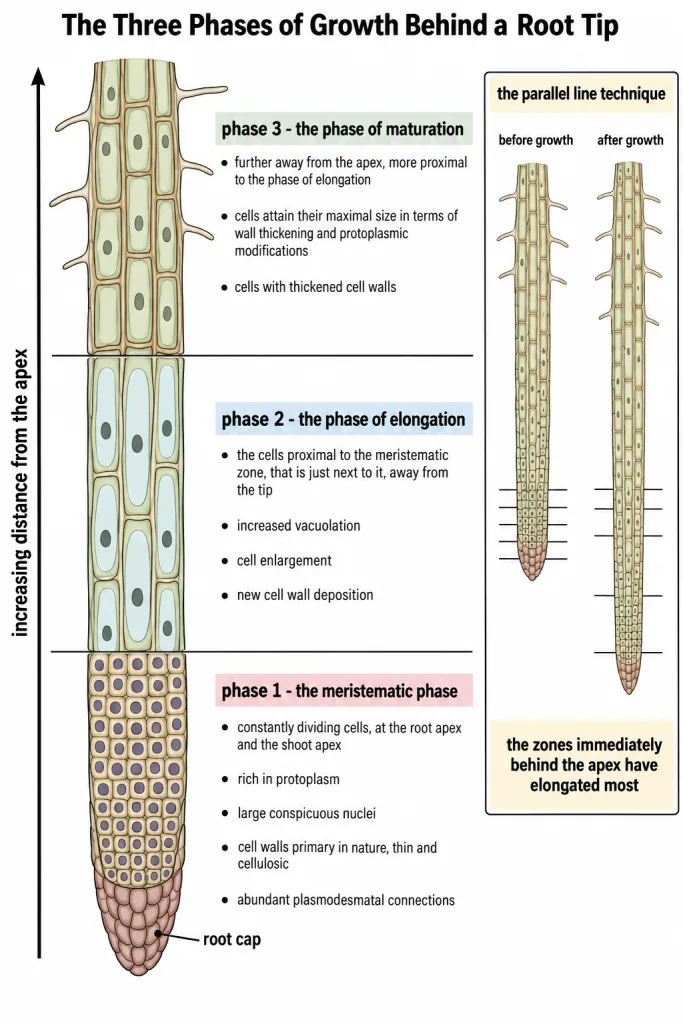
1. The meristematic phase. The constantly dividing cells, both at the root apex and the shoot apex, represent the meristematic phase of growth. The cells here are:
- rich in protoplasm
- with large conspicuous nuclei
- cell walls primary in nature, thin and cellulosic
- with abundant plasmodesmatal connections
2. The phase of elongation. The cells proximal to the meristematic zone - just next to it, away from the tip - represent the phase of elongation. Its characteristics are:
- increased vacuolation
- cell enlargement
- new cell wall deposition
3. The phase of maturation. Further away from the apex, more proximal to the phase of elongation, lies the portion of the axis undergoing the phase of maturation. The cells of this zone attain their maximal size in terms of wall thickening and protoplasmic modifications. Most of the tissues and cell types you have already studied represent this phase.
The word proximal is a trap on its own. Here it means just next, away from the tip - so the order running back from the root apex is meristematic, then elongation, then maturation.
The zones of elongation can be shown experimentally by the parallel line technique: fine lines are marked at equal spacing behind the root apex, and after a period of growth the zones immediately behind the apex are found to have elongated most, while lines further back have hardly moved apart.
[NEET Important] Match each phase to its one giveaway feature. Meristematic - dense protoplasm and large nuclei with thin primary walls. Elongation - vacuolation and new wall deposition. Maturation - maximal wall thickening. The commonest wrong option puts vacuolation in the meristematic zone, which is exactly backwards: those cells are packed with protoplasm, not vacuole.
Quick Recap
- At the cellular level, growth is principally a consequence of increase in the amount of protoplasm.
- Protoplasm is hard to measure directly, so growth is measured by proxies: fresh weight, dry weight, length, area, volume and cell number.
- One maize root apical meristem can give rise to more than 17,500 new cells per hour - growth as increase in cell number.
- Watermelon cells may increase in size by up to 3,50,000 times - growth as increase in cell size.
- A pollen tube's growth is measured as length; a dorsiventral leaf's growth as increase in surface area.
- No single parameter works throughout a plant's life - different organs and stages grow in different ways.
- Three phases of growth: meristematic, elongation, maturation.
- Meristematic - constantly dividing cells at root and shoot apex, rich in protoplasm, large conspicuous nuclei, thin primary cellulosic walls, abundant plasmodesmata.
- Elongation - increased vacuolation, cell enlargement, new cell wall deposition.
- Maturation - cells attain maximal size in wall thickening and protoplasmic modifications.
- The parallel line technique shows that the zones immediately behind the apex elongate most.
Solved Examples
Question 1
Q. At the cellular level, what is growth principally a consequence of?
Answer. An increase in the amount of protoplasm. Everything else that is measured is only a stand-in for it.
Question 2
Q. If protoplasm is what increases, why is it not what we measure?
Answer. Because an increase in protoplasm is difficult to measure directly. So we measure some quantity which is more or less proportional to it instead.
Question 3
Q. List the parameters by which growth is measured.
Answer. Increase in fresh weight, dry weight, length, area, volume and cell number.
Question 4
Q. Why is not any one parameter good enough to demonstrate growth throughout the life of a flowering plant? This is one of the chapter-end exercises.
Answer. Because a plant does not grow in the same way at every stage or in every organ, so no single measurement follows it all the way through.
- In a meristem, growth shows up as more cells - one maize root apical meristem makes more than 17,500 new cells per hour - but those cells stay small, so length or volume barely moves.
- In an elongating cell, growth shows up as size - a watermelon cell may increase in size up to 3,50,000 times - while cell number hardly changes.
- A pollen tube grows in length only, so area or weight tells you nothing; a dorsiventral leaf grows in surface area, so length alone underreports it.
- Fresh weight rises and falls with the water status of the plant during a single day, so it is unreliable.
- Dry weight actually falls in a germinating seed, because the stored food is being respired away, even though the seedling is clearly growing.
So the parameter has to be chosen to suit the organ and the stage of growth being studied.
Question 5
Q. How many new cells can a single maize root apical meristem produce in an hour, and what does this figure illustrate?
Answer. More than 17,500 new cells per hour. It illustrates growth expressed as an increase in cell number.
Question 6
Q. By how much may a watermelon cell increase in size, and what does this figure illustrate?
Answer. Up to 3,50,000 times. It illustrates growth expressed as an increase in the size of the cell.
Question 7
Q. Name the three phases into which the period of growth is generally divided.
Answer. Meristematic, elongation and maturation.
Question 8
Q. Describe the cells of the meristematic phase.
Answer. They are the constantly dividing cells at the root apex and the shoot apex. They are rich in protoplasm with large conspicuous nuclei, their cell walls are primary in nature, thin and cellulosic, and they have abundant plasmodesmatal connections.
Question 9
Q. What are the three characteristics of cells in the phase of elongation?
Answer. Increased vacuolation, cell enlargement and new cell wall deposition.
Question 10
Q. What happens to cells in the phase of maturation?
Answer. They attain their maximal size in terms of wall thickening and protoplasmic modifications. Most of the tissues and cell types studied in earlier classes represent this phase.
Question 11
Q. In this chapter, what does the word proximal mean, and what order does it give the three phases?
Answer. Proximal means just next, away from the tip. So working back from the apex the order is meristematic, then elongation, then maturation - the cells proximal to the meristematic zone are elongating, and the region proximal to the elongation zone is maturing.
Question 12
Q. What does the parallel line technique demonstrate about a root?
Answer. Lines are marked at equal spacing behind the root apex, and after growth the zones immediately behind the apex are found to have elongated most. It shows that elongation is confined to a zone just behind the tip, not spread evenly along the root.