
Same Syllabus. A Different Exam.
The Solved Examples section worked this chapter the way a written paper does - define the term, describe the experiment, explain the effect. NEET does not ask you to explain anything here. It names one regulator, one discoverer or one effect, gives four options, and you have about half a minute.
The marking is +4 for a correct answer and -1 for a wrong one. In a written answer, saying "a cytokinin-type hormone" instead of naming zeatin still earns most of the marks. Here, choosing gibberellin where the answer is cytokinin is worth -1, which puts you five marks behind someone who left it blank.
This chapter is pure recall, and that is the good news. There is nothing to derive except two small formulas. Almost every question is a matching question in disguise - a regulator to an effect, a scientist to a discovery, a term to its one-line definition. Build the three tables below into your memory and most of the chapter answers itself.
The one place students still lose marks is the negatives - the sentences with a "not" in them. They are collected in their own block; learn them as sentences, not as impressions.
The Four Shapes This Chapter Is Asked In
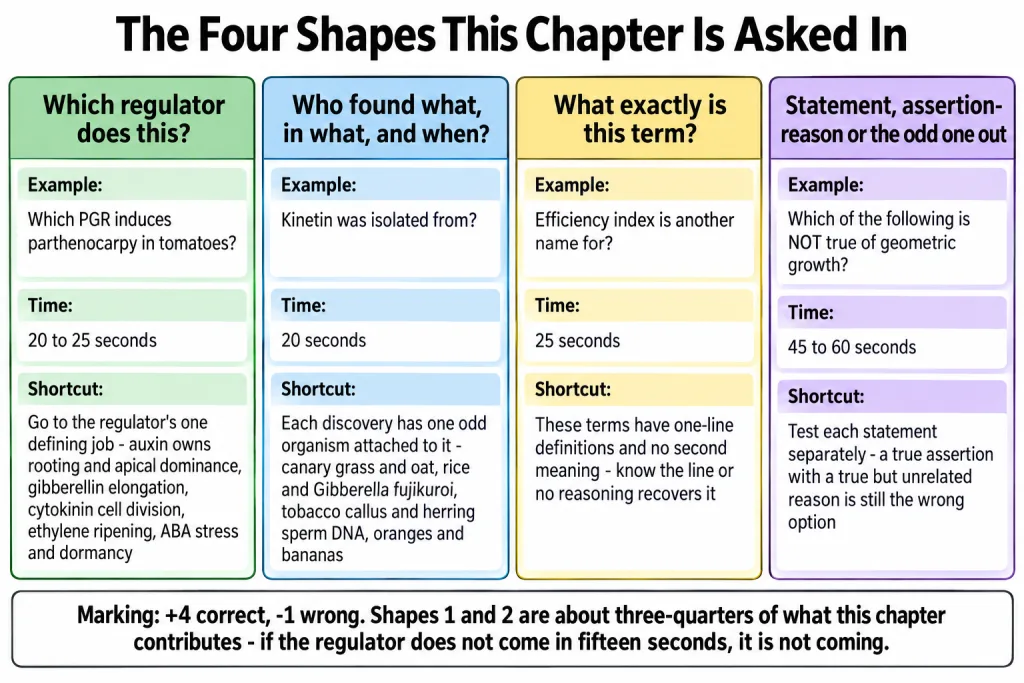
Shape 1 - Which regulator does this? "Which PGR induces parthenocarpy in tomatoes?" "Which PGR is used to break potato tuber dormancy?" The stem names an effect and the four options are four regulators. Budget 20 to 25 seconds. The shortcut: go to the regulator's one defining job, not to a list of all its jobs. Auxin owns rooting and apical dominance, gibberellin owns elongation, cytokinin owns cell division, ethylene owns ripening, ABA owns stress and dormancy.
Shape 2 - Who found what, in what, and when? "Kinetin was isolated from?" "Bakanae disease is caused by?" Budget 20 seconds. The shortcut: each discovery has one odd organism attached to it, and the organism is usually enough - canary grass and oat for auxin, rice and Gibberella fujikuroi for gibberellin, tobacco callus and herring sperm DNA for cytokinin, oranges and bananas for ethylene.
Shape 3 - What exactly is this term? "Efficiency index is another name for?" "Respiratory climactic refers to?" Budget 25 seconds. The shortcut: these terms have one-line definitions and no second meaning. If you know the line, you answer instantly; if you do not, no amount of reasoning recovers it. That is why they are worth memorising word for word.
Shape 4 - Statement, assertion-reason or the odd one out. "Which of the following is NOT true of geometric growth?" "Assertion: a short day plant flowers when the night is long. Reason: the leaves perceive the photoperiod." Budget 45 to 60 seconds - these are the only questions in the chapter that need real reading. The shortcut: test each statement separately against the negatives block, and remember that a true assertion with a true but unrelated reason is still the wrong option.
[NEET Important] Shapes 1 and 2 are about three-quarters of what this chapter contributes to the paper. They are pure recall and they are fast. Do not spend a minute on a matching question - if the regulator does not come in fifteen seconds, it is not coming.
One Regulator, One Address
Every Shape 1 and Shape 2 question is one row of this table. Read it across, not down.
| Regulator | Chemical nature | Found by / found in | Its ONE defining job |
|---|---|---|---|
| Auxin (IAA) | indole compound | Darwin and Darwin on canary grass coleoptiles; isolated by F. W. Went from oat coleoptile tips; first isolated from human urine | apical dominance and rooting of stem cuttings |
| Gibberellin () | terpene, and all GAs are acidic | E. Kurosawa (1926), from sterile filtrates of Gibberella fujikuroi, the bakanae or foolish-seedling fungus of rice | elongation of the axis - and bolting |
| Cytokinin (kinetin) | adenine derivative, -furfurylamino purine | F. Skoog on tobacco callus; Miller et al. (1955) crystallised kinetin from autoclaved herring sperm DNA; zeatin from corn kernels and coconut milk | cell division (cytokinesis) |
| Ethylene () | a gas | H. H. Cousins (1910) - ripened oranges hastened ripening of stored unripe bananas | fruit ripening |
| Abscisic acid (ABA) | carotenoid derivative | mid-1960s, three inhibitors - inhibitor-B, abscission II and dormin - proved chemically identical | stomatal closure and dormancy - the stress hormone |
And every Shape 3 question is one row of this one.
| Term | Its one line |
|---|---|
| Growth | irreversible permanent increase in size of an organ, its parts or a single cell |
| Growth rate | the increased growth per unit time |
| Efficiency index | another name for , the relative growth rate in - the plant's ability to produce new plant material |
| Absolute growth rate | total growth per unit time |
| Relative growth rate | growth per unit time per unit initial parameter |
| Differentiation | the act leading to maturation of cells derived from meristems |
| Dedifferentiation | a differentiated living cell regaining the capacity to divide |
| Redifferentiation | the products of a dedifferentiated meristem losing that capacity again |
| Plasticity | following different pathways to form different structures in response to environment or phase of life |
| Heterophylly | different leaf shapes on one plant - the example of plasticity |
| Callus | a mass of undifferentiated cells |
| Bolting | internode elongation just prior to flowering |
| Parthenocarpy | fruit without fertilisation - induced by auxin in tomato |
| Respiratory climactic | the rise in respiration rate during fruit ripening, caused by ethylene |
| Photoperiodism | the response of plants to periods of day and night length |
| Critical day length | the day length above or below which a given species will flower |
| Florigen | the transmissible flowering hormone that moves leaf to shoot apex |
| Phytochrome | the pigment that perceives the photoperiodic stimulus |
| Vernalisation | promotion of flowering by a period of low temperature |
[NEET Important] The fourth column of the first table is what you answer Shape 1 with. When two regulators both plausibly do the job, ask which one owns it. Both gibberellin and cytokinin delay senescence, but if the option list also holds ethylene and ABA, the question is really testing who delays and who promotes, not which of the two delayers is better.
The Numbers, and the Negatives
Every number in the chapter
- One maize root apical meristem: more than 17,500 new cells per hour.
- Watermelon cells: increase in size by up to 3,50,000 times.
- Gibberellins reported: more than 100, denoted , , and so on.
- Sugarcane sprayed with gibberellin: yield up by as much as 20 tonnes per acre.
- Five major groups of PGRs, and three of them are promoters (auxin, gibberellin, cytokinin).
- Three phases of growth: meristematic, elongation, maturation.
- Three phases of a sigmoid curve: lag, log (exponential), stationary.
- Three plant groups by photoperiod: short day, long day, day-neutral.
- Dates: Cousins 1910 (ethylene), Kurosawa 1926 (gibberellin), Miller et al. 1955 (kinetin), mid-1960s (ABA).
- Three names that turned out to be one substance: inhibitor-B, abscission II and dormin = abscisic acid.
Every negative in the chapter
These are the sentences with a "not" in them, and they are where the -1 marks come from.
- Swelling of wood placed in water is NOT growth - reversible, and no metabolism.
- A typical monocotyledon does NOT show secondary growth - the lateral meristems are named for dicots and gymnosperms.
- Kinetin does NOT occur naturally in plants.
- 2,4-D does NOT affect mature monocotyledonous plants - which is exactly why it makes a weed-free lawn.
- Ethylene is NOT a straightforward promoter - it could fit either group but is largely an inhibitor of growth activities.
- ABA acts as an ANTAGONIST to GAs in most situations - so anything GA does, expect ABA to undo.
- In photoperiodism it is NOT the light period that matters but the uninterrupted DARK period - a short day plant is really a long night plant, and a flash of light in the middle of the night stops it flowering while making a long day plant flower.
- A defoliated plant will NOT respond to a photoperiodic cycle - the leaf is the site of perception.
- A winter variety of wheat planted in spring will NOT flower or produce grain in that season.
- No single parameter can demonstrate growth throughout a plant's life - and dry weight can fall in a germinating seed that is plainly growing.
The Pairs That Get Swapped
Half the wrong answers in this chapter come from six pairs. In each row, the two entries are true of different things, and the option list will offer you the other one.
| If the question says | The answer is | The trap option is |
|---|---|---|
| causes apical dominance | auxin | cytokinin - which overcomes it |
| delays leaf senescence | cytokinin (also gibberellin) | ethylene or ABA - which promote it |
| induces dormancy | ABA | gibberellin or ethylene - which break it |
| breaks potato tuber dormancy | ethylene | ABA |
| only ONE daughter cell keeps dividing | arithmetic growth, linear curve | geometric growth, where both keep dividing |
| increase in CELL NUMBER per hour | maize root apical meristem | watermelon, which is cell size |
| isolated from corn kernels and coconut milk | zeatin | kinetin, which came from herring sperm DNA |
| the site where the photoperiod is perceived | the leaf | the shoot apex, which is where flowering happens |
One more that is not a pair but a direction. Auxin prevents fruit and leaf drop at early stages but promotes the abscission of older, mature leaves and fruits. Both halves are true, and a question quoting only one half is testing whether you know the other.
[NEET Important] When two regulators appear in the same option list, the question is almost always about the antagonism between them, not about either one alone. Read the stem again and decide which direction it is asking for - promote or inhibit, cause or overcome, induce or break.
Solved Examples at NEET Pace
Each item names the shortcut it uses, because the shortcut is the thing worth carrying into the exam hall.
Question 1
Q. Auxin was isolated by F. W. Went from the tips of coleoptiles of which seedlings?
Answer. Oat seedlings. Shortcut: one organism per discovery. The Darwins used canary grass, Went used oat. Both appear as options and only the person in the stem tells them apart.
Question 2
Q. Kinetin was obtained from autoclaved herring sperm DNA. Does it occur naturally in plants?
Answer. No. Kinetin does not occur naturally in plants. Shortcut: kinetin is a laboratory product, zeatin is the natural one - from corn kernels and coconut milk.
Question 3
Q. Which growth regulator is a derivative of carotenoids?
Answer. Abscisic acid. Shortcut: run the chemical-nature list once - indole for auxin, adenine for cytokinin, terpene for gibberellin, gas for ethylene, carotenoid for ABA. Four of the five are unique words; the odd one out is whatever remains.
Question 4
Q. A field of dicotyledonous weeds in a lawn of grass has to be cleared without harming the grass. Which compound is used?
Answer. 2,4-D. Shortcut: the negative is the answer - 2,4-D kills dicot weeds and does not affect mature monocotyledonous plants, and lawn grass is a monocot.
Question 5
Q. In arithmetic growth, what happens to the two daughter cells after mitosis?
Answer. Only one continues to divide; the other differentiates and matures. Shortcut: arithmetic = one divides = straight line. Geometric = both divide = sigmoid. Count the dividing daughters and the curve follows.
Question 6
Q. In the exponential growth equation, what does the letter stand for, and what else is it called?
Answer. is the relative growth rate, and it is also called the efficiency index - the measure of the plant's ability to produce new plant material. Shortcut: efficiency index has exactly one meaning in this chapter, so the moment the phrase appears the answer is fixed.
Question 7
Q. Interfascicular cambium arising from fully differentiated parenchyma is an example of what?
Answer. Dedifferentiation. Shortcut: ask which way the capacity to divide is moving. Regained = dedifferentiation. Lost again = redifferentiation. The word "parenchyma becoming a meristem" always means regained.
Question 8
Q. Which PGR would be sprayed on sugarcane to increase yield, and by how much?
Answer. Gibberellin, increasing yield by as much as 20 tonnes per acre, because sugarcane stores its sugar in the stem and gibberellin lengthens the stem. Shortcut: gibberellin owns elongation, so any yield question about a stem crop is gibberellin.
Question 9
Q. The rise in the rate of respiration during fruit ripening is called what, and which PGR causes it?
Answer. Respiratory climactic, caused by ethylene. Shortcut: this term has one definition and appears nowhere else in Class 11. Recognise the phrase, answer, move on.
Question 10
Q. A grower wants female flowers in cucumber to raise the yield. What is applied?
Answer. Ethephon, the most widely used source of ethylene. Shortcut: ethephon is the practical form of ethylene - if a question describes a spray or an aqueous solution rather than a gas, the answer is usually ethephon.
Question 11
Q. A short day plant is exposed to a long night that is interrupted by a brief flash of light in the middle. Will it flower?
Answer. No. Shortcut: it is the uninterrupted dark period that counts. A flash of light breaks the night into two shorter nights, neither long enough - and the same flash would make a long day plant flower.
Question 12
Q. Which is true - the leaves perceive the photoperiod, or the shoot apex does?
Answer. The leaves perceive it; the shoot apex is where flowering happens. Shortcut: perception and response are in different places, and florigen is the messenger between them. This one distinction answers both the defoliated-plant question and most assertion-reason items on flowering.
Question 13
Q. Which of these delays leaf senescence - ethylene, ABA or cytokinin?
Answer. Cytokinin, through nutrient mobilisation; gibberellin also delays senescence, while ethylene and ABA promote it. Shortcut: split the five regulators into delayers and promoters once, and this whole family of questions collapses to two lists.
Question 14
Q. Name the three inhibitors that turned out to be the same substance.
Answer. Inhibitor-B, abscission II and dormin - all three were proved chemically identical and named abscisic acid. Shortcut: three odd names in one option list almost always means ABA.
A Drill Before You Move On
Decide each one before you read the verdict. Aim for 20 to 25 seconds per question - this chapter should be fast.
- Growth in a watermelon is expressed as an increase in cell number. - False. That is the maize root apical meristem. The watermelon is cell size.
- All gibberellins are acidic. - True, and it is asked directly.
- Cytokinin causes apical dominance. - False. Auxin causes it; cytokinin overcomes it.
- A sigmoid growth curve is typical of cells, tissues and organs of a plant growing in a natural environment. - True.
- The lag, log and stationary phases are the same as the meristematic, elongation and maturation phases. - False. Different classifications entirely - one describes a growth curve over time, the other describes zones behind a root tip.
- Ethylene breaks seed and bud dormancy. - True, and it also initiates germination in peanut seeds and sprouting of potato tubers.
- ABA acts as a synergist to gibberellins. - False. Antagonist, in most situations.
- A defoliated plant can still perceive day length through its shoot apex. - False. The leaf is the site of perception.
- Bolting means internode elongation just after flowering. - False. Just prior to flowering.
- Development is the sum of growth and differentiation. - True, word for word.