
Abscisic Acid - The Inhibitor of the Group
Every other regulator you have met so far pushes growth along. Abscisic acid, ABA, pulls the other way, and the chapter introduces it as the inhibitor of the set.
ABA was discovered for its role in regulating ABSCISSION and DORMANCY - and that is where the name comes from. Abscission is the shedding of a leaf, flower or fruit; abscisic acid is the acid found to be regulating it. But like other PGRs, it also has other wide-ranging effects on plant growth and development.
ABA ACTS AS A GENERAL PLANT GROWTH INHIBITOR AND AN INHIBITOR OF PLANT METABOLISM. Both halves of that sentence are examinable: growth is slowed AND metabolism is slowed. ABA does not merely stop a plant getting bigger; it turns the plant's chemistry down.
ABA INHIBITS SEED GERMINATION. A seed carrying ABA stays a seed. The opposite pair is worth writing down at once: gibberellin and ethylene promote seed germination, abscisic acid inhibits it.
[NEET Important] Get the name and the discovery together - ABA was discovered for its role in regulating ABSCISSION AND DORMANCY. The most common wrong statement is that ABA is a growth promoter with a special effect on abscission; it is a general plant growth inhibitor and an inhibitor of plant metabolism. On germination, remember ABA inhibits, gibberellin and ethylene promote.
Why ABA Is Called the Stress Hormone
Here is the part of ABA that every paper wants.
ABA STIMULATES THE CLOSURE OF STOMATA and INCREASES THE TOLERANCE OF PLANTS TO VARIOUS KINDS OF STRESSES. THEREFORE IT IS ALSO CALLED THE STRESS HORMONE.
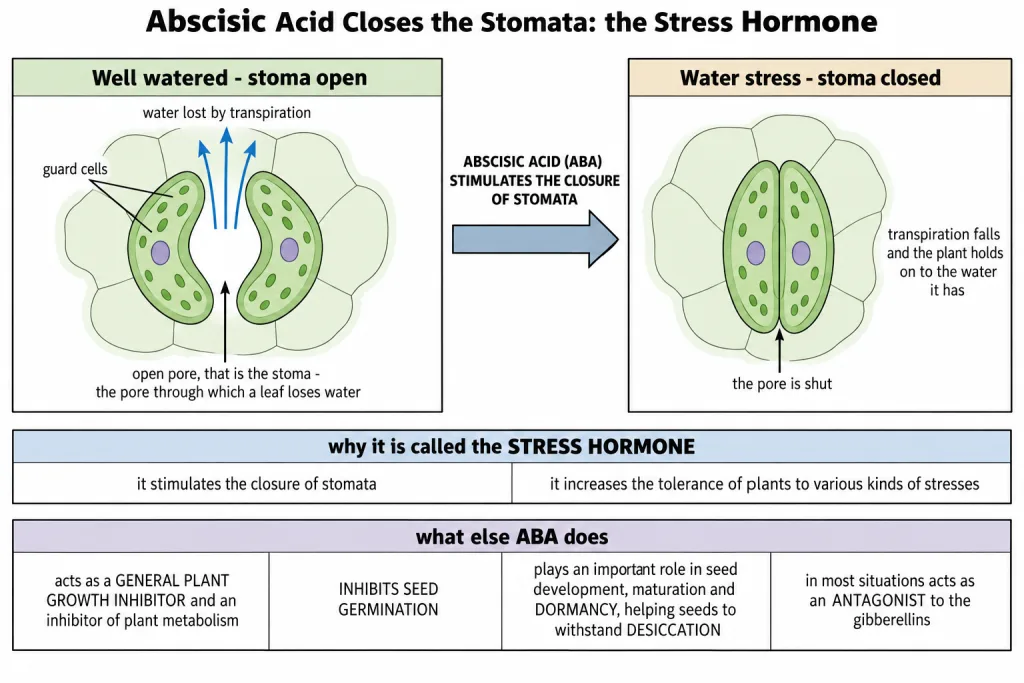
Take the stomatal effect on its own for a moment, because it is asked on its own. A stoma is the pore through which a leaf loses water. A plant short of water cannot afford that loss. ABA stimulates the closure of stomata, the pores shut, transpiration falls, and the plant holds on to the water it has. The regulator to name for immediate stomatal closure is abscisic acid - no other PGR in this chapter closes stomata.
The second half of the sentence is broader: ABA increases the tolerance of plants to various kinds of stresses - drought, cold, salt, whatever the plant is up against. Put that beside the general inhibition of growth and metabolism and you get the logic of the whole hormone: when conditions turn hostile, ABA shuts the plant down and makes it wait.
ABA plays an important role in SEED DEVELOPMENT, MATURATION AND DORMANCY. By inducing dormancy, ABA helps seeds to withstand DESICCATION and other factors unfavourable for growth. A dormant seed is a seed that has stopped, dried down and can wait for a better season - and it is ABA that puts it into that state.
IN MOST SITUATIONS, ABA ACTS AS AN ANTAGONIST TO GAs. The chapter says so in as many words. Gibberellin lengthens, germinates and mobilises; ABA inhibits, dormant-ises and shuts down. Wherever you meet doing something, expect ABA doing the reverse.
[NEET Important] "Stress hormone" must be justified with the two facts that earn the name: it STIMULATES THE CLOSURE OF STOMATA and it INCREASES THE TOLERANCE OF PLANTS TO VARIOUS KINDS OF STRESSES. A one-line answer that only says "it is produced during stress" scores nothing. ABA is the antagonist of GAs in most situations is a direct-recall line. And for "which regulator gives immediate stomatal closure", the answer is abscisic acid, with cytokinin, ethylene and gibberellic acid offered as decoys.
How the Growth Regulators Interact
The account of the regulators closes with a summary that is examined as heavily as any single hormone, because it tells you how to think about the whole set.
For any and every phase of growth, differentiation and development of plants, one or the other PGR has some role to play. No stage of a plant's life is run by one hormone alone.
Such roles could be COMPLIMENTARY or ANTAGONISTIC. These could be INDIVIDUALISTIC or SYNERGISTIC. Two regulators may work towards the same end or against each other; a regulator may act alone or only in company.
Similarly, there are a number of events in the life of a plant where MORE THAN ONE PGR INTERACTS to affect that event - the chapter's own examples are dormancy in seeds and buds, abscission, senescence and apical dominance.
Here is that whole grid in one place. This is the single most useful revision object in the chapter - learn it across the rows, and almost every "which regulator would you use" question answers itself.
| Event | Caused or promoted by | Opposed, delayed or reversed by |
|---|---|---|
| Apical dominance | auxin CAUSES it | cytokinin OVERCOMES it |
| Senescence | ethylene and abscisic acid PROMOTE it | cytokinin and gibberellin DELAY it |
| Dormancy of seeds and buds | abscisic acid INDUCES it | gibberellin and ethylene BREAK it |
| Abscission | ethylene and abscisic acid PROMOTE it; auxin PROMOTES the abscission of older mature leaves and fruits | auxin PREVENTS the early drop of young leaves and fruits |
| Stomatal closure | abscisic acid STIMULATES it | no other PGR in this chapter opposes it |
| Seed germination | gibberellin and ethylene PROMOTE it | abscisic acid INHIBITS it |
Read the abscission row twice. Auxin sits on both sides of it - it prevents the early drop of young leaves and fruits, but it promotes the abscission of older, mature leaves and fruits. That double role is a favourite question and the reason abscission is listed as an event where more than one PGR interacts.
Finally, keep the regulators in their place. The role of PGRs is only ONE KIND OF INTRINSIC CONTROL. Along with genomic control and extrinsic factors, they play an important role in plant growth and development. And many extrinsic factors, such as TEMPERATURE and LIGHT, control plant growth and development VIA PGRs - the outside world does not act on the plant directly, it acts through these chemicals. Events of this kind include vernalisation, flowering, dormancy, seed germination and plant movements.
The chapter turns next to the role of light and temperature - both extrinsic factors - on the initiation of flowering, and that material is taken up in its own section.
[NEET Important] The four adjectives are asked as a set - COMPLIMENTARY or ANTAGONISTIC, INDIVIDUALISTIC or SYNERGISTIC - and so is the list of events where more than one PGR interacts: dormancy in seeds and buds, abscission, senescence, apical dominance. Two more single-line recalls sit here: PGRs are only one kind of INTRINSIC control, working alongside GENOMIC CONTROL and EXTRINSIC FACTORS, and extrinsic factors such as temperature and light act VIA PGRs. The distractor claims that temperature and light act on growth directly, without any regulator.
Quick Recap
- ABA was discovered for its role in regulating ABSCISSION and DORMANCY, which is where the name comes from.
- It acts as a GENERAL PLANT GROWTH INHIBITOR and an INHIBITOR OF PLANT METABOLISM.
- ABA INHIBITS SEED GERMINATION.
- ABA STIMULATES THE CLOSURE OF STOMATA and INCREASES THE TOLERANCE OF PLANTS TO VARIOUS KINDS OF STRESSES; therefore it is also called the STRESS HORMONE.
- ABA plays an important role in SEED DEVELOPMENT, MATURATION AND DORMANCY.
- By inducing dormancy, ABA helps seeds to withstand DESICCATION and other factors unfavourable for growth.
- In most situations, ABA acts as an ANTAGONIST TO GAs.
- For any and every phase of growth, differentiation and development, one or the other PGR has some role to play.
- Such roles could be COMPLIMENTARY or ANTAGONISTIC, INDIVIDUALISTIC or SYNERGISTIC.
- Events where MORE THAN ONE PGR interacts: dormancy in seeds and buds, abscission, senescence, apical dominance.
- Apical dominance: auxin CAUSES, cytokinin OVERCOMES.
- Senescence: ethylene and ABA PROMOTE, cytokinin and gibberellin DELAY.
- Dormancy: ABA INDUCES, gibberellin and ethylene BREAK.
- Abscission: ethylene and ABA PROMOTE; auxin PREVENTS early drop of young organs but PROMOTES abscission of older mature ones.
- Stomatal closure: ABA. Seed germination: gibberellin and ethylene PROMOTE, ABA INHIBITS.
- The role of PGRs is only ONE KIND OF INTRINSIC CONTROL, working along with genomic control and extrinsic factors.
- Many extrinsic factors such as TEMPERATURE and LIGHT control plant growth and development VIA PGRs - in events such as vernalisation, flowering, dormancy, seed germination and plant movements.
Solved Examples
Question 1
Q. For what role was abscisic acid discovered, and how does the name follow from it?
Answer. ABA was discovered for its role in regulating abscission and dormancy. Abscission is the shedding of leaves, flowers and fruits, and the acid that was found to regulate it was named abscisic acid.
Question 2
Q. What kind of regulator is ABA?
Answer. It acts as a general plant growth inhibitor and an inhibitor of plant metabolism. It is the inhibitor of this group, against the promoters - auxins, gibberellins and cytokinins.
Question 3
Q. What is the effect of ABA on seed germination?
Answer. ABA inhibits seed germination. Gibberellin and ethylene do the opposite - they promote it.
Question 4
Q. Why is abscisic acid also known as stress hormone? This is one of the chapter-end exercises.
Answer. Because everything ABA does helps a plant survive conditions that are against it.
- It stimulates the closure of stomata. The stomata are the pores through which a leaf loses water, so closing them cuts transpiration and the plant loses less water - the single most useful thing a plant can do in a drought.
- It increases the tolerance of plants to various kinds of stresses, such as drought, cold and salt - and this is the property that gives the hormone its name.
- It acts as a general plant growth inhibitor and an inhibitor of plant metabolism, so the plant slows down and conserves its resources instead of spending them on growth while conditions are hostile.
- It induces dormancy, and by inducing dormancy ABA helps seeds to withstand desiccation and other factors unfavourable for growth - the seed waits out the bad season instead of germinating into it.
For all these reasons ABA is called the stress hormone.
Question 5
Q. Which growth regulator would you use to induce immediate stomatal closure in leaves? This is one of the chapter-end exercises.
Answer. Abscisic acid. ABA stimulates the closure of stomata, and it is the only regulator in this chapter that does so. This is also the effect that, together with increasing the tolerance of plants to various kinds of stresses, earns ABA the name stress hormone.
Question 6
Q. What role does ABA play in the life of a seed?
Answer. ABA plays an important role in seed development, maturation and dormancy. By inducing dormancy, ABA helps seeds to withstand desiccation and other factors unfavourable for growth.
Question 7
Q. ABA is the antagonist of which other growth regulator?
Answer. In most situations, ABA acts as an antagonist to the GAs, the gibberellins. Where gibberellin lengthens the axis, breaks dormancy and promotes germination, ABA inhibits growth, induces dormancy and inhibits germination.
Question 8
Q. In what four ways can the roles of different PGRs be related to one another?
Answer. Such roles could be complimentary or antagonistic, and they could be individualistic or synergistic.
Question 9
Q. Name four events in which more than one PGR interacts.
Answer. Dormancy in seeds and buds, abscission, senescence and apical dominance.
Question 10
Q. Which regulators promote senescence and which delay it?
Answer. Ethylene and abscisic acid promote senescence. Cytokinin and gibberellin delay it.
Question 11
Q. Which regulator induces dormancy and which regulators break it?
Answer. Abscisic acid induces dormancy. Gibberellin and ethylene break it.
Question 12
Q. Explain the double role of auxin in abscission.
Answer. Auxin prevents the early drop of young leaves, flowers and fruits - while an organ is young, auxin keeps it attached. But auxin promotes the abscission of older, mature leaves and fruits. So the same regulator sits on both sides of the same event, which is exactly why the chapter lists abscission among the events where more than one PGR interacts. Ethylene and abscisic acid promote abscission throughout.
Question 13
Q. Is the action of the PGRs the only control over plant growth and development?
Answer. No. The role of PGRs is only one kind of intrinsic control. Along with genomic control and extrinsic factors, they play an important role in plant growth and development. In fact many extrinsic factors, such as temperature and light, control plant growth and development via PGRs - the outside factor acts on the plant through the regulators, in events such as vernalisation, flowering, dormancy, seed germination and plant movements.