
A Growth Regulator That Is a Gas
Ethylene is a simple GASEOUS PGR. That one word - gaseous - separates it from every other regulator in this chapter, and it explains almost everything ethylene does in practice. A gas does not have to be transported through the plant in a stream of sap; it diffuses, out of one fruit and into the next, out of one tissue and through the air spaces of another.
Chemically it is ethene, - about as simple a molecule as a hormone can be.
It is synthesised in large amounts by tissues undergoing SENESCENCE and by RIPENING FRUITS. Both sources are ageing tissues, and that fits the work ethylene does.
Its influences on the growing plant begin at the seedling stage:
- HORIZONTAL GROWTH OF SEEDLINGS. The seedling stops growing straight up and grows sideways.
- SWELLING OF THE AXIS. The stem gets shorter and thicker instead of longer and thinner.
- APICAL HOOK FORMATION IN DICOT SEEDLINGS. The tip of the emerging shoot bends over into a hook, so the delicate apex is dragged up through the soil rather than pushed through it.
And on the mature plant:
- ETHYLENE PROMOTES SENESCENCE AND ABSCISSION OF PLANT ORGANS, ESPECIALLY OF LEAVES AND FLOWERS.
Note the direction, because half the marks in this chapter are directions. Ethylene PROMOTES senescence. Cytokinin and gibberellin DELAY it. Ethylene PROMOTES abscission, and so does abscisic acid; auxin prevents the early drop of young leaves and fruits.
[NEET Important] "A simple gaseous PGR" is the definition asked for, and "tissues undergoing senescence and ripening fruits" is the source asked for. The three seedling effects come as a set - horizontal growth, swelling of the axis, apical hook formation in dicot seedlings - and the trap is to attach the apical hook to auxin. Note also that ethylene is a growth INHIBITOR in the seedling sense - it shortens and thickens - yet it PROMOTES ripening, abscission and senescence.
Ripening, the Respiratory Climactic, and Dormancy
Ethylene is highly effective in FRUIT RIPENING. This is its most familiar job and the one every application question is built on.
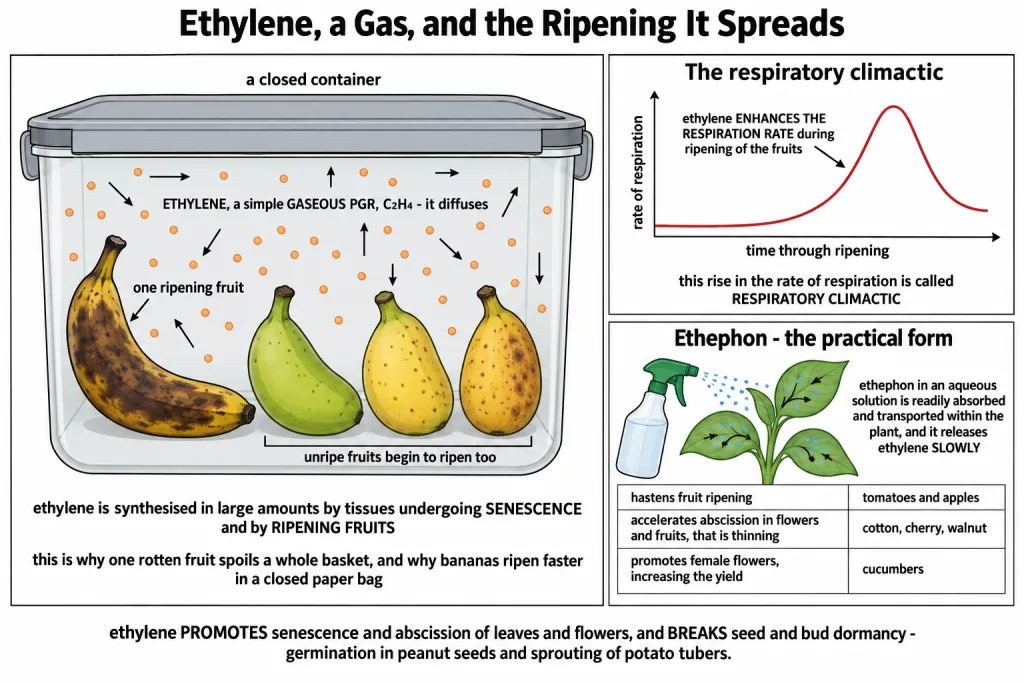
Ripening is not a passive softening. It is an active, energy-hungry process, and ethylene drives it:
ETHYLENE ENHANCES THE RESPIRATION RATE DURING RIPENING OF THE FRUITS. THIS RISE IN THE RATE OF RESPIRATION IS CALLED RESPIRATORY CLIMACTIC.
Learn that term exactly. Respiratory climactic = the rise in the rate of respiration that occurs during the ripening of a fruit. It is a one-mark definition and it is asked as a name ("what is this rise called?") and as a definition ("what is respiratory climactic?") in equal measure.
Because ethylene is a gas, ripening spreads. A fruit that is ripening or senescing pours out ethylene; that ethylene reaches the fruits packed beside it, and they begin to ripen too. It is the reason one rotten fruit spoils a whole basket, and the reason bananas ripen faster in a closed paper bag than in the open air.
Ethylene also acts on resting structures:
- ETHYLENE BREAKS SEED AND BUD DORMANCY.
- It INITIATES GERMINATION IN PEANUT SEEDS.
- It causes SPROUTING OF POTATO TUBERS.
Again, note the opposite number. Abscisic acid INDUCES dormancy. Ethylene and gibberellin BREAK it.
[NEET Important] RESPIRATORY CLIMACTIC is the highest-value single term in this section - name it and define it. On dormancy, keep the pair straight: ethylene breaks seed and bud dormancy, initiates germination in peanut seeds and sprouting of potato tubers, while abscisic acid does the opposite. The two crop names, peanut and potato, are asked as crop names, so do not let them slide into "cereals" or "onion".
Deep Water Rice, Roots, Flowering and Ethephon
Three more effects, and then the compound that delivers ethylene in the field.
- ETHYLENE PROMOTES RAPID INTERNODE AND PETIOLE ELONGATION IN DEEP WATER RICE PLANTS. It helps the leaves and the upper parts of the shoot to remain above water. The logic is neat: the plant is drowning, the submerged tissue makes ethylene, the trapped gas cannot escape into water, and the internodes stretch until the leaves reach the air.
- ETHYLENE PROMOTES ROOT GROWTH AND ROOT HAIR FORMATION, thus helping the plant to increase its absorption surface.
- ETHYLENE IS USED TO INITIATE FLOWERING AND FOR SYNCHRONISING FRUIT-SET IN PINEAPPLES. It also INDUCES FLOWERING IN MANGO.
Since ethylene regulates so many physiological processes, it is one of the most widely used PGRs in agriculture.
The most widely used compound as a source of ethylene is ETHEPHON. Ethylene itself is a gas and hard to apply to a field; ethephon solves that problem.
ETHEPHON IN AN AQUEOUS SOLUTION IS READILY ABSORBED AND TRANSPORTED WITHIN THE PLANT, AND IT RELEASES ETHYLENE SLOWLY. So it is sprayed as a liquid, moves inside the plant, and then acts as a gas from within - a slow-release source.
What ethephon is used for:
| Use of ethephon | Crop named in the chapter |
|---|---|
| Hastens fruit ripening | tomatoes and apples |
| Accelerates abscission in flowers and fruits (thinning) | cotton, cherry, walnut |
| Promotes female flowers, thereby increasing the yield | cucumbers |
Thinning deserves a sentence of its own. A tree that sets too many fruits gives many small poor ones. Ethephon makes some of the flowers and young fruits drop, and the ones that remain grow bigger - that deliberate shedding is what "thinning" means.
[NEET Important] The crop-to-effect grid is the examinable object here: pineapple - flowering and synchronised fruit-set; mango - flowering; tomato and apple - ripening; cotton, cherry and walnut - thinning by abscission; cucumber - female flowers and higher yield; deep water rice - internode and petiole elongation. The most swapped pair is pineapple and mango against tomato and apple. On ethephon, the examinable phrase is "readily absorbed and transported within the plant and releases ethylene slowly".
Quick Recap
- Ethylene is a simple GASEOUS PGR, chemically .
- It is synthesised in large amounts by tissues undergoing SENESCENCE and by RIPENING FRUITS.
- Seedling effects: horizontal growth of seedlings, swelling of the axis, and APICAL HOOK FORMATION in dicot seedlings.
- Ethylene PROMOTES SENESCENCE and ABSCISSION of plant organs, especially of leaves and flowers.
- Ethylene is highly effective in FRUIT RIPENING.
- It ENHANCES THE RESPIRATION RATE during ripening; this rise in the rate of respiration is called RESPIRATORY CLIMACTIC.
- Ethylene BREAKS SEED AND BUD DORMANCY, initiates GERMINATION IN PEANUT SEEDS and SPROUTING OF POTATO TUBERS.
- It promotes rapid INTERNODE and PETIOLE ELONGATION IN DEEP WATER RICE PLANTS, helping leaves and upper parts of the shoot to remain above water.
- It promotes ROOT GROWTH and ROOT HAIR FORMATION, increasing the absorption surface.
- It is used to INITIATE FLOWERING and to SYNCHRONISE FRUIT-SET IN PINEAPPLES, and INDUCES FLOWERING IN MANGO.
- Since ethylene regulates so many physiological processes, it is one of the most widely used PGRs in agriculture.
- The most widely used compound as a source of ethylene is ETHEPHON.
- Ethephon in aqueous solution is readily absorbed and transported within the plant and releases ethylene slowly.
- Ethephon hastens fruit ripening in TOMATOES and APPLES, accelerates abscission in flowers and fruits (thinning of COTTON, CHERRY, WALNUT), and promotes FEMALE FLOWERS IN CUCUMBERS, thereby increasing the yield.
- Directions to keep: ethylene PROMOTES senescence and abscission and BREAKS dormancy.
Solved Examples
Question 1
Q. What kind of substance is ethylene, and how is that unusual for a growth regulator?
Answer. Ethylene is a simple gaseous PGR. It is the only gaseous plant growth regulator in this chapter, so it moves by diffusing through the air rather than only travelling inside the plant.
Question 2
Q. Which tissues make ethylene in large amounts?
Answer. Tissues undergoing senescence and ripening fruits.
Question 3
Q. What are the effects of ethylene on a dicot seedling?
Answer. Horizontal growth of the seedling, swelling of the axis, and apical hook formation in dicot seedlings. The hook matters: the bent tip lets the shoot pull its delicate apex up through the soil instead of pushing it through.
Question 4
Q. What effect does ethylene have on senescence and abscission?
Answer. Ethylene promotes senescence and abscission of plant organs, especially of leaves and flowers.
Question 5
Q. What is the respiratory climactic?
Answer. Ethylene enhances the respiration rate during the ripening of fruits, and this rise in the rate of respiration is called the respiratory climactic.
Question 6
Q. Which growth regulator would you use to quickly ripen a fruit? This is one of the chapter-end exercises.
Answer. Ethylene. Ethylene is highly effective in fruit ripening, and it enhances the respiration rate during ripening, the rise called the respiratory climactic. In practice the farmer or trader does not handle the gas itself but sprays ethephon, which is the most widely used compound as a source of ethylene: in aqueous solution it is readily absorbed and transported within the plant and releases ethylene slowly, and it hastens fruit ripening in tomatoes and apples.
Question 7
Q. Name the resting structures ethylene acts on, and say what it does to them.
Answer. Ethylene breaks seed and bud dormancy. It initiates germination in peanut seeds and causes the sprouting of potato tubers.
Question 8
Q. How does ethylene help a deep water rice plant survive?
Answer. It promotes rapid internode and petiole elongation in deep water rice plants, so the stem stretches quickly as the water rises. This helps the leaves and the upper parts of the shoot to remain above water, where they can still get air and light.
Question 9
Q. How does ethylene increase the absorption surface of a plant?
Answer. It promotes root growth and root hair formation. More roots and more root hairs mean more surface in contact with the soil solution.
Question 10
Q. Give the uses of ethylene in pineapple and in mango.
Answer. In pineapple, ethylene is used to initiate flowering and to synchronise fruit-set, so the whole field can be harvested together. In mango, it induces flowering.
Question 11
Q. What is ethephon, and why is it used instead of ethylene itself?
Answer. Ethephon is the most widely used compound as a source of ethylene. It is used because ethylene is a gas and cannot easily be sprayed on a field. Ethephon in an aqueous solution is readily absorbed and transported within the plant and releases ethylene slowly, so a liquid spray becomes a steady supply of the gas inside the plant.
Question 12
Q. List the effects of ethephon named in this chapter.
Answer. It hastens fruit ripening in tomatoes and apples; it accelerates abscission in flowers and fruits, which is used for the thinning of cotton, cherry and walnut; and it promotes female flowers in cucumbers, thereby increasing the yield.
Question 13
Q. What would be expected to happen if a rotten fruit gets mixed with unripe fruits? This is one of the chapter-end exercises.
Answer. The unripe fruits would ripen much faster, and then over-ripen and spoil as well.
The reason is ethylene. A rotten fruit is a senescing, over-ripe tissue, and such tissues give off large amounts of ethylene. Ethylene is a gas, so it does not stay inside that one fruit - it spreads through the air of the container to every fruit around it.
In those fruits ethylene does what it always does: it is highly effective in fruit ripening and it enhances the respiration rate, the rise called the respiratory climactic. So the whole lot ripens early and together, and because ethylene also promotes senescence, the fruits then go past ripe and rot.
This is exactly why one bad fruit spoils the basket, and why bananas ripen faster in a closed bag - the bag traps the ethylene they release.