
Differentiation - The Act Leading to Maturation
A meristem makes cells. It does not make xylem, or epidermis, or a root cap. Those come later, and the process that produces them has a name.
The cells derived from root apical and shoot apical meristems and cambium differentiate and mature to perform specific functions. This act leading to maturation is termed differentiation.
So a cell is born meristematic, is pushed out of the meristem, loses the power to divide, and then takes on the shape, wall and contents of the job it is going to do. That last part is differentiation.
During differentiation, cells undergo few to major structural changes both in their cell walls and protoplasm. Notice that both are named. The wall changes and the living contents change, and a question that offers you only one of the two is wrong.
The worked example the chapter gives is the tracheary element, and every adjective in it is examinable.
To form a tracheary element, the cells lose their protoplasm. They also develop a very strong, elastic, lignocellulosic secondary cell wall, to carry water to long distances even under extreme tension.
Take that sentence apart, because each piece is doing work:
- Lose their protoplasm - the mature tracheary element is dead and empty, which is what leaves a clear pipe for water.
- Secondary cell wall - not the thin primary wall of a meristematic cell. A secondary wall laid down inside it.
- Very strong - so the pipe does not collapse.
- Elastic - so it can take the strain without cracking.
- Lignocellulosic - lignin plus cellulose, which is where the strength comes from.
- To carry water to long distances even under extreme tension - water in the xylem is pulled, not pushed, so the walls are under tension, and the wall is built to survive it.
That is the model answer for "correlate an anatomical feature with the function it performs".
[NEET Important] This one sentence is quoted almost word for word in question papers. The two commonest traps are swapping secondary for primary and dropping one adjective - usually "elastic" or "lignocellulosic". A tracheary element loses its protoplasm and gains a strong, elastic, lignocellulosic secondary wall; it does not keep dense protoplasm, and its wall is not thin and cellulosic. Also remember that differentiation changes both wall and protoplasm, not the wall alone.
Dedifferentiation and Redifferentiation
Plants show another interesting phenomenon, and it is the one that makes plant cells so different from animal cells.
The living differentiated cells that have by now lost the capacity to divide can regain the capacity of division under certain conditions. This phenomenon is termed dedifferentiation.
Read the conditions carefully - living and differentiated. A dead tracheary element cannot dedifferentiate. A cell that has kept its protoplasm can.
The chapter's examples are the formation of the meristems interfascicular cambium and cork cambium from fully differentiated parenchyma cells. Both are new meristems built out of ordinary parenchyma that had already stopped dividing.
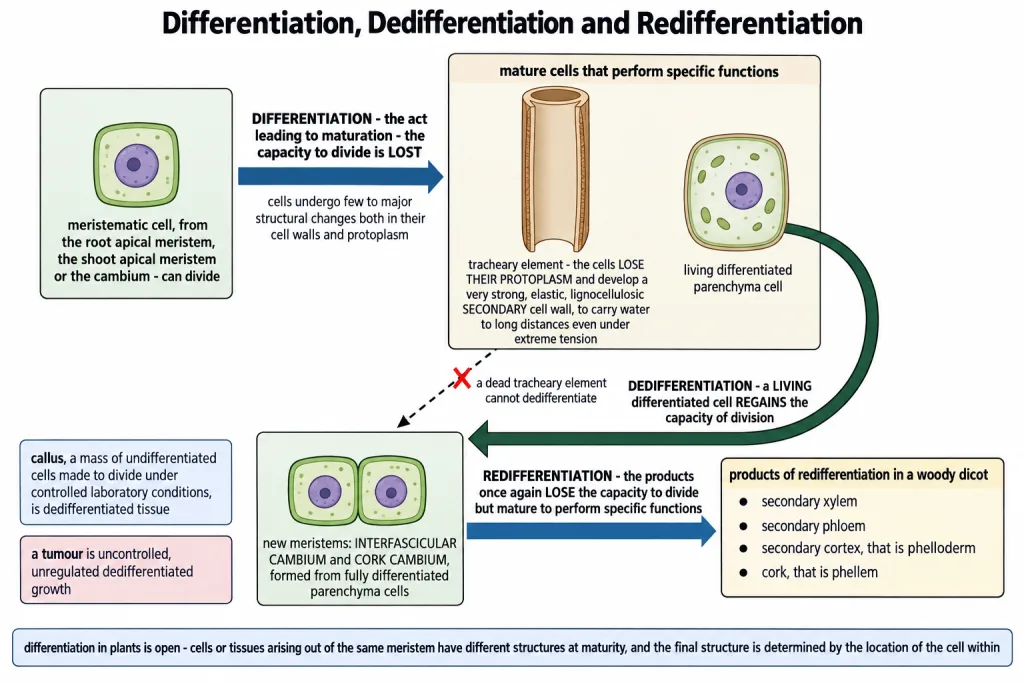
And then the cycle closes. Such meristems or tissues are able to divide and produce cells that once again lose the capacity to divide but mature to perform specific functions - that is, they get redifferentiated.
So the three words sit in a line:
| Term | What happens | Example |
|---|---|---|
| Differentiation | a meristem product matures to perform a specific function | a tracheary element forming from a cambial derivative |
| Dedifferentiation | a living differentiated cell regains the capacity to divide | interfascicular cambium and cork cambium from fully differentiated parenchyma |
| Redifferentiation | the cells made by that new meristem again lose the power to divide and mature | secondary xylem and cork |
The chapter asks you to list the tissues in a woody dicotyledonous plant that are products of redifferentiation. Here is the answer, and it is worth memorising as a pair of lists:
- From the vascular cambium (itself a dedifferentiated meristem in the interfascicular region): secondary xylem, secondary phloem and secondary cortex, that is, phelloderm.
- From the cork cambium: cork, that is, phellem - and the phelloderm it cuts off on the inner side.
The chapter also asks two short questions in passing, and both are standard viva and NEET items.
How would you describe a tumour? A tumour is uncontrolled, unregulated dedifferentiated growth. The cells have regained the power to divide, but they divide without maturing into anything useful - there is division with no differentiation behind it, and no organ is built.
What would you call the parenchyma cells that are made to divide under controlled laboratory conditions during plant tissue culture? That mass is callus, and callus is dedifferentiated tissue. The difference from a tumour is the word controlled: in culture the divisions are managed, and the callus can later be pushed to redifferentiate into shoots and roots.
[NEET Important] Match the tissue to the right word. Interfascicular cambium and cork cambium are the standard examples of dedifferentiation - they are meristems made from parenchyma. Secondary xylem, secondary phloem, phelloderm and cork are the standard examples of redifferentiation - they are mature tissues made by those meristems. The examiner's favourite swap is to offer cork cambium as a product of redifferentiation, or secondary xylem as an example of dedifferentiation. Also keep callus = dedifferentiated tissue and tumour = uncontrolled, unregulated dedifferentiated growth.
Differentiation in Plants Is Open
Recall that growth in plants is open - new cells are always being added by the meristem, so growth can be indeterminate or determinate and no final size is written in from the start.
Now we may say that even differentiation in plants is open.
Why? Because cells or tissues arising out of the same meristem have different structures at maturity. One meristem, many outcomes. Nothing about the cell decides its fate in advance.
The final structure at maturity of a cell or tissue is also determined by the location of the cell within. Position decides fate.
The chapter's example says it in one line: cells positioned away from the root apical meristem differentiate as root-cap cells, while those pushed to the periphery mature as epidermis. Same meristem, same starting cells, two completely different mature tissues - and the only difference between them is where they ended up.
You can add more of your own from the anatomy you already know. Derivatives of the vascular cambium laid down on the inner face become secondary xylem, while those on the outer face become secondary phloem. Cells of the ground meristem near the surface become collenchyma, those deeper become parenchyma. In every case the cell's position in the organ, not its ancestry, sets what it turns into.
This is why the pair of words matters. Growth is open because the meristem keeps supplying cells and there is no fixed final size. Differentiation is open because the fate of a cell is not fixed in advance but set by its position, so cells from one meristem end up as different mature structures.
[NEET Important] Open growth and open differentiation are asked as one item, and the reason for each is different. Growth is open because of continuous addition of cells by the meristem; differentiation is open because of position-dependent fate, so the same meristem yields different structures at maturity. Give the wrong reason for the wrong half and the mark is gone. The chapter's proof example is always the same: root cap versus epidermis from the root apical meristem.
Quick Recap
- Cells derived from root apical and shoot apical meristems and cambium differentiate and mature to perform specific functions; this act leading to maturation is differentiation.
- During differentiation, cells undergo few to major structural changes both in their cell walls and protoplasm.
- To form a tracheary element, the cells lose their protoplasm and develop a very strong, elastic, lignocellulosic secondary cell wall, to carry water to long distances even under extreme tension.
- Dedifferentiation - living differentiated cells that have lost the capacity to divide regain the capacity of division under certain conditions.
- Examples of dedifferentiation: formation of the meristems interfascicular cambium and cork cambium from fully differentiated parenchyma cells.
- Redifferentiation - such meristems or tissues divide and produce cells that once again lose the capacity to divide but mature to perform specific functions.
- Products of redifferentiation in a woody dicot: secondary xylem, secondary phloem and secondary cortex (phelloderm) from the vascular cambium, and cork (phellem) from the cork cambium.
- A tumour is uncontrolled, unregulated dedifferentiated growth - cells divide without maturing into anything useful.
- The callus of plant tissue culture is dedifferentiated tissue - parenchyma cells made to divide under controlled laboratory conditions.
- Growth in plants is open, and differentiation in plants is also open.
- Differentiation is open because cells or tissues arising out of the same meristem have different structures at maturity.
- The final structure at maturity of a cell or tissue is also determined by the location of the cell within.
- Example: cells positioned away from the root apical meristem differentiate as root-cap cells, while those pushed to the periphery mature as epidermis.
Solved Examples
Question 1
Q. Define differentiation.
Answer. The cells derived from root apical and shoot apical meristems and cambium differentiate and mature to perform specific functions. This act leading to maturation is termed differentiation.
Question 2
Q. What kinds of changes does a cell undergo during differentiation?
Answer. Cells undergo few to major structural changes both in their cell walls and protoplasm. Both parts change - the wall is remodelled and the living contents are altered - and how big the change is depends on the tissue being formed.
Question 3
Q. Describe the changes a cell goes through to become a tracheary element, and explain why each one is needed.
Answer. The cells lose their protoplasm, so the mature element is dead and empty and water has a clear path. They also develop a very strong, elastic, lignocellulosic secondary cell wall, and each word earns its place. Secondary because a new wall is laid down inside the thin primary one. Very strong so the pipe does not collapse. Elastic so it takes strain without cracking. Lignocellulosic because lignin with cellulose gives that strength. All of this is to carry water to long distances even under extreme tension, since water in the xylem is pulled upward and the walls are under tension the whole time.
Question 4
Q. Define dedifferentiation and give the chapter's two examples.
Answer. Living differentiated cells that have by now lost the capacity to divide can regain the capacity of division under certain conditions; this is dedifferentiation. The examples are the formation of the meristems interfascicular cambium and cork cambium from fully differentiated parenchyma cells.
Question 5
Q. Define redifferentiation.
Answer. The meristems formed by dedifferentiation divide and produce cells that once again lose the capacity to divide but mature to perform specific functions. Cells maturing in this second round are said to be redifferentiated.
Question 6
Q. List the tissues in a woody dicotyledonous plant that are products of redifferentiation.
Answer. From the vascular cambium: secondary xylem, secondary phloem, and the secondary cortex, that is, phelloderm. From the cork cambium: cork, that is, phellem. All of these are mature tissues produced by a meristem that was itself made by dedifferentiation, so they count as redifferentiated.
Question 7
Q. How would you describe a tumour?
Answer. A tumour is uncontrolled, unregulated dedifferentiated growth. Cells that had stopped dividing regain the power of division, but they go on dividing without maturing into anything useful - there is no differentiation to follow the division, so no proper tissue or organ is built.
Question 8
Q. What would you call the parenchyma cells that are made to divide under controlled laboratory conditions during plant tissue culture?
Answer. Callus, and callus is dedifferentiated tissue - fully differentiated parenchyma that has regained the capacity to divide. The difference from a tumour is that here the division is controlled, and the callus can later be made to redifferentiate into shoots and roots.
Question 9
Q. "Both growth and differentiation in higher plants are open." Comment. This is one of the chapter-end exercises.
Answer. Both statements are true, but for different reasons, and the answer needs both halves.
Growth is open. Plants keep meristems, whose cells divide and self-perpetuate, so new cells are always being added to the plant body. Because the meristem is never used up, no fixed final size is written into the plant - growth can be indeterminate, and even the organs that are determinate are limited by their own meristematic activity running out, not by a ceiling on the plant.
Differentiation is open too. Cells or tissues arising out of the same meristem have different structures at maturity, so the fate of a cell is not fixed in advance. The final structure at maturity of a cell or tissue is determined by the location of the cell within. Cells positioned away from the root apical meristem differentiate as root-cap cells, while those pushed to the periphery mature as epidermis - one meristem, two completely different mature tissues, decided by position.
So growth is open because the meristem keeps adding cells, and differentiation is open because position, not ancestry, sets what a cell becomes.
Question 10
Q. What would be expected to happen if dividing cells stop differentiating? This is one of the chapter-end exercises.
Answer. You would get a growing mass of undifferentiated dividing cells - a callus-like or tumour-like mass. The cells would keep dividing, so the mass would get bigger, but nothing would mature.
- No xylem, no phloem, no epidermis and no other specialised tissue would be formed, because every one of them is a product of differentiation.
- With no tissues, no organ could take shape - no proper root, stem or leaf.
- The plant could not function, since there would be no conducting tissue to move water and food and no protective tissue on the surface.
So growth would continue but development would stop, and the result would be an unorganised mass rather than a plant body.
Question 11
Q. Why is differentiation in plants said to be open?
Answer. Because cells or tissues arising out of the same meristem have different structures at maturity. Nothing decides the fate of the cell in advance, so one meristem can give rise to many different mature tissues.
Question 12
Q. What decides the final structure a cell takes at maturity? Give the chapter's example.
Answer. The location of the cell within - position decides fate. Cells positioned away from the root apical meristem differentiate as root-cap cells, while those pushed to the periphery mature as epidermis.
Question 13
Q. Distinguish differentiation, dedifferentiation and redifferentiation in one line each.
Answer. Differentiation - a meristem product matures to perform a specific function. Dedifferentiation - a living differentiated cell regains the capacity to divide, as in interfascicular cambium and cork cambium from parenchyma. Redifferentiation - the cells made by such a meristem again lose the capacity to divide and mature, as in secondary xylem, secondary phloem, phelloderm and cork.