
Flowering Depends on Day Length
A note before you start. The chapter's own last line before the summary points forward - it says that the role of light and temperature on the initiation of flowering will be discussed. This section is that discussion. It is here because two of the chapter-end exercises turn on it: one asks how a short day plant and a long day plant can flower at the same place on the same day, and the other asks whether a defoliated plant would respond to a photoperiodic cycle. Neither question can be answered without what follows. Give this section the same attention you gave the rest of the chapter.
Start with the observation that sets the whole topic up.
Flowering in many plants depends not on how big the plant is but on how long the day is. A plant may be large, healthy and well fed and still not flower, because the length of the day is wrong for it.
The response of plants to periods of day and night length is called photoperiodism.
Plants are sorted into three groups by their response, and the number that sorts them is the critical day length.
Critical day length is the day length above or below which a plant will flower. It is a different number for every species - there is no single universal value, and that one sentence is the whole of exercise 7.
| Group | Flowers when | Examples |
|---|---|---|
| Short day plants (SDP) | the day length is shorter than the critical day length | chrysanthemum, tobacco, soyabean, rice, Xanthium |
| Long day plants (LDP) | the day length is longer than the critical day length | wheat, barley, spinach, radish, henbane (Hyoscyamus niger) |
| Day-neutral plants (DNP) | irrespective of day length | tomato, cucumber, maize, sunflower |
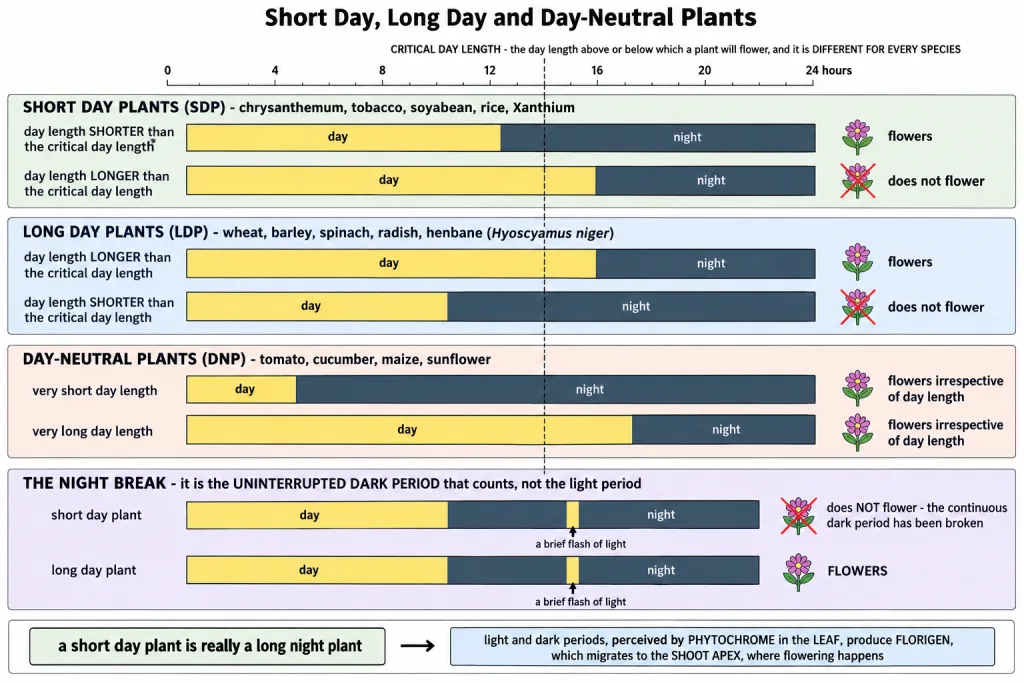
Read the table as a comparison, not as three separate facts. A short day plant needs the day to be shorter than its own critical value; a long day plant needs the day to be longer than its own critical value; a day-neutral plant does not care.
[NEET Important] The examiner's favourite species list is the one above, and the favourite trap is Xanthium against henbane. Xanthium is a short day plant; henbane, Hyoscyamus niger, is a long day plant. Learn rice and soyabean as short day and wheat, barley, spinach and radish as long day - wheat and rice sitting in opposite groups is asked constantly. And remember that critical day length is species-specific, so a question that offers "the critical day length is the same for all plants" is always wrong.
The Names Are Misleading - It Is the Dark Period That Counts
This is the single most examined idea in photoperiodism, and it exists because the names lie.
What actually matters is the length of the uninterrupted dark period, not the length of the light period.
A short day plant is really a long night plant. It flowers because the continuous dark period is longer than a critical length, not because the day is short. The two go together in nature - a short day comes with a long night - so the plant was named for the wrong half of the cycle.
The test that proves it is the night-break experiment.
- Interrupt the night of a short day plant with even a brief flash of light and it will not flower. The dark period has been broken into two shorter stretches, so the plant no longer gets the continuous darkness it needs. The day length was never touched.
- The same flash makes a long day plant flower. Breaking the long night is exactly what a long day plant wants.
One flash of light, two opposite results. That single sentence is the question.
So restate both definitions in the safer form. A short day plant needs a continuous dark period longer than a critical length. A long day plant flowers when the dark period is shorter than a critical length - and it can be forced to flower by interrupting a long night.
[NEET Important] The commonest wrong answer says that a night break promotes flowering in a short day plant. It does the opposite - it stops it. Hold the pairing: night break -> short day plant does not flower, long day plant does flower. The reason to give in a written answer is always the uninterrupted dark period, never the day length.
Where the Stimulus Is Perceived and Where It Acts
These are two different places in the plant, and the whole of exercise 9 depends on knowing that.
- The leaves perceive the photoperiod. The leaf is the sense organ for day length.
- The shoot apex, that is the apical meristem, is where flowering actually happens. The leaf never turns into a flower.
Since the place that senses the day length is not the place that makes the flower, something must travel between them. A hormonal substance must migrate from the leaves to the shoot apex to induce flowering. This transmissible flowering hormone is called florigen.
Two consequences follow, and both are examined.
A plant must have at least one leaf to perceive a photoperiodic stimulus. One leaf is enough; none is not.
A fully defoliated plant cannot respond to a photoperiodic cycle at all. There is nothing left to perceive the day length and nothing to make the stimulus, so however favourable the photoperiod is, no flowering response follows.
The pigment that does the perceiving has a name. The photoperiodic stimulus is perceived by a pigment called phytochrome.
Put the chain together in the order it happens: light and dark periods -> perceived by phytochrome in the leaf -> florigen produced -> florigen migrates to the shoot apex -> flowering.
[NEET Important] Three one-word answers get asked over and over. Site of perception - the leaf. Site of flowering - the shoot apex or apical meristem. The transmissible flowering hormone - florigen. The photoperiodic pigment - phytochrome. The standard distractor puts perception at the shoot apex, which reverses the whole chain, or offers auxin, gibberellin or cytokinin in place of florigen.
Vernalisation - Flowering Promoted by Cold
Light is only half of what the chapter promised. Temperature is the other half.
Vernalisation is the promotion of flowering by a period of low temperature. More formally, it is the qualitative or quantitative dependence of flowering on exposure to low temperature.
Why a plant would want to be held back by cold is the part students skip, and it is a marking-scheme line. Vernalisation prevents precocious reproductive development late in the growing season, and it enables the plant to have enough time to reach maturity. A plant that flowered the moment conditions looked mild would be caught out; the cold requirement makes it wait.
Two classes of plants show vernalisation.
- Food plants with spring and winter varieties. Wheat, barley and rye each have two varieties, spring and winter.
- Spring varieties are planted in spring and come to flower and produce grain before the end of the growing season.
- Winter varieties, if planted in spring, will not flower or produce grain within a season. They are instead planted in autumn. They germinate, and over winter come out as small seedlings. They resume growth in spring and are harvested around mid-summer.
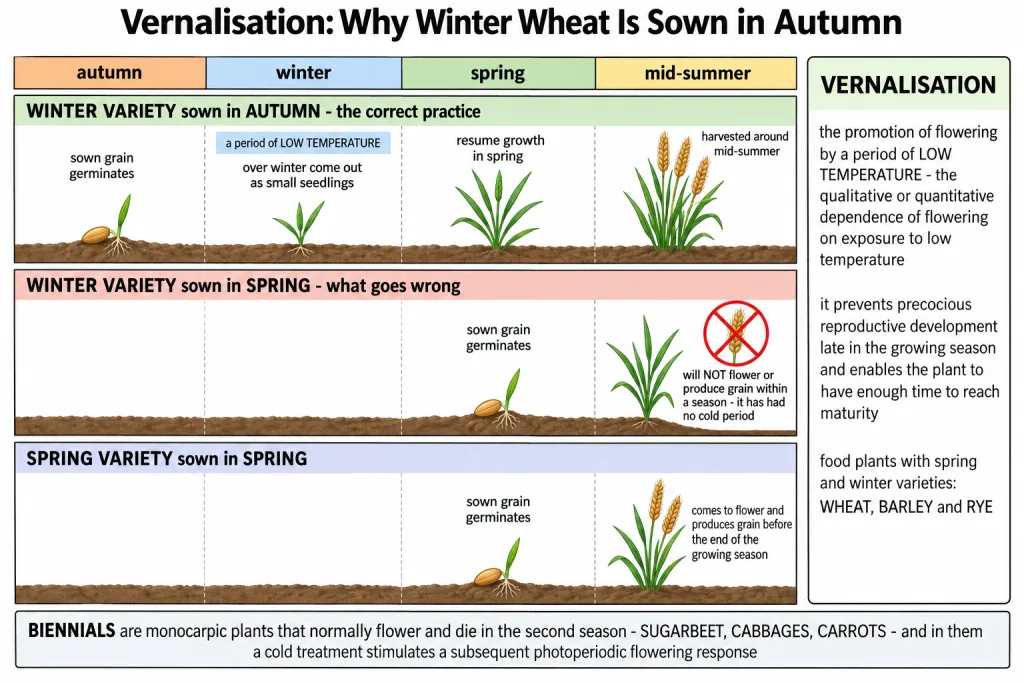
2. Biennials. Biennials are monocarpic plants that normally flower and die in the second season. Sugarbeet, cabbages and carrots are the examples to name. In these plants, subjecting the growing plant to a cold treatment stimulates a subsequent photoperiodic flowering response - the cold does not make the flower by itself, it makes the plant able to answer the photoperiod.
Notice how the two halves of this section join up in that last sentence. Cold first, photoperiod after.
[NEET Important] Vernalisation is always low temperature, never high, and it promotes flowering. The favourite distractor is a definition that says cold inhibits flowering. The second favourite is the variety trap: the winter variety is the one that needs the cold - plant it in spring and it will not flower or produce grain that season. Keep the biennial examples sugarbeet, cabbages and carrots separate from the cereal examples wheat, barley and rye.
Quick Recap
- Flowering in many plants depends not on the size of the plant but on the length of the day.
- Photoperiodism is the response of plants to periods of day and night length.
- Critical day length is the day length above or below which a plant will flower, and it is different for every species.
- Short day plants (SDP) flower when the day length is shorter than their critical day length: chrysanthemum, tobacco, soyabean, rice, Xanthium.
- Long day plants (LDP) flower when the day length is longer than their critical day length: wheat, barley, spinach, radish, henbane (Hyoscyamus niger).
- Day-neutral plants (DNP) flower irrespective of day length: tomato, cucumber, maize, sunflower.
- The names are misleading - what matters is the length of the uninterrupted dark period, not the light period.
- A short day plant is really a long night plant; it needs a continuous dark period longer than a critical length.
- Interrupting the night with a brief flash of light stops a short day plant flowering, and makes a long day plant flower.
- The leaves perceive the photoperiod; the shoot apex, or apical meristem, is where flowering happens.
- A hormonal substance must migrate from the leaves to the shoot apex - the transmissible flowering hormone is florigen.
- A plant must have at least one leaf to perceive a photoperiodic stimulus; a fully defoliated plant cannot respond to a photoperiodic cycle at all.
- The photoperiodic stimulus is perceived by a pigment called phytochrome.
- Vernalisation is the promotion of flowering by a period of low temperature - the qualitative or quantitative dependence of flowering on exposure to low temperature.
- It prevents precocious reproductive development late in the growing season and enables the plant to have enough time to reach maturity.
- Wheat, barley and rye have spring and winter varieties. Spring varieties are planted in spring and flower and produce grain before the end of the growing season.
- Winter varieties planted in spring will not flower or produce grain within a season; they are planted in autumn, germinate, over winter as small seedlings, resume growth in spring and are harvested around mid-summer.
- Biennials are monocarpic plants that normally flower and die in the second season - sugarbeet, cabbages, carrots.
- Subjecting the growing plant to a cold treatment stimulates a subsequent photoperiodic flowering response.
Solved Examples
Question 1
Q. What is photoperiodism?
Answer. The response of plants to periods of day and night length is called photoperiodism. It is the reason flowering in many plants depends not on how big the plant is but on how long the day is.
Question 2
Q. Define critical day length. Is it the same for all plants?
Answer. Critical day length is the day length above or below which a plant will flower. No - it is a different number for every species. There is no single universal value, and that is why the same day at the same place can suit two different plants.
Question 3
Q. Name the three groups of plants based on their photoperiodic response and give examples of each.
Answer.
- Short day plants (SDP) - flower when the day length is shorter than the critical day length. Chrysanthemum, tobacco, soyabean, rice, Xanthium.
- Long day plants (LDP) - flower when the day length is longer than the critical day length. Wheat, barley, spinach, radish, henbane (Hyoscyamus niger).
- Day-neutral plants (DNP) - flower irrespective of day length. Tomato, cucumber, maize, sunflower.
Question 4
Q. Why is the term "short day plant" said to be misleading?
Answer. Because the plant is not really responding to the short day at all. What actually matters is the length of the uninterrupted dark period, not the light period. A short day plant is really a long night plant - it needs a continuous dark period longer than a critical length. Short days simply happen to come with long nights, so the group was named for the wrong half of the cycle.
Question 5
Q. A short day plant and a long day plant are each given a brief flash of light in the middle of the night. What happens to each, and why?
Answer. The short day plant will not flower. The flash breaks the continuous dark period into two shorter stretches, so it no longer gets the uninterrupted darkness longer than its critical length that it needs. The same flash makes the long day plant flower, because a long day plant needs the dark period to be short, and breaking the night achieves exactly that. One flash, two opposite results - and note that the day length was never changed in either case.
Question 6
Q. Which part of the plant perceives the photoperiod, and which part actually flowers?
Answer. The leaves perceive the photoperiod. The shoot apex, that is the apical meristem, is where flowering actually happens. The two sites are different, which is why a signal has to travel between them.
Question 7
Q. What is florigen, and why must it exist?
Answer. Florigen is the transmissible flowering hormone. It must exist because the place that senses day length is not the place that makes the flower - the leaves perceive the photoperiod but the shoot apex flowers. So a hormonal substance must migrate from the leaves to the shoot apex to induce flowering, and that substance is florigen.
Question 8
Q. Name the pigment that perceives the photoperiodic stimulus.
Answer. Phytochrome.
Question 9
Q. "Both a short day plant and a long day plant can flower simultaneously in a given place." Explain. This is one of the chapter-end exercises.
Answer. Yes, they can, and the reason is that critical day length is not one universal number - each species has its own.
A short day plant flowers when the day length is shorter than its own critical day length. A long day plant flowers when the day length is longer than its own critical day length. If the short day plant's critical value is higher than the long day plant's critical value, then a single day length can fall between the two and satisfy both plants at the same time.
Take a worked case. Suppose at a certain place on a certain date the day length is 13 hours.
- The short day plant has a critical day length of 14 hours. 13 hours is shorter than 14 hours, so its condition is met and it flowers.
- The long day plant has a critical day length of 12 hours. 13 hours is longer than 12 hours, so its condition is met and it flowers too.
Both plants flower on the same day in the same place from the very same 13-hour photoperiod.
So it is the relation of the actual day length to each plant's own critical value that decides flowering, not the absolute number of hours. A day of 13 hours is neither "short" nor "long" in itself - it is short for one plant and long for another.
Question 10
Q. Would a defoliated plant respond to a photoperiodic cycle? Why? This is one of the chapter-end exercises.
Answer. No, it would not.
The site of perception of the photoperiodic stimulus is the leaf. A plant must have at least one leaf to perceive a photoperiodic stimulus, and a defoliated plant has no leaves at all.
So the chain that normally leads to flowering is broken at its first step. The day length cannot be perceived, therefore no florigen is produced and none is transported to the shoot apex, and therefore no flowering response follows - however favourable the photoperiod may be.
Question 11
Q. What is vernalisation, and what does it do for the plant?
Answer. Vernalisation is the promotion of flowering by a period of low temperature. Put formally, it is the qualitative or quantitative dependence of flowering on exposure to low temperature. It prevents precocious reproductive development late in the growing season and enables the plant to have enough time to reach maturity.
Question 12
Q. Distinguish the spring and winter varieties of wheat, barley and rye.
Answer. Spring varieties are planted in spring and come to flower and produce grain before the end of the growing season.
Winter varieties, if planted in spring, will not flower or produce grain within a season. They are planted in autumn, they germinate and over winter come out as small seedlings, they resume growth in spring, and they are harvested around mid-summer. The winter variety is the one that needs the cold.
Question 13
Q. What are biennials, and how does cold treatment affect them?
Answer. Biennials are monocarpic plants that normally flower and die in the second season. Sugarbeet, cabbages and carrots are examples. Subjecting the growing plant to a cold treatment stimulates a subsequent photoperiodic flowering response - the cold does not produce the flower by itself, it makes the plant able to respond to the photoperiod afterwards.